Energy Weekly Review 2026-08-28

Week In Review
If there was a single thread running through this week’s energy news, it was manufacturing. Not reactor physics, not cell chemistry, not policy — the unglamorous question of how you actually build the thing, thousands of times, at a price someone will pay. Oak Ridge and Idaho National Laboratory printed a nuclear pressure vessel with robotic arms because the United States no longer has enough forging capacity to supply a reactor build-out. Lawrence Livermore and Ampera are jetting molten thorium into microscopic spheres because TRISO fuel kernels have to be uniform and nobody has a cheap way to make them at volume. Livermore and Inertia cut the time to grow a frozen deuterium-tritium fuel layer from roughly a week to a few hours, because a commercial inertial fusion plant needs hundreds of targets per minute and artisanal production is not a business model. In each case the science is largely settled and the production line is the frontier.
That framing also explains the week’s most consequential procurement. The US Army named five microreactor developers to build power plants on five bases under its Janus program, with an operational deadline of September 2028 — an aggressive date that functions less as a defense requirement than as a forcing function on supply chains. One of the selected designs cleared a real technical gate the day before the announcement, when Westinghouse’s eVinci achieved zero-power criticality at the Nevada test site, confirming that its core behaves the way the models said it would. Meanwhile, at the far end of the same fuel cycle, Finland’s Posiva began drilling the first deposition hole at Onkalo, 450 metres underground. A sector that spent decades unable to answer “and then what?” is now building both the front end and the back end at once.
On the renewable side, the story was volume and geography. Benchmark Mineral Intelligence counted 18 GWh of grid-scale battery storage coming online in July alone, pushing the global installed base past 700 GWh — a number that would have sounded fanciful five years ago and is now a monthly rounding exercise. What that volume buys shows up concretely in the Democratic Republic of Congo, where a 233 MWp solar array paired with 526 MWh of batteries began delivering round-the-clock power to a copper mine that would otherwise burn diesel. Solar plus storage has quietly stopped being an intermittent resource and started being a dispatchable one, at least where the sun is reliable and the load is steady.
The two remaining items point at where the technology goes when lithium-ion and rigid glass panels stop being the answer. Allegro Energy’s partnership with Jena Flow Batteries aims to industrialise a flow battery whose electrolyte is essentially water, oil and detergent — a bet that twelve-hour storage will be won on commodity materials rather than exotic ones. And SolarWindow’s 0.85 mm self-adhesive photovoltaic film is an attempt to put 24% cells on surfaces — truck roofs, curved train shells, aircraft skins — that a framed module can never reach. Neither will move the needle this year. Both are early signs that the industry has enough headroom to start optimising for form factor and materials abundance, not just for cost per watt.
Items
US Army Picks Five Microreactor Developers for Base Power
The US Department of the Army selected five companies to build microreactors at five installations under the Janus program, a roughly $2.2 billion initiative aimed at giving bases a power source that does not depend on the civilian grid. Antares Nuclear will site a reactor at Fort Bragg in North Carolina, BWXT Advanced Technologies at Fort Campbell in Kentucky, General Atomics Electromagnetic Systems at Fort Hood in Texas, Radiant Industries at Fort Benning in Georgia, and Westinghouse Government Services at Fort Drum in New York.
The designs span a wide range of the microreactor space. BWXT’s BANR is rated at 20 MWe; the General Atomics system starts near 5 MWe and is designed to scale toward 20 MWe; Radiant’s Kaleidos is a 1 MW transportable unit, covered by an agreement for as many as 15 units worth up to $750 million; and Westinghouse’s eVinci is designed to run continuously for eight years without refuelling. That diversity is deliberate — the Army is buying options on several architectures rather than standardising on one.
The timeline is the aggressive part. The program traces to an executive order signed in May 2025, and the Army has set an operational deadline of 30 September 2028, with funding contingent on developers hitting technical milestones running through 2027 to 2031. Two years from contract award to a licensed, fuelled, operating reactor would be fast by any historical standard in the nuclear industry.
Whether or not every site meets that date, the procurement matters for reasons beyond the bases themselves. Microreactor developers have spent years designing for a commercial market that does not yet have a first customer willing to absorb first-of-a-kind costs. A federal buyer with a fixed deadline and milestone-linked funding supplies exactly that — and, if the designs work, a demonstrated operating record that civilian utilities can point to. “Awarding these contracts accelerates our ability to deliver safe, reliable baseload power directly to our installations,” said Army Secretary Dan Driscoll.
Source: World Nuclear News
Westinghouse’s eVinci Microreactor Goes Critical at Zero Power
Westinghouse completed zero-power criticality testing of its eVinci microreactor at the National Criticality Experiments Research Center at the Nevada National Security Site, working with Los Alamos and Idaho National Laboratory. The test article was a one-fifth-scale representation of the commercial design, and the exercise validated the company’s core design assumptions and neutronics models.
“Cold criticality” is a term of art worth unpacking. A reactor is critical when its chain reaction is self-sustaining — each generation of fissions producing exactly enough neutrons to trigger the next. In a zero-power test the reaction sustains itself but generates essentially no heat, which lets engineers measure how the core actually behaves at very low power and compare it against simulation. It is the moment where years of computational physics meet a physical assembly for the first time, and it is where design errors surface cheaply rather than expensively.
The commercial eVinci is a 5 MWe (15 MWt) unit designed to run eight or more years between refuellings. Its distinguishing features are heat pipes instead of pumped coolant loops, a closed Brayton cycle for power conversion, TRISO fuel, and control drums rather than inserted rods. The heat-pipe approach means there is no coolant pump to fail and no primary loop to depressurise — a design philosophy that trades some power density for a much simpler safety case.
Westinghouse says it will continue prototyping to validate performance, operability and manufacturability. The design has attracted interest well beyond the commercial grid: lunar surface power, research reactors, and defence installations have all been discussed, and Penn State University has previously expressed interest in hosting one as a campus research reactor. The same design was selected this week for the Army’s Fort Drum site.
Source: ANS Nuclear Newswire
Fusion Fuel Layers That Took a Week Now Take Three Hours
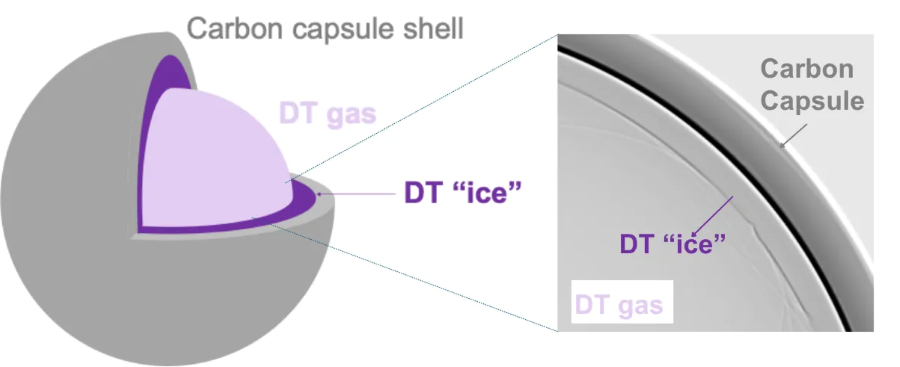
Inertial confinement fusion has an unglamorous logistics problem that rarely makes headlines. Each shot consumes a target: a small carbon sphere with a thin layer of frozen deuterium-tritium ice coating the inside. That ice layer has to be extraordinarily smooth, because tiny surface defects seed instabilities that tear the implosion apart before it can ignite. At the National Ignition Facility, growing one to specification has taken up to a week, with manual intervention along the way.
A commercial inertial fusion power plant would need several hundred fuel injections per minute. The arithmetic does not work.
Inertia Enterprises and Lawrence Livermore National Laboratory have now reported an accelerated process that produces a D-T ice layer within design tolerances in two to three hours. The work follows an April agreement between the two organisations covering research, development and prototyping of systems for Inertia’s planned fusion pilot plant. “The quality of these rapid ice layers are comparable in many ways to the NIF layers that take much longer to grow,” said LLNL’s Chris Weber. Abbas Nikroo of NIF called it “the most thorough examination of D-T ice layering that I am aware of examining the various key practical parameters.”
The knock-on effects go beyond throughput. Faster layering means less tritium sitting in inventory at any moment, which lowers material handling costs and reduces the regulatory burden that comes with holding large quantities of a radioactive gas. Tritium is scarce, expensive and heavily regulated; a process that needs less of it in circulation improves the economics of an inertial fusion plant independent of anything happening in the target chamber.
“This milestone achievement… would not have been possible without our close collaboration with LLNL,” said Inertia’s Annie Kritcher. The result does not solve fusion energy gain — that remains the harder problem. It removes one of the reasons a solved gain problem would still not produce a power plant.
Source: ANS Nuclear Newswire
Livermore and Ampera Take On Thorium Fuel Kernels

Lawrence Livermore National Laboratory and Ampera announced a partnership to develop thorium-based TRISO fuel under a project named THUNDER — Thorium Unimodal Droplet Ejection for Reactors. The approach applies liquid metal-jetting technology to produce uniform, spherical thorium-232 kernels, the seed particles at the centre of each TRISO fuel grain.
TRISO fuel is one of the more elegant ideas in reactor engineering: each fuel kernel is individually wrapped in layers of carbon and ceramic, so every particle is its own containment vessel. The coatings resist irradiation, corrosion, oxidation and extreme temperature, which is why most microreactor and high-temperature gas reactor designs — including several selected for the Army program this week — depend on it. The catch is that the kernels underneath must be highly uniform in size and shape, and producing billions of them cheaply is a genuine manufacturing challenge.
The project builds on LLNL’s 2023 PowderJet work, which developed a “droplet-on-demand” liquid metal-jetting technique capable of producing highly spherical, size-controlled metallic particles. Extending it to thorium is the new step.
Thorium itself carries a distinct set of arguments. According to LLNL, it “is abundant, produces a less persistent waste stream, and is more difficult to weaponize, adding a layer of proliferation resistance.” Thorium-232 is not fissile on its own; it absorbs a neutron and transmutes to uranium-233, effectively breeding its own fuel during operation. That property has kept thorium perennially interesting and perennially unrealised — the fuel cycle is more complex than uranium’s, and the industrial base for it barely exists.
“Working with Ampera gives us opportunity to apply joint expertise to a challenging nuclear fuel problem,” said LLNL research engineer Viktor Sukhotskiy. Ampera CEO Brian Matthews framed it commercially: the partnership helps “accelerate the technical foundation required to vertically integrate our fuel supply, reduce cost and supply-chain risk.” No development timeline was given.
Source: ANS Nuclear Newswire
Robots Print a Nuclear Pressure Vessel

Oak Ridge National Laboratory and Idaho National Laboratory have produced a small nuclear pressure vessel — three feet by five feet, in a steel alloy suitable for nuclear service — using wire arc additive manufacturing on ORNL’s MedUSA platform. Three coordinated robotic arms melt wire with electric arcs and build the component up layer by layer.
The reason this matters has nothing to do with novelty for its own sake. Reactor pressure vessels are among the most demanding components in industrial manufacturing: thick-walled steel that must contain high pressure and high temperature, under neutron irradiation, for decades. They are conventionally forged, and forging capacity for nuclear-grade components is limited worldwide and very limited domestically. Every serious plan to expand US nuclear capacity runs into the same bottleneck, and forging presses take the better part of a decade and enormous capital to build.
Additive manufacturing offers what ORNL describes as speed and flexibility that forging does not. A robotic deposition cell can be reconfigured for a different geometry without new dies. It can produce one-off or low-volume components — exactly the profile of an advanced reactor industry with a dozen competing designs and no standardised part.
The hard part is qualification. Nuclear components must be certified to codes written with forged and cast metallurgy in mind, and a printed vessel has a different grain structure, different residual stresses, and different inspection requirements than a forged one. Demonstrating that a part can be built is the easy half; proving to a regulator that it will behave predictably for sixty years is the rest.
That is explicitly the point of the collaboration. “By working with industry to demonstrate, validate, and qualify advanced manufacturing technologies, we can reduce risk, accelerate deployment, and strengthen the domestic supply chains,” said Robert Wagner, ORNL’s associate laboratory director.
Source: ANS Nuclear Newswire
Finland Drills the First Hole for Permanent Nuclear Waste Disposal
Workers at Finland’s Onkalo repository began drilling the first actual deposition hole this week — the cavity into which a canister of used nuclear fuel will eventually be lowered and sealed. It is a small operation with outsized symbolic weight: the world’s first permanent deep geological repository for spent fuel moving from construction into the specific act of preparing to receive waste.
The specifications convey how exacting the work is. The repository sits roughly 450 metres below the surface near Olkiluoto. Each hole is 8.4 metres deep and 1.75 metres in diameter, and must not deviate from vertical by more than 25 millimetres over its full depth. “The final adjustments to the equipment were made during the morning and early afternoon, and before long the drill was already getting to work on the rock,” said Kimmo Lehtola, Posiva’s construction manager.
The disposal concept relies on nested barriers rather than any single one. Fuel goes into a tightly sealed iron-copper canister; the canister is surrounded by a bentonite clay buffer that swells when wet, sealing gaps; the access tunnel is backfilled with swellable clay and closed with seal structures; and the enclosing bedrock provides the outermost barrier. Each layer is designed to fail slowly and independently of the others.
Posiva — jointly owned by the Finnish utilities Fortum and TVO — has been working toward this for a quarter century. The site was selected in 2000, government approval came in 2015, and construction began in 2016. The company’s stated goal is to reach operational readiness for final disposal by the end of 2026, under a licence framework extending to 2070.
The significance reaches beyond Finland. Spent fuel disposal has been the standing rebuttal to nuclear expansion for two generations, in large part because no country had demonstrated a permanent solution rather than an indefinite interim one. Onkalo does not make that argument disappear, but it converts it from a hypothetical into an engineering programme with holes in the ground and a schedule.
Source: World Nuclear News
A Congolese Copper Mine Gets 24-Hour Solar Power
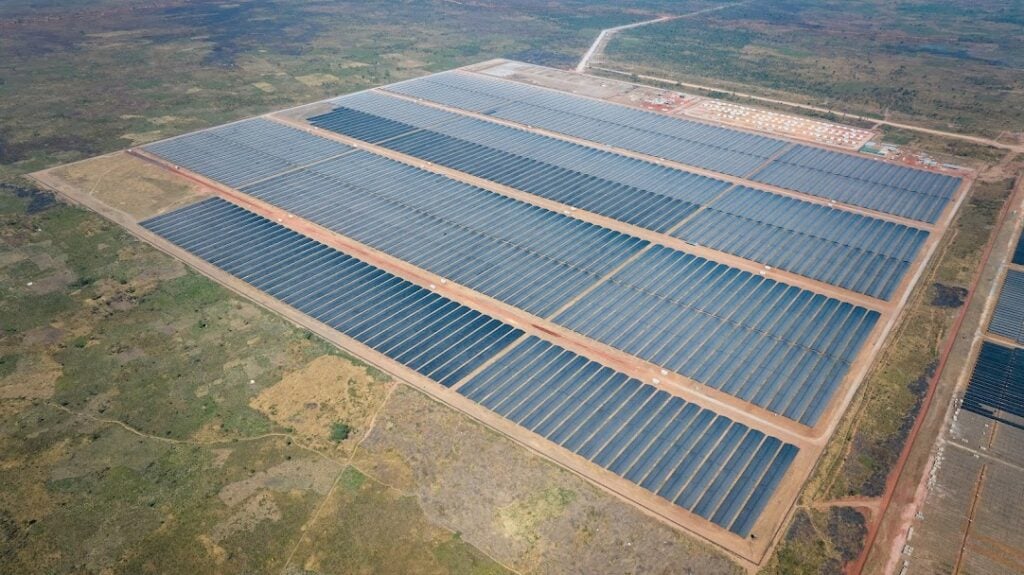
A solar-plus-storage plant serving the Kamoa Copper operation in the Democratic Republic of Congo has reached commercial operation, delivering what its developer describes as Africa’s first round-the-clock “solar baseload” power. The system pairs 233 MWp of photovoltaic capacity with a 123 MVA / 526 MWh battery, and is contracted to guarantee at least 30 MW of dispatchable output continuously, with peak output reaching 180 MW and a 95% availability factor.
The architecture is straightforward. During daylight the array serves load directly and charges the battery; after sunset the battery carries the guaranteed baseload block. What makes it notable is the contractual framing — the mine is not buying solar energy when available, it is buying a firm capacity commitment backed by solar and storage. That is a different product, and one that industrial offtakers can actually plan around.
The economics work here for reasons specific to the site. Remote mines run on diesel or heavy fuel oil trucked long distances over poor roads, which is both expensive and logistically fragile. The DRC’s grid is unreliable at the scale a copper operation needs. Against that baseline, a solar-and-battery hybrid does not need to beat cheap grid power; it needs to beat delivered diesel, which is a much lower bar. The project is projected to avoid 78,750 tonnes of CO2 annually.
The plant was developed by CrossBoundary Energy as an independent power producer, with a power purchase agreement signed in the second quarter of 2025. Kamoa Copper is a joint venture between Canada’s Ivanhoe Mines, China’s Zijin Mining Group and the DRC government.
“The speed at which this project was delivered demonstrates how quickly renewable energy can be deployed at scale to support remote mining operations,” said Kamoa Copper project manager Auguy Bakome — roughly a year from PPA signature to commercial operation for a plant of this size.
Source: Energy-Storage.news
Global Battery Storage Passes 700 GWh, With 18 GWh Added in July
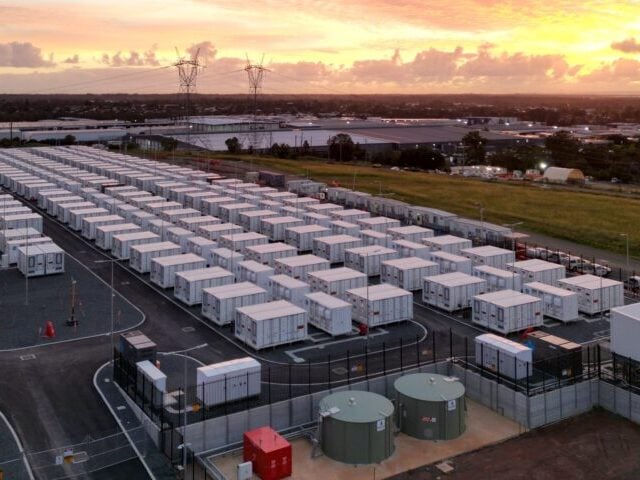
Benchmark Mineral Intelligence reports that 18 GWh of large-scale battery energy storage came online globally in July 2026, bringing the year-to-date total to 154 GWh and the cumulative installed base to 274 GW / 716 GWh. Year-to-date deployment is up 27% against the same period a year earlier.
The regional breakdown shows how lopsided the buildout remains. China accounted for roughly 70% of July’s additions, at 4,568 MW / 13,019 MWh, including the month’s single largest project — a 400 MW / 2.4 GWh installation in Inner Mongolia. Europe recorded one of its strongest months on record at 833 MW / 2,472 MWh. North America added 328 MW / 1,256 MWh, Oceania 1,190 MWh, Asia excluding China 340 MWh, and Africa 540 MWh.
Two ratios in that table are worth pausing on. The first is duration: 6,199 MW of power and 18,817 MWh of energy implies an average of about three hours, consistent with the four-hour lithium-ion systems that dominate procurement. The second is Africa’s line — 95 MW but 540 MWh, closer to six hours, reflecting projects like the DRC mine hybrid where storage is doing genuine overnight shifting rather than peak shaving.
The cumulative figure is the one that reframes things. A 716 GWh installed base means grid storage has crossed from a technology utilities pilot into infrastructure they procure routinely. At 154 GWh added in seven months, the global fleet is now growing by more than a fifth of its own accumulated size annually.
North America’s relatively modest 1,256 MWh in July is the outlier worth watching. The US added record volumes in the first half of the year, so a single soft month says little on its own — but the gap between Chinese and American monthly deployment is now large enough that it reflects manufacturing location and procurement pipelines rather than demand.
Source: Energy-Storage.news
A Flow Battery Made of Water, Oil and Detergent Heads for Manufacturing
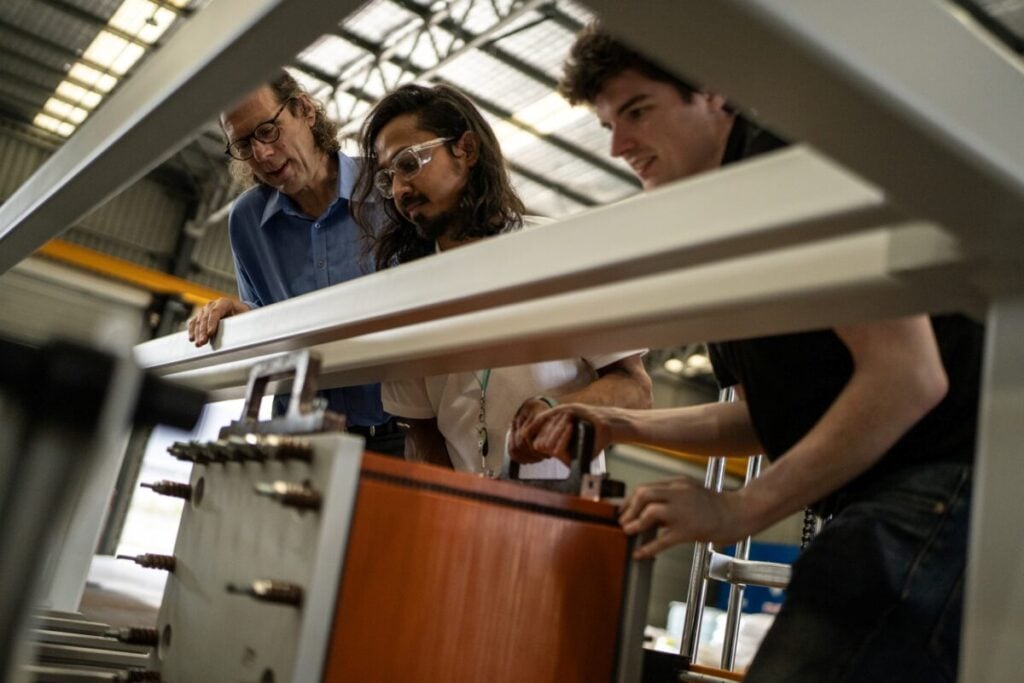
Australian developer Allegro Energy has partnered with Jena Flow Batteries and its parent company Suqian Time Energy Technology to move its microemulsion flow battery from prototype toward commercial-scale manufacturing. The arrangement gives Allegro access to gigawatt-scale flow battery production capacity and system integration expertise without having to build that infrastructure itself.
The technology’s distinguishing feature is what is in the tank. Allegro’s proprietary electrolyte is a microemulsion — water, oil and a surfactant in the family of dishwashing liquid, combined in specific ratios. Conventional flow batteries typically rely on vanadium, which is expensive and geographically concentrated, or on engineered organic molecules that must be synthesised. Allegro’s bet is that a non-flammable electrolyte assembled from bulk commodity chemicals will win on cost at scale, even if it gives up some performance.
Flow batteries occupy a different niche from lithium-ion. Because energy is stored in liquid in tanks and power is set by the separate stack, capacity and duration scale independently — adding hours means adding tank volume, not more cells. That makes the architecture natural for durations beyond the two-to-four hours where lithium-ion is most economic. Allegro’s CEO argues the technology “beats lithium quite easily in the long-term” on full lifetime cost, including replacement and recycling.
The company has a trial underway with Origin Energy involving an 800 kWh system, with potential scaling to 5 MW / 60 MWh — a twelve-hour duration. The partners intend to deploy pilot systems in Australia at increasing scale before pursuing international markets.
Australia is a sensible proving ground. Its National Electricity Market already runs high renewable penetration with a battery fleet setting records for evening-peak dispatch, and the marginal value of storage there is shifting from the first few hours after sunset toward the longer overnight and multi-day shifts that lithium-ion serves poorly. Whether a detergent-based electrolyte can survive thousands of cycles at commercial scale is the open question, and pilot deployments are how it gets answered.
Source: Energy-Storage.news
A 0.85 mm Solar Film You Stick On Things
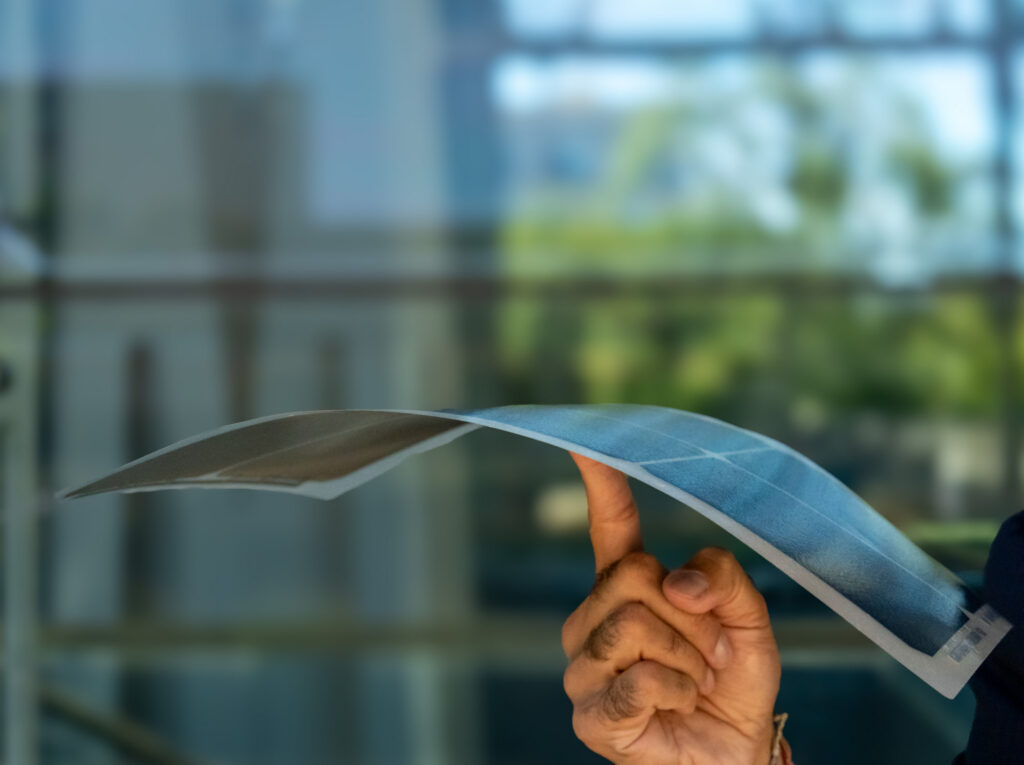
SolarWindow has launched ElectroFlex, a self-adhesive photovoltaic film 0.85 mm thick in total, built on interdigitated back-contact cells rated at 24.4% efficiency and delivering roughly 73 watts per kilogram. It ships without a frame, without glass, and in customisable sizes and colours.
The layer stack is worth reading as a piece of engineering: 0.10 mm of front encapsulant, 0.16 mm of solar cells, 0.04 mm of copper backing, 0.30 mm of composite laminate, and a 0.25 mm rear substrate. Interdigitated back-contact cells put all the electrical contacts on the rear face, which removes the shading from front-side grid lines and — more relevant here — makes the front surface flat enough to laminate thinly.
The efficiency figure deserves context. At 24.4% cell efficiency, this is not a compromise technology; it sits in the same range as good conventional silicon modules. What is different is the delivery: a rigid framed module weighs on the order of 12 kg per square metre and needs mounting hardware and a structure that can carry it. A film at 73 W/kg that adheres directly to a surface changes which surfaces are candidates at all.
SolarWindow is targeting transportation, marine, aerospace, architecture, agriculture, infrastructure and specialty vehicles, with named use cases including data centres, commercial truck roofs, curved train surfaces, and drone and aircraft structures. Curved surfaces in particular have been effectively off-limits to conventional modules.
The product is initially available only to Tier 1 original equipment manufacturers in the United States, with North American and Asian expansion planned over coming quarters — an OEM-first strategy that suggests the company sees the value in being designed into vehicles and buildings rather than retrofitted onto them. The company is separately developing LiquidElectricity, a transparent coating intended to turn glass and plastic surfaces into generating elements, which remains the more speculative of the two efforts.
Source: pv magazine