Robotics Weekly Review 2026-11-15

Week In Review
The Conference on Robot Learning met in Austin this week, and the two largest robot-brain programs in the industry used it to make the same argument from different directions: the bottleneck in robot learning is no longer the model, it is the cost of getting experience into it. NVIDIA’s GR00T 2 and Isaac Lab 3.0 lean on massively parallel simulation and a hundred thousand hours of first-person human video so that a new task needs five demonstrations rather than five thousand. Google DeepMind’s Gemini Robotics 2.5 credits a frontier language model with running thousands of simulated rehearsals of a Mercedes-Benz kitting job before Apptronik’s Apollo 2 attempted it on a live line. IEEE Spectrum’s survey of agentic robotics goes a step further and asks whether robots should be learning from demonstrations at all, when coding agents can write, test, and repair the controlling program in simulation until it works. Two academic results make the same point at smaller scale: MIT and Carnegie Mellon’s Workspace Models move the expensive reasoning offline so the robot can act in milliseconds, and a soft-robotics group shows that a reduced-order model lets a soft arm learn in three hours what would have taken three years on hardware.
On the commercial side, the week offered an unusually honest look at what it takes to put humanoids to work. GXO’s letter of intent for up to 1,000 Apptronik Apollo units is the largest humanoid commitment a logistics operator has made, and every clause of it is conditional on performance targets in 2027 trials. AGIBOT’s 24-hour convenience store trial in Shanghai published its own scorecard, including the two robots out of six that failed. Figure’s job postings reveal roughly thirty operational roles, including a night-shift coordinator who triages failures while the robots run. And J.P. Morgan’s forecast of 300,000 to 400,000 US-built humanoids by 2030 argues that supply, not demand, is what limits the ramp, which puts the emphasis back on actuators, hands, and factories.
Finally, a reminder that not every useful robot is humanoid: Colorado State’s elephant-trunk tensegrity robots have no joints at all, and get their versatility from linking up with one another. Taken together, the week describes a field where the learning problem is becoming tractable, and where the hard remaining questions are about reliability, human support, and manufacturing at scale.
Items
NVIDIA Brings GR00T 2 and a Faster Simulator to CoRL
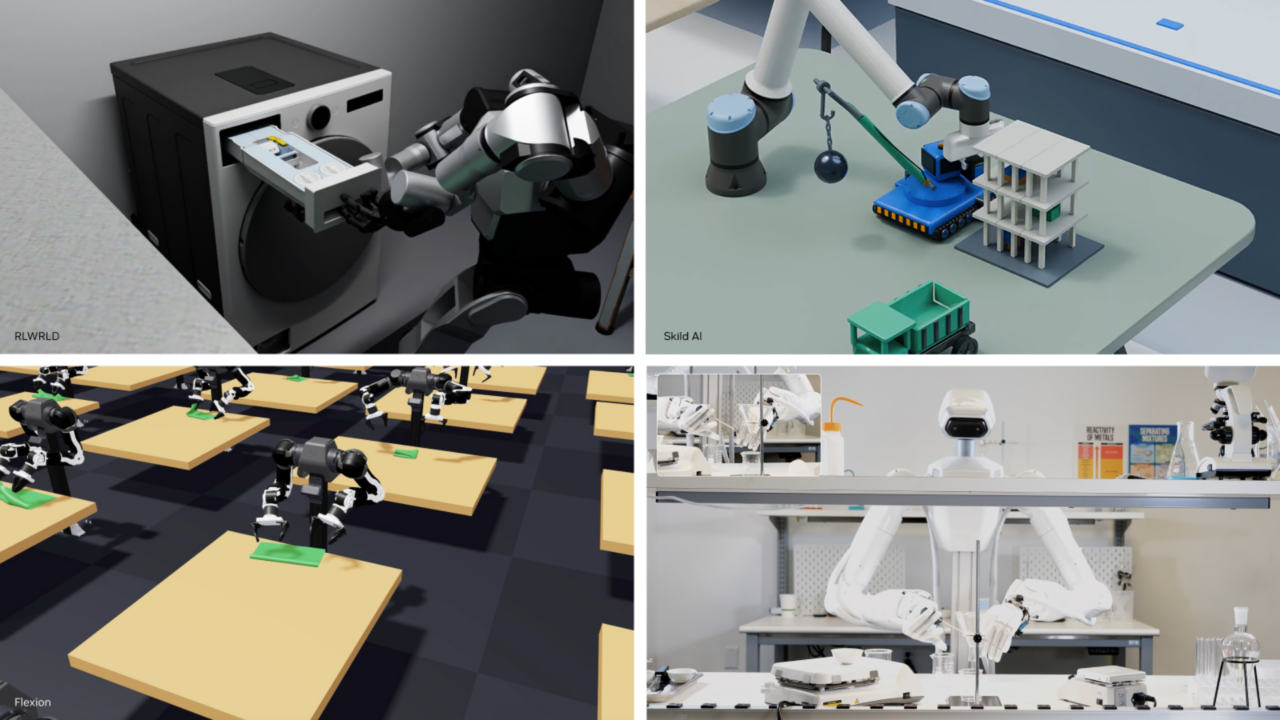
NVIDIA used the Conference on Robot Learning in Austin to release the second generation of its GR00T robot foundation model and a new version of its Isaac Lab training environment, framed around one problem: fine manipulation such as aligning gears, seating cables, and assembling components is where learned policies have struggled most, and the fix is more practice in simulation rather than more teleoperation on hardware.
GR00T 2 is described as a world action model built on NVIDIA’s Cosmos platform and trained on 100,000 hours of egocentric human video. According to NVIDIA, the model completed 40 of 50 evaluated tasks with no task-specific demonstrations at all, reached 71 percent average success with a single demonstration per task, and 95 percent with five. It currently sits in the top three on the RoboCasa365, RoboLab, RoboDojo, and MolmoSpaces benchmarks. Early testers include Nexuni for laundry handling, Foxconn for server manufacturing, and Siemens for industrial applications.
Isaac Lab 3.0 is the training side of the story. NVIDIA reports a 2.5-fold throughput improvement over the previous release on vision-based dexterous manipulation benchmarks, and the new version integrates the Newton physics engine so that deformable objects such as cables and cloth can be simulated alongside rigid articulated systems. Thousands of simulated robots can be trained in parallel, and a companion Video to Data workflow converts ordinary human video into simulated robot demonstrations.
The partner results are where the approach shows its teeth. AlphaNIST, a project built on the stack, trains one policy on all 20 tasks of the NIST Assembly Task Board and reports 98 percent training success against 81 percent for policies trained task by task, using 39 times less GPU time. A University of Washington and NVIDIA method called Success-Guided Sampling concentrates practice on tasks where the robot is succeeding about half the time, and scales training beyond a million parallel environments. UC Berkeley’s Graph-as-Policy framework uses software agents to stitch individual skills into coordinated programs and refine them in simulation. Two new benchmarks, DexBench with 15 tasks across retail, logistics, manufacturing, and hospitality scenes, and VABAR with six tiered industrial tasks, give the field standard tests for generalization.
Ken Goldberg of UC Berkeley, whose lab contributed to several of the projects, is quoted calling agentic robotics “the most exciting technological development since the internet in 1995.” Whether or not that holds up, the direction is clear: the robot’s competence is increasingly rehearsed in software before it ever touches a part.
Source: NVIDIA Blog
Gemini Robotics 2.5 Runs Apollo 2 on Live Mercedes-Benz Lines at 96 Percent

Google DeepMind released Gemini Robotics 2.5, which it calls its most capable vision-language-action model to date, and anchored the announcement in a factory rather than a lab. Apptronik’s Apollo 2 humanoids running the model performed automotive kitting, sorting individual parts from bulk bins into organized per-vehicle trays, on active Mercedes-Benz production lines in Kecskemét, Hungary and Sindelfingen, Germany. DeepMind reports a 96 percent success rate on the task. The robots used Apptronik’s SharpaWave hand, a five-fingered hand with 22 degrees of freedom, and the same model also drives the two-fingered Franka Duo platform.
Across more than 200 evaluated tasks, DeepMind reports success rates 30 to 100 percent higher than the previous generation depending on task type, with tasks completed 20 to 30 percent faster. The task list is deliberately domestic and varied: serving food with tongs, tying bows on gift boxes, pipetting liquids, closing toolboxes, sweeping trash, packing rice cookers, untying ribbons, hanging garments, and folding clothing.
The most interesting claim is about how the model was built. DeepMind credits Gemini 4 Argon, its frontier general-purpose model, with serving as a simulation engine during development. From a real camera scene, Argon generated thousands of varied practice runs and realistic digital twins, which let the team test hypotheses about why a task was failing and try fixes in simulation before returning to the robot. That is a different use of a large language model than the usual role of interpreting instructions, and it echoes the agentic approach being pursued elsewhere in the field.
Safety work takes up a substantial part of the release. The model accepts inference-time reasoning guidance about physical hazards, and DeepMind reports that with such guidance, safe task completion improved 33 percent around obstacles and 43 percent around nearby people. The company also open-sourced ASIMOV-Jailbreak, a benchmark of disguised unsafe requests, and reports that Gemini 4 Argon resisted 99.5 percent of them against an 82 percent baseline.
The model is rolling out to DeepMind’s robotics partners, and no general availability date or pricing was given. The Mercedes-Benz work is a demonstration on live lines, not a purchase announcement. Even so, a humanoid kitting parts at 96 percent on a running automotive line, with a general model rather than a hand-built controller, is the kind of evidence the humanoid sector has been short of.
Source: Google DeepMind
Can Coding Agents Replace the Robot Data Pile?

Evan Ackerman’s survey in IEEE Spectrum takes on the central bet of the current robotics boom, which is that enough recorded human demonstrations will eventually yield a general-purpose robot, and lays out a credible alternative. The imitation-learning paradigm, Ken Goldberg of UC Berkeley tells Spectrum, “has hit a plateau,” particularly for industrial work that demands very high reliability. The policies it produces are black boxes that humans cannot inspect, and adding data does not reliably fix the failures that emerge.
The alternative, which its proponents call agentic robotics, reframes robot programming as a coding problem. Large language models already carry a great deal of robotics knowledge and can call existing tools for perception, grasp planning, and motion planning. A coordinating agent decomposes a task into subtasks, specialized agents write code for each, the code runs in simulation, failures are diagnosed, and the loop repeats until the program works. The output is human-readable code rather than learned weights, and no demonstrations are collected.
The numbers Spectrum reports from UC Berkeley are striking: success rates reaching 99 percent on tasks where imitation learning managed about 20 percent. One enabling trick was to have agents calibrate the simulator itself, adjusting lighting, backgrounds, and physical parameters until the simulated scene matched real video of the workcell. Spencer Huang of NVIDIA points to semiconductor manufacturing as the first target, where precision requirements make reliability non-negotiable, and says that at Wistron in Taiwan the time to retask a robot would fall from eight hours to one or two minutes.
The article is careful about what remains unsolved. No physics engine models contact accurately, so the gap between simulation and reality persists. Torsten Kroeger of Alphabet’s Intrinsic raises the alignment problem in the plainest terms: “how do we know that these agents are really doing the right thing all the time?” Verification of safety and security as these systems scale is an open question.
Huang’s closing picture is a useful one for anyone trying to make sense of the week’s announcements. General intelligence in robots, he suggests, may arrive not as one enormous policy but as agents orchestrating a mix of conventional tools and specialized learned skills, so that the system as a whole looks capable in a human-like way while each part remains inspectable.
Source: IEEE Spectrum
GXO Signs for Up to 1,000 Apptronik Apollo Humanoids, All of It Conditional
GXO Logistics, one of the largest contract logistics operators in the world, and Apptronik have signed a letter of intent that could put up to 1,000 Apollo humanoid robots into GXO warehouses over four years under a robotics-as-a-service model. The partnership dates to 2024, and the companies say they have evaluated Apollo on more than 50 distinct logistics tasks at Apptronik’s Robot Park facility. The next step is expanded live trials in 2027, with the first commercial deployment planned for North America in late 2027.
The planned work covers the standard warehouse repertoire: goods-to-person and person-to-goods picking, moving cases and totes, packing, and sortation. Each use case will be assessed and sequenced against jointly agreed productivity, safety, and operational key performance indicators, and the release is explicit that commercial expansion depends on meeting those targets during the 2027 trials.
Patrick Kelleher, GXO’s chief executive, said that “humanoid robots are the latest evolution of intelligent automation, and their increasing dexterity will make them one of the most transformative applications of physical AI in logistics.” Jeff Cardenas, Apptronik’s co-founder and chief executive, described the deal as showing “what’s possible when you pair a leading logistics provider with robots designed from the start for thoughtful collaboration with people.”
Scale matters here in both directions. GXO reports more than 150,000 team members across over 1,000 facilities and more than 200 million square feet, so even the full 1,000 robots would be a narrow slice of its operation. Apptronik, with nearly 500 employees, would be committing to a production and support effort well beyond anything it has delivered so far. No pricing, contract value, or specific sites were disclosed.
The structure of the agreement is itself informative. A letter of intent gated on performance metrics, rather than a purchase order, is how a sophisticated buyer expresses real interest while keeping the burden of proof on the robot. Coming two days after Apollo 2 was shown kitting parts on Mercedes-Benz lines, it suggests Apptronik now has both the technical demonstration and the commercial pipeline, and 2027 will show whether the two connect.
Source: GXO Logistics
Six AGIBOT Humanoids Ran a Shanghai Convenience Store for 24 Hours, and Four Passed
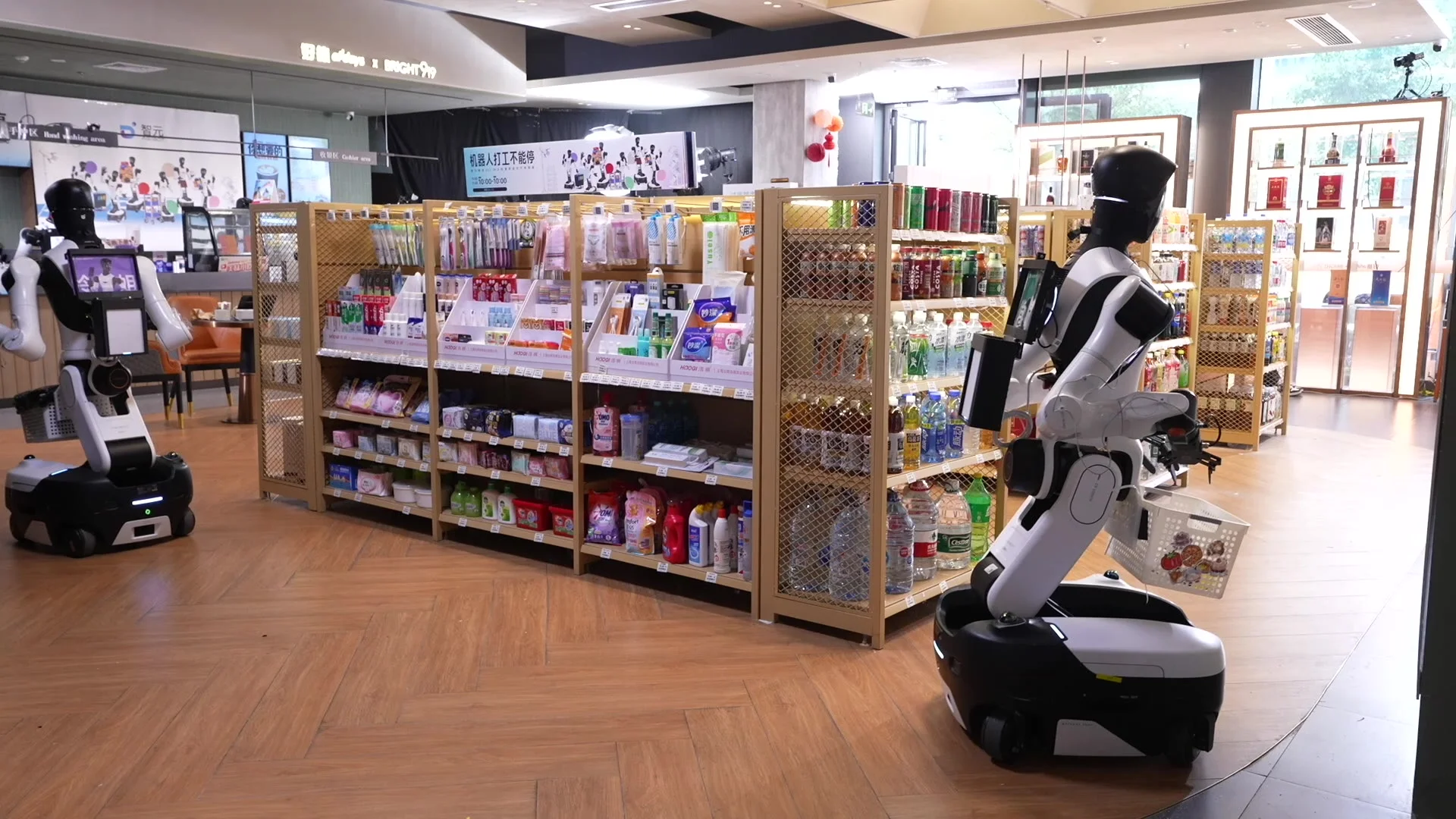
Humanoids Daily reports on an unusually transparent public test: six AGIBOT G2 wheeled humanoids staffed an operating convenience store in Shanghai’s Xuhui District from 10 a.m. on November 2 to 10 a.m. on November 3, livestreamed to an audience the organizers put at more than two million viewers. Over the 24 hours the robots executed 1,730 tasks, and the organizers published the breakdown: 683 customer-service interactions, 369 product pickups and deliveries, 277 shelf inspection and restocking operations, 147 coffee orders, 128 table-cleaning tasks, and 126 breakfast servings.
What sets the trial apart from a demo video is that it had a grading scheme and the robots did not all pass it. Evaluators scored duty time, task completion, customer feedback, response times, and handling of unexpected situations, and introduced deliberate difficulties: look-alike products such as regular and sugar-free versions of the same drink, merchandise rearranged on shelves, and obstacles placed in aisles to test navigation. Four of the six robots passed the final assessment. Two did not.
The robots were coordinated by AGIBOT’s Genie Master embodied AI framework, and the company says that both successful and failed attempts were fed back into training through what it calls an Embodied Execution Protocol. That closes the loop between a public deployment and the next model iteration, which is the practical reason to run a trial this visible.
Humanoids Daily places the trial in the context of AGIBOT’s commercial trajectory: 20,000 robots produced by September 2026, 2025 revenue of 1.05 billion yuan, and Hong Kong IPO proceedings initiated in July. A retail store is a forgiving environment compared with a factory, and a wheeled base sidesteps the hardest part of humanoid locomotion. But a published scorecard with a 67 percent pass rate under adversarial conditions tells a prospective buyer more than any choreographed clip.
Source: Humanoids Daily
The Thirty Human Jobs That Keep Figure’s Humanoids Running
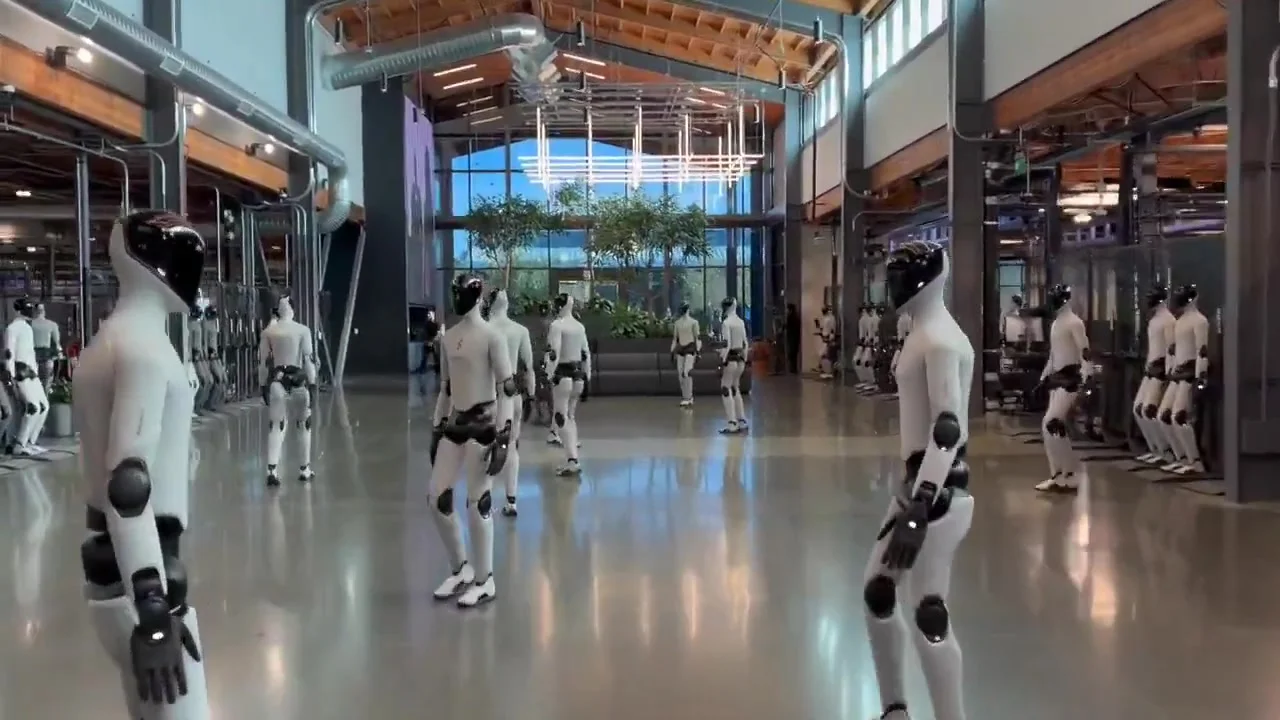
Humanoids Daily went through Figure AI’s job postings and found roughly 30 operational roles across three teams whose purpose is to keep the company’s humanoid fleet working. The most evocative is a night-shift coordinator in Santa Clara, paid $40 to $45 an hour for a 10:30 p.m. to 7 a.m. shift, who leads operators, triages robot failures, and files technical tickets. Commercial site operators in Reno and Los Angeles are offered $26 to $30 an hour. A swing-shift coordinator in Fontana, California, leading an onsite team at a customer facility, is listed at $140,000 to $165,000 a year. Humanoid robot pilots in San Jose, on six-month contracts at $32 an hour, perform teleoperation for training data.
The geography of the postings sketches Figure’s operation: Santa Clara, San Jose, Reno, Los Angeles, Fontana, BMW’s Spartanburg plant in South Carolina, and data-collection centers in São Paulo and Mexico City. The company has said it built 1,000 Figure 03 units as of July 2026. The São Paulo facility operates around the clock collecting demonstration data, paying between 8,000 and 13,000 Brazilian reais a month, and Humanoids Daily cites company leadership indicating that Figure spent about $8.1 million on data collection in a single week.
One detail the report highlights is a tension with the company’s public positioning. Figure’s chief executive, Brett Adcock, said in October 2025 that the company would not teleoperate robots commercially, yet the current operator postings reference safety procedures for teleoperation equipment at customer sites. The most natural reading is that remote intervention remains part of how deployments are kept running.
None of this is a criticism of Figure in particular. Every humanoid company deploying at scale is building a comparable layer of coordinators, operators, and pilots, and the postings simply make it visible. The question for the sector is how quickly that layer shrinks relative to the fleet. A ratio of 30 roles to a fleet in the hundreds is the cost of a technology that is still being taught; the economics work when the same team supports thousands.
Source: Humanoids Daily
J.P. Morgan Forecasts 300,000 to 400,000 US-Made Humanoids by 2030, Limited by Supply
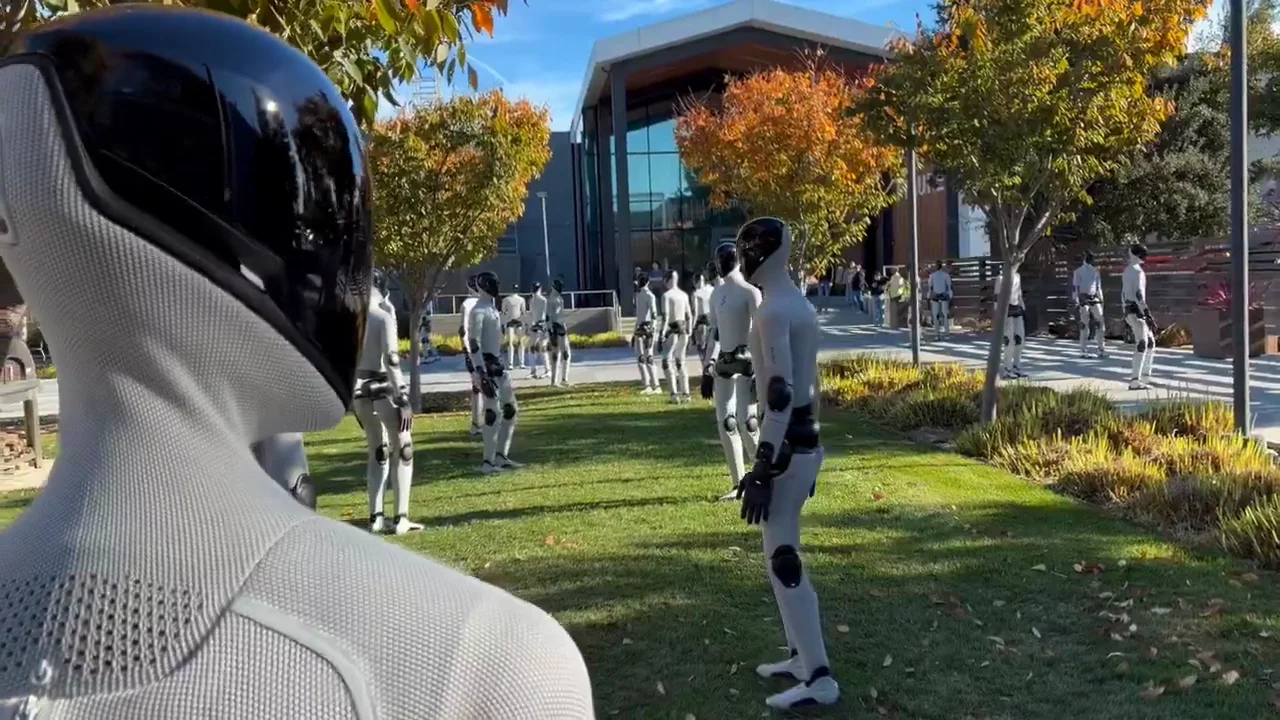
A J.P. Morgan research note, reported by Humanoids Daily, forecasts that US production of humanoid robots will reach 300,000 to 400,000 units a year by 2030 and roughly 1.5 million by 2035. The bank’s central argument is that the pace will be set by how fast robots can be built, not by how many customers want them. Manufacturing, logistics, and warehousing are identified as the first markets, driven by labor shortages and economics that the bank believes are approaching parity with human labor.
The parity calculation is concrete. J.P. Morgan estimates that running a humanoid across multiple shifts could save a customer about $100,000 a year. Humanoids Daily notes the number lines up with what Agility Robotics’ chief financial officer has said its Digit robot generates annually under a robots-as-a-service model, which suggests the industry’s pricing is already converging on roughly that figure.
On the supply side, the bank names hands, actuators, AI systems, and manufacturing capacity as the binding constraints. Most US makers other than Tesla are targeting 10,000 to 30,000 units a year. Figure’s BotQ facility was built for an initial 12,000 units with ambitions of 50,000. Agility aims to cut Digit’s bill of materials from $150,000 to $30,000 at a volume of 10,000 units a year. Those targets add up to a fraction of the 2030 forecast, which is the point: hitting it requires factories that largely do not yet exist.
That makes components the investable layer, and J.P. Morgan forecasts the parts market for actuators, motors, and vision systems will approach $30 billion by 2035, naming Timken, ROBOTIS, Leader Drive, Orbbec, and Cognex as suppliers to watch. The note also flags policy: following President Trump’s October comments that imported robotics pose a national security risk, the bank suggests tariffs or domestic production incentives could follow.
Forecasts of this kind are routinely wrong in both directions, and this one depends on humanoids achieving the reliability that this week’s trials and deployments are still working toward. But the shift in framing is worth noting. When a major bank’s analysts argue that demand is not the problem, the engineering questions about hands and actuators become industrial-policy questions about who builds them.
Source: Humanoids Daily
Robots Get a Kind of Muscle Memory That Plans in Milliseconds

Researchers at MIT’s Computer Science and Artificial Intelligence Laboratory and Carnegie Mellon University’s Machine Learning Department have introduced Workspace Models, a way for robots to remember what matters about a task without consulting a large vision-language model every time they need to act. The work addresses a real deployment problem: the big multimodal models that give robots their understanding of a scene are too slow to run in the control loop, and asking them to search through a history of observations in real time makes things worse.
The approach moves the reasoning offline. During training, two large vision-language models collaborate, one reviewing video and the other extracting spatial information from images, to teach a much smaller module which details are salient. That module, the Workspace Model, compresses the robot’s observation history into a compact high-dimensional vector that holds the task-relevant information. A separate policy network then predicts actions from that vector. At run time, only the small components are involved, so the robot can respond in milliseconds.
In cube-manipulation tasks on robotic arms, TechXplore reports the system reached about 92 percent success, roughly 25 percentage points better than competing agent-based approaches, with the fastest inference time among methods capable of long-horizon memory. Lead researcher Nitish Dashora frames the motivation plainly: “If we want robots to surpass human performance one day, we might want to look toward a lighter, more compact system.” MIT associate professor Pulkit Agrawal adds that the method helps the robot distinguish important memories from noise, which prevents overfitting to new objects and environments.
The pattern is familiar from human skill acquisition, where deliberate reasoning gives way to fast, automatic execution. For robotics, it offers a way to use the large models where they are strongest, in training and supervision, while keeping the robot’s reflexes cheap enough to run on modest onboard hardware. The paper, “Workspace Models: Lightweight Robotic Memory via Saliency-Driven Supervision,” is available as a preprint.
Source: TechXplore
A Soft Robot Arm Learns in Three Hours What Would Take Three Years on Hardware
Soft robots are attractive because they are safe, compliant, and cheap, and frustrating because their continuous, deformable bodies are hard to model and slow to train. Reinforcement learning, which has transformed legged locomotion, has struggled in soft robotics for a simple reason: the number of trials a policy needs would take years to collect on a physical soft arm, and simulators of soft bodies are either inaccurate or too slow.
A preprint from Roshan Kaundinya, Hehui Zheng, Robert Katzschmann, and George Haller attacks the problem with applied mathematics rather than more compute. The authors observe that soft robot dynamics have a natural separation of time scales, with fast transients dying out quickly and leaving slow behavior that lives on a low-dimensional surface in the system’s state space. They use a construction called adiabatic spectral submanifolds to find that surface and fit a compact polynomial model to it from pre-collected data. That reduced model is then used as the training environment for reinforcement learning.
The numbers they report are the kind that change what is practical. A trajectory-tracking policy for a pneumatic soft arm was trained in three hours on a six-dimensional reduced model and deployed to hardware without fine-tuning. The authors extrapolate that the same training on the physical arm would have taken about three years. Identifying the reduced model took five minutes, against 13 and 100 hours for the neural-network alternatives they compared, and the model has just 6,924 parameters. Despite its size, the resulting policy tracked trajectories with 40 percent lower error than otherwise identical policies trained on a 4.8-million-parameter recurrent network or a 1.7-million-parameter transformer.
The paper brings together two lines of work, learned control of soft robots and the dynamical-systems theory of spectral submanifolds, that have rarely been combined. If the result generalizes beyond trajectory tracking, it suggests that soft robots could join rigid ones as practical targets for learned control, with the training problem reduced from a data-collection marathon to an afternoon on a laptop.
Source: arXiv
Elephant-Trunk Robots With No Joints That Link Up to Work Together

A team at Colorado State University’s Department of Mechanical Engineering, led by associate professor Jianguo Zhao, has built flexible robots modeled on elephant trunks that bend, collapse, and reshape themselves without a single conventional joint. The work appears in Nature Machine Intelligence, with doctoral students Mahmud Hasan Saikot and Sydney Spiegel as co-first authors.
The structural idea is tensegrity, a design principle in which stiff rods are held in position by tensioned cables so that the whole structure is light, strong, and continuously deformable. Each robot is a tubelike body with a pair of gripping claws at either end. Changing cable tension bends the body, letting it move in a way the researchers compare to a tentacle or a snake rather than a limb with discrete joints. The claws allow a unit to grip objects of varying sizes and to navigate difficult terrain by anchoring and pulling.
The more unusual capability is modularity. Because each unit has claws at both ends, several robots can attach to one another to form chains and loops, extending reach or spanning gaps that a single unit could not cross. The team has demonstrated autonomous docking between two units, although the robots are otherwise piloted by humans for now.
The stated goal is teams of dozens or hundreds of such robots operating with minimal supervision in space exploration and search-and-rescue, environments where a rigid robot of fixed shape is at a disadvantage and where shipping mass and volume are at a premium. The path from a piloted pair to an autonomous swarm is long, but the underlying body design, cheap, jointless, and reconfigurable, is the kind of thing that could make that path worth walking.
Source: TechXplore