Energy Weekly Review 2026-11-13

Week In Review
The week’s nuclear news was about things being built rather than things being promised. The Nuclear Regulatory Commission issued a construction permit for Dow and X-energy’s Long Mott station in Texas, the first permit for a high-temperature gas-cooled reactor in roughly six decades and the first ever for a reactor sited inside an operating chemical plant. Two days later the Department of Energy cleared Oklo’s Groves-1 test reactor for unrestricted operation, a machine that went from bare ground to first criticality in under a year. And Constellation’s quarterly update showed the uprate strategy for the existing fleet scaling into billions of dollars of committed capital, backed by a conditional federal loan. Together these three stories describe an American nuclear sector that is simultaneously squeezing more out of its 1970s-era reactors, proving new designs on fast timelines, and getting regulatory decisions on schedule.
Fusion had its own version of the same shift. The United Kingdom’s STEP programme put five engineering contracts out to tender for its prototype plant at a former coal site, covering breeder blankets, fuel cycle, and plant integration, the unglamorous systems a working power plant needs beyond the plasma itself. Thea Energy, meanwhile, brought its planar stellarator magnets to MIT for full-force testing, a step from design studies toward hardware validation. Neither is a physics breakthrough. Both are the kind of procurement and qualification work that separates a research program from a construction project.
On the storage side, a Wood Mackenzie analysis reported in pv magazine argues that sodium-ion cells are approaching cost parity with lithium iron phosphate, with tens of gigawatt-hours already under supply agreement. That economic story sits alongside a laboratory one: KAIST researchers showed that aligning the polymer chains in a battery separator lets lithium metal cells survive fifteen-minute charging. Hydrogen research produced two complementary results, an EPFL team’s all-organic photocatalyst sheet that splits water with no applied voltage and a Cornell-led model that pins down exactly when bubbles start wrecking electrolyzer efficiency. Both are early-stage, but both attack bottlenecks that have resisted incremental tinkering.
Finally, a study in Organization Science offers a useful lens on all of the above. Examining seven decades of American solar history, it concludes that silicon beat thin film not because it was the better technology but because it was better positioned to exploit the supply chains and manufacturing ecosystem that grew up around it. The lesson applies directly to sodium-ion batteries, pebble-bed reactors, and stellarators alike: the technology that wins is often the one whose surrounding industry matures first.
Items
NRC Grants a Construction Permit for the First Industrial-Site Reactor in the United States

The Nuclear Regulatory Commission has approved a construction permit for Dow’s Long Mott Generating Station at the company’s Seadrift chemical manufacturing site on the Texas Gulf Coast. According to ANS Nuclear Newswire, the plant will consist of four X-energy Xe-100 reactors, each rated at 80 megawatts electric and 200 megawatts thermal, for a combined 320 megawatts of electrical output. The reactors are also designed to deliver high-temperature steam directly into Dow’s industrial processes, which is the point of putting them inside a chemical plant rather than at a conventional utility site.
The permit marks several firsts. ANS reports it is the first construction permit for a high-temperature gas-cooled reactor in nearly 60 years, the first U.S. approval of a pebble-bed design, and the first NRC construction permit for a reactor located at an industrial facility. The Xe-100 uses TRISO fuel particles, tiny uranium kernels wrapped in ceramic layers that retain fission products at very high temperatures, packed into graphite pebbles and cooled by helium gas. That fuel form is central to the design’s safety case, because the fuel itself rather than active cooling systems provides the main barrier against release.
The regulatory timeline is as notable as the technology. NRC Chairman Ho Nieh is quoted saying the commission “delivered on the 18-month schedule, proving we can do rigorous safety reviews” on a predictable timetable. X-energy CEO Clay Sell called it “an important day” and noted the permit arrived earlier than the company expected. The environmental assessment had been completed in spring 2026, and the permit followed the final safety review by only a few weeks.
The project is supported by roughly $2.15 billion in cost-shared funding through the Department of Energy’s Advanced Reactor Demonstration Program, per ANS. Dow expects a preliminary investment decision in 2027, construction later this decade, and commercial operation in the early 2030s, with a 60-year design life. If it proceeds, Long Mott would be the template for a class of plants that most of the industry has talked about for years: small reactors supplying both power and process heat to heavy industry, sited where the heat is consumed.
Source: ANS Nuclear Newswire
Oklo’s Groves-1 Test Reactor Is Cleared for Unrestricted Operation Less Than a Year After Groundbreaking

The U.S. Department of Energy has authorized Oklo’s Groves Isotope Test Reactor in Caldwell County, Texas, for unrestricted operations, according to World Nuclear News. The reactor, also called Groves-1, reached first criticality in August 2026, and WNN reports that the entire path from groundbreaking to a self-sustaining chain reaction took less than one year. For an industry where a decade from site selection to startup is unremarkable, that pace is the headline.
Groves-1 is one of 11 advanced reactor projects the DOE selected in August 2025 under its Nuclear Reactor Pilot Program, an effort to let developers test designs on DOE authority rather than through the full NRC commercial licensing process. The program sits within a broader push, which WNN refers to as the Nuclear Energy Launch Pad, to compress the time between a reactor concept and operating hardware. Groves-1 is an early demonstration that the model can work in practice.
The reactor’s job is not to make electricity. WNN lists its planned uses as training and qualifying personnel for Oklo’s future deployments, testing the performance of control rod drive mechanisms, running criticality and reactivity benchmarks to support isotope production, and general equipment evaluation and data collection. Oklo plans a companion facility, Groves-2 Forge, for producing and processing isotopes, and the operating experience will feed into the company’s Aurora powerhouse, a fast-spectrum fission plant intended for commercial power.
Oklo CEO and co-founder Jacob DeWitte is quoted saying that “taking Groves-1 from greenfield to criticality in less than a year was an important demonstration of what our team can accomplish.” The broader significance is that fast reactor physics, isotope production, and operator training can now be exercised on real hardware in Texas rather than on paper, and that the federal pilot pathway has produced its first fully cleared operating machine.
Source: World Nuclear News
Constellation Commits Billions to Uprating Its Existing Reactors, Backed by a Conditional Federal Loan
Constellation Energy’s third-quarter earnings call, as reported by ANS Nuclear Newswire, laid out how far the company has taken its strategy of extracting more power from the reactors it already owns. During the quarter, Constellation signed agreements totaling 4,560 megawatts of new capacity, of which 1,165 megawatts comes from nuclear uprates, meaning engineering modifications that let existing plants run at higher output. The company plans to invest $1.3 billion in uprates across 2026 and 2027, with a further $3 billion allocated for 2028 through 2032.
The Department of Energy has committed a conditional $5 billion loan covering up to 80 percent of eligible uprate costs through 2035, according to ANS. That financing matters because uprates are among the cheapest sources of new firm capacity available anywhere: the site, the grid connection, the operating license, and the trained workforce already exist. CEO Joe Dominguez told analysts, “We have not finished exploring uprates at plants. Design and engineering work continues.”
Constellation also announced the first customer under a new program called Peak+, a 270-megawatt, 20-year agreement starting in 2028. Dominguez described it as giving “customers another path to get new demand on line efficiently,” pairing nuclear supply with new peaking resources, potentially including battery storage, to serve large loads. The customer was not named, but the structure addresses the central grid question of the moment: how to connect large new consumers without waiting years for new generation.
Fleet performance underpins all of this. ANS reports third-quarter nuclear generation of 46,677 gigawatt-hours at a 97.2 percent capacity factor, up from 96.8 percent a year earlier. The restart of the former Three Mile Island Unit 1, now called Crane, remains on schedule for the second half of 2027 with fuel assemblies and transformers already on site. Dominguez also addressed concerns about post-midterm politics, arguing that support for both nuclear energy and data center growth remains bipartisan.
Source: ANS Nuclear Newswire
Britain’s STEP Fusion Plant Opens Tenders for the Systems That Make a Reactor a Power Station
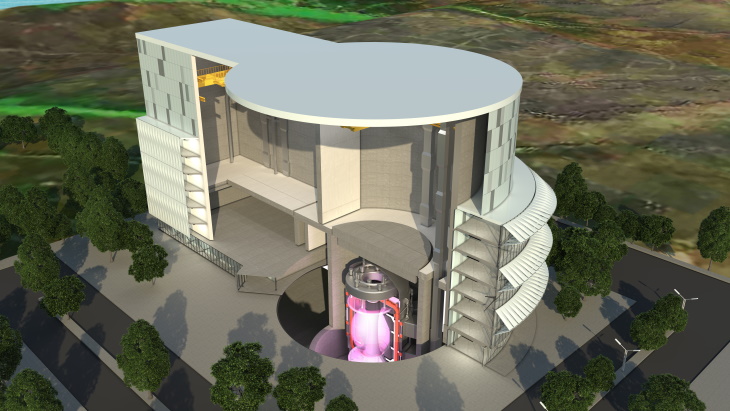
UK Fusion Energy has invited bids for five engineering partnership contracts worth up to 115 million pounds, roughly $152 million, to support construction of the Spherical Tokamak for Energy Production, or STEP, at the former West Burton coal plant site in Nottinghamshire. World Nuclear News reports the plant is intended to begin operating by 2040 and to produce more than 100 megawatts of net electricity, which would make it the first fusion device designed from the outset to put power on a grid.
The contract lots describe what distinguishes a power plant from a plasma experiment. According to WNN, they cover a breeder blanket system partner at 20 million pounds, a fuel cycle system partner at 20 million pounds, a test operations partner at 35 million pounds, a control system partner at 15 million pounds, and a systems engineering and whole-plant integration partner at 25 million pounds. The breeder blanket is the component that captures fusion neutrons to produce tritium fuel and extract heat, and the fuel cycle system processes that tritium. No operating fusion machine has yet integrated these at the scale a power plant requires.
The tender closes on 29 January 2027, with award decisions expected on 6 April 2027 and contracts beginning on 23 April 2027. Each runs for two years with two optional one-year extensions. WNN notes that in March 2026 the ILIOS consortium, led by a Kier and Nuvia venture with AECOM, AL_A, and Turner & Townsend, won the first 200 million pound tranche for design and construction of buildings and infrastructure, so the civil works are already contracted.
UK Fusion Energy says the program “aims to deliver a prototype fusion energy plant by 2040, while also developing a robust fusion supply chain.” That second clause is the strategic point. Britain is using STEP to grow companies that can build fusion components for whoever eventually commercializes the technology, whether at West Burton or elsewhere.
Source: World Nuclear News
Thea Energy Takes Its Flat Stellarator Magnets to MIT for Full-Force Testing

Thea Energy has announced a collaboration with MIT’s Plasma Science and Fusion Center to test and validate an encircling magnet coil for its Eos stellarator design, ANS Nuclear Newswire reports. Stellarators are fusion devices that confine plasma with a twisted magnetic field produced entirely by external coils, which makes them inherently steady-state but has historically required contorted three-dimensional magnets that are expensive to build and hard to maintain.
Thea’s approach replaces those sculpted coils with flat ones. According to ANS, the Eos design uses 12 encircling coils plus roughly 300 small programmable shaping magnets that together generate the required field shape through software control rather than mechanical complexity. The company, spun out of Princeton Plasma Physics Laboratory in 2022, argues this simplifies construction, lowers cost, and shortens maintenance cycles compared with conventional stellarators.
The MIT program will test the magnet hardware at full magnetic field and full force, analyze coil efficiency under conditions representative of an actual fusion power plant, and run resilience tests aimed at the high plant availability a commercial facility would need. Zachary Hartwig, who heads the PSFC Engineering Group, is quoted saying the center’s “testing infrastructure is ideally suited to evaluate Thea Energy’s encircling coils” and that the work “aligns directly with our mission at MIT to advance scalable and efficient fusion technology.”
Thea is targeting operation of its large-scale Eos demonstration facility by 2030 and commercial fusion energy from a plant called Helios by 2035, per ANS. The company has also received Department of Energy INFUSE awards for three projects covering thermal cycling in high-temperature superconducting magnets, boron-based vapor shields, and strategies for suppressing magnetic islands, the field imperfections that degrade stellarator confinement. Magnet qualification at a facility that has already tested record-setting fusion coils is the natural next gate.
Source: ANS Nuclear Newswire
Sodium-Ion Batteries Close In on Lithium Iron Phosphate Costs With 70 Gigawatt-Hours Under Contract

Sodium-ion batteries, which swap lithium for the far more abundant sodium, are approaching commercial parity with the lithium iron phosphate cells that dominate stationary storage, according to a Wood Mackenzie analysis reported by pv magazine. Supply agreements for sodium-ion cells now exceed 70 gigawatt-hours globally across China, the United States, and Europe, with India still in early validation.
The cost picture is close but not yet level. pv magazine reports a current sodium-ion cell cost around $229 per kilowatt-hour against roughly $200 for LFP. Wood Mackenzie expects cell-level parity by late 2026 but does not anticipate parity at the module and system level until after 2030, because sodium-ion’s lower energy density means more enclosure, wiring, and balance-of-system hardware per stored kilowatt-hour. Even so, the analysts project a 21 percent lower total cost of ownership over a 20-year project life, driven by longer service life and better performance in cold conditions.
Manufacturing is scaling in step. BYD is targeting 30 gigawatt-hours of sodium-ion capacity and CATL aims to ship more than 1 gigawatt-hour by the end of 2026, per the report, with learning rates in China projected at 18 to 20 percent through 2035. Beyond cost, the chemistry’s advantages include a wider operating temperature range, independence from lithium supply, and no need for cobalt or nickel.
Policy is accelerating the shift from several directions. pv magazine notes that China introduced a consumption tax on lithium-ion batteries in July 2026 and a 2 percent levy on LFP in September, rising to 4 percent in 2027. The United States imposes tariffs of 58 percent on imported Chinese storage cells while offering Section 45X production credits for domestic manufacturing, and the EU Battery Regulation’s carbon footprint rules favor chemistries with fewer critical raw materials. India has a $1.25 billion incentive program. Taken together, the report describes a technology arriving at the moment when policy, cost curves, and supply security concerns all point the same way.
Source: pv magazine
Aligned Polymer Separators Let Lithium Metal Batteries Survive Fifteen-Minute Charging

Researchers at the Korea Advanced Institute of Science and Technology have shown that controlling the molecular orientation of a battery separator can dramatically improve how lithium metal batteries handle fast charging. The work, led by professors Dong Ki Yoon and Hye Ryung Byon and published in ACS Nano, uses liquid-crystalline polymers whose chains can be aligned in a chosen direction during fabrication, Tech Xplore reports.
Lithium metal anodes offer far higher energy density than the graphite used in today’s cells, but they are notorious for growing dendrites, needle-like lithium deposits that form during charging, degrade capacity, and can short-circuit the cell. Fast charging makes the problem worse because uneven ion flow concentrates lithium plating in a few spots. The KAIST team’s insight was that the separator, the porous membrane between electrodes, could be engineered to guide ions along straight, uniform paths rather than letting them wander.
According to Tech Xplore, the researchers incorporated polyethylene glycol chains into porous liquid-crystalline polymer separators and compared vertically aligned versions with horizontally aligned ones. The vertical alignment reduced the complexity of ion transport pathways by roughly 2.5-fold, producing faster and more uniform lithium-ion movement that suppressed dendrite growth. Cells using the vertically aligned separators retained 94 percent of their initial capacity after 100 cycles at a 4C rate, which corresponds to a full charge in about 15 minutes.
The result is a materials-design approach rather than a new chemistry, which makes it potentially compatible with other lithium metal developments such as solid-state electrolytes. It also illustrates a broader trend in battery research toward treating the separator as an active component that shapes ion flow rather than a passive barrier.
Source: Tech Xplore
An All-Organic Photocatalyst Sheet Splits Water Without Any Applied Voltage

Researchers at EPFL in Lausanne have demonstrated the first organic semiconductor-based photocatalyst sheet that splits water into hydrogen and oxygen using simulated sunlight alone, with no external voltage applied. Tech Xplore reports the work, led by Nicolas Diercks and Jin Su Park in EPFL’s LIMNO laboratory and published in Nature Energy, as a proof of concept for a long-sought route to solar hydrogen using cheap, printable organic materials rather than inorganic semiconductors or precious-metal catalysts.
The elegance of the design lies in using one material for both halves of the reaction. The team deposited a semiconducting polymer blend onto conductive glass substrates coated with self-assembled molecular contact layers. Depending on the orientation of the molecular dipole in that contact layer, the same organic film acts either as a photocathode that evolves hydrogen or as a photoanode that evolves oxygen. Wiring the two together into a single sheet produces an unassisted water-splitting device.
The performance numbers are modest, and the researchers say so. According to Tech Xplore, the sheet reached a solar-to-hydrogen efficiency of about 0.1 percent, a stabilized hydrogen production rate of 1.3 micromoles per hour per square centimeter, and sustained operation for more than two hours while producing hydrogen and oxygen in the expected two-to-one ratio. Tests at domain sizes of 1 millimeter, 100 micrometers, and 10 micrometers showed efficiency falling as domains shrank, which pointed to the main bottleneck: charge extraction losses at the boundaries between domains.
That diagnosis is the useful part. The team identifies specific paths forward, including narrower-bandgap acceptor materials, better charge-selective contact molecules, and more selective deposition of co-catalysts. Organic photovoltaics took decades to climb from sub-percent to double-digit efficiencies, and this work establishes that the same material family can in principle run the full water-splitting reaction, giving that climb a starting point.
Source: Tech Xplore
A Multiscale Model Pins Down When Bubbles Start Wrecking Electrolyzer Efficiency

Every electrolyzer producing hydrogen from water also produces bubbles, and those bubbles cost energy by blocking electrode surfaces and disrupting ion flow. A team from Cornell University and City University of Hong Kong has built a computational model that captures how bubbles degrade efficiency across scales from the molecular to the device level, and identifies a critical bubble radius beyond which losses climb steeply. Tech Xplore reports the study, published in EES Catalysis on November 9, 2026.
The core finding is a threshold effect. According to the report, once bubbles grow past a critical radius before detaching from the electrode, the additional voltage required rises exponentially, in some conditions exceeding bubble-free values by more than 50 percent. Below that threshold the penalty is small. Simulations indicate that keeping the ratio of detachment radius to critical radius below one limits the extra voltage from individual bubbles to within 3 percent, which gives engineers a concrete design target rather than a vague instruction to minimize bubbles.
The modeling achievement is what made the finding possible. Lead researchers Lenan Zhang of Cornell’s Sibley School of Mechanical and Aerospace Engineering and Weihong Li of City University of Hong Kong, with co-first authors Muhan Zhang and Kaiyu Li, built a framework that simulates interconnected processes spanning eight orders of magnitude in length while cutting computational effort by nearly a thousandfold. Zhang noted that “experimentally, it’s really challenging to isolate the impact of bubbles on each individual scale,” which is why the problem has been understood qualitatively but not quantitatively.
The practical implication is that electrode surface design, wettability, and flow conditions can be tuned to force early bubble detachment, and that the payoff for doing so is now predictable. For green hydrogen, where electricity is the dominant cost, every percentage point of electrolyzer efficiency translates directly into cheaper fuel.
Source: Tech Xplore
Silicon Did Not Beat Thin Film Because It Was Better. It Beat It Because of the Ecosystem.

Why does one energy technology win and another lose? A study in Organization Science by Mara Guerra of Bayes Business School at City St George’s, University of London, and Rajshree Agarwal of the University of Maryland traces the American solar photovoltaic industry from the 1950s to the present to answer that question for silicon and thin-film cells. Tech Xplore reports that silicon held 91 percent of industry sales by 2020, even though thin film was long considered the more promising path to low cost and a similar number of companies initially entered each sector.
The researchers’ conclusion is that the outcome was less about the cells than about everything around them. Silicon benefited from a “reinforcement loop”: established supply chains and manufacturing equipment, much of it borrowed from the semiconductor industry, allowed rapid scaling, which improved reliability, reputation, and cost, which in turn attracted more investment and demand. Thin film, by contrast, was caught in “balancing loops.” Each thin-film approach needed customized supply chains and equipment, which weakened economies of scale and slowed learning. According to the study, three-quarters of thin-film companies exited the market over the period examined.
Guerra puts it directly: “Silicon did not simply win because it was better. It won because it was better equipped to take advantage of an ecosystem that had developed around solar power as demand began to take off.”
The finding is uncomfortable for anyone who believes the best technology wins on merit, but it is useful. It suggests that a challenger technology, whether a new battery chemistry, a new reactor type, or a new fusion confinement scheme, should be judged as much on how readily it can borrow existing industrial infrastructure as on its laboratory performance. Technologies that can ride on established supply chains compound their advantages; technologies that require bespoke everything must be dramatically better just to keep pace.
Source: Tech Xplore