Energy Weekly Review 2026-09-04

Week In Review
This was the week fusion stopped being purely a physics story and started behaving like an industry with paperwork. Tennessee’s environmental regulator issued the first commercial fusion machine operating license granted under a fusion-specific state framework, clearing Type One Energy to build a stellarator on a retired coal site outside Oak Ridge. Two days later, a Wisconsin utility took an equity stake in Realta Fusion and began jointly scoping a 200 MW plant — a ratepayer-funded company putting its own balance sheet behind a machine that does not yet exist. And Japan’s trade ministry conditionally selected Helical Fusion for its national demonstration subsidy program. Licensing, utility offtake partnerships, and industrial policy are the three things that turn a laboratory result into a power plant, and all three moved in the same seven days.
The fission news followed a similar pattern of institutional firsts. At Palisades in Michigan, Holtec began loading 204 fuel assemblies into a reactor that stopped operating in 2022 and was headed for demolition — an unwinding of a decommissioning decision with no precedent in the United States. Further out on the speculative frontier, Lloyd’s Register, Maersk, and the ports of Charleston and Felixstowe launched a study of a nuclear-powered trans-Atlantic container ship, whose central finding before it even starts is that the hard problems are legal rather than technical. Both stories describe the same underlying shift: the constraint on nuclear energy has migrated from engineering to institutions, and institutions are now moving.
Away from nuclear, the week’s most interesting results were about making energy conversion do more with less hardware. SunHydrogen pushed an integrated photoelectrochemical module past 10% solar-to-hydrogen efficiency by fusing the light absorber and the water-splitting catalyst into one device, skipping the separate electrolyzer entirely. Skyven’s industrial heat pump reached a coefficient of performance of 8.0, delivering factory steam at roughly ten times the fuel efficiency of a boiler and with no flame at all. A Korean team converted silicon scavenged from a dead solar panel into high-grade silicon nitride ceramic, turning a recycling cost center into a product worth more than the original feedstock. Each replaces a multi-stage industrial process with a shorter one.
Underneath all of it sits the unglamorous work of measurement and materials. Texas Instruments put electrochemical impedance spectroscopy directly onto a battery-monitoring chip, so grid storage operators can finally tell a cell that is merely discharged from a cell that is quietly dying — a diagnostic gap that has been as much a financing problem as a safety one. And two startups are betting robots and language models can find new superconductors faster than physicists can, running hundreds of synthesis experiments a day in search of wire-capable materials. That last thread loops back to the first: superconducting magnets can account for up to half the cost of a fusion reactor. The licensing milestones of this week describe machines whose economics will ultimately be set by materials nobody has discovered yet.
Items
Tennessee Issues the First Fusion-Specific Commercial License
Type One Energy has received a commercial fusion machine operating license from the Tennessee Department of Environment and Conservation — the first license granted under the fusion-specific regulatory framework the state put in place in June 2026. The award was announced on August 31 at the Organization of Agreement States annual meeting in Nashville.
The distinction matters more than the permit itself. Fusion devices have historically been licensed by analogy, squeezed into regulatory categories written for fission reactors or particle accelerators, neither of which fits well. Tennessee instead wrote a process for fusion machines specifically and then used it. Chief executive Chris Mowry framed this as the substantive first: a fusion-plant-specific licensing pathway has now been developed and exercised end to end, giving other jurisdictions a worked example rather than a theory.
The license covers Type One’s site at the Tennessee Valley Authority’s Bull Run Energy Complex near Oak Ridge — a retired coal plant that the company adopted as headquarters after relocating from Madison, Wisconsin in 2024. The campus operates as a joint development effort with TVA, Oak Ridge National Laboratory, and the University of Tennessee, an unusually dense concentration of fusion-relevant expertise within a few miles of one another.
Type One is building toward a stellarator, the twisted magnetic geometry that confines plasma using coil shape rather than a driven plasma current. The company’s Infinity One prototype comes first, followed by the Infinity Two pilot plant, targeted at 400 megawatts with full startup expected by 2034. Those are long timelines, and the license does not certify that the physics will work. What it establishes is that when the machine is ready, the legal path to operating it will already exist.
Source: ANS Nuclear Newswire
A Wisconsin Utility Buys Equity in a Fusion Startup
Madison Gas and Electric has made a direct equity investment in Realta Fusion, becoming a shareholder in the University of Wisconsin–Madison spinout rather than merely signing a letter of intent. The two companies are now jointly exploring the development, siting, permitting, and financing of a fusion facility of at least 200 megawatts — roughly enough for 150,000 homes.
Utility involvement in fusion has mostly taken the form of power purchase agreements: a promise to buy electricity if and when it appears, which costs the utility nothing today. An equity stake is a different commitment. A regulated utility putting capital into a pre-revenue fusion company is making a statement about siting, interconnection, and permitting expertise being as scarce as the physics — and about wanting a seat at the table while those decisions are made.
MGE will also supply engineering, technical services, and equipment for Realta’s planned R&D center and headquarters at OM Station, the former Oscar Mayer site in Madison. The facility, called the Realta Forge, is drawing up to $55 million in combined state and city investment, which puts Wisconsin in the small club of jurisdictions treating fusion as economic development rather than a science budget line.
Realta’s technical approach is a tandem axisymmetric magnetic mirror: plasma confined between two high-field superconducting magnets, heated by radio-frequency energy delivered to both ions and electrons and topped up with high-energy neutral particle injection. Mirrors were largely abandoned in the 1980s because plasma leaked out the ends; high-temperature superconducting magnets, which produce far stronger fields in a compact package, are what made the geometry worth revisiting. Realta tests the concept on the WHAM prototype and has received support from the Department of Energy’s Milestone-Based Fusion Development Program, targeting commercialization in the early 2030s and an operating plant by the middle of that decade.
Source: ANS Nuclear Newswire
Japan Picks Helical Fusion for Its Demonstration Program
Japan’s Ministry of Economy, Trade and Industry has conditionally selected Helical Fusion as a project operator under its FY2025 Supplementary Grant for Promoting Fusion Energy Power Generation Demonstration Project. The program sits inside Japan’s Basic Energy Plan and its Fusion Energy Innovation Strategy, and will distribute roughly JPY60 billion — about USD 370 million — among the selected operators through February 2029.
Helical Fusion, founded in Tokyo in October 2021, builds on decades of work at the National Institute for Fusion Science, home of the Large Helical Device. Its reactor is a helical stellarator: a toroidal chamber twisted into a configuration that generates the confining magnetic field entirely from external coils, so the plasma does not need a driven internal current to stay bottled.
That design choice determines the company’s pitch. Because stellarators need no plasma current, they can in principle run continuously rather than in pulses, and they are not subject to the sudden current-driven disruptions that can damage tokamak walls. Helical frames its requirements as three items: steady-state operation, net electricity output, and — a criterion rarely stated so plainly — regular, efficient component maintenance. Fusion machines will need their innermost components replaced periodically under intense neutron bombardment, and a plant that cannot be serviced quickly cannot sell power reliably.
The company plans to finish demonstrating individual components in the near term, run integrated demonstrations on a device called Helix HARUKA in the 2030s, and then build a power-generating plant, Helix KANATA. Japan’s selection of a helical design alongside its other national fusion efforts is a hedge worth noticing: with the physics of no single confinement scheme yet settled at power-plant scale, a state program backing more than one geometry is buying optionality rather than picking a winner.
Source: World Nuclear News
Fuel Goes Back Into Palisades
On the morning of Sunday, August 31, staff at the Palisades plant in Covert, Michigan began loading fuel into the reactor vessel, formally placing the 777-megawatt unit into Mode 6, the refueling condition. The core takes 204 fuel assemblies, a mix of fresh fuel and partially burned assemblies left from the plant’s previous operating cycles.
Palisades last generated commercial power in 2022 and was slated for decommissioning — the industrial equivalent of a demolition permit. Holtec International acquired it and set out to reverse that, which no operator in the United States has previously accomplished. Bringing a plant back from a decommissioning decision means re-establishing every system, procedure, and license condition that was being unwound, and it took more than two years of inspection, maintenance, refurbishment, and equipment replacement to reach this point.
Loading fuel is the step where that work stops being reversible. Chief nuclear officer Fadi Diya described it as marking the completion of major restoration and the transition into the advanced phases of restart. Ahead lie systems testing, inspections, and startup activities before the reactor can be brought critical and synchronized to the grid.
Holtec has not announced a firm restart date, though chief executive Kris Singh has said he expects commercial operation ahead of the plant’s contractual obligation to supply power by March 2027. The significance runs past this one site: a successful Palisades restart establishes that a closed reactor with remaining service life is a recoverable asset rather than scrap, which changes the calculus for every plant currently facing an early shutdown decision on economic grounds.
Source: ANS Nuclear Newswire
Maersk and Lloyd’s Register Study a Nuclear Container Ship
Lloyd’s Register, AP Moller-Maersk, the Port of Charleston, and the Port of Felixstowe have launched a joint project to examine a nuclear-powered container ship running a trans-Atlantic route between South Carolina and Suffolk. The work supports the US-UK Technology Prosperity Deal’s aim of exploring civil maritime nuclear applications, and this first phase is a feasibility and requirements study whose results will determine whether a second phase follows.
Naval reactors have propelled ships for seventy years, so the physics of marine nuclear propulsion is thoroughly settled. What has never been settled is the commercial and legal apparatus around it. The study’s focus list reflects that: ship security, safeguards, cyber resilience, emergency response, insurance frameworks, and — the recurring obstacle — alignment between maritime regulators and nuclear regulators, two communities with different vocabularies and different assumptions about who is in charge.
An earlier study reached the conclusion that frames this one: the principal barriers to nuclear ships calling at ports are not technical but regulatory, arising from misalignment between local and international rules. A vessel that cannot dock is not a vessel. Choosing two specific ports and one specific corridor, rather than studying the question in the abstract, is a way of forcing those questions into concrete form — Charleston and Felixstowe have named harbormasters, named insurers, and named local authorities who would have to say yes.
Shipping accounts for a meaningful share of global emissions and has proven stubbornly hard to decarbonize, because the alternatives all involve carrying fuel that is bulkier, more expensive, or both. A reactor sidesteps the energy density problem entirely. Whether it can clear the institutional one is what this project exists to find out, and the honest answer is that nobody yet knows.
Source: World Nuclear News
A Solar Module That Makes Hydrogen Without an Electrolyzer
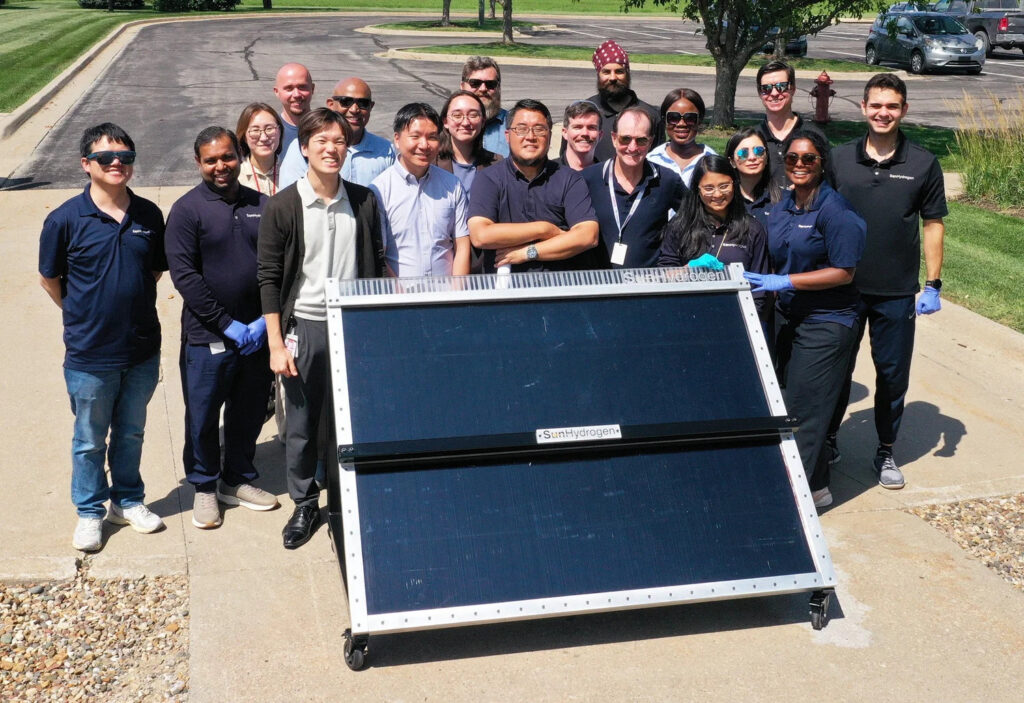
SunHydrogen, an Iowa-headquartered photoelectrochemical company, has reported solar-to-hydrogen conversion efficiency above 10% on 100 cm² modules in testing at Sparc Hydrogen’s laboratories. The company had previously recorded 10.8% active-area efficiency in testing at Honda R&D, and a much larger 1.92 m² development module reached roughly 9% in outdoor conditions.
The conventional route to green hydrogen is two boxes: a solar panel that makes electricity and an electrolyzer that consumes it to split water. Each box has its own capital cost, its own power electronics, and its own conversion losses. SunHydrogen’s approach collapses them into one. The light-absorbing semiconductor, its purpose-designed electrical contacts, and the water-splitting catalysts are engineered to work as a single integrated unit, so sunlight arrives and hydrogen leaves without electricity ever being routed through external wiring.
Ten percent has long been treated as the rough threshold where photoelectrochemical hydrogen starts to look economically interesting rather than merely scientifically elegant. The harder part has always been holding that efficiency as devices scale, because photoelectrochemical cells combine the failure modes of a solar cell with those of an electrochemical reactor operating in contact with water and evolving gas. The gap between 10.8% at small scale and roughly 9% on the near-two-square-meter module is a reasonable illustration of that penalty — and also of the fact that it is not catastrophic.
The company is targeting efficiencies approaching 15% while scaling to larger, manufacturable modules. Durability data, which is ultimately the number that decides whether this technology deploys, was not reported. A device that hits 15% and degrades in a year is a laboratory curiosity; one that holds 10% for a decade in the field is an industry.
Source: pv magazine
Robots and Language Models Hunt for Better Superconductors
Two startups — Periodic Labs in San Francisco and Quantum Formatics in Cambridge, Massachusetts — are building automated laboratories to search for new superconductors at a pace human researchers cannot match. Periodic Labs, founded in September 2025 and cofounded by former Google DeepMind researcher Ekin Doğuş Çubuk, runs robotic arms that load material samples into X-ray diffraction machines, with large language models reading the resulting diffraction patterns to judge whether a synthesis succeeded and decide what to try next.
The company currently performs about 100 experiments a day and plans to reach 1,000 with a second laboratory. That throughput is the entire point. Materials discovery has historically been rate-limited by how many samples a graduate student can synthesize and characterize; when the search space is combinatorially enormous and theory cannot reliably predict which compositions will superconduct, brute-force exploration with fast feedback becomes a credible strategy. Quantum Formatics takes a related approach with a proprietary algorithm it calls “the System,” and has published three papers in Nature Computational Materials describing the methodology.
Notably, neither company is chasing room-temperature superconductivity. Both target materials working at 10 to 20 kelvin — still brutally cold, but above the roughly 10 K limit of niobium-titanium, the workhorse alloy in today’s magnets. Quantum Formatics adds a constraint that matters more than raw critical temperature: the material must have mechanical properties good enough to be drawn into wire. Many known high-temperature superconductors are brittle ceramics that resist being made into anything useful, which is why a modest improvement in a ductile material can be worth more than a spectacular one in a compound that shatters. The company expects prototype wire within roughly a year for qualification testing.
The energy stakes are considerable. Päivi Törmä of the Super C consortium has suggested superconducting applications in data centers and medical imaging could be ten times more energy efficient, with some scenarios reaching hundreds or thousands of times. And superconducting magnets can represent up to half the cost of a fusion reactor — which means a cheaper, more manufacturable wire would ripple directly through the economics of every fusion company in this week’s news.
Source: IEEE Spectrum
Turning Dead Solar Panels Into High-Value Ceramic
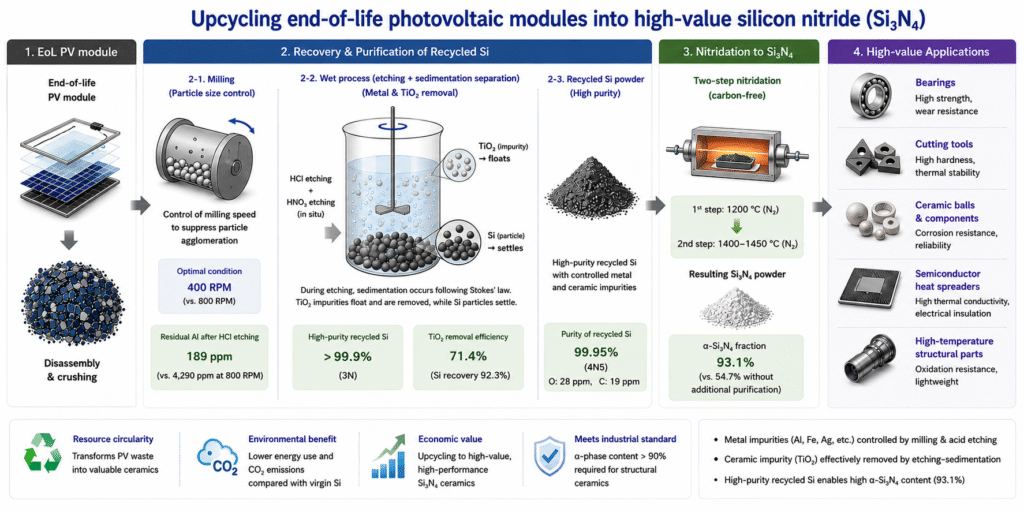
A team from the Korea Institute of Energy Research and Chungnam National University, led by corresponding author Jin-Seok Lee, has demonstrated a route from end-of-life solar panels to silicon nitride ceramic — a material worth substantially more than the recovered silicon it comes from. The work appeared in Materials Today Sustainability on September 3.
The process starts with silicon recovered from a single retired Suntech module and runs it through a sequence designed for field conditions rather than laboratory ideals: mechanical milling, sieving to remove backsheet fragments and leftover encapsulant, thermal combustion of organics at 600 °C, a two-stage acid purification using hydrochloric acid for base metals and nitric acid for silver, and water sedimentation to strip out titanium dioxide. The cleaned silicon is then ball-milled and nitrided under a nitrogen-hydrogen atmosphere at 1,350 °C followed by 1,450 °C.
The purification steps turn out to be what makes the product valuable. The recovered silicon reached 99.95% purity at a 92.3% recovery rate, and the resulting ceramic was 93.1% alpha-phase silicon nitride — compared with only 54.7% alpha phase when the extra purification was skipped. Alpha phase is the form that matters for high-performance applications, so impurity control is not a matter of tidiness but the difference between a premium ceramic and a low-grade powder.
Silicon nitride is prized for high strength, thermal stability, wear resistance, and electrical insulation, and finds use across automotive, aerospace, electronics, medical, energy, and general manufacturing. That is the economic argument: photovoltaic recycling has largely been framed as a waste-management obligation, where the recovered silicon competes against cheap virgin polysilicon and rarely wins. Upcycling into a higher-value material inverts the logic. The researchers partnered with Korean PV recycler Wonkwang S&T on scaling, which is the necessary next step — a process validated on one module is a demonstration, not a business.
Source: pv magazine
An Industrial Heat Pump Hits a Coefficient of Performance of 8.0
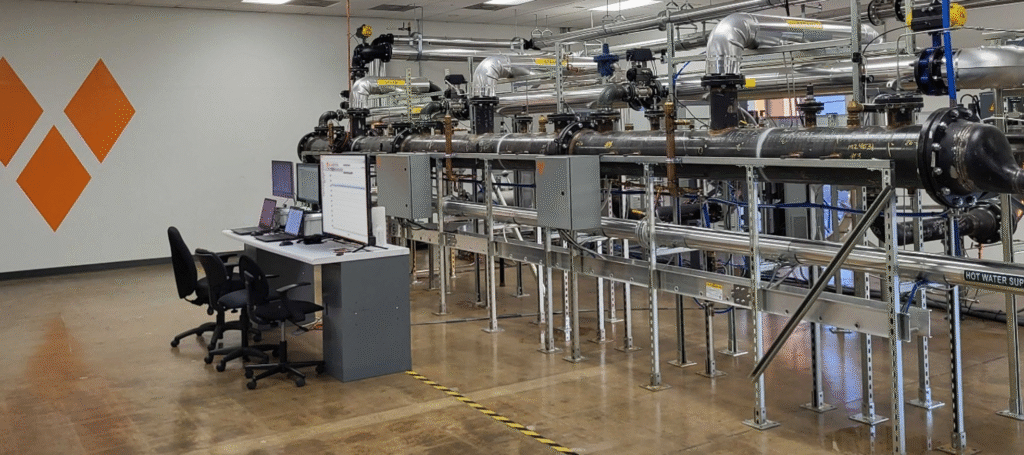
Skyven Technologies, with operations in Texas and Antwerp, reports that its Arcturus industrial heat pump has reached a coefficient of performance of 8.0 at its Dallas demonstration center. COP is a simple ratio: eight units of heat delivered per unit of electricity consumed. The figure is roughly double the 6.5 recorded when the demonstration center was commissioned in November 2025, achieved through refinements to design, controls, and system integration rather than a new machine.
Industrial steam is one of the least discussed and most stubborn pieces of the energy system. Food processing, chemicals, paper, and pharmaceuticals all run on it, and it is almost universally produced by burning gas in a boiler — a process that is roughly 80% efficient at best and, critically, has no obvious substitute at the temperatures involved. Heat pumps have long been dismissed for industrial duty because moving heat uphill gets harder the steeper the climb, and factories need steep climbs.
Arcturus is built for those lifts, spanning 38 °C to 185 °C with performance varying across the range. Because it moves heat rather than burning fuel, it produces no direct CO2 from steam generation at all. Skyven’s framing is that the system is about ten times as efficient as a conventional boiler — a comparison that holds because a boiler cannot exceed a COP of 1 by definition, while a heat pump harvests ambient or waste heat and simply relocates it.
The commercial case is sharpened by carbon pricing. Under the EU Emissions Trading System, industrial sites pay for the CO2 their steam generation emits; eliminating combustion removes that line item entirely. Chief executive Arun Gupta says the technology can cut European manufacturers’ steam costs by half or more while removing ETS allowance exposure, with typical first-year savings of €1–5 million per customer. Those are company figures rather than independently audited results, but the direction is what matters: industrial heat decarbonization has been waiting for a technology that pays for itself without a subsidy, and the arithmetic of a COP of 8 against a priced carbon obligation is starting to look like one.
Source: pv magazine
A Chip That Can Tell a Tired Battery Cell From an Empty One
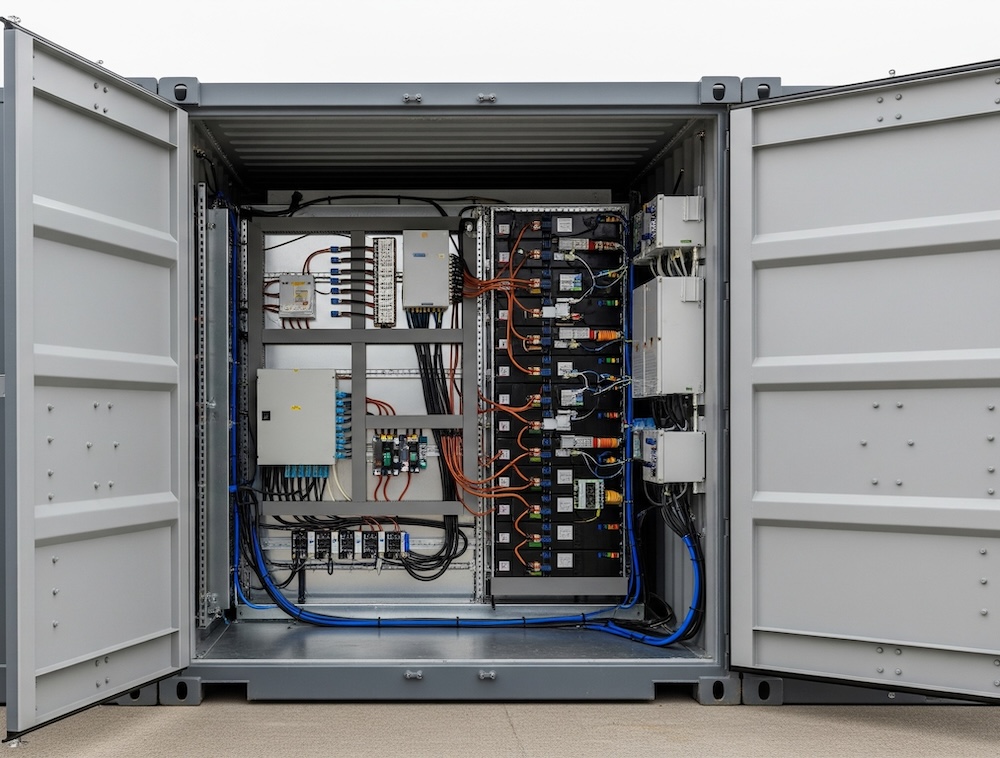
Texas Instruments has introduced the BQ79826Z-Q1, a 26-channel battery monitoring device for grid-scale lithium iron phosphate systems that integrates electrochemical impedance spectroscopy directly onto the chip. Rather than passively reading voltages, the device injects small AC perturbation signals into each cell and measures the resulting internal impedance across a range of frequencies.
The problem it addresses is specific to LFP chemistry, which now dominates stationary storage because it is safe, cheap, and long-lived. LFP’s drawback is that its voltage curve is nearly flat across the middle of its charge range — a cell at 40% and a cell at 60% read almost identically. Conventional battery management systems infer health from voltage and cycle counts, and against a flat curve those inferences degrade badly. As TI’s Henrik Mannesson describes it, impedance spectroscopy lets engineers separate state of charge from permanent chemical degradation such as lithium plating.
That distinction has consequences beyond diagnostics. Lithium plating is a precursor to internal short circuits and thermal runaway, so detecting it early is a safety function, not just a maintenance convenience. It is also a financial one: TI frames the improved data as affecting project bankability, and the connection is direct — a lender financing a twenty-year storage asset is pricing uncertainty about degradation, and better measurement narrows that uncertainty.
The chip handles 26 cells, which TI notes is eight more than competing parts, so four devices cover a full 104-cell module. It is in pre-production sampling now, with volume production expected by the end of 2026 and first commercial systems anticipated in 2027. This is unglamorous silicon that will never be the headline on a storage project, but the ability to know precisely what is happening inside several hundred thousand cells is what lets those projects be insured, financed, and operated close to their real limits rather than conservative guesses about them.
Source: pv magazine