Energy Weekly Review 2026-10-30

Week In Review
The week’s nuclear news was about getting more out of what already exists, and about turning paper designs into hardware. The largest single item was financial: the Department of Energy offered Constellation a conditional loan of up to five billion dollars to uprate eight existing plants in Illinois, Maryland, and Pennsylvania, adding nearly 1.1 gigawatts without pouring a new foundation. On the manufacturing side, NuScale signed Doosan Enerbility to build the upper reactor coolant system for its first Power Module, moving the only NRC-certified small modular reactor from a seven-year preparation phase into actual production. And at the front of the fuel cycle, ARPA-E selected eight projects to make reactor fuel from transuranic waste and surplus weapons plutonium, an idea that treats the country’s most awkward legacy inventory as feedstock rather than liability. Nuclear flexibility, the usual objection to a grid heavy in both reactors and renewables, got a modeling answer from University of Central Florida researchers studying thermal energy storage bolted onto molten salt reactors, so that a plant can run steadily while selling its output when it is worth the most.
Fusion’s news was industrial rather than scientific, which is what one expects of a field moving from laboratories toward factories. The Commerce Department signed letters of intent for up to 175 million dollars to Helion and 85 million dollars to Commonwealth Fusion Systems, not for plasma physics but for the power semiconductors and radiation-hardened electronics that fusion machines will need in quantity. In Tokyo the same week, Proxima Fusion signed with Fujikura to study an industrial-scale plant for high-temperature superconducting tape in Lower Saxony, citing a requirement of roughly 40,000 kilometres of tape per commercial stellarator. Both stories say the same thing: the constraint on fusion in the 2030s is as likely to be supply chain as physics, and governments and companies are now acting on that.
The research items concern the materials beneath the panels. An Oxford and Wuhan team reported in Nature that bismuth sulfide sidesteps a trade-off that has constrained solar absorbers since the field began: materials that absorb light strongly usually lose their charges quickly, and this one does not. More immediately practical, Chinese researchers built a silicon heterojunction cell at 24.92 percent efficiency using a gallium-doped zinc oxide electrode in place of the indium oxide that heterojunction manufacturing has depended on, attacking one of the few material bottlenecks in the solar supply chain.
Two grid stories round out the week, both about batteries and both about perception versus process. Canary Media’s analysis of EPRI data found that grid battery failure rates fell by more than 97 percent between 2016 and 2025 while deployments grew 250-fold, a safety record now comparable to the oil-filled transformers nobody worries about. And in PJM, the capacity-starved grid operator serving thirteen states, an administrative fix for hybrid resources could unlock 24 gigawatts of storage at existing plant sites under surplus interconnection rules that other regions already use. As one advocate put it, these are not physical limitations of the grid, only a quagmire of process. Uprates, surplus interconnection, and fuel from existing inventories share a logic: the fastest new capacity is often hiding inside assets that are already built.
Items
DOE Offers Constellation Up to $5 Billion to Uprate Eight Nuclear Plants
The Department of Energy’s Office of Energy Dominance Financing announced a conditional loan commitment of up to five billion dollars to Constellation Energy for power uprates and modernization across eight nuclear plants in three states. The Illinois plants are Braidwood, Byron, Clinton, Dresden, LaSalle, and Quad Cities; the others are Calvert Cliffs in Maryland and Limerick in Pennsylvania. According to the department, the work will add nearly 1.1 gigawatts of electricity, enough for more than 930,000 homes, and support more than 10,000 project-related jobs.
An uprate raises the licensed output of an existing reactor, typically through better fuel, more precise instrumentation, and upgrades to turbines and other secondary-side equipment. It is the cheapest and fastest way to add firm generation, because the reactor, the site, the grid connection, and the operating staff already exist. The plants in question serve the PJM Interconnection and Midcontinent Independent System Operator regions, where capacity prices have climbed as data center demand has grown.
The loan supports the administration’s Executive Order on Reinvigorating the Nuclear Industrial Base and the Utility Power Reactor Incremental Scaling Effort, known as UPRISE, launched in March 2026. The department said that with this commitment, 95 percent of the five-gigawatt uprate and restart objective has now been identified. Secretary Chris Wright described uprates that maximize generation from existing facilities as an example of commonsense energy addition policy, and office director Gregory Beard said the investments will add reliable baseload power, help lower electricity costs, and strengthen energy security.
Five gigawatts from uprates and restarts is roughly the output of four or five large new reactors, delivered in years rather than decades. The Constellation commitment is conditional, as such loans always are, but it puts a specific fleet and a specific gigawatt figure behind a program that until now had been mostly a target.
Source: U.S. Department of Energy
NuScale and Doosan Move the First SMR Power Module into Manufacturing
NuScale Power and Doosan Enerbility have signed a manufacturing agreement covering the upper reactor coolant system of the NuScale Power Module, with production at Doosan’s reactor facility in Changwon, Korea. The module is rated at 77 megawatts electric, or 250 megawatts thermal, and plants can be configured with up to twelve modules for 924 megawatts electric. NuScale holds the first and only design certification for a small modular reactor from the U.S. Nuclear Regulatory Commission.
The two companies have worked together since 2019, and NuScale says the seven years of joint development covered the manufacturing processes and supply chain needed to build modules for domestic and international deployment. This contract moves that work from preparation into production of the first article, the initial unit from which subsequent manufacturing is refined. Chief executive John Hopkins called it a meaningful step in converting an approved design into deliverable modules, and Jongdoo Kim, who heads Doosan’s nuclear business group, said it marks the point at which SMR technology moves from technical validation into actual manufacturing.
The gap between a certified design and a shipped reactor vessel has been the hard part of the SMR story. Certification proves that a design can be licensed; a forging contract proves that someone is willing to pay for the steel. Doosan is one of the few firms in the world with the heavy nuclear forging capacity to make large reactor components, and its commitment to a first article is the kind of concrete step that turns a paper reactor into a supply chain.
Source: NuScale Power
ARPA-E Funds Eight Projects to Turn Transuranic Waste and Weapons Plutonium into Reactor Fuel
The Department of Energy’s Advanced Research Projects Agency-Energy has selected eight projects under its HORNIG program, short for High-Performance Optimized Recycled Nuclear Isotopes for Gen IV Reactors, with up to 50 million dollars in combined funding and roughly 45 million dollars allocated so far. The program’s aim is to develop fuels for advanced reactors that use transuranic elements, including plutonium, drawn from used nuclear fuel and from weapons production inventories. ARPA-E also wants to shorten fuel development and qualification from more than a decade to under seven years by running manufacturing, modeling, and testing in parallel rather than in sequence.
The awards span every major advanced reactor fuel form. Westinghouse received seven million dollars for additively manufactured metallic fuel made by laser powder bed fusion, targeting 24-month cycles. Oregon State University got the same amount for transuranic nitride fuel fabricated at low temperature. Idaho National Laboratory will develop and irradiate chloride fuel salts bearing recycled transuranics for molten salt reactors. Standard Nuclear, which acquired Ultra Safe Nuclear’s assets out of bankruptcy and has two TRISO plants under construction, will make TRISO particles from recycled transuranic and uranium feedstock for high-temperature gas reactors. Oklo received about 6.8 million dollars for metallic uranium-transuranic-zirconium fuel from electrorefiner product, suited to sodium-cooled reactors. Texas A&M will study thorium-based molten salt fuel that burns transuranics, while Sandia National Laboratories and Exodys Energy received smaller awards for technoeconomic and fuel-cycle analysis.
The program builds on CURIE, launched in 2022, which focused on separating useful isotopes from used fuel. HORNIG is the next step: taking those separated materials and making them into something a reactor can burn. According to ANS, Exodys Energy is one of five companies being considered to receive surplus U.S. plutonium from the department. The program supports Executive Order 14302 on reinvigorating the nuclear industrial base.
The United States holds decades of used fuel and tons of surplus weapons plutonium that it has struggled to dispose of. Reactors that can burn these materials would convert a disposal problem into an energy source, reduce the long-lived radioactivity destined for a repository, and provide fuel for fast and molten salt reactors at a time when high-assay enriched uranium remains scarce. Seven million dollars per project will not qualify a fuel, but it will tell the department which of these pathways deserves the much larger investment that qualification requires.
Source: ANS Nuclear Newswire
Commerce Department Backs Fusion Semiconductors with $260 Million for Helion and CFS
The Department of Commerce has signed letters of intent for research and development awards under the CHIPS and Science Act to two fusion companies, directed not at plasma physics but at the semiconductors and power electronics that fusion power plants will need. Helion Energy is in line for up to 175 million dollars to develop and scale high-voltage power semiconductors and advanced energy power modules for pulsed-power applications. According to ANS, more than 100 million dollars of that goes to next-generation semiconductor research and packaging and roughly 80 million dollars to tooling, design, and process development; with private investment, the total effort is 225 million dollars.
Commonwealth Fusion Systems would receive up to 85 million dollars for semiconductors used in radio-frequency plasma heating, power electronics, embedded diagnostic systems, and radiation-hardened electronics for tokamak development, with applications in robotic maintenance systems, radio-frequency power generators, and plasma management controllers. In both cases the government would take a minority, non-controlling, non-voting equity stake upon finalizing the award, a condition that has become standard for CHIPS awards.
Helion’s machine, a pulsed field-reversed configuration, depends on switching very large currents very quickly, and the semiconductors that do so are specialized enough that the company has had to develop its own. Chief executive David Kirtley said that building fusion plants at scale requires accelerating semiconductor technology development critical to fusion’s viability. CFS’s Bob Mumgaard called the award an important opportunity to drive semiconductor development unique to the fusion industry. Secretary Howard Lutnick framed the investments as expanding domestic research, securing supply chains, and creating jobs.
The choice of funding instrument is telling. Fusion research has historically been paid for by the Department of Energy’s science office. Commerce funding it through a chip program means the government now regards fusion companies as industrial customers for a strategic component, in the same category as data centers and defense, and is willing to build the component supply chain ahead of the first commercial plant.
Source: ANS Nuclear Newswire
Proxima Fusion and Fujikura Plan Europe’s Superconducting Tape Supply in Tokyo

Proxima Fusion, the Munich stellarator company, signed a memorandum of understanding with Fujikura in Tokyo to advance plans for industrial-scale manufacturing of high-temperature superconducting tape in Germany. The signing by Proxima chief executive Francesco Sciortino and Fujikura president Naoki Okada took place during German Chancellor Friedrich Merz’s visit to Japan. The proposed facility would be in Lower Saxony, and the agreement pairs Fujikura’s tape technology and manufacturing expertise with Proxima’s long-term demand and technical requirements.
The quantities explain why a fusion company is thinking about tape factories a decade before its power plant. Proxima says its Alpha net-energy demonstrator, targeted for the early 2030s, will need about 20,000 kilometres of HTS tape, and each Stellaris commercial plant planned for later that decade will need about 40,000 kilometres. Stellarators use intricately shaped magnets to confine plasma without the large driven current that tokamaks require, which makes them potentially simpler to run continuously, but every one of those magnets is wound from tape. “A fusion power plant’s supply chain has to be ready years before the plant itself,” Sciortino said. Okada said Fujikura will apply its accumulated technology and manufacturing expertise to assess the feasibility of a supply platform in Germany.
On the same day, Proxima signed a separate memorandum with Kyoto Fusioneering covering next-generation gyrotrons, the microwave sources that heat fusion plasma, along with fuel cycle technologies and participation in the German federal fusion hubs initiative. Proxima employs about 200 people across Munich, Zurich, and Oxford, and its Alpha Alliance of industrial partners numbers more than fifty.
The two agreements show how fusion industrial policy is taking shape. Japan has the superconductor and gyrotron manufacturing base; Germany has the stellarator physics heritage of the Wendelstein 7-X program and a government aiming to build the world’s first fusion power plant. Connecting demand in one country with manufacturing know-how in the other, under a state visit, is how supply chains for a new industry get built before the first product exists.
Source: Proxima Fusion
Thermal Energy Storage Could Let Nuclear Plants Run Steady and Sell Flexible
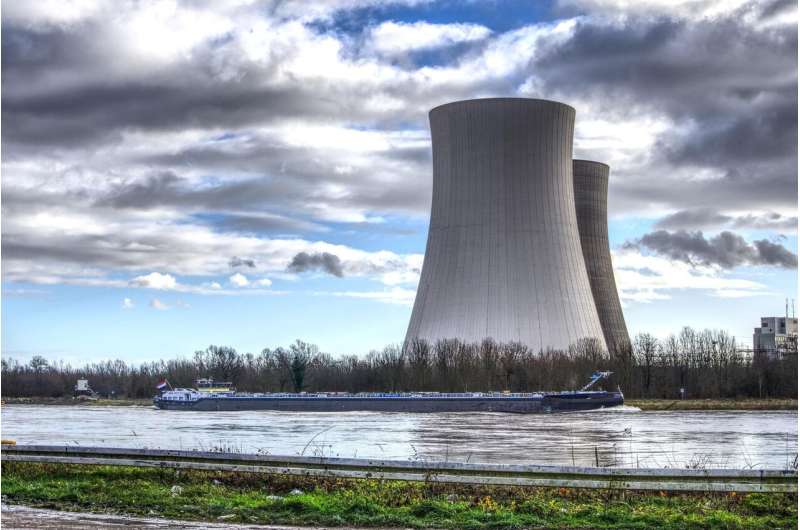
Researchers at the University of Central Florida’s Center for Advanced Turbomachinery and Energy Research have published a study of thermal energy storage integrated with nuclear reactors, in the Journal of Energy Resources Technology, Part A. The problem they address is one every reactor operator now faces: nuclear plants are designed to run at constant output around the clock, but they increasingly share grids with solar and wind that swing through the day, so the price of electricity swings too. As doctoral researcher Augusto Delavald Marques put it, nuclear power needs to be flexible while reactors operate at a steady pace, because grid demand varies throughout the day.
The proposed answer is to put a heat buffer between the reactor and the turbine. A thermal storage system absorbs heat from the reactor when electricity demand and prices are low and releases it to generate power when prices are high. The reactor itself never changes its output, which avoids the thermal cycling and fuel management complications of running a reactor up and down. The team combined thermodynamic modeling with economic analysis and found that this time-shifting increases the value of the electricity produced while accommodating more renewable generation on the same grid.
The study focused on molten salt reactors, which run at higher temperatures than today’s water-cooled plants and are therefore well matched to molten salt thermal storage of the kind already used at concentrating solar plants. The research team included doctoral researchers Marques and Abhilash Prasad, postdoctoral scholar Shinjan Ghosh, associate professor Erik Fernandez, alumnus Marcel Otto, and center director Jayanta Kapat.
The commercial logic is straightforward. A reactor that can sell its energy during the evening peak rather than the midday solar glut earns more per megawatt-hour, and in markets with capacity payments, dispatchable output is worth more still. If thermal storage lets a reactor earn like a peaker while operating like baseload, it improves the economics of advanced nuclear without touching the reactor design.
Source: Tech Xplore
Oxford Finds a Semiconductor That Absorbs Strongly and Holds Its Charge

A University of Oxford team working with Wuhan University has identified, in a paper published in Nature, a semiconductor that escapes a trade-off that has constrained solar materials for decades. Materials that absorb light strongly, which is what a thin solar cell wants, usually lose their photogenerated charges quickly through recombination before the charges can be collected as current. In bismuth sulfide, the researchers measured a charge recombination rate at room temperature 75 percent lower than conventional materials with equivalent light absorption.
The explanation lies in the material’s unusual electronic structure. Bismuth sulfide has two pathways for absorbing light: a strong primary route sitting just above a weaker secondary one. Charges excited through the strong route settle into the lower-energy states of the weaker route, which act as reservoirs where recombination is slow. The team established this with ultrafast terahertz spectroscopy, exciting thin films with extremely short laser pulses and timing how quickly the charges disappeared, at temperatures from room temperature down to near absolute zero. Electronic structure calculations from Professor Marina Filip’s group supplied the theory.
Professor Laura Herz, the lead author, said the discovery is exciting not because it improves an existing semiconductor property but because it identifies a different way in which semiconductors can behave. The team cautions that further work is needed to translate the finding into practical solar cells, but the mechanism provides a roadmap for searching for other materials with the same two-tier structure.
Solar cell progress has lately come from engineering, such as tandem stacks and better contacts, rather than from new physics in the absorber. A new design rule for absorbers, one that says what to look for in a band structure, opens a different and potentially larger space of materials, including ones made from abundant and non-toxic elements like bismuth and sulfur.
Source: Tech Xplore
An Indium-Free Electrode Takes Silicon Heterojunction Cells to 24.92 Percent
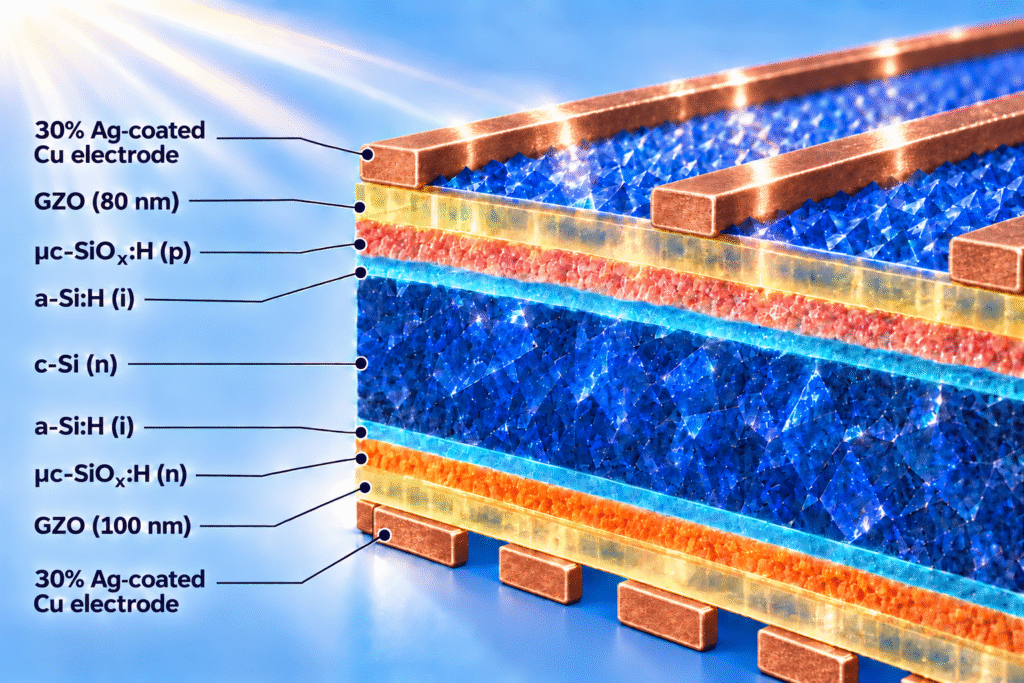
Researchers in China have built silicon heterojunction solar cells using gallium-doped zinc oxide as the transparent conductive electrode and reached a conversion efficiency of 24.92 percent, according to pv magazine. That is only 0.68 percentage points below equivalent cells using the conventional indium-based electrode. The work, published in Solar Energy Materials and Solar Cells, came from the Chinese Academy of Sciences, the University of Chinese Academy of Sciences, Dinto Solar, and Anhui Huasun Energy, one of the largest heterojunction manufacturers.
Heterojunction cells are among the most efficient silicon designs in production, but they have a material problem. Their transparent front and rear electrodes are made of indium tin oxide, and indium is a scarce byproduct of zinc mining whose supply cannot easily scale with multi-hundred-gigawatt solar manufacturing. Zinc oxide doped with gallium is cheap and abundant, but historically it has been harder to make it both conductive and transparent enough.
The team worked on full industrial wafers, 210 by 105 millimetres and about 130 micrometres thick, using standard cleaning and texturing, plasma-enhanced chemical vapor deposition for the amorphous silicon passivation layers, and room-temperature reactive plasma deposition for the gallium-doped zinc oxide, 80 nanometres on the front and 100 on the rear. The key variable was the oxygen content of the deposition gas, varied from 5 to 25 percent; the optimum was 10 percent, which produced a hexagonal wurtzite film with resistivity of 4.9 times ten to the minus four ohm-centimetres and optical transmittance of 83.45 percent across the 400 to 1100 nanometre range. Contacts were screen-printed silver-coated copper, itself a cost-cutting substitution for pure silver.
A loss of less than one percentage point for eliminating indium entirely is a trade most manufacturers would take at the right wafer price, and the use of a leading manufacturer’s wafer format suggests this is aimed at production lines rather than a laboratory record. Together with the copper contacts, the result sketches a heterojunction cell that depends on no scarce metal at all.
Source: pv magazine
Grid Battery Failures Fell 97 Percent While Deployments Grew 250-Fold
Canary Media’s Julian Spector has examined the data on grid battery safety and found a sharp divergence between risk and perception, which he compares to shark attacks: both frighten the public far more than the statistics warrant. The Electric Power Research Institute maintains a database of failures at commercial and grid-scale batteries, counting arc flashes, fires, and explosions. Pairing it with installation tallies from the Solar Energy Industries Association and Benchmark Mineral Intelligence, the analysis finds that by 2025 the annual failure rate for U.S. grid batteries had dropped by more than 97 percent compared with 2016, over a period in which cumulative deployments grew 250-fold. Three separate years recorded zero failures.
Lakshmi Srinivasan, the EPRI lead author, noted the irony that the dataset is thin precisely because failures are rare. “There just aren’t a lot of failures, which is a good thing, but that means you don’t have a very robust dataset to analyze,” she said. Her comparison is instructive: grid batteries now fail at rates comparable to the oil-filled transformers that have sat at substations for decades without public concern.
The fear is not baseless, which is why the data matter. A 2019 battery explosion in Phoenix hospitalized four emergency responders. In January 2025, a major fire at the Moss Landing facility in California destroyed the plant and prompted community evacuation, though no one was injured. Despite the low measured risk, Moss Landing is now cited routinely by communities evaluating new battery projects.
Grid storage is the fastest-growing source of firm capacity in several U.S. markets, and local opposition on safety grounds is now one of the main constraints on where it can be sited. A quantified safety record, in a form that fire marshals and county boards can use, is as important to deployment as any improvement in cell chemistry.
Source: Canary Media
PJM Could Add 24 Gigawatts of Storage at Existing Plants If It Fixes Its Rules

PJM Interconnection, the largest grid operator in the United States, serving thirteen mid-Atlantic, Midwestern, and Southern states, faces severe capacity constraints driven by data center demand and has seen electricity prices climb accordingly. One of the fastest ways to add capacity is Surplus Interconnection Service, which lets a developer add a battery, solar, or wind at an existing power plant site and use the plant’s unused grid connection rights, skipping the years-long interconnection queue. According to Lawrence Berkeley National Laboratory research cited by Canary Media, PJM could add 24 gigawatts of energy storage this way at existing plant sites, along with 102 gigawatts of solar and 28 gigawatts of wind co-located with gas peakers, saving developers more than 31 billion dollars in interconnection and grid upgrade costs and cutting deployment time to one or two years.
Other regions are using the tool. The Midcontinent Independent System Operator has 14.8 gigawatts proposed across 138 active surplus requests, the Southwest Power Pool 14.3 gigawatts across 89, and the U.S. West 6 gigawatts across 51. PJM had received fourteen requests and approved two as of November 2025. The Federal Energy Regulatory Commission approved fixes to PJM’s grid study procedures in early 2025, but no new projects have advanced because of a second barrier: PJM’s market rules require hybrid resources, meaning projects combining more than one technology, to operate as a single unit in both energy and capacity markets. That prevents the owner of a gas plant from keeping its existing contracts while a battery developer signs a separate one for the storage, a split that other grid operators already allow.
The proposed rule change would, in the words of RMI’s Katie Siegner, function like an itemized receipt, letting the components of a hybrid resource carry separate obligations. PJM’s Market Implementation Committee takes up the question at its November 4 meeting; if approved, FERC permission could come by April 2027. Jon Gordon of Advanced Energy United said members are ready to go but “the devil’s really in some of the wonky details that have become obstacles,” and added that “we’re not talking about physical limitations to the grid. We’re just talking about this quagmire of administrative processes and legal rights.”
Pressure is building from several directions. Illinois, Maryland, and New Jersey have storage targets; Indiana and Virginia recently passed laws requiring utilities to analyze surplus interconnection potential; and FERC’s October rejection of PJM’s large-load interconnection plan has pushed data center developers toward batteries as the fastest way to supply their own capacity. Twenty-four gigawatts of storage unlocked by a market rule, rather than by new wires or new generation, is a reminder that in constrained grids the binding constraint is often paperwork.
Source: Canary Media