Space Weekly Review 2026-10-31

Week In Review
The week’s biggest story came from a telescope that has not yet formally begun its main survey. The Vera C. Rubin Observatory’s first dwarf planet candidate, 2026 ED138, is the largest trans-Neptunian object identified in roughly two decades, and it was pulled from commissioning data, not from the Legacy Survey of Space and Time proper (The Rubin Observatory Finds Its First Dwarf Planet Candidate). Centauri Dreams took the discovery as a prompt to think about what a decade of ten-terabyte nights will do to our map of the outer solar system, from hundreds of new dwarf planets to a steady catch of interstellar visitors (ED138: What a New Dwarf Planet Portends). The same theme of seeing the previously unseen ran through a Heriot-Watt photonic chip that combines light from six telescopes on a sliver of glass and reaches fainter stars than the instrument it replaced (Tiny Photonic Chip Links Telescopes Together).
Two results gave us the past and future of planetary systems in the same week. A rose-colored meteorite from the Sahara, Teghaza 001, turns out to be more than 4.1 billion years old and carries the fingerprints of liquid water from Mars’ earliest crust (NASA-funded Study Details One of Oldest Mars Meteorites Ever Found). At the other end of the timeline, the Very Large Telescope found a white dwarf wearing two separate rings of pulverized planetary material, a preview of what our own Sun’s remains might look like (Dead Star and Planetary Bodies: A Unique Disc of Debris). In between, Hubble resolved the 1,000-astronomical-unit “Cat’s Tail” in the Beta Pictoris disk and showed it is organic dust from a collision of Pluto-sized bodies (Enormous ‘Cat’s Tail’ Tells of Cosmic Collision 63 Light-Years Away). Lucy, meanwhile, became the first spacecraft to enter the Jupiter Trojan region, where it will begin sampling the leftover building blocks of the giant planets next year (NASA’s Lucy Reaches Trojan Asteroid Region 5 Years After Launch).
On the industrial side, the week recorded both an ending and several beginnings. SpaceX flew the 700th Falcon 9, and Spaceflight Now notes the company is winding the vehicle down in favor of Starship, with regular orbital Starship missions expected from 2027 (SpaceX Closes Out October with 700th Falcon 9 Launch). NASA opened a request for industry ideas to boost, upgrade, or retire Hubble before atmospheric drag brings it down in the early 2030s, a sign that in-space servicing is now treated as something to buy rather than build (NASA Explores Potential Commercial Servicing for Hubble Telescope). And a startup called Cowboy Space proposed a rocket whose upper stage never comes home because it is the product: a megawatt-class orbital data center (Cowboy Space Reveals Big Iron Data Center Rocket). Whether or not that particular bet pays off, it illustrates how falling launch costs are changing what counts as a reasonable thing to put in orbit.
Items
The Rubin Observatory Finds Its First Dwarf Planet Candidate
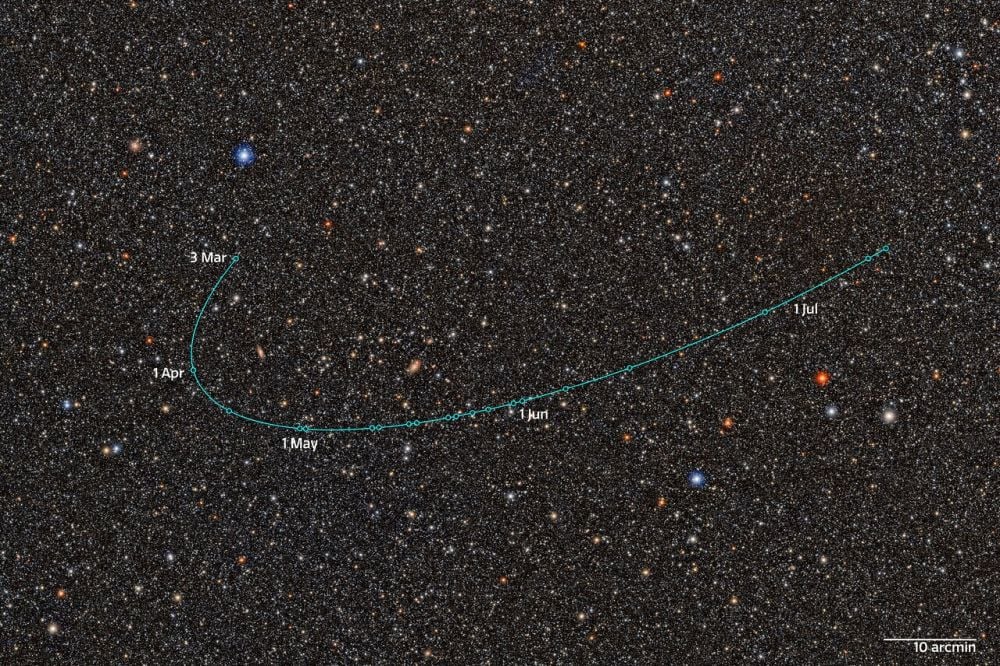
The Vera C. Rubin Observatory has produced its first dwarf planet candidate before its main ten-year survey has even started. The object, designated 2026 ED138, was spotted on October 13 by Matthew Holman, a senior astrophysicist at the Center for Astrophysics at Harvard and Smithsonian, while analyzing data from Rubin’s Simonyi Survey Telescope. Mario Jurić, the observatory’s solar system lead scientist at the University of Washington, then found twenty more detections in archived Rubin images, cementing the find.
According to Universe Today’s account, the Simonyi telescope caught the object thirty times across twenty separate nights between March 4 and July 11 of this year. Additional “precovery” detections turned up in Dark Energy Camera images from 2016, letting the team trace its orbit across a full decade. That orbital baseline is what makes the discovery solid rather than tentative. The object sits about 46 astronomical units from the Sun, slightly beyond Pluto’s average distance of roughly 40, and its path is tilted about 25 degrees to the plane of the planets, placing it in the “hot classical” family of trans-Neptunian objects whose orbits were stirred up early in the solar system’s history.
The estimated diameter ranges from 600 to 1,500 kilometers, depending on how reflective its surface turns out to be. Even the low end would make it a serious dwarf planet candidate, and the high end would rank it among the largest bodies known beyond Neptune. Either way, it is the largest trans-Neptunian object found in about twenty years.
The find matters as much for what it says about the instrument as for the object itself. Rubin’s combination of a wide field and a huge camera lets it pick out faint, slow-moving bodies that previous surveys could not reach. If a commissioning dataset can yield an object this large, the full Legacy Survey of Space and Time should fill in the outer solar system’s census in a way no earlier program could.
Source: Universe Today
ED138: What a New Dwarf Planet Portends
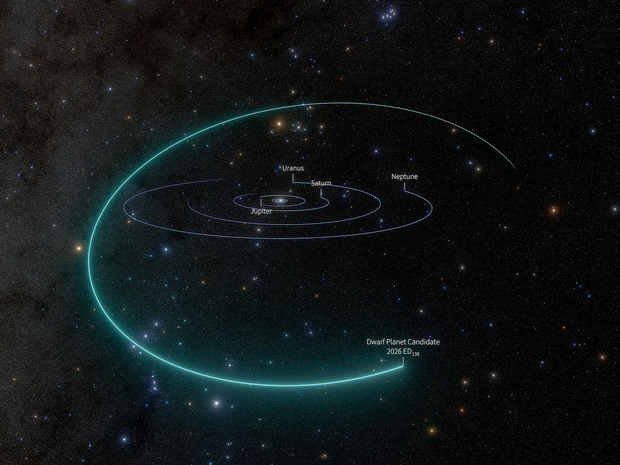
Paul Gilster’s Centauri Dreams essay treats 2026 ED138 less as a single discovery than as a first data point in a coming flood. Gilster walks through the same facts, a body some 46 astronomical units out, 600 to 1,500 kilometers across, inclined about 25 degrees, and then asks what the orbital tilt is telling us. An inclination that steep points to a history of gravitational shoving, most likely by Neptune, which means the object is a fossil of the early migration of the giant planets rather than a quiet relic that formed where it sits.
The piece also highlights the “precovery” workflow that Holman and Jurić used, reaching back to 2016 imagery to lock down the orbit. That capability is what turns a faint streak into a confirmed world in weeks rather than years, and Gilster argues it will be routine as Rubin’s archive grows.
The larger point is scale. Rubin produces about ten terabytes of data every night, and over a ten-year survey it is expected to turn up dwarf planets not in ones and twos but, as the essay puts it, conceivably in the hundreds, along with vast numbers of smaller Kuiper Belt objects. The same continuous monitoring is exactly the kind of net that catches interstellar interlopers like ’Oumuamua and Borisov, which were found largely by luck. A facility that watches the whole visible sky every few nights will see such visitors early and often, giving mission planners a real chance to intercept one.
For anyone who grew up with a solar system of nine planets and a vague Kuiper Belt, the essay is a useful reframing. The outer solar system is about to become a mapped territory, and ED138 is the first marker.
Source: Centauri Dreams
Dead Star and Planetary Bodies: A Unique Disc of Debris

Astronomers using the European Southern Observatory’s Very Large Telescope have found a white dwarf surrounded not by one disc of shredded planetary material but by two, separated by a clear gap. The star, J1328−1450, is the burned-out core of a Sun-like star, and the double-ring structure is the first confirmed example of this kind of complexity around a stellar remnant. The results appear in Nature Astronomy, led by Nicola Gentile Fusillo of the University of Trieste.
The team used the X-Shooter spectrograph to read the chemistry of the gas in each ring. Both contain calcium, oxygen, magnesium, and iron, the same ingredients found in rocky bodies in our own solar system. But the two rings differ from each other, with the inner one enriched in magnesium gas. That difference suggests two separate bodies being torn apart, rather than a single disrupted object spreading outward. ESO’s release estimates the inner body at asteroid size, a few kilometers across, while the outer one could be as large as Pluto or Earth’s Moon.
White dwarfs are the fate of every star like the Sun. When such a star swells into a red giant and then collapses, the surviving planets, asteroids, and comets are left orbiting a dense, hot ember. Some of them wander too close and are shredded by tides into debris that rains onto the star’s surface. Astronomers have long used the polluted atmospheres of white dwarfs as a way to assay the composition of extrasolar rocky material, but they had generally assumed the debris arrived in simple, single discs.
The J1328−1450 system shows the process can be far messier and more structured. Multiple bodies, at different distances, with different compositions, can be in the middle of destruction at the same time. For our own solar system, which will face this future in several billion years, it is a glimpse of how the pieces might be arranged after the Sun is gone.
Source: ESO
NASA’s Lucy Reaches Trojan Asteroid Region 5 Years After Launch
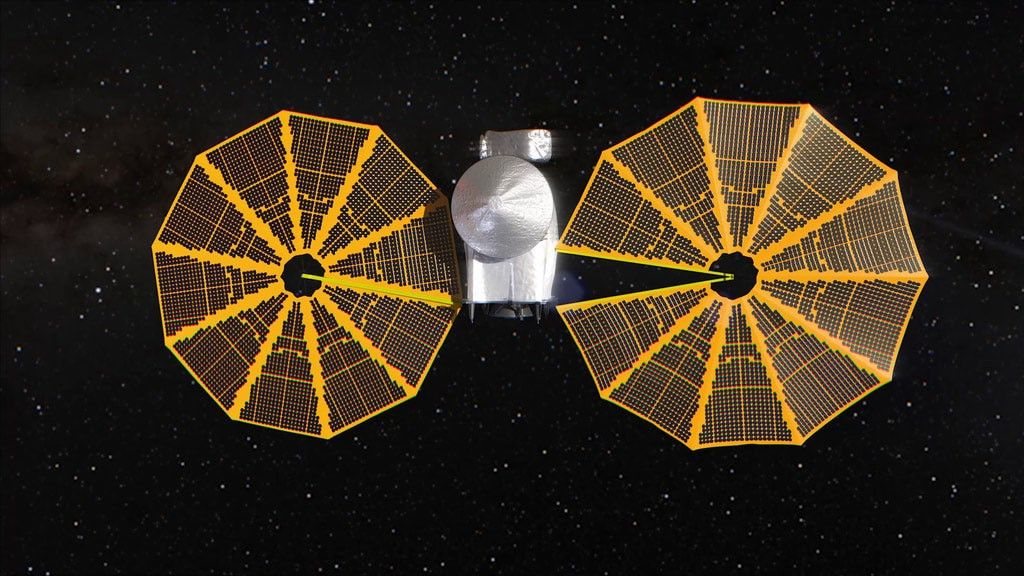
Five years and more than 2.2 billion miles after its launch on October 16, 2021, NASA’s Lucy spacecraft has entered the realm of the Jupiter Trojan asteroids. No spacecraft has visited this region before. The Trojans are two swarms of primitive bodies that share Jupiter’s orbit, clustered around the planet’s leading and trailing Lagrange points, gravitational “islands of stability” roughly 484 million miles ahead of and behind Jupiter. Lucy is now approaching the leading swarm at Lagrange point 4.
NASA’s mission blog describes the spacecraft as fully operational and adapted to conditions where the Sun appears more than five times farther away than it does from Earth, meaning dimmer light for its large solar arrays and much colder temperatures for its instruments. Lucy’s design, with its enormous fan-shaped solar panels, was built for exactly this environment.
The encounter schedule is now set. Lucy’s first Trojan target, Eurybates, comes on August 11, 2027. Polymele follows in September 2027, Leucus in April 2028, and Orus in November 2028. The spacecraft then swings back to Earth in 2030 for a gravity assist that will throw it out to the trailing swarm, where it will visit the binary pair Patroclus and Menoetius in March 2033.
The scientific prize is a look at material that has been preserved since the solar system’s formation. The Trojans are thought to be leftovers from the era when the giant planets were assembling and migrating, captured into their stable orbits during that upheaval. Each one Lucy visits is a different sample from that period, and the mission’s name, borrowed from the famous hominid fossil, reflects the hope that these bodies will do for planetary origins what Lucy’s skeleton did for human ones.
Source: NASA Science
NASA-funded Study Details One of Oldest Mars Meteorites Ever Found

A rose-colored rock found in Mali’s Sahara Desert in 2022 has turned out to be one of the three most ancient pieces of Mars ever recovered on Earth. Teghaza 001, weighing about 800 grams, formed more than 4.1 billion years ago, during the period when Mars’ crust was first solidifying. The study, led by Yang Liu of NASA’s Jet Propulsion Laboratory, is published in Science.
What makes the meteorite so useful is that it contains zircon crystals, tiny minerals that lock in a record of their formation time. Francois Tissot of Caltech developed a novel rubidium-strontium dating method that the team used to pin the age. Co-author Lee Saper, formerly of JPL and now at NASA Ames, contributed to the analysis. Together the measurements show not only when the rock formed but that liquid water altered it about 4.1 billion years ago. A companion paper in Science Advances, published in June 2026, detailed the rock’s water content.
That water signature is the heart of the result. It is direct, laboratory-grade evidence that Mars had water interacting with its crust in its first few hundred million years, the same era in which life was emerging on Earth. Orbital images and rover data have long suggested an early wet Mars, but a sample in hand lets scientists measure the chemistry directly, with instruments no rover could carry.
The team also matched the meteorite’s mineralogy against orbital maps of Mars and identified 13 candidate regions where it may have originated. That narrows the connection between a rock on a lab bench and a specific piece of Martian terrain, and it gives future sample-return planners a short list of places where the planet’s oldest, water-touched crust is exposed.
Source: NASA
Enormous ‘Cat’s Tail’ Tells of Cosmic Collision 63 Light-Years Away

Beta Pictoris, a young star 63 light-years away in the constellation Pictor, has been a laboratory for planet formation since the 1980s, when its dusty disk became the first ever imaged around another star. A few years ago the James Webb Space Telescope spotted a strange curved feature in that disk, nicknamed the “Cat’s Tail,” visible only in the infrared. Now a University of Arizona team led by doctoral student Arin Avsar has captured it in optical light with the Hubble Space Telescope and worked out what it is made of and how it is oriented. The results appear in The Astrophysical Journal Letters.
The tail stretches roughly 1,000 astronomical units, about 25 times the distance from the Sun to Pluto. One researcher, keeping with the theme, measured it as about 200 trillion house cats laid end to end. The Hubble data show it is composed almost entirely of carbon-rich organic refractory material in the form of tiny, porous dust grains, each about a micron across. That composition, combined with the sheer quantity of material, points to a violent origin: a collision between large bodies comparable to Pluto.
The new observations also resolved a geometric puzzle. Earlier interpretations had the tail trailing away behind the star from our point of view. The Hubble analysis shows it instead extends straight sideways across the plane of the sky. In addition, the team found a warp in the surrounding dust halo, which they attribute to the gravitational pull of Beta Pictoris b, a gas giant about ten times the mass of Jupiter that orbits within the disk.
Taken together, the result is a snapshot of a planetary system in its rough adolescence, where large bodies are still crashing together and a massive planet is sculpting the leftovers. Our own solar system likely went through a similar phase, with the Moon-forming impact among its consequences. Beta Pictoris lets us watch that stage in real time.
Source: Phys.org
Tiny Photonic Chip Links Telescopes Together

Combining the light from several separated telescopes, a technique called interferometry, can produce images far sharper than any single telescope could achieve, but the optics needed to merge the beams have traditionally been large, delicate tables of mirrors and lenses. A team led by Heriot-Watt University in Scotland has replaced that apparatus with a glass chip a couple of centimeters across. Tested at the CHARA Array in California, which links six telescopes, the chip reached fainter stars than the instrument it replaced. The work is published in Monthly Notices of the Royal Astronomical Society, with Aline Dinkelaker of the Leibniz Institute for Astrophysics Potsdam as lead author.
The chip was made by ultrafast-laser inscription, a process in which focused laser pulses write light-guiding channels directly inside a block of glass. Those channels route and combine the beams from each telescope with a stability that free-space optics struggle to match. Robert Thomson and Aurélien Benoît of Heriot-Watt’s Institute of Photonics and Quantum Sciences led the chip development, in collaboration with the universities of Cologne and Potsdam and Georgia State University, which operates CHARA. The program behind it spans more than fifteen years, and the on-sky observations reported here were taken in 2024 and 2025.
Sensitivity is the key gain. Interferometers have historically been limited to bright targets because so much light is lost in the beam-combining optics. A compact, efficient chip that loses less light opens the technique to fainter and more distant objects: the surfaces of more stars, the inner regions of planet-forming disks, and the environments around black holes.
The approach also scales. Because the chip is small and manufactured rather than hand-aligned, adding more telescopes or building arrays with longer baselines becomes an engineering problem rather than an optical one. That is the path toward ground-based imaging with resolution that would otherwise require a telescope hundreds of meters across.
Source: Phys.org
NASA Explores Potential Commercial Servicing for Hubble Telescope
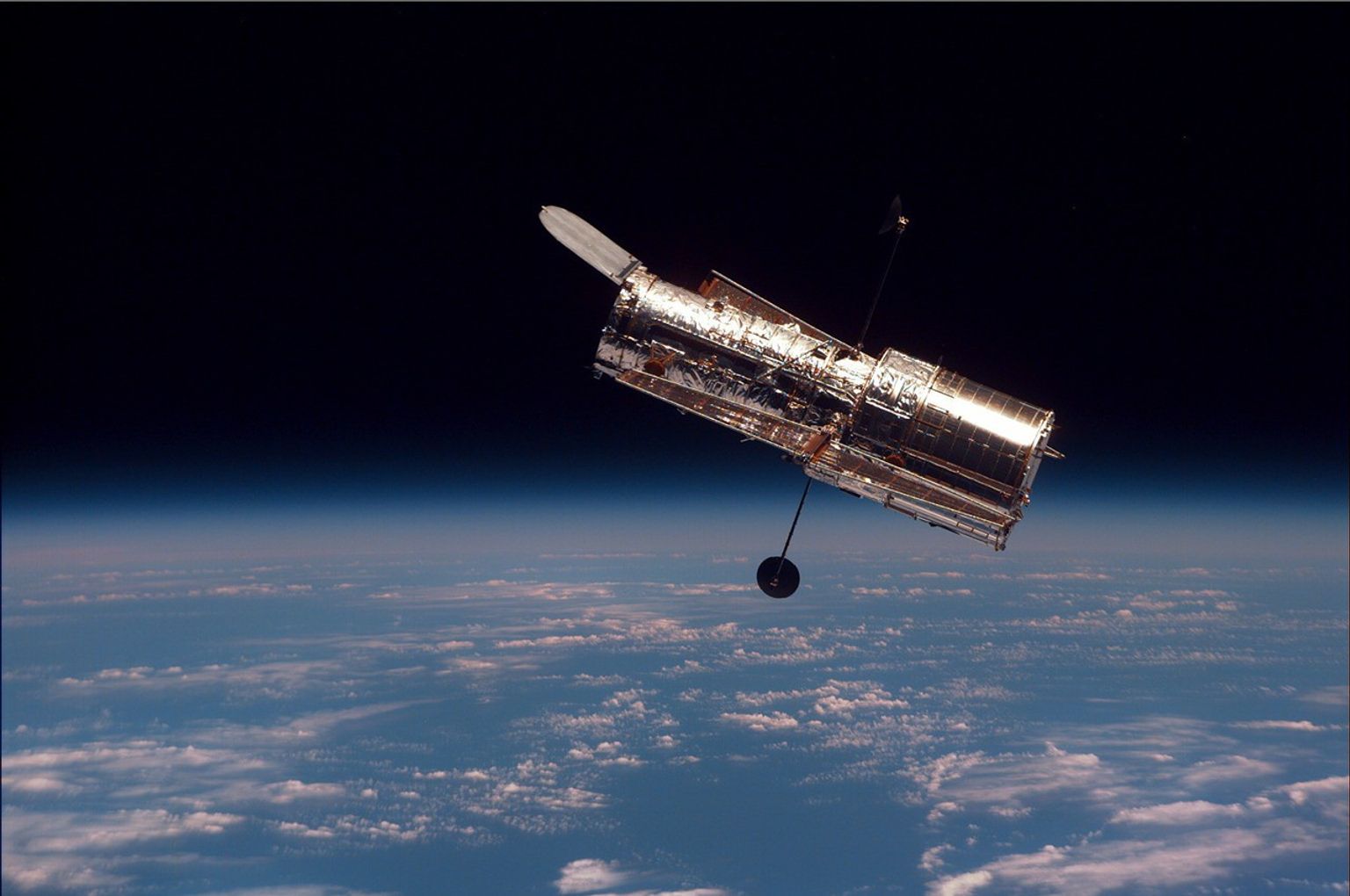
NASA has issued a Request for Information asking industry what it could do for the Hubble Space Telescope. Released on October 29, the request lays out three possibilities: boosting the observatory to a higher orbit, servicing it to extend or enhance its capabilities, or performing a safe, controlled re-entry or disposal when the time comes. Responses are due by November 30 at 3 p.m. EST.
The reason is orbital physics. Hubble has no propulsion of its own, and after more than 35 years in low Earth orbit, atmospheric drag has been steadily lowering its altitude. NASA’s current prediction is that the telescope would re-enter the atmosphere in 2033 or 2034 if nothing is done, which means any servicing mission would need to fly by 2032. The telescope itself remains scientifically productive, as this week’s Beta Pictoris result shows, so the question is whether that productivity can be bought more years.
NASA Administrator Jared Isaacman framed the request in terms of value: “If there are innovative and cost-effective ways to extend the life of an asset already on orbit, we owe it to the American taxpayer.” Hubble operations are managed by NASA’s Goddard Space Flight Center with support from Lockheed Martin Space and the Space Telescope Science Institute.
The deeper significance is that NASA is treating in-space servicing as a commercial capability it can procure. The Space Shuttle servicing missions that kept Hubble going were enormous government undertakings. If a commercial vehicle can rendezvous with, grapple, and raise a 1990-vintage telescope that was never designed for robotic servicing, the same capability becomes available for every other high-value asset in orbit. The response to this request will say a great deal about how mature that market has become.
Source: NASA Science
SpaceX Closes Out October with 700th Falcon 9 Launch

A Falcon 9 lifted off from Vandenberg Space Force Base at 9:04 p.m. PDT on October 30 carrying 27 Starlink satellites, and with it the vehicle passed a milestone no other orbital rocket has approached: 700 launches. The booster, B1093, was flying for the eighteenth time, having previously carried a Transporter rideshare, two Space Development Agency missions, and 14 Starlink batches. It landed on the droneship Of Course I Still Love You about eight and a half minutes after liftoff, the 231st landing on that vessel and the 675th Falcon booster recovery overall.
Spaceflight Now’s coverage puts the number in context. SpaceX conducted 130 orbital launches through the end of October from four facilities: Cape Canaveral, Kennedy, Starbase, and Vandenberg. October alone accounted for ten. Yet the pace is slowing deliberately. This was the first time since July 2025 that the company’s trailing 365-day launch count dropped below 150, a reflection of its decision to wind down Falcon operations and shift capacity toward Starship, with regular orbital Starship missions expected to begin in 2027.
That makes the 700th flight a retrospective as much as a record. When Falcon 9 first flew in 2010, orbital rockets were expendable and launched a handful of times a year. The vehicle’s reusable first stage turned launch into something closer to airline operations and made a constellation of thousands of satellites economically possible. The Starlink network that most of these recent flights have built is, in turn, the revenue base funding its successor.
For the industry, the transition is the story to watch. A rocket that has flown 700 times with a mature, well-understood failure history is being retired in favor of a much larger, fully reusable vehicle still finding its footing. If that handoff succeeds, launch costs fall again; if it stumbles, the world’s dominant launch provider will have voluntarily given up its workhorse.
Source: Spaceflight Now
Cowboy Space Reveals Big Iron Data Center Rocket
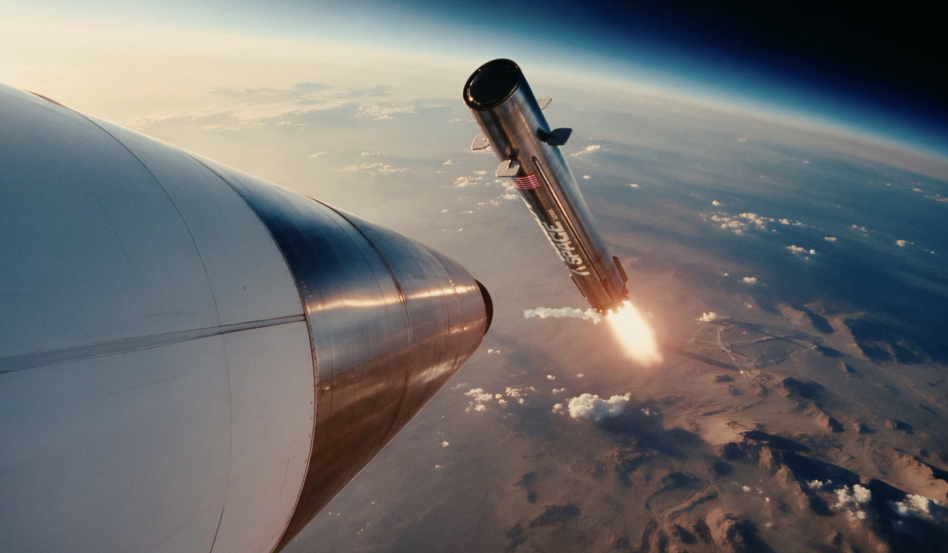
Cowboy Space has unveiled a launch vehicle built around an unusual premise: the upper stage does not come back, and it is not thrown away either. It stays in orbit as a megawatt-class data center. The rocket, called Big Iron, is an 86-meter stainless-steel vehicle burning liquid oxygen and methane, with nine first-stage engines the company calls Clydesdale, each rated at 300,000 pounds of thrust. Payload says the vehicle is designed to be road-transportable and to deliver more than 15,000 kilograms to sun-synchronous orbit.
Once on orbit, each upper stage unfolds into a structure 132 by 73 meters, generating megawatt-class power and housing five racks of NVIDIA Vera Rubin GPUs. The engineering reuses the vehicle’s own parts in a way reminiscent of Skylab, which was built from a converted Saturn V stage: the rocket’s skin serves as a radiator, ammonia doubles as coolant, and nitrogen pressurant deploys the solar panels. A program called Big Iron Express would sell outside customers access to up to a megawatt of orbital power. The long-term plan, pending FCC approval, is a constellation of up to 20,000 such satellites, named Stampede.
The company has some hardware behind the renderings. A Clydesdale combustion chamber was tested at NASA’s Stennis Space Center, a campaign a team of about 30 completed in 90 days. A demonstration satellite, Reason-1, launched October 1 on SpaceX’s Transporter-18 rideshare, and a successor, Reason-2, is slated for 2027 to process weather data for NOAA. Big Iron’s first flight is targeted for 2028.
The idea of orbital computing has gained currency as terrestrial data centers run into limits on power and cooling, and space offers uninterrupted sunlight and a cold sink to radiate into. The counterarguments are real: radiation-hardening commercial GPUs, the difficulty of servicing hardware that fails, and the sheer mass of radiators needed to dump a megawatt of heat. Cowboy Space’s answer is to make the launch vehicle and the data center the same object, so the mass is paid for once. Whether the economics close is unproven, but the 2028 flight target means the question will get a concrete test rather than remaining a debate.
Source: Payload