Resource Abundance Weekly Review 2026-09-24

Week In Review
Energy is the master resource, and this week’s strongest items were about pointing cheap, dense energy directly at the production of other things. A University of Michigan analysis in Nature Communications argues that small modular reactors make far more economic sense feeding hydrogen into ammonia, refining, and steel plants than selling electricity to the grid, with projected margins for ammonia that no grid market could match. In Russia’s far northeast, Rosatom finished the second reactor for a floating nuclear plant whose sole customer is a copper mine, a concrete case of a reactor being built to unlock an ore body that would otherwise be stranded. And the International Energy Agency’s new electrification report, prepared amid the Strait of Hormuz crisis, finds that fuel-importing countries could cut their energy import bills by more than 400 billion dollars a year by 2035 by switching from imported molecules to domestically generated electrons.
A second cluster concerns doing the same job with less, or with something cheaper. Maryland and Vanderbilt chemists found a way to pull a third electron from each sulfur atom in a lithium-sulfur battery, extracting more energy from one of the most abundant elements on Earth without adding more of it. KAIST engineers borrowed semiconductor lithography to extend the life of anode-free batteries that dispense with graphite entirely. Kyoto University reported in Nature a foaming polymer that turns brilliant white and water-repellent using only ultraviolet light and a weak solvent, a possible route around titanium dioxide pigment and fluorinated coatings. Each is a substitution story: sulfur for scarce cathode metals, structure for graphite, geometry for chemistry.
The waste-to-value thread that dominated last week continued with an unusually candid economic accounting. Penn State food scientists worked out that fat in discarded ice cream can be recovered at roughly 95 percent yield by simple centrifugation, and put a minimum selling price on the product rather than stopping at the lab bench.
Finally, two pieces from Human Progress supply the scoreboard. The weekly Doomslayer roundup records a new inflation-adjusted record for US median household income, record global nuclear generation, a recovered cod fishery, and a lettuce farm that no human hand touches. Cato Institute president Peter Goettler’s essay on how pessimism puts progress at risk argues that the numbers on poverty, longevity, and child mortality are so lopsidedly good that the real danger is a politics that no longer believes them. Read together, the week describes an economy in which more energy, smarter materials, and honest accounting keep making the essentials cheaper, and in which the main constraint is the willingness to notice.
Items
Small Modular Reactors Pay Off in Industry, Not Grid Power

Small modular reactors have been sold mainly as a way to put carbon-free electricity on the grid. A University of Michigan study in Nature Communications argues that this is the wrong market. Lead author Marisol Garrouste, who completed the work as a doctoral student in nuclear engineering and is now at Électricité de France, worked with associate professor Brendan Kochunas and postdoctoral researcher Jessica Lovering to model where compact, factory-built reactors could actually earn money.
The answer is industrial heat and hydrogen. Kochunas is blunt that SMRs “do not seem able to outcompete renewables or large light water reactors” for grid electricity. But when the reactor’s output is used to make clean hydrogen for ammonia synthesis, oil refining, and steelmaking, the economics flip. The study projects profit margins of about 300 percent for ammonia production, more than 50 percent at refining sites, and around 20 percent for steel, sectors where SMRs can undercut the fossil fuels they replace.
The scale implied is large. With the US hydrogen production tax credit of up to 3 dollars per kilogram in place, the authors estimate a first deployment wave of 91 gigawatts of SMR capacity and a second wave of 171.9 gigawatts, roughly 1.8 times the entire current US nuclear fleet. Without the credit the figures fall to 4 and 7.8 gigawatts, which shows how sensitive the buildout is to the hydrogen price. The two waves would cut 8 to 14 percent of US industrial emissions.
For readers of this review the significance is the coupling. Ammonia is fertilizer, steel is infrastructure, and refining is fuel. A reactor that makes those cheaper is an abundance machine, and this analysis suggests that is where the technology’s real value lies.
Source: TechXplore
Second Reactor Completed for Floating Plant That Will Power a Copper Mine

The Baimskaya copper deposit in Russia’s Chukotka region is one of the world’s larger undeveloped copper resources, and it sits in Arctic terrain with no grid to speak of. Rosatom’s solution is to bring the power plant by sea. World Nuclear News reports that the company’s ZiO-Podolsk works has completed the second RITM-200C reactor for the FPU-106 floating nuclear power plant, the first of a fleet destined for the mine.
Each floating plant carries two RITM-200C units rated at 58 megawatts electric. The Baimskaya development needs about 300 megawatts, so the plan calls for three floating plants of just over 100 megawatts each plus a fourth as backup during maintenance and refuelling outages. Four such plants are under construction for Chukotka. The first reactor for FPU-106 arrived in May, and the second now awaits installation at the shipyard.
The RITM design has a track record. According to the report, 16 units have been produced to date, 8 of them operating aboard the nuclear icebreakers Arktika, Ural, Sibir, and Yakutia, with 12 more at various stages of manufacture. “2026 has been a landmark year for ZiO-Podolsk’s mechanical engineering teams,” said plant head Anton Lebedev, noting it was the first time a complete set of RITM units had been produced.
Whatever one thinks of the geopolitics, the engineering logic is clear and transferable. Reactors compact enough to float can be delivered to remote ore bodies that diesel could never economically serve, which turns geological resources into recoverable ones. It is the same coupling of energy to extraction the Michigan study models, executed in steel.
Source: World Nuclear News
IEA: Electrification Could Cut Importers’ Energy Bills by 400 Billion Dollars a Year
The International Energy Agency released a special report on accelerating global electrification, prepared at the request of Türkiye and Australia for the COP31 process and published as the Strait of Hormuz crisis continues to disrupt oil and gas flows. Its headline finding is that electricity could cost-effectively supply 33 percent of the world’s final energy consumption by 2035, up from 23 percent today, which puts a proposed 35 percent target within reach.
The economic case is framed around import dependence. Countries that buy fuel from abroad could reduce their energy import bills by more than 400 billion dollars by 2035 if they accelerate electrification significantly. Global oil demand could fall by 18 million barrels per day relative to baseline over the same period, mostly through electric vehicles, and carbon dioxide emissions from transport, buildings, and industry could drop 40 percent. The agency notes that the current crisis conditions make electrification even more competitive than its earlier analyses suggested.
The report does not treat the transition as automatic. It calls for scaled-up investment in generation and grids, more flexible power systems, and attention to electricity security threats including supply-chain vulnerabilities, cybersecurity, and climate hazards. It also flags the need to help households and businesses with upfront conversion costs.
The abundance angle is that electricity, unlike oil, can be manufactured almost anywhere from sunlight, wind, uranium, or gas. Shifting a third of final energy onto that platform converts a scarce, geopolitically exposed import into a domestically produced commodity, and the 400 billion dollar figure is a rough measure of what that substitution is worth.
Source: International Energy Agency
A Third Electron From Sulfur Lifts Lithium-Sulfur Battery Energy and Voltage

Sulfur is cheap, abundant, and produced in vast quantities as a byproduct of oil and gas refining, which is why lithium-sulfur batteries have long been an attractive alternative to cathodes built on nickel and cobalt. Their limitation has been chemistry: each sulfur atom conventionally accepts two electrons, capping the energy stored. Researchers at the University of Maryland, Vanderbilt University, and Brookhaven National Laboratory report in Nature Energy a way to get three.
The team, with senior author Chunsheng Wang at Maryland, Vanderbilt’s De-en Jiang and PhD student Jinyi Zhang, and first author Nan Zhang, developed a chloride-containing ionic liquid electrolyte. During charging, chloride ions react with sulfur to form disulfur dichloride, opening a third electron-transfer step. The cell pairs a lithium metal anode with a sulfur, porous carbon, and lithium chloride cathode. Computer simulations guided the electrolyte composition.
The gains are substantial. Charge per gram of sulfur rose 58 percent, average voltage increased from 2.05 to 2.54 volts, and the sulfur-carbon cathode materials delivered more than 1,700 watt-hours per kilogram. A pouch-cell prototype retained 78 percent of its capacity after 100 charge-discharge cycles, which is early-stage durability and the obvious next challenge.
“Our main achievement is getting more energy from sulfur by using this additional reaction, not simply by putting more sulfur into the battery,” Wang said. That is the essence of resource efficiency: more service from the same quantity of an already plentiful input, in a chemistry that sidesteps the constrained metals.
Source: TechXplore
Semiconductor Lithography Extends the Life of Graphite-Free Batteries

Anode-free batteries remove the graphite anode from a lithium-ion cell altogether, plating lithium directly onto a bare copper current collector during charging. That cuts weight and volume, which is why the design is attractive for electric vehicles. The problem is that lithium deposits unevenly, forming dendrites that degrade the cell and shorten its life. A team at the Korea Advanced Institute of Science and Technology, with Kyungpook National University and the National NanoFab Center, reports in Advanced Functional Materials two fixes borrowed from chipmaking.
The first is geometry. Using secondary sputtering lithography, the researchers etched microscopic tubes roughly 300 nanometers wide and 150 nanometers tall into the copper foil, raising its available surface area about fourfold and giving lithium a uniform set of sites on which to deposit. The second is a 10-nanometer MXene coating that acts as a primer, encouraging the formation of a lithium fluoride-rich protective layer during operation that suppresses side reactions and dendrite growth.
Professors Jinwoo Lee and Hee-Tae Jung led the work. “This study shows how ultrafine fabrication techniques used in semiconductor manufacturing can create both uniform sites for lithium deposition and a stable protective layer without changing the bulk electrolyte formulation or adding excess lithium,” Lee said.
The dematerialisation logic is what makes this a resource story. Graphite is on critical-minerals lists and its supply is concentrated, and a battery that needs none while carrying less lithium than designs that pre-load excess metal is a cheaper, lighter battery built from less.
Source: TechXplore
Foaming Polymer Turns White and Waterproof Without Titanium Dioxide or PFAS
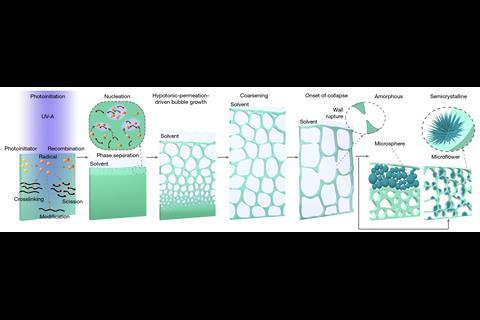
Whiteness in paints, plastics, and coatings usually comes from titanium dioxide pigment, and water repellency often comes from per- and polyfluoroalkyl substances, the persistent fluorinated compounds now under regulatory pressure worldwide. A team at Kyoto University’s Institute for Integrated Cell-Material Sciences, led by Easan Sivaniah with Taiki Yanagishima of Tokyo Metropolitan University, reports in Nature a way to get both properties from the polymer itself.
The method exposes a polymer film to ultraviolet light in the presence of a weak solvent. The UV generates free radicals that break down parts of the polymer while the solvent triggers pore nucleation. “There’s sort of a creation and destruction happening within the film,” Yanagishima said. The result is a rigid foam with rough surface structures the team calls microflowers, surrounding an internal network of pores. Those structures scatter light the way snow and clouds do, producing a bright white without any pigment, and the surface geometry repels water without a fluorinated coating.
Sivaniah describes the work as “attacking three issues at once,” and says “it does work for practically every polymer we’ve tested.” Niamh Fox of the University of Manchester provided outside commentary in the Chemistry World report.
This is a laboratory result, and the economics of scaling the UV-solvent treatment are not yet established. But the principle, replacing two supply-chain-sensitive additives with structure alone, is the purest form of substitution, and the generality across polymers suggests a wide field of application if the process proves cheap.
Source: Chemistry World
Fat in Discarded Ice Cream Can Be Recovered at a Profit

Roughly 5 percent of the material that enters ice cream production ends up as waste, amounting to millions of pounds a year discarded because of quality problems, equipment cleaning, and allergen cross-contamination rules. That waste is rich in fat, three to five times more concentrated than cow’s milk. Researchers at Pennsylvania State University’s College of Agricultural Sciences asked whether it could be recovered economically, and report in Cleaner Engineering and Technology that it can.
The team, with senior author Yi Zhang, chemical engineer Rui Shi, and first author Fuad Ale-Enriquez, worked with Perry’s Ice Cream Company of Akron, New York, which shipped 90-pound batches of waste product for testing. Fat content in the waste ranged from 1.8 to 10.3 percent. The researchers compared enzymatic proteolysis using pepsin, trypsin, and bromelain against pH shifting under acidic or alkaline conditions, each followed by centrifugation to separate the fat.
The finding that matters for economics is that the simplest route won. Plain centrifugation recovered about 95 percent of the fat, and Zhang notes “you don’t necessarily need” enzymes at all. The team’s techno-economic analysis puts the minimum selling price of the recovered fat at 0.40 dollars per kilogram, with Zhang adding that “larger-scale processing operations could improve profitability.”
Recovered dairy fat is a saleable ingredient, and a process that needs little more than a centrifuge is one a mid-sized plant could adopt. The study is a small case, but it models the discipline this review looks for: a waste stream, a yield, a price, and a path to scale.
Source: TechXplore
Doomslayer: Record Household Income, Record Nuclear Output, a Farm Untouched by Hands

Human Progress’s weekly Doomslayer roundup, compiled by Malcolm Cochran, is a running tally of the news that does not make the front page. This week’s edition is unusually dense with resource and production milestones.
On the income side, inflation-adjusted US median household income reached 87,460 dollars in 2025, surpassing the prior record of 85,320 dollars set in 2019. An analysis by The Economist cited in the roundup finds AI-related industries added roughly 1 million jobs beyond expected trends, about 320,000 in data-center construction and manufacturing and 730,000 in engineering and software, against only about 200,000 AI-attributed layoffs since mid-2023.
On energy, global nuclear reactors generated 2,702 terawatt-hours in 2025, up from 2,667 the year before, with China leading construction at 38 of the 80 reactors being built worldwide. The United States added 11.4 gigawatts of solar in the second quarter of 2026, 45 percent growth year-over-year, and US crude oil production is projected to average a record 13.8 million barrels a day this year.
On food and biology, Newfoundland and Labrador’s northern cod stock, which collapsed in the early 1990s, has recovered to the healthy zone, allowing a 55 percent catch increase to 59,000 tonnes in 2026. A Norwegian farm described by SINTEF researchers grows lettuce that “no one touches from the moment it is sown” until purchase. Colorado State University researchers quantified that irrigation raises US crop yields by 3 to 39 percent depending on crop, and that without those gains 32 million hectares of forest and 7 million hectares of other vegetation worldwide would have to be converted to farmland. China’s new Pinglu Canal shortens the southwest’s route to the sea by more than 560 kilometers.
Individually these are footnotes. Collectively they are the evidence that the long-run trend toward more from less, in land, energy, and labor, continued through 2025 and into 2026.
Source: Human Progress
How Pessimism Puts Progress at Risk

Peter Goettler, president and chief executive of the Cato Institute, argues in Human Progress that the prevailing gloom about economic and social conditions is a misdiagnosis with real consequences. His starting point is the data. In 1981, 42 percent of the world’s population lived on less than 3 dollars a day; today the figure is below 10 percent. Global life expectancy has more than doubled from about 32 years in 1900 to over 73, and US life expectancy reached nearly 80 in 2025. Mortality among children under five has fallen by more than half since 1990. Smallpox is eradicated, polio nearly so, and HIV is treatable.
Goettler ties these gains to institutions. Citing the Economic Freedom of the World 2025 annual report, he notes that people in the freest quarter of countries earn more than six times as much as those in the least free, live 17 years longer on average, and work nearly 17 percent less. That index peaked in 2019 and has, in his words, “declined sharply” since.
He identifies three sources of misperception: a media bias toward negative narratives, a natural human focus on immediate difficulties, and government interventions that inflate the cost of housing, healthcare, and education, making people feel poorer in the areas that dominate household budgets even as everything else gets cheaper. The risk he sees is that the resulting populism turns against “freedom and openness,” through opposition to immigration, tariffs, wealth taxes, and hostility to new technology.
The relevance to resource abundance is direct. Every item in this review depends on capital, trade, and permission to build. A public that believes the world is getting poorer will not grant them. Goettler’s essay is a reminder that the ultimate resource, in Julian Simon’s phrase, is human ingenuity, and that ingenuity needs the room to operate.
Source: Human Progress