Resource Abundance Weekly Review 2026-11-05

Week In Review
The week’s strongest signal came from the primary supply side, where several large deposits moved from paper toward production. Freeport-McMoRan’s board approved a $4.5 billion expansion of its Bagdad mine in Arizona, a brownfield project that will more than double the mine’s copper output from reserves the company says can support eighty more years of operation. In Arkansas, Standard Lithium and Equinor published the engineering study that takes their Smackover brine project to a final investment decision, with operating costs modelled well below the lithium price the study assumes. And in Norway, Rare Earths Norway committed €24 million to a pilot plant that will process ore from the Fen carbonatite, described as Europe’s largest documented rare earth deposit. Each of these is a case of a known resource being unlocked by capital and process engineering rather than by discovery, which is how most new supply actually arrives.
A second thread ran through the laboratory and recycling items: separating the valuable fraction from a messy feed is getting cheaper and more selective. Fraunhofer researchers in Freiberg reported two routes for pulling neodymium, boron and iron out of discarded hard drives, aimed at keeping the recovered material in Europe rather than sending it to China for reprocessing. A Kobe University team built a polymer membrane whose sub-nanometre water channels let lithium through while blocking magnesium, yielding battery-grade lithium carbonate and purified salt from the same seawater stream. And chemists at TU Berlin published a catalytic process in Nature that turns silicone waste back into the monomer from which new silicone is made, at mild temperatures and with yields near 99 percent, for a material whose production normally starts with a 2,000 °C furnace.
The third thread was energy as a feedstock for everything else. A catalyst from the Institute of Science Tokyo synthesises ammonia at 300 °C and nine atmospheres using cobalt instead of ruthenium, a step toward fertiliser production that needs far less pressure and no precious metals. On the nuclear side, Kazakhstan’s president set a goal of a uranium reserve sufficient for a century of domestic reactor operation and backed it with new exploration ground, Urenco USA shipped the first commercial cylinder of uranium enriched above five percent produced in the West, and the US Nuclear Regulatory Commission completed its safety review of four high-temperature reactors that will supply steam and power to a Dow chemical complex in Texas. Together those three describe a fuel cycle growing at every stage, from ore in the ground to heat delivered inside a factory fence.
What ties the week together is that none of these items depends on a new discovery of anything. The copper, lithium, rare earths and uranium were all known to exist. The silicone, hard drives and seawater were all already there. What changed is the cost of turning each of them into something useful, which is the only thing that ever changes.
Items
Freeport Commits $4.5 Billion to More Than Double Copper Output at Bagdad

Freeport-McMoRan has approved a $4.5 billion expansion of its Bagdad open-pit mine in northwestern Arizona, according to The Northern Miner. The project adds a new concentrator able to process 115,000 tonnes of ore per day, plus the infrastructure to feed it. The company expects annual copper production to rise by roughly 225 million pounds to more than 400 million pounds, which would make Bagdad the second-largest copper mine in the United States after Freeport’s own Morenci operation. Molybdenum, a by-product used in steel alloys, would climb by 12 million pounds a year to more than 20 million.
Construction is expected to take about three and a half years, with first production from the expanded plant targeted for mid-2030. The economics rest on the mine’s existing resource base rather than on any new discovery. Freeport says Bagdad’s reserves support more than eighty years of operation, and the larger concentrator spreads fixed costs over more tonnes, so the company projects long-term unit net cash costs falling by about 20 percent. Chief executive Kathleen Quirk called it a “low-risk brownfield project” and “an important step in advancing Freeport’s U.S. copper growth strategy.”
The price tag is a reminder that building anything large in the United States has become more expensive. The $4.5 billion figure is a $1 billion, or 29 percent, increase over the $3.5 billion Freeport estimated in 2023, which the company attributes to cost escalation, scope changes and refined engineering. Even so, the company says the project’s economics hold at a copper price of roughly $4 per pound.
That matters because copper is widely regarded as the transition metal most exposed to a supply shortfall later this decade. Expansions at existing mines, where the orebody is understood, the permits largely exist and the workforce is in place, are the fastest way to close that gap. Bagdad shows that at current prices, the arithmetic for such expansions now works even with American construction costs.
Source: The Northern Miner
Standard Lithium’s Arkansas Brine Project Reaches the Final Investment Decision
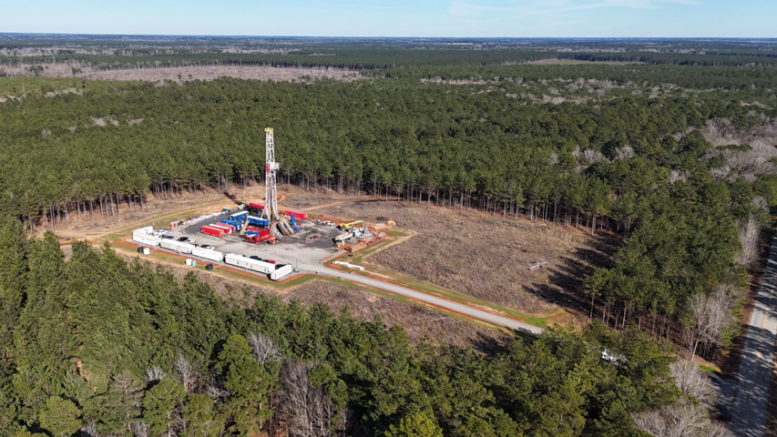
Standard Lithium and its partner Equinor have released the definitive engineering study for the South West Arkansas project, clearing the way for a final investment decision on what would be one of the first large-scale direct lithium extraction operations in the United States, The Northern Miner reports. The plan calls for $1.45 billion of capital, construction beginning in early 2027, and first production of 22,500 tonnes per year of battery-grade lithium carbonate in 2029. A second, larger development on the adjacent Franklin property is modelled to add up to 70,000 tonnes a year in the early 2030s.
The resource is lithium dissolved in the Smackover Formation, a deep saline aquifer that oil and gas companies have been pumping for bromine and hydrocarbons for decades. Instead of evaporating the brine in ponds for months, as is done in South America, direct extraction pulls lithium out chemically in hours and returns the water underground. Standard Lithium’s study reports brine grades of 442 milligrams per litre at South West Arkansas and 562 at Franklin, with measured and indicated resources of 1.18 million and 1.77 million tonnes of lithium carbonate equivalent respectively, plus large inferred resources on top.
The study’s cost figures are the important part. Average operating costs are modelled at $4,516 per tonne, with all-in sustaining costs of $5,924 per tonne, against an assumed lithium carbonate price of $22,400. On those numbers the project returns a net present value of $1.28 billion at an 8 percent discount rate and an internal rate of return of 18.2 percent over a twenty-year modelled life. Even if lithium prices fall well below the study’s assumption, the gap between production cost and sale price leaves substantial room.
Financing is largely lined up. The US Department of Energy awarded a $225 million grant in January 2025, and the Export-Import Bank of the United States and Export Finance Norway have expressed interest in more than $1 billion of debt. Trafigura has agreed to take up to 12,000 tonnes per year and LG Energy Solution 8,000 tonnes, covering roughly 89 percent of the first phase’s output. Jesse Edmondson, a Standard Lithium vice-president, told the publication the company sees a path for the Smackover region “to at least 100,000 tonnes per year in the next 10 years, potentially up to 150,000 tonnes per year.” For comparison, that upper figure would be a meaningful fraction of current global lithium supply, drawn from a brine that was being discarded as oilfield waste water.
Source: The Northern Miner
Rare Earths Norway Funds a Pilot Plant for Europe’s Largest Rare Earth Deposit
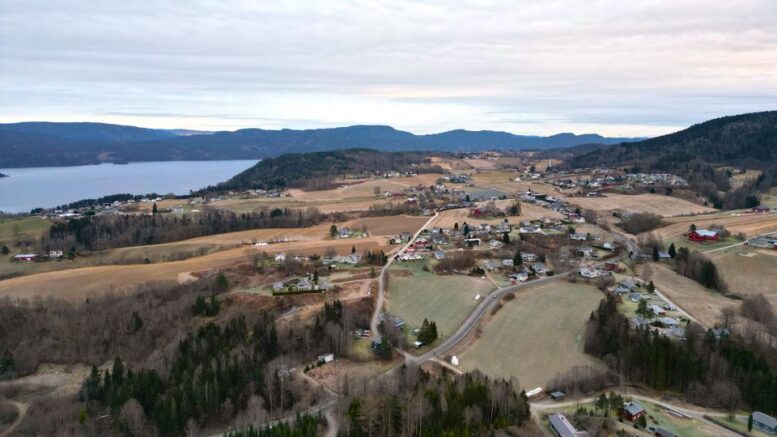
Rare Earths Norway has approved construction of a €24 million pilot processing facility at Ulefoss, about 160 kilometres southwest of Oslo, to demonstrate the full flowsheet for its Fen project, according to The Northern Miner. The plant is scheduled to begin operating in the third quarter of 2027 and will process 6,000 tonnes of ore over three years, taking material from crushed rock all the way to separated rare earth oxides. Those oxides will go to European partners for trial production of metals and permanent magnets, the components that go into wind turbine generators, electric motors and electronics.
The Fen deposit is a carbonatite, a rare type of igneous rock that hosts many of the world’s richest rare earth concentrations. A March 2026 resource estimate put the indicated resource at 123 million tonnes grading 1.35 percent total rare earth oxides, or about 1.7 million tonnes of contained oxides, with a further 1.08 billion tonnes inferred at 1.31 percent, equivalent to 14.2 million tonnes. Neodymium and praseodymium, the two elements that matter most for high-strength magnets, make up roughly 19 percent of the total. The company has also redesigned the mine plan so that a protective layer of rock above the workings is 100 metres thick instead of 25, which allows the town above to carry on undisturbed.
Public money is part of the package. Innovation Norway is contributing €5.4 million and the Telemark Development Fund €1.9 million, and in April 2026 the Norwegian government took over zoning authority for the project on grounds of national interest. Chief executive Håvard Moe said the investment “is a concrete step towards bringing the Fen deposit into production,” with commercial output targeted for the early 2030s.
Bernd Schäfer, who heads the EU-backed EIT RawMaterials consortium, framed the stakes in supply terms: “Europe’s dependence on imported rare earths is a strategic vulnerability we can no longer afford to ignore.” The pilot plant is the step that turns a large resource number into an engineering answer about recovery rates and costs, and it is the step most rare earth projects outside China have failed to take.
Source: The Northern Miner
Fraunhofer Develops Two Routes to Recover Magnet Metals From Old Hard Drives

Researchers at the Fraunhofer Institute for Ceramic Technologies and Systems in Freiberg, Germany, have developed two processes for recovering neodymium, boron and iron from the permanent magnets in discarded hard disk drives, TechXplore reports. The work, carried out under a project called NEO-CYCLE, is led by Sandra Pavón, who heads the institute’s hydrometallurgical recycling and raw materials chemistry group. The goal is to feed recovered rare earths into high-value European products rather than exporting the scrap.
The first route is solid-state chlorination, in which the magnet material reacts with a chlorinating agent at elevated temperature to convert the metals into chlorides that can then be separated. According to the report, this achieves nearly complete extraction of the metals while consuming comparatively small quantities of chemicals, which is the main cost driver in conventional acid leaching. The second route is electrochemical, dissolving and re-depositing the metals under controlled potential. Both are being evaluated for yield, purity and cost.
The economic context is a global permanent magnet market growing at up to 8.3 percent a year, driven by electric motors and wind turbines, while Europe has almost no domestic rare earth processing. The report notes that about 90 percent of neodymium-bearing material collected for recycling in Europe today is shipped to China for processing and then reimported as finished magnets. A European recovery route would keep that value, and that supply, at home.
Pavón described the target applications in terms that go beyond magnets: “We aim to recover rare earth elements from electronic waste and use them in high-value products such as green fertilizers and in the production of pharmaceuticals.” Hard drives are an attractive first feedstock because they are collected in large volumes from data centres and offices, their magnets are of consistent composition, and they can be removed mechanically before chemical treatment. Whether the process competes with primary production will depend on the chlorination step holding its low reagent consumption at scale.
Source: TechXplore
A Kobe Membrane With Sub-Nanometre Water Channels Pulls Lithium and Pure Salt From Seawater

A team at Kobe University has built a polymer membrane whose interconnected, water-filled channels are just 0.5 to 0.7 nanometres across, narrow enough to let singly charged ions such as lithium, sodium and chloride pass while turning back doubly charged ions such as magnesium, according to TechXplore. The work, published in Science Advances, uses porous organic polymers derived from a rigid molecule called Tröger’s base to create the channels.
The selectivity mechanism combines three effects. Ions must partly shed their shell of water molecules to enter a channel this small, which costs far more energy for a magnesium ion than for a lithium ion. The channel’s confinement and the electrostatic charge on its walls then add a further barrier that doubly charged ions cannot overcome. The authors stress that “the key is not simply to make membrane pores smaller, but to control how water molecules organize” inside them, which is what determines whether an ion can reorganise its hydration shell and slip through.
The performance figures are striking. In a three-stage electrodialysis process on a magnesium-rich feed, the membrane cut the magnesium-to-lithium ratio from 40 to 0.08, a 500-fold reduction, and the recovered product reached 99.5 percent lithium carbonate purity. Applied to seawater, the same membrane concentrated sodium and chloride to 99.4 percent of the measured ion mass in the treated stream, which is to say it produced clean salt as a by-product. The membrane ran for more than 400 hours continuously without degradation.
Magnesium contamination is the central problem in extracting lithium from salt-lake brines and from seawater, because magnesium and lithium behave similarly in most chemical separations and magnesium is always far more abundant. A membrane that resolves them in a single physical step, with no reagents, would simplify the flowsheet for brine operations like the Arkansas project described above and open the far larger but far more dilute reserve in the oceans.
Source: TechXplore
A Cobalt Catalyst Makes Ammonia at 300 °C and Nine Atmospheres

Researchers at the Institute of Science Tokyo have reported a catalyst that synthesises ammonia from nitrogen and hydrogen at 300 °C and 0.9 megapascals, roughly nine atmospheres, conditions far milder than the high temperatures and pressures of the industrial Haber-Bosch process, Phys.org reports. The paper, in the Journal of the American Chemical Society, describes a barium-based compound with the formula Ba₃AlO₄₋ₓNᵧHz, which has an anti-perovskite crystal structure. The team deposited it as an ultrathin shell on aluminium oxide nanorods decorated with clusters of cobalt.
The catalyst produced ammonia at 15.9 millimoles per gram per hour, outperforming both the benchmark ruthenium catalysts used in research and the iron catalysts used in industry under the same conditions. The mechanism, worked out through spectroscopy and calculation, involves molecular dinitrogen anions, N₂ molecules that have picked up an extra electron at the interface where cobalt, barium and aluminium meet. That extra electron weakens the triple bond between the two nitrogen atoms, which is the hardest step in making ammonia. The cobalt and aluminium then handle the subsequent hydrogenation steps.
The appeal is twofold. Cobalt is far cheaper and more abundant than ruthenium, the precious metal that most low-temperature ammonia catalysts rely on. And a process that runs at nine atmospheres can use much lighter equipment than conventional high-pressure synthesis, which makes small, distributed ammonia plants plausible rather than only the enormous centralised ones that exist today.
Ammonia is the feedstock for almost all synthetic nitrogen fertiliser, and the Haber-Bosch process that makes it is one of the largest single industrial energy consumers in the world. A catalyst that lowers the pressure and temperature substantially would cut that energy and allow ammonia to be made where hydrogen is cheap, whether from stranded renewables or from nuclear heat. The result is a laboratory rate on a laboratory catalyst, and the hydrogen still has to come from somewhere, but the direction is toward cheaper nitrogen for food.
Source: Phys.org
TU Berlin Chemists Turn Silicone Waste Back Into Its Building Block With 99 Percent Yield

A team at the Technical University of Berlin led by Martin Oestreich has developed a catalytic process that converts waste silicone into dimethyldichlorosilane, the monomer from which essentially all commercial silicone is manufactured, Phys.org reports. The work was published in Nature on an accelerated schedule and a patent application has been filed. Silicones are prized for their chemical and thermal stability, which is precisely what has made them almost impossible to recycle: the silicon-oxygen backbone does not break under the conditions that depolymerise most plastics.
The trick is a silylium ion, a positively charged silicon species, used as a catalyst together with triphosgene, a solid that releases phosgene gas during the reaction. The silylium ion strips a chloride from the phosgene to form a reactive COCl⁺ fragment that attacks the silicon-oxygen bonds in the polymer. The oxygen leaves as carbon dioxide, which prevents it from recombining into unwanted side products, and the silicon ends up as dimethyldichlorosilane ready for repolymerisation.
The reaction runs at 80 °C for 24 hours. On individual silicone products the yield reaches 99 percent, and on mixed silicone waste of the kind a real collection stream would deliver it is 86 percent. For comparison, making virgin dimethyldichlorosilane starts with reducing quartz to metallurgical silicon in an electric arc furnace at around 2,000 °C, so recovering the monomer at 80 °C represents a very large energy saving per kilogram.
The report puts the global silicone market at more than €21 billion in 2025, projected to exceed €33 billion by 2033, with applications from sealants and medical implants to cookware and electronics encapsulation. Phosgene is hazardous and the process will need engineering to handle it at scale, but the chemistry is simple, the conditions are mild and the product is the exact feedstock the industry already uses. That is the profile of a recycling route that could become economic rather than merely virtuous.
Source: Phys.org
Kazakhstan Sets Out to Secure a Century of Uranium for Its Own Reactors

President Kassym-Jomart Tokayev has announced that Kazakhstan intends to build a strategic uranium reserve large enough to fuel its planned nuclear power plants for more than a hundred years, World Nuclear News reports. The chairman of the country’s Atomic Energy Agency followed up with a development strategy targeting at least 150,000 tonnes of uranium in reserve by 2050. “We need to start thinking now about how we will supply these stations with uranium raw materials in 50 years, and even beyond,” Tokayev said.
Kazakhstan is already the world’s dominant producer. The report puts its 2025 output at roughly 25,839 tonnes of uranium, about 40 percent of the global total, a position it has held since 2009, and the country holds about 14 percent of world uranium resources. Most of that production is by in-situ leaching, in which a mild solution is pumped through the orebody underground and the dissolved uranium recovered at the surface, a method far cheaper than conventional mining and the main reason uranium has stayed inexpensive despite the nuclear build-out now under way.
The new element is exploration specifically for domestic use. The strategy designates six exploration areas covering more than 1,000 square kilometres, plus a 124-square-kilometre block at Kyzyltu, to be developed as a national reserve rather than for export. The reactors they will feed are two VVER-1200 pressurised water units at Balkhash, for which Rosatom signed an engineering, procurement and construction contract in September. The plant is estimated at $14.4 billion for the two units plus $2 billion for security and infrastructure, with construction starting in 2027, the first unit operating by 2034 and nuclear supplying 5 percent of the national mix by 2035. A 2024 referendum approved the plant with over 70 percent support from 7.8 million voters.
A century-scale reserve is an unusual planning horizon for any commodity, and it illustrates something general about resource estimates: they expand when someone has a reason to look. Kazakhstan’s in-situ deposits were barely counted a few decades ago. The reserve the country is now assembling will be measured, in effect, by how much exploration it chooses to fund.
Source: World Nuclear News
Urenco USA Produces the West’s First Commercial Uranium Enriched Above Five Percent
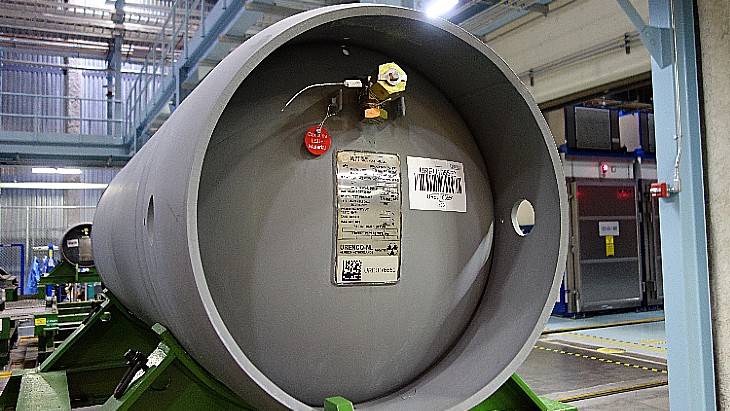
Urenco USA has produced its first commercial cylinder of LEU+, uranium enriched to between 5 and 10 percent uranium-235, at its National Enrichment Facility in New Mexico, World Nuclear News reports. The company says it is the first commercial production of this material anywhere in the Western world. Standard reactor fuel is enriched to between 3 and 5 percent, and until the US Nuclear Regulatory Commission authorised Urenco in September 2025 to enrich up to 10 percent, no Western plant was licensed to go higher.
The immediate use is in existing light water reactors. Fuel enriched above 5 percent carries more fissile material per assembly, which lets a reactor run longer between refuelling outages and extract more energy from each fuel load. Operators have been pressing for this because every extra month of continuous operation is avoided downtime, and because fewer assemblies mean less spent fuel to manage. LEU+ can also serve as the feedstock for HALEU, the higher-assay material that most advanced reactor designs require and that Western supply chains have struggled to provide.
Managing director Jody Blackshear said that “through the coordinated efforts of teams across our site and company, we can now supply an innovative fuel option.” The milestone sits inside a larger expansion. Urenco is installing 700,000 separative work units of additional capacity at the New Mexico site now, and has a long-term goal of more than 7 million SWU within the next decade. A new 2.1 million SWU plant is planned to begin construction in 2029, with cascades coming online from 2032 through 2036.
Enrichment capacity has been the quiet bottleneck of Western nuclear fuel supply. An expanding, higher-assay Western enrichment base means the reactors being planned across North America and Europe, including the industrial units described in the next item, can be fuelled from domestic sources at a cost that does not depend on geopolitics.
Source: World Nuclear News
Regulators Finish the Safety Review of Four Reactors That Will Power a Dow Chemical Plant

The US Nuclear Regulatory Commission has completed its safety review of the Xe-100 reactors proposed for the Long Mott Generating Station in Texas, issuing its Final Safety Evaluation Report on 30 October, World Nuclear News reports. With the environmental assessment finished in May, both of the agency’s primary reviews are now complete, and the NRC said followers should “stay tuned for a construction permit announcement soon.” Long Mott Energy, a subsidiary of Dow, submitted the application in March 2025.
The plant consists of four Xe-100 high-temperature gas-cooled reactors from X-energy, with a combined output of 800 megawatts thermal or 320 megawatts electric. Unlike conventional light water reactors, the gas-cooled Xe-100 delivers heat at temperatures well suited to industrial process steam. That is the point of the project: the reactors will supply both electricity and steam to Dow’s Seadrift Operations, a large chemicals complex on the Gulf Coast, with surplus power exported to the grid. X-energy describes it as “the first grid-scale advanced nuclear reactor at an industrial facility in US history.”
Dragan Popovic, X-energy’s chief global operating officer, said that “licensing a new reactor is earned through the quality of the application and the rigor of the regulator’s review.” The completed safety evaluation is the document that establishes the design meets the NRC’s criteria, drawing on the design basis, safety analyses and probabilistic risk assessments submitted with the application.
The significance for materials production is direct. Chemical plants run on heat, and most of that heat today comes from burning natural gas, which ties the cost of every downstream product to the gas price. A reactor inside the fence line that delivers steam at a predictable cost for decades changes the economics of everything made on that site. If Long Mott proceeds on schedule, it will be the first demonstration in the United States of nuclear heat as an industrial feedstock, and the model is applicable to desalination, hydrogen, ammonia and refining wherever a reactor can be sited beside the plant that needs the heat.
Source: World Nuclear News