Resource Abundance Weekly Review 2026-11-12

Week In Review
The week’s news was dominated by supply arriving in bulk from places that were not producing much a few years ago. Guinea’s Simandou complex, the largest untapped iron ore deposit in the world until recently, is now shipping, and its rail and port operator is aiming for 120 million tonnes of annual export capacity by the end of 2027. Uzbekistan’s state uranium producer plans to double output to 15,000 tonnes a year by 2030, which would put it above Canada, using in-situ recovery wells rather than open pits. And in Quebec, PMET Resources published a feasibility study that cuts operating costs by 19 percent and triples the projected value of what is shaping up as one of North America’s largest hard-rock lithium mines. None of these are lab results. They are tonnes, wells, and mills, and they are the mechanism by which commodity prices fall over the long run.
Two items show how ingenuity expands the resource base without digging a single new hole. Troilus Mining found 34 metres of gold-bearing rock in ground its mine plan had classified as waste, because old drill core from the 1980s had simply never been assayed. And CSIRO stitched together more than 33,000 hyperspectral satellite scenes into a continent-wide mineral map of Australia that reads 200 spectral bands where the previous generation read 14. Both stories make the same point: the amount of ore in the ground is partly a function of how carefully we have looked, and looking is getting cheaper.
Recovery from waste streams had a strong week on the chemistry side. Glasgow engineers used a fibre laser to peel apart end-of-life solar panels and pull out the silver and silicon that make up a tiny fraction of the panel’s weight but two-thirds of its scrap value, with a commercial partner aiming to scale on existing laser equipment within a year. Chemists at the Leibniz Institute for Catalysis found that polyethylene bags dissolve in dilute nitric acid and hydrogen peroxide at 120 °C, yielding the dicarboxylic acids that nylon is made from, with no catalyst and none of the 600 °C heat that pyrolysis needs. Both processes are explicitly pitched at industrial scale rather than as curiosities.
Finally, two items concern the energy and land inputs behind everything else. The US Nuclear Regulatory Commission issued a construction permit for four high-temperature gas-cooled reactors at Dow’s Seadrift chemical complex, the first such permit in nearly 60 years and a direct coupling of nuclear heat to industrial production. Plant geneticists identified two genes that let barley mature early enough for a second crop on the same land without losing yield, explaining a quiet productivity gain that Chinese breeders had been selecting for since the 1960s. And Human Progress reports that roughly a third of US states loosened rules on homebuilding this year, a reminder that for the most expensive resource most households buy, the binding constraint is permission rather than materials.
Items
Simandou Aims for 120 Million Tonnes of Iron Ore Exports a Year by End of 2027

Simandou, in the mountains of southeastern Guinea, has been known as the world’s largest high-grade untapped iron ore deposit for decades. What held it back was not geology but logistics: the ore lies some 600 kilometres from the coast, and getting it out required building a trans-Guinean railway and a deepwater port from scratch. That infrastructure is now operating, and according to a Northern Miner report citing BMO Capital Markets and Bloomberg data, the Compagnie du TransGuinéen that runs it is targeting 120 million tonnes of annual export capacity by the end of 2027, up from an annualized rate of roughly 72 million tonnes today.
The ramp-up is already visible in the export figures. The report says Guinea shipped 8.9 million tonnes in the third quarter of 2026, a 48 percent jump on the 6 million tonnes shipped the quarter before. The Baowu-led Winning Consortium Simandou, which holds blocks 1 and 2, accounted for 6.55 million tonnes of that, and Rio Tinto’s SimFer joint venture on blocks 3 and 4 for 2.16 million tonnes. If October’s pace holds, Guinea would export around 28 million tonnes this year. Rio Tinto says SimFer remains on track for a 60 million tonne annual rate in the second half of 2028, and the port’s second stage at Morébaya is due to be commissioned in March 2027.
Not everyone expects the full capacity to arrive on the operator’s schedule. The report notes that Fearnley Securities sees 120 million tonnes being reached during 2028, while S&P Global’s analysts expect the full ramp-up to take more than five years and forecast about 70 million tonnes of Guinean exports in 2028. Either way, the direction is the same. A new source of iron ore on the scale of a mid-sized Australian producer is entering a market that has been supplied for a generation by the same handful of mines in Western Australia and Brazil.
The ownership structure, with each mining consortium holding 42.5 percent of the infrastructure and Guinea 15 percent, means the railway and port are shared assets rather than a single company’s bottleneck. For steelmakers, Simandou’s high-grade ore is also attractive because it needs less processing, which lowers energy use per tonne of steel. The long-run effect of a project like this is to push the global cost curve for iron ore to the right, making the cheapest unit of steel in 2030 cheaper than it would otherwise have been.
Source: The Northern Miner
PMET Cuts Operating Costs 19 Percent and Triples the Value of Its Quebec Lithium Mine
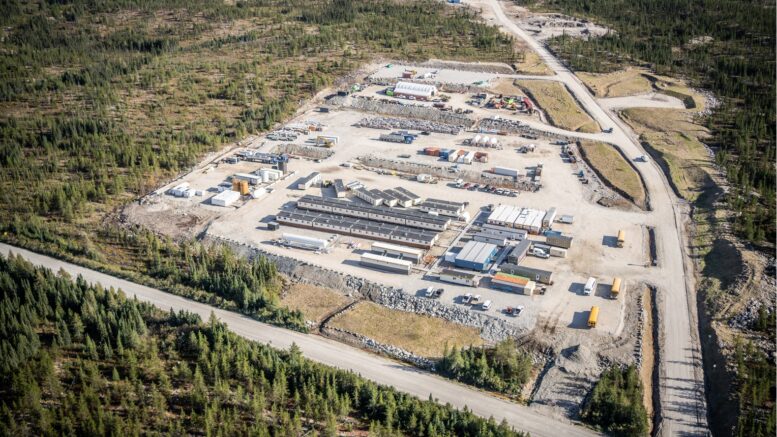
PMET Resources released an updated feasibility study this week for its Shaakichiuwaanaan project, about 890 kilometres north of Montreal in the Eeyou Istchee James Bay region, and the numbers moved substantially in the right direction. According to the Northern Miner’s report, the study projects a post-tax net present value of C$5.1 billion at an 8 percent discount rate with a 40 percent internal rate of return. The previous lithium-only plan carried an after-tax value of C$1.6 billion and an 18 percent return, so the project’s expected value has more than tripled.
Part of the improvement comes from price assumptions, and part from genuine engineering. The new study assumes spodumene concentrate at $1,788 a tonne, 46 percent above the $1,221 used before, and the report notes that at a more conservative $1,400 the value falls to C$3.3 billion. But the operating cost estimate also dropped 19 percent to $594 per tonne of concentrate, and the project now books a $148-per-tonne credit from tantalum, a metal used in capacitors and superalloys that occurs alongside the lithium at 148 parts per million. Initial capital is put at C$1.39 billion before credits, or C$1.08 billion after pre-production revenue and tax credits.
The resource behind these figures is large by any standard. Probable reserves stand at 83 million tonnes grading 1.27 percent lithium oxide, equivalent to 2.61 million tonnes of lithium carbonate, plus 12,300 tonnes of tantalum pentoxide. Volkswagen holds a 9.5 percent stake in the company. A final investment decision is targeted for late 2027, plant commissioning for late 2029, and commercial production by the end of March 2030.
There may be more to come. A preliminary economic assessment due this quarter will examine whether the neighbouring CV13 deposit’s lithium, caesium, and tantalum could be brought forward, and Raymond James analyst Brian MacArthur told the Northern Miner that “there could be more positive updates.” The broader lesson is familiar from every commodity cycle: when a project is re-engineered rather than simply re-priced, its cost per tonne tends to fall, and the mine that looked marginal at one price becomes robust at a lower one.
Source: The Northern Miner
Uzbekistan Plans to Double Uranium Output to 15,000 Tonnes a Year by 2030
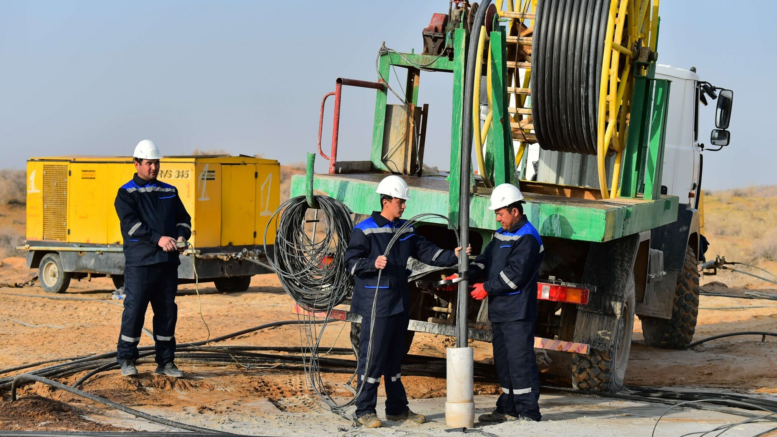
As reactors return to favour worldwide, the question of who will supply the fuel is becoming pressing. Uzbekistan’s answer, reported by the Northern Miner this week, is to double production. State-owned Navoiyuran produced 7,000 tonnes of uranium in 2025, a 35 percent increase on the year before and enough to rank it among the world’s six largest producers. The company expects about 7,500 tonnes in 2026 and is targeting 15,000 tonnes annually by 2030, which the report notes would exceed Canada’s 2024 output of roughly 14,300 tonnes.
Every one of Navoiyuran’s operations uses in-situ recovery, a method in which a dissolving solution is pumped through wells into the ore body and the uranium-bearing liquid is drawn back to the surface. There is no open pit, no mill, and very little waste rock, which is why in-situ mines can be built quickly and cheaply relative to conventional ones. The newest, Qizilkok, began commercial production in April 2026 with a planned capacity of 1,200 tonnes a year over a 15-year life, drawing on 9,400 tonnes of reserves reported to the JORC standard.
The expansion plan has several supporting pieces. The company aims to grow its explored reserves to 200,000 tonnes by 2030, build new processing and sorption units, and cut its dependence on sulphuric acid, the main reagent in in-situ leaching, so that it supplies no more than 60 percent of operations by 2030, with alternative reagents covering the rest. Navoiyuran’s net profit rose 138 percent to $348 million in the first half of 2026, according to the report, and the government is considering an initial public offering of a 10 to 15 percent stake.
A doubling of output from a single producer of this size would materially change the uranium supply picture at a moment when enrichment and reactor construction are both accelerating. It also underlines a recurring pattern in the resource economy: the cheapest new supply often comes not from a new discovery but from a cheaper extraction method applied to deposits that were already known.
Source: The Northern Miner
US Regulators Issue the First High-Temperature Gas Reactor Construction Permit in Nearly 60 Years

The US Nuclear Regulatory Commission has issued a construction permit for the Long Mott Generating Station at Dow’s Seadrift chemical complex on the Texas Gulf Coast, World Nuclear News reported this week. The plant will consist of four X-energy Xe-100 reactors, each rated at 80 megawatts electric and 200 megawatts thermal, and it is designed to supply both electricity and high-temperature steam directly to Dow’s manufacturing operations. According to the report, it is the first construction permit for a high-temperature gas-cooled reactor granted in the United States in nearly 60 years.
The permit sets a string of regulatory precedents. World Nuclear News lists it as the first approval of a multi-module advanced reactor, the first of a pebble-bed core, the first of a design that refuels while running, and the first high-temperature gas-cooled reactor reviewed under the NRC’s Licensing Modernization Project framework. The emergency planning zone is 400 metres rather than the 16 kilometres that applies to conventional plants, which is what allows reactors to sit inside a working chemical site. NRC Chairman Ho Nieh said the agency “delivered on the 18-month schedule, proving we can do rigorous safety reviews on predictable timelines,” and X-energy chief executive Clay Sell said the permit arrived earlier than expected.
The project is funded in part through the Department of Energy’s Advanced Reactor Demonstration Program. Dow, acting through its subsidiary Long Mott Energy, expects a preliminary investment decision in 2027, with construction possible late this decade and startup early in the next. The plant is licensed for a 60-year operating life.
What matters beyond the regulatory firsts is the application. Chemical plants run on heat as much as on electricity, and most of that heat today comes from burning natural gas. A reactor that delivers steam at the temperatures industrial processes need, sited where the steam is used, turns nuclear fission into a feedstock for making materials. If the model works at Seadrift, the same architecture applies to ammonia, hydrogen, desalination, and refining, all of which are constrained by the cost of heat.
Source: World Nuclear News
Troilus Finds 34 Metres of Gold in Rock Its Mine Plan Had Written Off as Waste
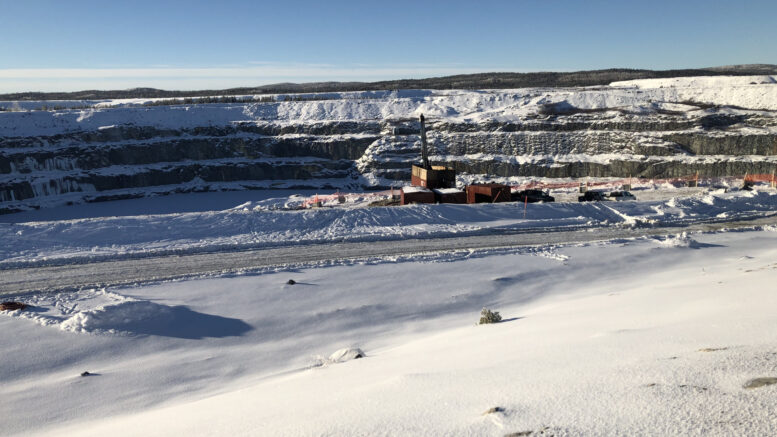
Troilus Mining reported a drill hole this week that cut 34 metres grading 1.29 grams of gold per tonne, including 12 metres at 3.04 grams, starting 207 metres below surface in the hanging wall of its Z87 zone in Quebec. The grades are respectable for an open-pit project. What makes the result notable is where it sits: in ground that the company’s current mine plan classifies as waste rock to be stripped and dumped.
The explanation, according to the Northern Miner, is a gap in the historical record. Drill core from the project’s earlier decades was never fully assayed in this interval, so the geological model had nothing to say about it and the planning software treated it as barren. Desjardins analyst Bryce Adams told the paper the result points to “potential resource conversion, lower strip ratios, improved early-year mill feed.” In plain terms, rock that was going to cost money to move may instead pay for its own removal and feed the mill in the years when cash flow matters most.
The project itself is large and well advanced. The Northern Miner puts initial capital at roughly C$2 billion over a 26-year mine life, with construction planned for 2027, first ore in September 2029, and commercial production in March 2030. Lenders have approved C$850 million of debt, with another C$250 million awaiting approval from Export Development Canada. The company’s current resource estimate excludes all of this year’s drilling, so the new intercept will need to be modelled before it changes anything official. Chief executive Justin Reid said the company remains “confident in our existing mine plan” while committed to “continual improvement.”
The story is a small but clean illustration of how reserves grow without new discoveries. Ore is a classification, not a fixed quantity, and it depends on what has been measured and at what price. Re-examining old core, like re-processing old tailings or re-logging old wells, is one of the cheapest ways a mining company can add resource, and it is happening across the industry as modern assay and modelling tools are applied to decades-old data.
Source: The Northern Miner
A Laser Peels Solar Panels Apart to Recover Silver and Silicon With 84 Percent Less Energy

A solar panel is a sandwich: glass on top, a sheet of silicon cells with silver contacts in the middle, and a polymer called ethylene vinyl acetate, or EVA, holding it all together. That glue is the problem for recyclers. Getting at the valuable layer today means either heating the panel to between 450 and 600 °C to burn the EVA off or dissolving it with aggressive chemicals, and both routes consume enough energy and reagent to make recovery marginal. Engineers at the University of Glasgow’s James Watt School of Engineering reported a different route this week in Communications Materials.
Their method uses a 1064-nanometre fibre laser, a standard industrial tool. The beam passes through the transparent EVA and heats the interface with the silicon underneath, causing the encapsulant to release as an intact film rather than being destroyed. The metal busbars are then separated mechanically, and what remains is a powder treated first with dilute sodium hydroxide to remove aluminium and then with an iron chloride and choline chloride brine that dissolves the silver. According to the TechXplore report, the process achieved better than 99 percent silver selectivity on one panel type and cut power consumption for the recycling step by 84 percent compared with thermal methods.
The economics hinge on a lopsided ratio. The report notes that the valuable metals amount to about 0.05 percent of a panel’s weight but roughly two-thirds of its scrap value, so a process that recovers them cleanly captures most of the money while handling very little of the mass. The volume of feedstock is about to grow enormously: more than a million tonnes of panels are expected to reach end of life by 2030 and over 200 million tonnes by 2050.
Glasgow has partnered with a local firm, Watt Laser Ltd, to commercialise the technique and expects it can be scaled on existing industrial laser equipment in under a year. That is a notably short path from paper to plant, and it reflects the fact that nothing in the process is exotic. Silver is the single most expensive input in a crystalline silicon cell, and a recovery stream that returns it at low energy cost helps keep panel prices falling even as demand for the metal rises.
Source: TechXplore
Plastic Bags Dissolve Into Nylon Precursors at 120 °C With No Catalyst

Polyethylene is the most produced plastic on Earth and the hardest to do anything useful with once it has been used. It is chemically inert by design, which is why bags and bottles last for centuries and why the main route for turning them back into chemicals, pyrolysis, needs temperatures around 600 °C. Chemists at the Leibniz Institute for Catalysis in Rostock, Germany, reported this week that the polymer gives way under far gentler conditions than anyone expected.
The recipe, as Dr. Esteban Mejía described it to Phys.org: “You put pieces of a plastic bag into a test tube containing highly diluted nitric acid and hydrogen peroxide, heat the mixture to a maximum of 120°, and watch as the polyethylene dissolves.” No catalyst is needed, precious-metal or otherwise. The long hydrocarbon chains are oxidised into dicarboxylic acids with between four and ten carbon atoms, and the six-carbon member of that family, adipic acid, is the direct precursor to nylon.
The scale of the opportunity is what motivates the work. The report cites roughly 400 million tonnes of plastic waste generated annually, much of it polyethylene, against about 8 million tonnes of polyamide produced each year from petroleum. A process that converts the former into feedstock for the latter would substitute a waste stream for a fossil input at a temperature a kitchen oven can reach. The team’s stated next steps are to improve selectivity toward the six-carbon product, work out the reaction mechanism, and move to a pilot plant, in collaboration with the University of Rostock and the University of Guayaquil.
Results are still at the test-tube stage and a manuscript is in preparation for the Journal of the American Chemical Society, so the usual caveats about scale-up apply. But the comparison with pyrolysis is instructive. Pyrolysis produces good oil, yet its energy demand gives it a large carbon and cost footprint. A reaction that runs at a fifth of the temperature with cheap bulk reagents starts from a very different place on the cost curve, which is why the institute is already describing it as suitable for mass production.
Source: Phys.org
CSIRO Maps Australia’s Minerals From Orbit Across 200 Spectral Bands

Australia’s national science agency, CSIRO, released a continent-wide hyperspectral mineral map this week, built from more than 33,000 satellite scenes and hundreds of terabytes of data. Hyperspectral sensors record reflected light in hundreds of narrow wavelength bands rather than the handful that ordinary imaging satellites capture, and because different minerals absorb light at characteristic wavelengths, the data can identify what is on the surface rather than just what colour it is. CSIRO’s Dr. Sandra Occhipinti put the upgrade from the previous 14-band capability this way: “It’s like the difference between listening to 14 notes on a piano and hearing a full orchestra.”
The map draws on three missions: Italy’s PRISMA, Germany’s EnMAP, and NASA’s EMIT instrument on the International Space Station. None was designed with Australian mineral exploration in mind, and combining them meant solving problems of cloud cover, inconsistent data quality, and differing orbits across imagery collected since 2019. The first published layer highlights aluminium-bearing sheet silicate minerals, a family of clays and micas whose composition shifts in predictable ways around hydrothermal ore systems. In effect, the map shows the chemical halo that mineralisation leaves on the surface, across an entire continent at once.
For explorers, the value is in narrowing the search. Greenfield exploration is expensive and most of its budget is spent ruling ground out. A free, continental dataset that flags prospective alteration signatures lets a company target drilling where the geology is already whispering, which the report says will cut time, cost, and risk. The map layer is available through CSIRO’s XT Portal at no charge.
The release lands as Australia tries to expand its production of the critical minerals used in batteries, magnets, and electronics. Ore bodies do not get easier to find as the obvious outcrops are claimed, so the next generation of discoveries will come from better instruments rather than more boots. A map that upgrades every square kilometre of the continent from 14 notes to a full orchestra is a sizeable step in that direction.
Source: Phys.org
Two Genes Explain How Barley Learned to Share a Field With Rice

Across central and eastern China, farmers grow two crops a year on the same land: barley sown in autumn and harvested in late spring, followed immediately by rice or another summer crop. The system only works if the barley finishes early enough to clear the field before the summer heat and rain, and for decades breeders have selected varieties that do exactly that without knowing why. A study published in Nature this week by researchers at the Leibniz Institute of Plant Genetics and Crop Plant Research, with colleagues at the Chinese Academy of Agricultural Sciences, identifies the genetic machinery behind it.
The answer lies in two genes. One is PHYTOCHROME C, a light receptor, where a single amino acid substitution makes the plant push out its ears earlier. The other is VERNALIZATION 1, a flowering regulator that comes in winter and spring forms. The crucial finding, according to the Phys.org report, is that the PhyC variant only delivers its benefit when paired with the winter-type VRN1: that combination brought the crop forward “without reducing grain yield” in field trials, while the same PhyC variant paired with spring-type VRN1 cut both biomass and yield. The two genes have to travel together.
That is precisely what the historical record shows they did. Analysing 505 Chinese barley varieties and 27 reference lines across eight decades of breeding, the team found the frequency of the winning combination rising steadily from the 1960s until, by the 1990s, more than 60 percent of modern autumn-sown varieties carried it. Breeders had been fixing a two-gene solution by trial and error. The researchers also used base editing to introduce the PhyC change into other cereals: it advanced flowering in wheat, a long-day plant like barley, but delayed it in rice, which flowers under short days.
Knowing the genes turns an accidental achievement into a deliberate tool. Breeders can now screen seedlings for the exact combination rather than waiting a season to see which plants mature in time, and they can move the trait into wheat varieties for regions where a second crop is currently out of reach. Double cropping is one of the oldest ways to get more food from the same land, and a precise genetic handle on it makes the technique portable.
Source: Phys.org
A Third of US States Loosened the Rules on Homebuilding in 2026
Housing is the largest resource purchase most households ever make, and in much of the developed world its cost has risen for decades while the cost of almost everything else manufactured has fallen. The explanation is rarely a shortage of land, lumber, or labour. It is that building is not permitted. Human Progress this week highlighted a Pew Charitable Trusts analysis finding that roughly one-third of US states enacted housing policy reforms during 2026, from North Carolina to Idaho and from New York to Kansas.
The reforms follow a recognisable playbook. States are allowing homes to be built near commercial areas, legalising apartments, accessory dwelling units, and small starter homes where single-family zoning had prohibited them, letting churches and nonprofits develop housing on land they already own, and streamlining building codes and permit procedures. Each measure attacks a different part of the same constraint: the regulatory cost of adding a dwelling to a place where people want to live.
What is striking is the breadth. Housing reform was for years a cause associated with a few expensive coastal metros, but the Pew analysis describes a bipartisan spread across states with very different politics and price levels. Human Progress summarises the shift as “a broadening consensus that housing shortages, high rents, unattainable homeownership, and historically high homelessness are not inevitable” but the product of policy choices that states can change.
The material consequences will take years to show up in completions, and the article offers no figures on units enabled. But the mechanism is the same one that governs every other resource. When the rules allow more of something to be produced, more of it gets produced, and the price falls toward the cost of making it. For housing, that cost is a fraction of current prices in most constrained markets, which is why permission reform is among the highest-leverage abundance policies available.
Source: Human Progress