Robotics Weekly Review 2026-11-08

Week In Review
The robots that mattered this week were the ones logging hours in places where failure is expensive. Boston Dynamics rebuilt its trailer-unloading robot around what actually took the first generation offline, drawing on more than 100,000 operating hours (Boston Dynamics Launches Next Generation Stretch Robot). In Tibet, a fleet of 60 battery-electric haul trucks reached site-wide driverless operation at a copper mine above 5,400 meters, where thin air and freeze-thaw roads punish both people and machines (Fleet of 60 electric trucks with EACON AHS enter full operation at 5,400 m Zhibula mine). And Japan’s Kajima moved its FieldAI-powered site robots from pilots to full-scale deployment, past 2,000 autonomous missions across more than ten active construction sites (Full-Scale Deployment of Robots with General-Purpose Autonomy Software on Construction Sites). None of these are humanoids. All of them are doing paid work today.
Drone delivery offered the week’s sharpest contrast between ambition and friction. Zipline raised $1.5 billion at a $21.5 billion valuation and signed Walmart up for 300 more delivery sites, with a stated goal of one million deliveries a day by the end of 2029 (Zipline Raises $1.5 Billion to Build Nationwide Drone Delivery Network). The same week, IEEE Spectrum documented what that scale sounds like from the ground, in Baton Rouge neighborhoods where residents counted a drone every 48 seconds and in a string of suburbs that have shut hubs down (Are Drone Ports the Next Annoying Tech Neighbor?). The industry’s growth curve and its social license are now moving on different timetables.
Capital and geopolitics reshaped the industry’s map. Agility Robotics became the first US-listed pure-play humanoid company, closing its debut day up modestly while the broader Nasdaq fell more than five percent (How did Agility Robotics perform on its first day on the stock market?). Chinese regulators blocked SoftBank’s $5.4 billion purchase of ABB Robotics, citing the risk of robot operating data leaving the country to train foreign AI models, a rationale that marks industrial robotics as strategic infrastructure (Industry experts discuss China blocking SoftBank acquisition of ABB Robotics). A visitor’s account of Unitree’s Hangzhou factory, cross-checked against the company’s own IPO filings, found that the world’s second-largest humanoid maker still builds its robots largely by hand, which says something useful about where the real bottlenecks and opportunities in humanoid manufacturing lie (Inside Unitree’s Hangzhou Factory, Robots Are Still Mostly Built by Hand).
On the learning side, two results converged on the same insight: robots can learn from data that was never collected as a complete robot demonstration. Beijing startup LiberAI reported that 10,000 hours of sensor-glove recordings of human hands outperformed two million hours of web video for teaching manipulation (LiberAI Unveils Liber-0: Learning from Human Experience for Zero-Shot Robot Manipulation). Seoul National University showed a humanoid stitching together walking and object handling from separately collected datasets, without anyone ever demonstrating the full sequence (Humanoid AI connects walking and object handling without demonstrations of complete task sequences). Both approaches attack the data bottleneck that has made general-purpose manipulation so slow to arrive.
Items
Boston Dynamics Rebuilds Stretch Around What Actually Broke in the Field
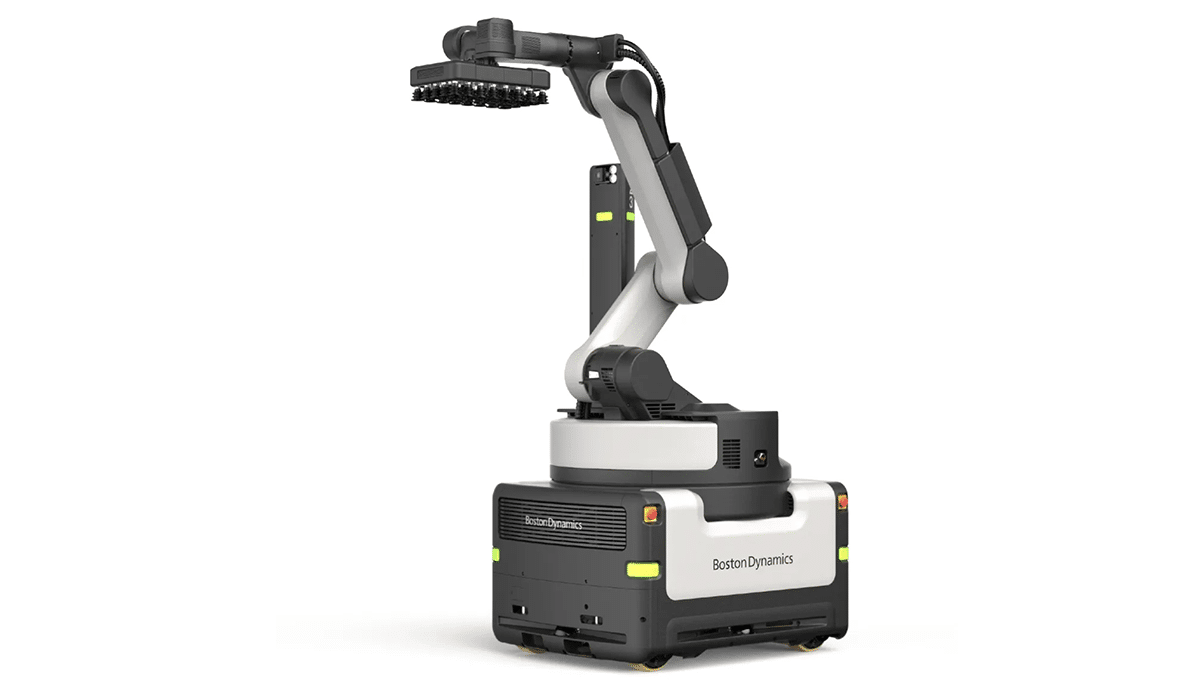
Boston Dynamics unveiled Stretch Gen 2 on November 3, the second generation of its mobile robot for unloading boxes from trailers and shipping containers. The company says the redesign was driven by data from more than 100,000 hours of first-generation operation and tens of millions of unloaded boxes. Brian Donnelly, who runs the company’s logistics robotics business, put the design philosophy plainly: the team focused on the things that actually took robots offline in the real world.
The headline performance figure is up to 1,000 cases per hour, with a battery sized for two shifts and a fast-charge cycle that reaches 90 percent in about 75 minutes. But the more telling changes are in maintainability. Internal cabling was cut by 81 percent, roughly half a mile of wire removed from each robot. Swapping a swerve drive module, a job the company says took a full day on the first generation, now takes about an hour. Onboard diagnostics are designed so that a customer’s own maintenance staff can handle routine service without waiting for a Boston Dynamics technician.
Other upgrades read like a catalog of lessons from loading docks. Automotive-grade connectors resist vibration. Continuous-rotation joints eliminate the 360-degree hard stops that constrained the arm. The emergency stop button is recessed and the exterior panels use new materials, both changes meant to prevent accidental safety triggers from a bump or a falling box. The gripper gets new valve systems and better sensing.
Trailer unloading is one of the few warehouse tasks where a dedicated robot has clearly beaten the humanoid alternative to commercial scale, and this release shows why. The hard problem was never the demo. It was keeping a machine running across thousands of hours in dusty, hot, irregular trailers, and the second generation is built almost entirely around uptime.
Source: Boston Dynamics
Sixty Driverless Electric Haul Trucks Reach Full Operation at a Copper Mine Above 5,400 Meters

EACON Mining Technology and Tibet Julong Copper, a subsidiary of Zijin Mining Group, announced that all 60 battery-electric SANY mining trucks at the Zhibula Copper Mine are now running autonomously across the entire site. International Mining, which reported the milestone on November 4, describes it as China’s largest single-site autonomous haulage fleet at a metal mine and the first site-wide battery-electric autonomous haulage project above 5,000 meters anywhere in the world.
The altitude is the point. At more than 5,400 meters, the mine contends with low atmospheric pressure and oxygen, intense ultraviolet exposure, snowfall, freeze-thaw cycles that leave haul roads slick, and steep mountainous terrain. These conditions are hard on human drivers, which is one reason remote high-altitude mines have become early adopters of autonomy. EACON’s system relies on multi-sensor fusion and adaptive vehicle control to keep trucks on course when road surfaces and visibility change hour to hour.
The deployment timeline shows how such projects actually ramp. The 60 trucks arrived in September 2025 and began manned operation. Validation for driverless running was completed within two weeks. By March 2026, 52 trucks were in regular autonomous operation, and by September 2026 all 60 were running without drivers site-wide. The operator reports an 80 percent reduction in driver requirements and a 16 percent increase in daily effective working hours, with roughly 12,000 tons of carbon emissions avoided annually from the switch to battery-electric trucks.
EACON is also retrofitting 18 diesel NHL NTE240 rigid dump trucks, each with a 220-ton capacity, for autonomous operation at the adjacent Julong Copper Mine. The combination of electrification and autonomy on the same fleet is becoming a pattern in Chinese mining, where the two technologies reinforce each other: autonomous trucks drive more consistently, which suits battery management, and electric drivetrains simplify the control problem.
Source: International Mining
Kajima Moves FieldAI Site Robots From Pilots to Full-Scale Construction Deployment
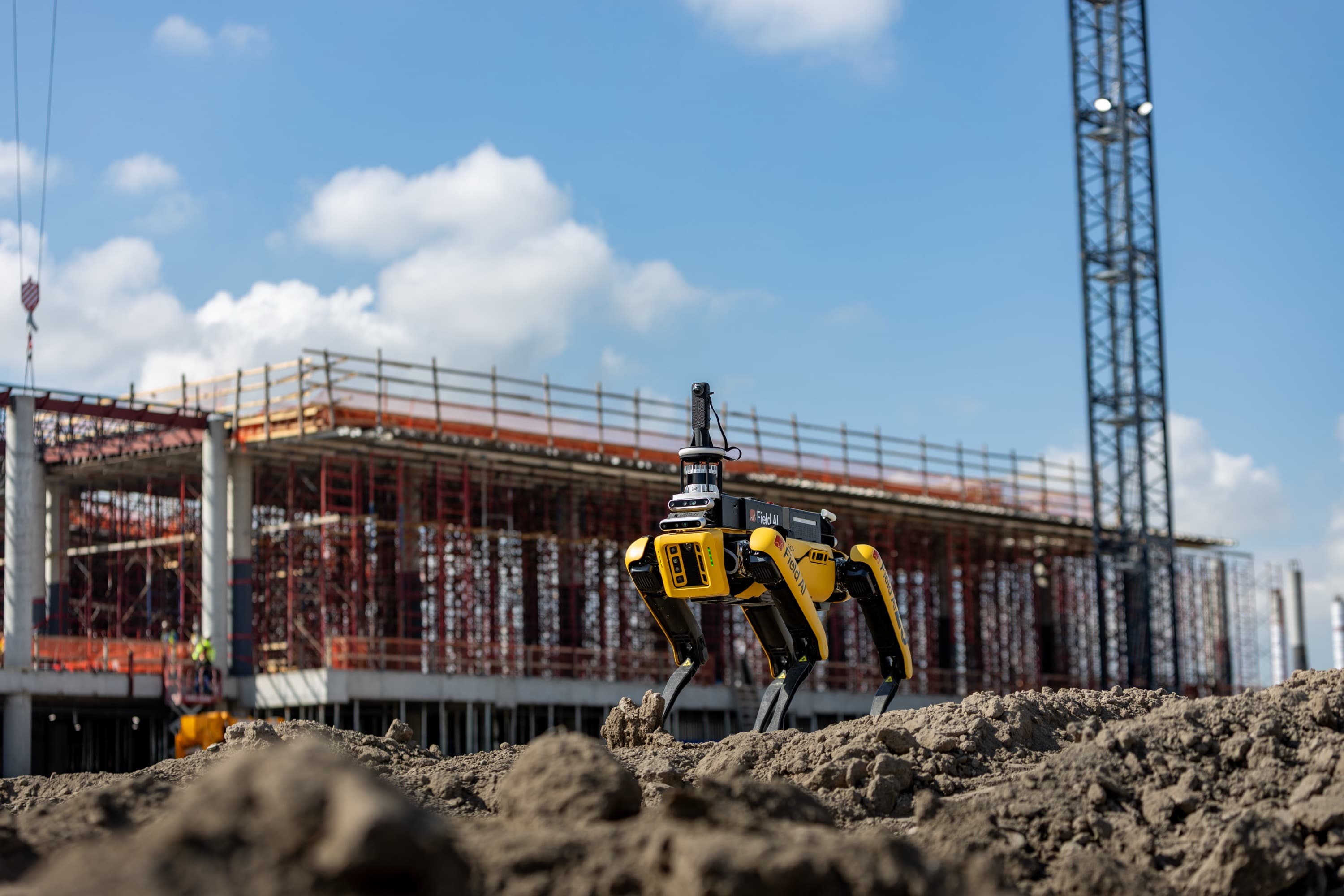
Kajima Corporation, one of Japan’s largest general contractors, announced on November 5 that it has begun full-scale deployment of autonomous robots running FieldAI’s physical AI software across its construction sites. The robots take over routine construction-management tasks such as site rounds, visual documentation, and 3D scanning, freeing engineers for the technical judgment required in safety, quality, and schedule management.
The architecture is deliberately robot-agnostic. An autonomy unit consisting of cameras, LiDAR, and an edge AI computer mounts on any robot platform, giving it what the press release calls the equivalent of human eyes and a brain. The brain is FieldAI’s Field Foundation Model, which combines data-driven learning with physics-based reasoning and uncertainty quantification. Because processing happens on the device, the robots operate indoors, underground, and in spaces without satellite positioning or reliable connectivity, all common on construction sites.
The numbers behind the announcement are what distinguish it from a pilot. Kajima has worked with FieldAI since 2023 and signed an enterprise-level service agreement in 2025. In roughly a year since that signing, the robots have been deployed at more than ten construction sites in Japan and have completed more than 2,000 autonomous missions across different robot types, tasks, and sites. Kajima stresses that the robots are in continuous use on active sites where the structure, materials, and equipment layout change daily, not in demonstrations under controlled conditions.
On first startup a robot explores an unknown area and builds a three-dimensional map. It then patrols autonomously, photographing and scanning while updating the map as the site changes, and returns to its charging station to upload data that is organized automatically for web access. Use cases include after-hours security patrols with light and audio alerts, whole-site digitization for progress tracking, and initial reconnaissance of disaster-recovery sites before human safety has been confirmed. Kajima says it will extend the same autonomy software to other construction machinery it is developing.
Source: Kajima Corporation
Zipline Raises $1.5 Billion and Signs Walmart for 300 More Drone Delivery Sites
Zipline announced on November 5 that it has raised $1.5 billion at a post-money valuation of $21.5 billion, with the round led by Paradigm, WCM Investment Management, and Layer Global. Valor Equity Partners, Fidelity, Uber, Tiger Global, J.P. Morgan, ARK Invest, and Salesforce Ventures also participated. The company says it will use the money to expand US manufacturing and hiring to build a nationwide drone delivery network.
The commercial anchor is Walmart. The two companies announced a multi-year national agreement to launch 300 additional delivery sites, with potential for further expansion. Zipline also disclosed operating figures from its Dallas-Fort Worth operations, where it reports more than one million deliveries this year with a median delivery time of 19 minutes, and about 10 minutes for bakery orders. Across its global operations, the company claims 150 million commercial autonomous miles flown without a safety incident, and says its long-range medical deliveries save more than 14,000 lives annually.
Zipline also published data on what drone delivery does for merchants. Among restaurant partners tracked from March through October, the company’s share of delivery revenue grew from about 11 percent to about 35 percent, and partners saw a 26 percent increase in delivery gross merchandise value, with 80 percent of that increase attributed to Zipline orders. The company says these orders were incremental rather than cannibalized from other platforms, which if it holds up is the argument that matters most to retailers deciding whether to host a drone hub.
The ambition is stated in round numbers. Zipline and Uber are targeting one million deliveries per day by 2029. That figure implies a density of drone hubs and flight frequency far beyond anything operating today, and it is the backdrop against which the community friction documented elsewhere this week should be read.
Source: Zipline
What a Drone Every 48 Seconds Sounds Like: The Backlash Against Delivery Hubs

David Berreby’s November 4 feature for IEEE Spectrum examines the growing resistance to drone delivery hubs in American suburbs, and it is a useful corrective to the view that the technology’s only remaining obstacles are regulatory. The piece centers on Baton Rouge, Louisiana, where residents near an Amazon Prime Air facility describe near-constant buzzing. One resident counted a drone every 48 seconds on a Saturday morning. Another compared the sound to a neighbor running a weed whacker for hours every day. Residents documented drones over playgrounds, schools, and cemeteries, and one made a forced landing on a highway median.
The scale planned by the industry makes this more than a local story. Berreby reports that Amazon intends to serve 500 US municipalities by the end of 2026, up from about 85 today, that Wing aims for 270 US hubs by the end of 2027, and that Zipline and Uber target a million deliveries daily by 2029. Amazon’s own environmental assessment for Baton Rouge projects operations from 6 a.m. to 10:30 p.m., with a tenth of flights in early-morning or evening hours. Acoustic research cited in the article finds that drone rotor noise is rated more annoying than cars, airplanes, or other familiar sounds at equivalent levels.
The article also shows that the industry can adapt when forced to. After community outcry, Amazon rerouted 70 percent of Baton Rouge flights, though Berreby notes this likely shifted the problem to other neighborhoods. Wing’s 2018 trial in Canberra, Australia, was shut down within months by activist opposition, after which the company says it fundamentally reshaped its engineering priorities, redesigning drones for lower noise and modifying flight algorithms. Wing’s largest drone now weighs under 11 kilograms with payload, compared with nearly 36 kilograms for Amazon’s MK30.
The political response is accelerating. Fifteen US states and Harris County, Texas, sued the Federal Aviation Administration in September to prevent easing of environmental review rules for drone sites. A Georgia county denied zoning for a Wing facility, and hubs have been shut in suburbs of Phoenix, Atlanta, St. Louis, Boston, and Detroit. David Ison of the Washington State Department of Transportation told Berreby that public outreach has been an afterthought, and that US law remains unsettled on whether property owners can restrict or demand compensation for flights overhead. Drone delivery’s medical and environmental benefits are real. Whether the industry earns the right to operate at the density it is planning for is the open question.
Source: IEEE Spectrum
Agility Robotics Becomes the First US-Listed Pure-Play Humanoid Company
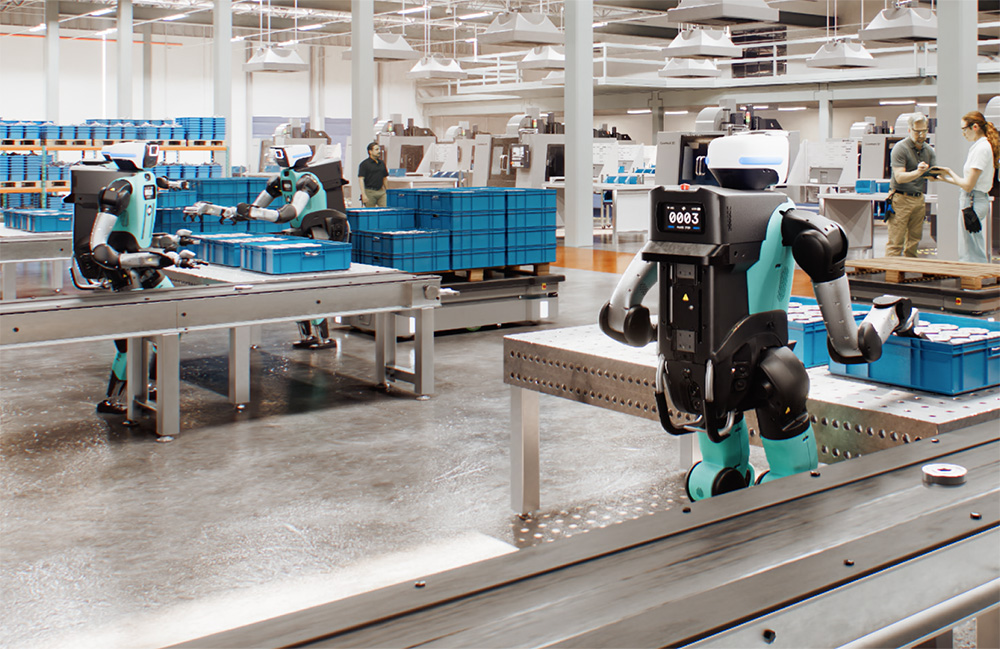
Agility Robotics began trading on the Nasdaq under the ticker AGLT on November 5, after completing its merger with Churchill Capital Corp XI. The Robot Report’s Brianna Wessling tracked the debut: the stock opened at $11.26, above the $10 SPAC reference price, swung between $8.40 and $12.15 during the session, and closed at $11.49, a gain of about two percent. The SPAC transaction generated roughly $465 million in gross proceeds.
The modest gain looks better in context. The Nasdaq fell more than five percent the same day on a selloff in AI-linked stocks, with NVIDIA down more than nine percent and AMD down more than 17 percent. Listed robotics peers fared poorly: Serve Robotics fell more than 12 percent, Symbotic and Intuitive Surgical both declined, and Rockwell Automation dropped more than 14 percent. Wessling attributes the broad weakness to uncertainty about data center investment following the midterm elections.
Agility enters public markets with more than $300 million in committed multi-year orders for Digit 5, its next-generation humanoid, with deliveries to early customers planned for 2027. Digit already operates with GXO, Schaeffler, and Toyota Motor Manufacturing Canada. The company has also signaled that it intends to broaden beyond the bipedal form factor, with wheeled robots and smaller bipedal models in its plans.
A public listing changes the information environment around humanoids. Agility will now report revenue, costs, and deployment figures on a quarterly basis, giving the field its first audited window into what a humanoid business actually looks like. That transparency will test the claims of every private competitor as much as it tests Agility.
Source: The Robot Report
China Blocks SoftBank’s $5.4 Billion Purchase of ABB Robotics Over Robot Data
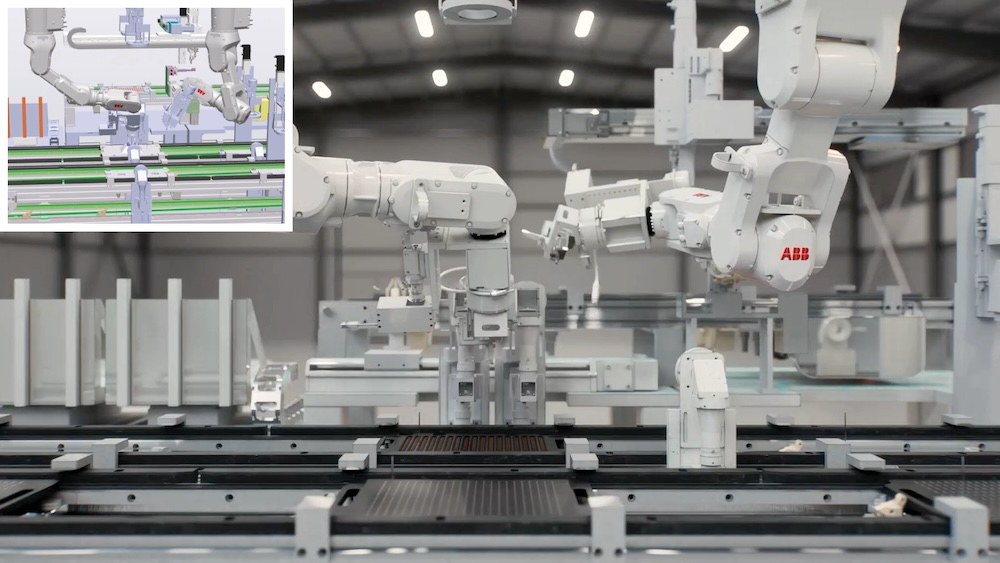
China’s Office of the Working Mechanism for Foreign Investment Security Review has blocked SoftBank Group’s acquisition of ABB Robotics, a deal announced in October 2025 and valued at roughly $5.4 billion. The stated concern, as reported by The Robot Report’s Eugene Demaitre on November 6, is that robot operating data generated in China could be transferred overseas and used to train AI models. ABB Robotics employs about 7,000 people and has more than 500,000 robots installed worldwide, with substantial manufacturing in China.
Demaitre gathered reactions from several analysts. Ash Sharma of Interact Analysis said industrial robotics is increasingly viewed as strategically important technology at the intersection of automation, data, and AI, and that separating the Chinese operation from a global transaction of this scale would be extremely challenging. Samantha Mou, also of Interact Analysis, suggested that rising R&D costs may have motivated ABB’s decision to sell, noting that established manufacturers will need to lead in AI-driven robotics to protect margins against intense competition in traditional robotics.
Robert Little, formerly chief of robotics strategy at Novanta, argued that SoftBank made sense as a partner bringing both investment and an AI focus, and that ABB is now in a difficult position: its robotics unit has considerable AI potential but needs sustained investment to realize it. Little also voiced concern that Chinese robot makers will emerge as stronger competitors. Ahmed Humayun of Gecko Robotics read the decision partly through the lens of heightened Chinese-Japanese tension over asset transfers.
The block is one of several recent government actions treating robots as strategic assets. Demaitre notes that the US Federal Communications Commission has banned new models of certain connected devices including legged robots and autonomous mobile robots, and that the US Commerce Department has determined robotics imports pose a national security threat, opening the door to tariffs. He also recalls that European antitrust scrutiny helped kill Amazon’s acquisition of iRobot, which later went bankrupt and was bought by Shenzhen-based Picea Robotics. The data robots collect on factory floors is now being treated by governments as something closer to a national resource than a byproduct.
Source: The Robot Report
Inside Unitree’s Factory, Humanoids Are Still Built by Hand
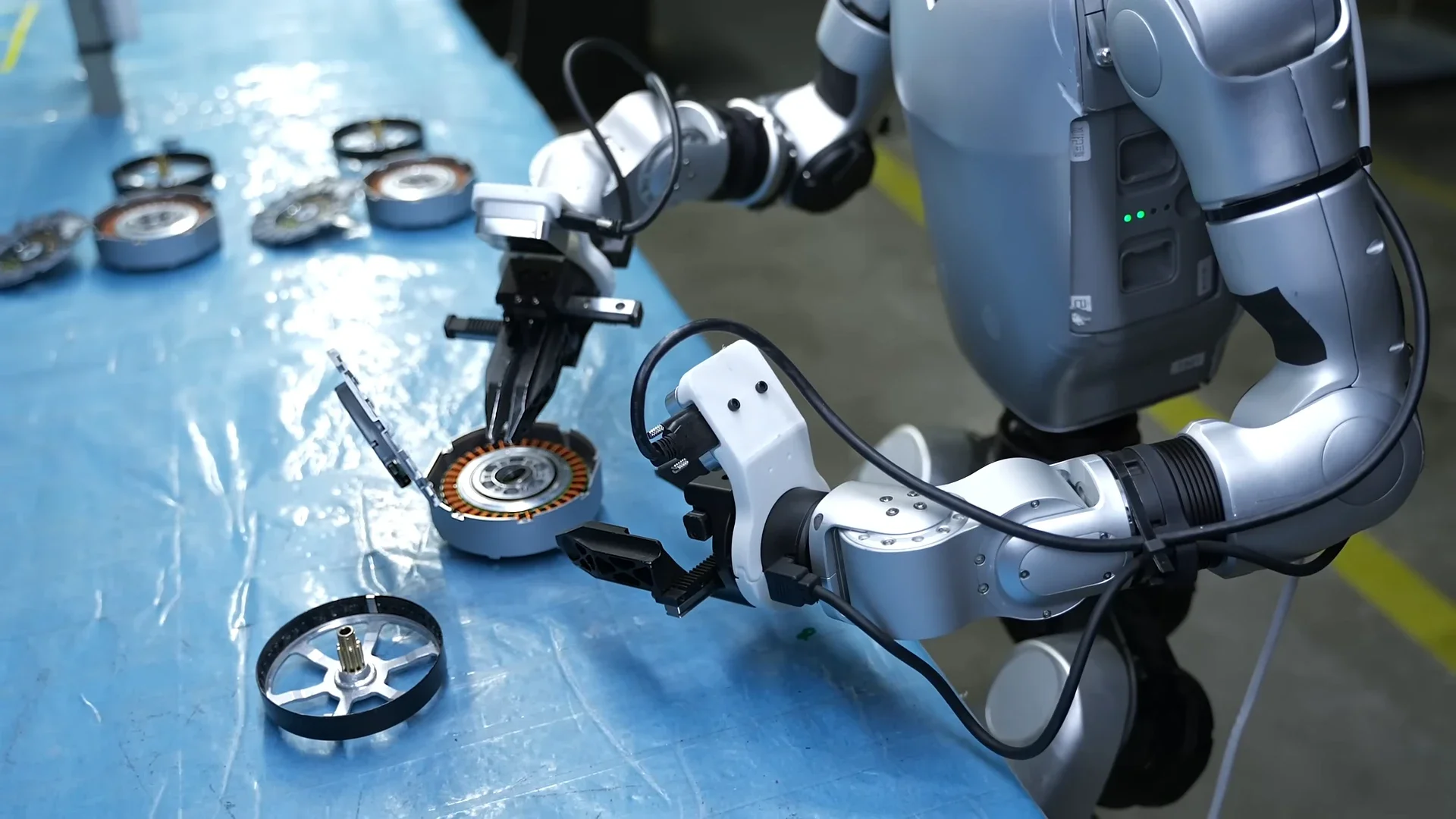
Josef Chen, founder of Kaikaku and an investor in US hardware startups, visited Unitree’s Hangzhou factory on November 5 and published his observations, which Humanoids Daily’s Pontus Armini reported on November 7 alongside figures from Unitree’s IPO filings. Chen saw one or two new automated lines in the actuator building, but most of the floor consisted of workers operating winding machines by hand. Photography was prohibited inside.
The filings support what Chen saw. Unitree’s machinery was valued at approximately $1.7 million at the end of 2025, which works out to roughly $50 in equipment per robot across the 31,980 robots it produced that year. Materials account for about 82 percent of cost of goods sold, overhead about 10 percent, and direct labor about 8 percent, with labor per robot having halved since 2023. Unitree’s February video of G1 humanoids assembling parts drew 28 million views, but the prospectus describes that work as a pilot and states that assembly is currently mainly manual.
Chen’s analysis turns this into an argument about where robotics investment should go. He estimates US factory wages at about 7.5 times Chinese levels, which would push labor to roughly 40 percent of costs for an American humanoid maker and make factory automation worth five to six times more to US manufacturers than to Unitree. The FCC’s July 2026 rule requiring 65 percent US-origin parts for approved foreign-made humanoids, rising to 75 percent by 2029, sharpens that incentive. Armini notes the contrasting approaches of US firms: 1X winds motors in-house in Hayward, California, Figure has scaled its BotQ line to one robot per hour, and Tesla is installing a Fremont line sized for a million units a year.
Chen’s conclusion is that the opportunity is in motors and production lines rather than in another humanoid startup. A humanoid carries 25 to 30 actuators, so a million units a year would require around 25 million motors, and he points to claims that AI has cut robot programming time from 21.5 to 7.9 days as evidence that automating the automation is becoming tractable. Chen discloses investments in several manufacturing startups, so he is talking his book. The underlying facts from the prospectus, though, stand on their own: the humanoid industry’s leading volume producer has not yet automated the making of humanoids.
Source: Humanoids Daily
LiberAI Finds Ten Thousand Hours of Glove Data Beats Two Million Hours of Video
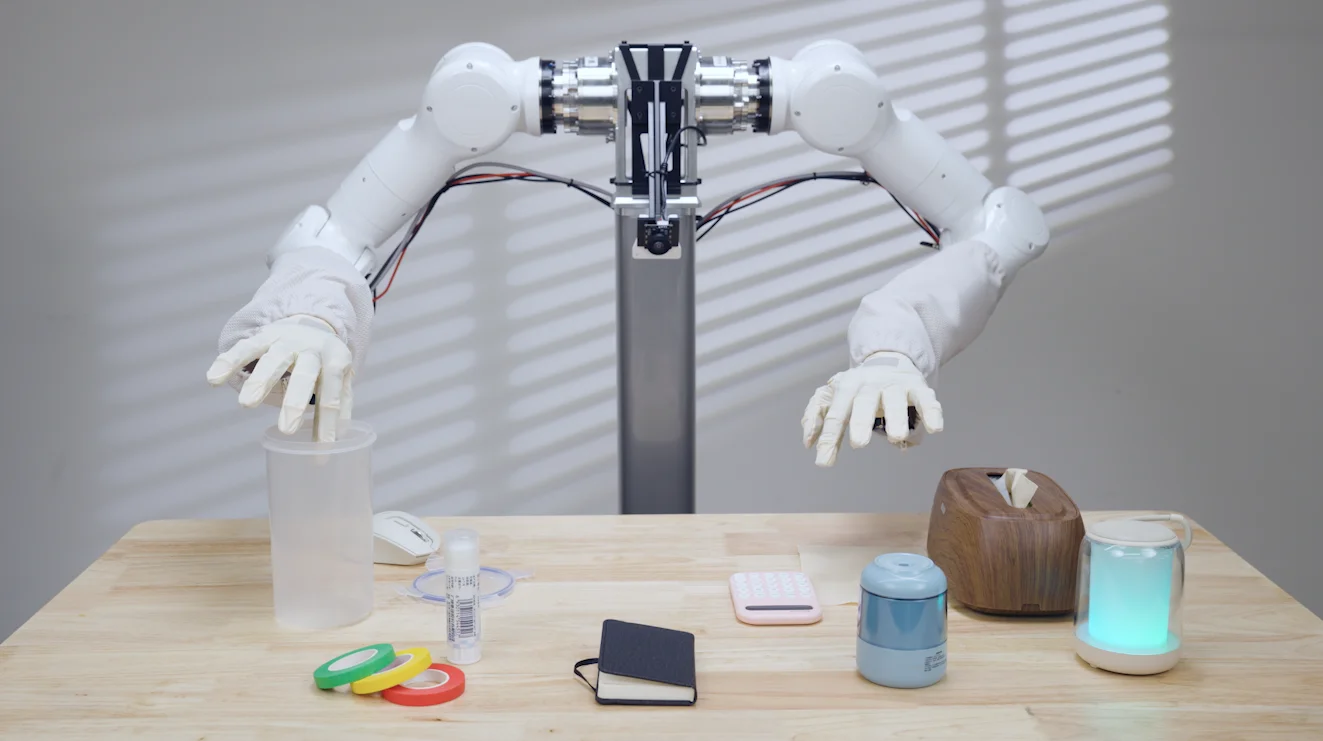
LiberAI, a Beijing startup founded in December 2025, unveiled Liber-0, which it calls a world action model for zero-shot robot manipulation. Humanoids Daily’s November 4 analysis of the technical report details a three-stage training recipe: broad visual prediction from more than 2.2 million hours of human video drawn from the web, joint learning of video frames and actions, and a final manipulation-focused stage. The action supervision comes from a purpose-built sensor glove and from robot teleoperation.
The most striking finding concerns data efficiency. In controlled single-source comparisons, 10,000 hours of recordings from LiberAI’s glove outperformed two million hours of web video, a 200-fold difference in volume. The company attributes this to three gaps that web video cannot close: human viewpoints and hands look different from robot cameras and grippers, pose estimation from video suffers from occlusion and depth errors, and humans and robots move differently to accomplish the same task. The LiberSense glove, 0.3 millimeters thick and weighing 131 grams with a skin-toned exterior, captures hand poses and trajectories along with first-person video from wrist-mounted cameras.
Zero-shot results on 60 tasks proposed by GPT-6 and run across 600 trials show where the approach stands: 36 percent overall success, 63.5 percent on pick-and-place, 34 percent on other manipulation, and 10.5 percent on long-horizon tasks beyond pick-and-place. Those are modest absolute numbers, but the ablations are informative. A policy trained only on pick-and-place robot data scored 2.2 on a progress measure for non-pick-and-place tasks; adding glove recordings of the missing actions such as folding, pressing, and opening raised that to 47.5, and combined glove data reached 54.6, close to the 56.3 achieved by a policy trained on robot demonstrations of every action type.
Diversity of demonstrators mattered too. Holding the number of glove episodes constant while increasing the number of people recording them from one to 100 raised progress scores from 12.7 to 40.1, approaching a robot-only baseline of 51.8. LiberAI acknowledges that the glove captures no contact or force information, which limits insertion, fastening, and soft-material handling, and names tactile sensing and broader home-environment data collection as priorities. The practical message is that cheap human-worn sensors may be a far better route to robot training data than scraping video, a conclusion with implications for every company building manipulation models.
Source: Humanoids Daily
A Humanoid Learns to Walk and Handle Objects Without Ever Seeing the Whole Task

Humanoid robots have a data problem specific to their form. Teaching one to walk to a table and pick something up normally requires demonstrations of the complete sequence, and a single mistake anywhere in a long demonstration spoils the whole recording. Walking and manipulation also use different joints, so a single model trained on both tends to do neither well. Researchers at Seoul National University led by Professor Songhwai Oh presented a framework at IROS 2026 that sidesteps both problems, as reported by TechXplore on November 2.
The system, called RISE for Responsibility-Induced Specialized Experts, pairs a shared vision-language perception model with several specialized action experts and a meta-controller that decides which expert acts. During training, the system computes each expert’s responsibility for a given data point based on how accurately it predicts the action, and routes learning accordingly. Experts specialize naturally, with one gravitating to locomotion and others to manipulation, without anyone assigning those roles in advance. The crucial consequence is that the walking data and the object-handling data can be collected separately, and the robot still learns to chain them.
In simulation, RISE achieved an 87.3 percent success rate on multistep tasks compared with 73.6 percent for a GR00T baseline. On a real Unitree G1 humanoid with 43 controllable degrees of freedom, success was 50 percent against 30 percent for the baseline. Those real-world numbers show how far humanoid loco-manipulation still has to go, but the relative gain is large and the method directly reduces the cost of collecting the data needed to improve it.
The result is complementary to the industry trend toward learning from fragmented human data rather than complete robot demonstrations. If locomotion can be learned from one dataset, manipulation from another, and the combination assembled by a controller that knows which skill is responsible when, then the enormous labor of recording end-to-end humanoid demonstrations becomes less of a prerequisite for general-purpose behavior.
Source: TechXplore