Space Weekly Review 2026-08-22

Week In Review
Reusability stopped being an American monopoly this week. On the morning of August 19, LandSpace brought the first stage of its ZhuQue-3 rocket back to a concrete pad in Gansu Province and set it down on its legs, making the company the first commercial Chinese firm to land an orbital-class booster and only the third entity anywhere to do it. That milestone landed in the same week that SpaceX demonstrated what the far end of the reusability curve looks like in practice: a hundred orbital missions flown in a single calendar year with four months still to go, and two Falcon 9 rockets lifting off 38.5 minutes apart from opposite coasts. One company is proving the technique; another is proving the industrial tempo it eventually enables. The gap between those two milestones is roughly a decade, which is a useful gauge of how fast the rest of the industry is closing.
The week’s astronomy was dominated by a single uncomfortable theme: the early universe keeps turning out to contain more mass than our models put there. A Leiden-led team found that nine massive galaxies from the young cosmos hold three to four times more stellar mass than previously measured, hidden in vast populations of faint low-mass stars that no telescope resolves individually. Closer to home, Hubble observations of 39 globular clusters pushed the Milky Way’s own assembly history 1.8 billion years further back than anyone had documented, pinning a dwarf-galaxy merger to just two billion years after the Big Bang. Both results say the same thing from different directions: galaxy building started earlier and ran harder than the standard picture allowed.
Against that backdrop of things being bigger than expected, several groups spent the week nailing down numbers with unusual precision. The European Southern Observatory unveiled S301, a star whipping around the Milky Way’s central black hole at 8 percent the speed of light — close enough that within a decade its orbit should yield the first direct measurement of Sagittarius A*’s spin. Physicists at Surrey replaced two long-standing theoretical estimates with actual accelerator measurements of reactions that govern how supernovae and neutron-star explosions forge elements. A South African–led radio survey found that dying black hole jets fade far faster than assumed, rewriting the duty cycle of one of the galaxy’s most powerful engines. And a Wisconsin group cataloged a rocky world 23.5 times Earth’s mass squeezed into 2.5 Earth radii — a planet that, by every standard formation model, should have grown a thick hydrogen envelope and did not.
The human-spaceflight note was quieter but not trivial: a six-hour spacewalk outside the International Space Station removed a failed high-speed communications antenna, ran out of clock before the spare could go on, and demonstrated exactly the kind of routine, unglamorous orbital maintenance that a permanent human presence in space actually consists of. Taken together, the week reads as a field maturing in two registers at once — hardware becoming ordinary enough to fly a hundred times a year, and measurements becoming sharp enough to tell us our textbooks are wrong.
Items
LandSpace Lands a ZhuQue-3 Booster, Breaking the Reusability Duopoly
At 7:35 a.m. local time on August 19, LandSpace’s ZhuQue-3 rocket lifted off from the Dongfeng Commercial Space Innovation Pilot Zone in northwestern China. The second stage carried on to orbit with Hongqing Technology’s Honghu 03 satellite aboard. The first stage did something no Chinese commercial booster had done before: it turned around, flew back, relit its engines over the Gansu desert, and settled onto its landing legs at LandSpace Landing Site #1 in Minqin County.
The achievement puts LandSpace in a club of three. Until this week, only SpaceX and Blue Origin had propulsively landed an orbital-class booster on legs. That is a narrower distinction than it sounds — several organizations have recovered boosters by other means, including a Chinese state effort that caught a Long March 10B stage in a sea-based net earlier this summer — but leg landing on a prepared pad is the configuration that makes rapid, low-cost reflight practical rather than merely possible.
This was LandSpace’s second attempt. The first ZhuQue-3 flight, in December 2025, reached orbit successfully but lost the booster during its landing attempt. Getting it right on the second try is a meaningfully faster learning curve than the industry norm; SpaceX needed several years and a string of spectacular failures to convert Falcon 9 recovery from aspiration to routine. LandSpace has said it is targeting a reflight of the recovered stage within months, which is the real test — landing a booster and flying it again are different engineering problems, and the second one is where the economics live.
The broader significance is about market structure. China’s commercial launch sector has been growing quickly but has largely competed on price with expendable vehicles. A domestic reusable medium-lift rocket changes the cost floor for Chinese constellation deployment, including the Guowang and Qianfan megaconstellations that have been launch-capacity constrained. It also means the technology that transformed Western launch economics over the past decade now has an independent second implementation, which tends to accelerate everyone.
Source: Spaceflight Now
SpaceX Passes 100 Orbital Missions in a Single Year
Shortly after midnight on August 21, a Falcon 9 lifted off from Vandenberg Space Force Base carrying 29 Starlink satellites on the Starlink 15-20 mission. It was SpaceX’s 100th orbital mission of 2026 — reached with more than four months left on the calendar.
To put that number in perspective: a hundred orbital launches in a year is more than the entire world managed annually for most of the space age. It is a cadence that requires not just reusable hardware but an industrial system around it — booster refurbishment lines, droneship logistics, range scheduling, payload integration throughput, and a workforce that treats launch as manufacturing rather than as an event. The rocket is arguably the easy part at this point.
The mission also underscored how much of that cadence is dedicated to a single customer: SpaceX itself. The overwhelming majority of these flights carry Starlink satellites, and founder Elon Musk confirmed the same week that the constellation now exceeds 11,000 satellites in orbit. That vertical integration is what makes the tempo economically sustainable — SpaceX does not need to find a hundred external customers per year, because it is its own anchor tenant.
There is a genuine question about what happens to this cadence as Starlink approaches its planned constellation size and as Starship comes online with an order of magnitude more capacity per flight. But for now, the practical effect is that access to low Earth orbit has become something close to a scheduled utility. Payloads that would once have waited years for a ride now wait months, and the marginal cost of putting a small satellite in orbit has fallen far enough that entire categories of mission — Earth observation constellations, in-orbit servicing demonstrators, university science payloads — have become financially reasonable.
Source: Spaceflight Now
Two Falcon 9 Launches, 38.5 Minutes Apart
On August 15, SpaceX launched two Falcon 9 rockets from opposite sides of the country with 38.5 minutes between liftoffs — a company record for turnaround between missions. The first carried eight Globalstar satellites from Cape Canaveral Space Force Station; the second flew a payload for the U.S. Space Force.
The Globalstar payload is itself a quiet piece of infrastructure news. Globalstar operates a low Earth orbit satellite network that provides voice, data, and — increasingly — direct-to-device messaging services, including emergency satellite connectivity built into consumer smartphones. The eight new spacecraft refresh a constellation whose aging is a genuine operational concern; satellite networks that people depend on for emergency communication cannot be allowed to degrade quietly.
The 38.5-minute figure matters more than it might appear. Launching two orbital rockets in under an hour requires two fully independent launch teams, two separate range clearances, and two sets of weather and collision-avoidance approvals converging without conflict. Ranges historically operated on a scale of days between launches, not minutes. Compressing that interval is a bureaucratic and logistical achievement at least as much as a technical one, and it reflects years of work by the Space Force to modernize how Cape Canaveral and Vandenberg schedule airspace and maritime exclusion zones.
For anyone thinking about responsive space capability — the ability to put a replacement satellite up quickly after a failure, or to deploy sensing assets on short notice — this is the relevant demonstration. The constraint on how fast a nation can reconstitute space capability is no longer the rocket. It is increasingly the paperwork and the range, and both are getting faster.
Source: Spaceflight Now
A Star Orbiting Sagittarius A* at Eight Percent the Speed of Light
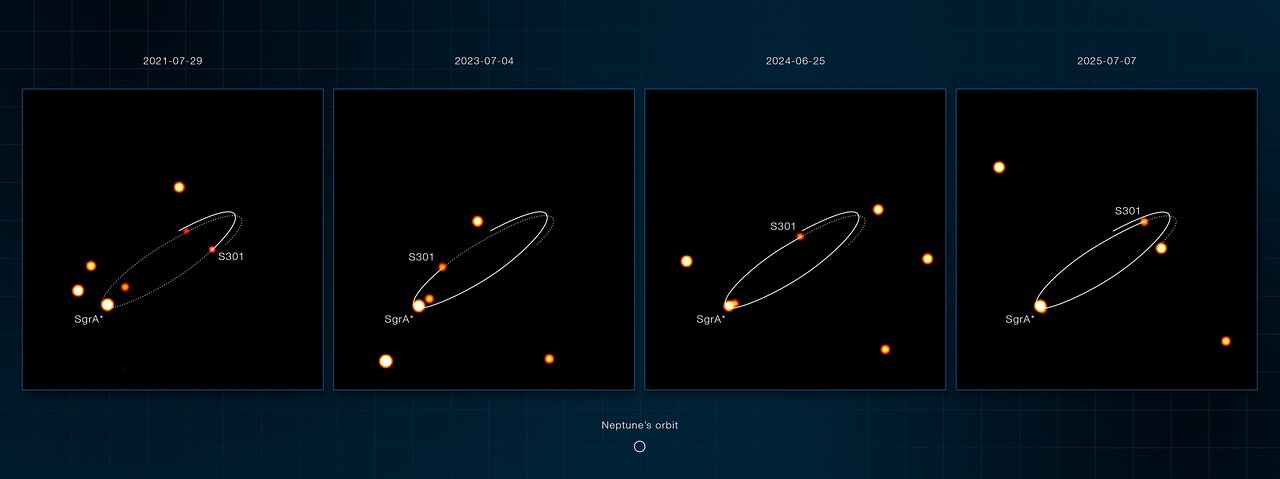
The European Southern Observatory announced on August 19 that astronomers have identified S301, the fastest-moving star ever found in the Milky Way and the closest known to our galaxy’s central supermassive black hole. At its closest approach, S301 passes within about 1.78 billion kilometers of Sagittarius A* — roughly 12 astronomical units, or about 20 percent farther out than Saturn orbits the Sun — while moving at 25,000 kilometers per second. That is eight percent the speed of light.
The star completes a full orbit in 8.7 years, which by the standards of this field is extraordinarily convenient. Previous record-holders among the so-called S-stars took decades to circle the four-million-solar-mass black hole, meaning a single orbit consumed a substantial fraction of an astronomer’s career. S301 was spotted in spring 2023 using the GRAVITY+ instrument on ESO’s Very Large Telescope Interferometer, and by tracing its motion backward through archival data the team confirmed sightings extending to 2017.
What makes S301 scientifically valuable is not its speed for its own sake but what that speed enables. A rotating black hole drags spacetime around with it — the Lense-Thirring effect, a prediction of general relativity that has never been directly measured around a supermassive black hole. S301 passes close enough to feel that dragging as a measurable precession of its orbit. Track it through two complete orbits, and the trajectory becomes constrained tightly enough to read off Sagittarius A*’s spin.
The next close pass is expected in 2031. Team member Felix Mang has said the group hopes to measure the spin within the next ten years. That measurement would matter well beyond relativity tests: a black hole’s spin encodes its accretion and merger history, so pinning down Sagittarius A*’s rotation would constrain how our galaxy’s central engine assembled itself. The results were published in Nature.
Source: European Southern Observatory
Hubble Pushes the Milky Way’s Assembly History 1.8 Billion Years Further Back
A study published in Nature Astronomy and announced on August 17 presents what its authors describe as definitive evidence that a dwarf galaxy merged with the young Milky Way about 11.8 billion years ago — roughly two billion years after the Big Bang. The dwarf galaxy, designated LKH, was previously suspected but not confirmed.
The evidence comes from globular clusters: dense, ancient balls of hundreds of thousands of stars that orbit the galaxy and act as fossils of its formation. The team analyzed Hubble Space Telescope observations of 39 globular clusters within the inner 20,000 light-years of the Milky Way, the region where traces of the oldest mergers should still be preserved. Clusters that arrived with an accreted galaxy carry distinctive chemical signatures and orbital properties that distinguish them from clusters formed in place.
The significance is chronological. Astronomers have long known the Milky Way grew by consuming smaller galaxies — the Gaia-Sausage-Enceladus merger, identified in the past decade, is the best-documented example. But that event dates to roughly 10 billion years ago, and it had marked the practical limit of our galaxy’s reconstructable history. Confirming LKH extends the record 1.8 billion years deeper into the past, into an era we could previously only study in other galaxies at enormous distance.
That matters because the Milky Way is the only large galaxy whose individual stars we can resolve and chemically fingerprint in bulk. Every year of history we can reconstruct here is a calibration point for models of how galaxies assemble everywhere. Knowing that our galaxy was already cannibalizing neighbors within two billion years of the Big Bang tightens constraints on how quickly structure formed in the early universe — and dovetails with the growing body of evidence that early galaxies were more massive and more developed than the standard picture predicted.
Source: ESA/Hubble
‘Hidden’ Small Stars Make the First Galaxies Three to Four Times More Massive
Astronomers led by Mariska Kriek at Leiden University reported in Nature Astronomy on August 18 that the most massive galaxies in the young universe contain far more small, faint stars than anyone had accounted for — and are therefore three to four times more massive than previous measurements indicated.
The measurement problem here is fundamental. At the distances involved, individual stars are utterly unresolvable; astronomers infer a galaxy’s stellar mass from its total light, using an assumed distribution of star masses called the initial mass function. Small, dim, long-lived stars contribute almost nothing to a galaxy’s brightness but a great deal to its mass. If a galaxy has more of them than assumed, its mass has been systematically underestimated, and there is no way to tell from a brightness measurement alone.
The team got around this by combining exceptionally deep James Webb Space Telescope spectra with earlier Very Large Telescope observations of nine massive galaxies that had already finished their main star-forming phase. Specific spectral features are sensitive to the presence of low-mass stars even when those stars contribute negligible light, which let the researchers determine for the first time how many small stars these distant galaxies actually contain. The answer was a “bottom-heavy” initial mass function — far more small stars than the standard assumption.
“This result shows that much more mass than we thought is hidden in small stars,” Kriek said. The consequence is that models of galaxy formation now have a harder problem to solve: they must explain how such enormous numbers of stars formed so early. There is also an intriguing corollary. Most known exoplanets orbit low-mass stars, so a universe with substantially more small stars in its first galaxies may also be a universe in which planets formed considerably earlier and in greater abundance than assumed.
Source: Leiden University
A ‘Mega-Earth’ 23 Times Our Mass That Should Not Exist
Researchers at the Wisconsin Center for Origins Research announced GJ 523b, the center’s first cataloged exoplanet — and a world that standard planet-formation theory has trouble accommodating. It is about 2.55 times Earth’s radius but 23.5 times Earth’s mass, yielding a bulk density of 7.8 grams per cubic centimeter. That is denser than Earth itself.
The problem is straightforward. In conventional core-accretion models, a rocky core growing past roughly ten Earth masses in a young protoplanetary disk should begin runaway accretion of hydrogen and helium, ballooning into a gas-rich sub-Neptune or a full gas giant. GJ 523b apparently reached more than twice that threshold and stayed essentially bare rock. Either it formed late, after its disk’s gas had already dissipated, or it acquired an envelope and subsequently lost it, or something in the standard picture needs adjusting.
The system offers a clue in its youth: it is estimated at only about 170 million years old, which is recent enough that whatever happened is not deeply buried in the past. Another oddity is the orbit. GJ 523b travels on a path inclined at least 71 degrees to its star’s equator — a near-polar orbit, more like a satellite passing over Earth’s poles than a planet tracing its star’s equatorial plane. Strongly misaligned orbits usually indicate a violent dynamical history: a close encounter with another planet, or gravitational interaction with a distant companion.
That combination — extreme density, extreme mass for a rocky body, and a wildly tilted orbit — makes GJ 523b a useful test case rather than merely a curiosity. The paper, led by graduate student Max Kroft in Thomas Beatty’s group at UW–Madison, is currently under review and available as a preprint. Objects that break models are how formation theory gets better, and this one appears to break several at once.
Source: University of Wisconsin–Madison College of Letters & Science
Dying Radio Galaxies Fade Far Faster Than Anyone Expected
When a supermassive black hole stops powering its jets, the enormous radio-emitting lobes it has inflated do not vanish immediately. They linger as fading “remnant” radio galaxies — cosmic ghosts that slowly dim as their electron populations lose energy. How long that afterglow lasts sets an important clock: it determines how often we should expect to catch black holes in the act of switching off, and by extension how the duty cycle of jet activity works.
A study announced August 18 and published in Monthly Notices of the Royal Astronomical Society suggests that clock runs considerably faster than assumed. Led by researchers at the University of Cape Town and the Inter-University Institute for Data Intensive Astronomy, the team examined 14 candidate remnant radio galaxies in the XMM–LSS deep field, combining MeerKAT’s MIGHTEE survey and the upgraded GMRT’s superMIGHTEE survey with complementary data from LOFAR, GMRT, and the Jansky Very Large Array. The combination spans 144 megahertz to 1.5 gigahertz — an unusually broad frequency baseline, which is what makes precise spectral aging possible.
Detailed modeling confirmed 12 of the 14 as genuine remnants and returned spectral ages of roughly 8 to 42 million years. That is young by the standards of this field, implying that the fading phase is both shorter and more dynamic than the standard picture allowed. The team also found a significant negative relationship between redshift and spectral age: remnants in the more distant, earlier universe appear to fade faster still, and therefore stay detectable for shorter windows.
The practical implication is a selection bias correction. If remnants fade quickly, then surveys have been systematically undercounting how often black hole jets shut down, which means the duty cycle of active galactic nuclei — how much of their lives these engines spend switched on versus off — needs revision. The result is also a demonstration of what the MeerKAT array, a precursor to the Square Kilometre Array, can do with deep-field radio data, and a preview of the population statistics the full SKA will deliver.
Source: University of Cape Town via EurekAlert
Physicists Replace Theory With Measurement in Two Key Stellar Explosion Reactions
Nuclear astrophysics has a persistent awkwardness: models of how stars explode and forge elements depend on reaction rates involving unstable nuclei that are extremely difficult to make and study in a laboratory. Many of those rates have been theoretical estimates. On August 17, the University of Surrey announced results from two experiments, published as separate papers in Physical Review Letters, that replace two such estimates with actual measurements.
The first concerns titanium-44, a radioactive isotope produced in core-collapse supernovae and detectable in supernova remnants by gamma-ray telescopes. Because we can observe how much titanium-44 a given remnant contains, it functions as a direct probe of conditions deep inside the explosion — but only if we know the rate of the nuclear reaction that controls its production. Working at Argonne National Laboratory, the Surrey team obtained the first experimental data constraining that rate.
The second experiment addressed Type-I X-ray bursts, the most frequent explosions in our galaxy. These occur when a neutron star in a close binary siphons hydrogen and helium from its companion until the accumulated fuel ignites in a thermonuclear runaway driven by the rapid proton capture process. At the Facility for Rare Isotope Beams, the team produced a beam of copper-59 nuclei, accelerated it to a substantial fraction of light speed, and directed it into a deuterium target — a technique called single-nucleon transfer spectroscopy that probes the structure of an unstable nucleus. The measurement addressed the copper-59 to zinc-60 capture rate and returned a more nuanced picture than the prior estimate.
Neither result will make headlines the way an image of a distant galaxy does, but this is the unglamorous foundation the rest of the field rests on. Every claim about which elements come from which kind of explosion — the origin of the calcium in your bones, the iron in your blood — traces back through a chain of reaction rates. Converting two more of those links from estimate to measurement makes the whole chain more trustworthy.
Source: University of Surrey
A Six-Hour Spacewalk, a Failed Antenna, and the First French Woman to Perform an EVA
NASA astronaut Anil Menon and ESA astronaut Sophie Adenot exited the International Space Station’s Quest airlock at 8:29 a.m. EDT on August 18 to replace a failed Space-to-Ground antenna — one of the units that carries high-rate data between the station and ground controllers. They returned six hours and 23 minutes later having removed the failed unit but without having installed its replacement.
Running out of time is a normal outcome in extravehicular activity. Spacewalks operate under hard limits set by suit consumables and crew fatigue, and the timeline is built around removing hardware before installing hardware precisely because removal is the step that must not be left half-finished. Flight controllers were weighing whether to fit the antenna installation into an already-scheduled spacewalk the following Tuesday or defer it to a later EVA. The station’s communications capability was not compromised in the interim; redundancy is the entire design philosophy of the system.
This was the 282nd spacewalk devoted to station assembly and maintenance, and the fifth of 2026. Cumulative EVA time in support of the ISS now stands at 74 days, 10 hours, and 44 minutes — more than two months of continuous human work performed in vacuum, one shift at a time, over more than a quarter century.
For Menon it was a second career spacewalk; for Adenot it was a first, and it made her the first French woman to perform one. It is worth noting what that milestone consists of in practice: not a symbolic gesture but a genuinely difficult day of technical labor, wrestling with a stuck antenna in a pressurized suit. As orbital infrastructure grows — commercial stations, servicing vehicles, larger constellations — the ability to send a person outside to fix something remains a capability with no substitute, and every one of these routine maintenance EVAs is a rehearsal for a future in which far more of it will be needed.
Source: Spaceflight Now