Space Weekly Review 2026-08-29

Week In Review
The week’s dominant thread was instrumentation — the machinery that turns questions into measurements. It closed with NASA and SpaceX clearing the Nancy Grace Roman Space Telescope for flight in NASA’s Roman Space Telescope ‘Go’ for Launch, an observatory built to survey wide swaths of sky rather than stare at single targets. That capability speaks directly to two of the week’s other stories. The reopened argument over whether cosmic expansion is still accelerating, laid out in The crisis in cosmology continues: Critical problems in a recent defense of cosmic acceleration, turns on subtle systematic biases in supernova samples — exactly the kind of dispute that a large, uniformly calibrated survey is designed to settle. And Gamma-ray signal could be long awaited evidence for WIMPs reports a tantalizing but unstable dark-matter candidate signal whose authors are explicit that confirmation requires a better instrument than the one that found it.
A second thread concerned what resolution buys you. NASA’s Webb telescope rules out two new Dyson sphere candidates is a negative result in the most useful sense: two stars flagged as possible alien megastructures turned out to be ordinary M dwarfs sitting in front of distant dusty galaxies, a confusion that only sharper imaging could resolve. The same logic runs through planetary science this week. Thermal anomaly discovered below Mars’ south pole extracted a three-dimensional picture of a planet’s interior from decades of accumulated spacecraft tracking data, and Did ocean motion carve Enceladus’s tiger stripes? proposed that the spacing of four famous fractures encodes the behavior of a hidden sea. On Mars itself, Curiosity Reaches 1-Kilometer Elevation Gain marked a milestone that is really a statement about persistence: a vertical kilometer of stratigraphy read one layer at a time.
The theoretical work matched the observational. Why some lava-covered exoplanets retain atmospheres for billions of years offers a framework explaining why some of the most brutally irradiated rocky worlds hold onto thick air — a prediction that becomes testable precisely because telescopes like Roman and Webb can now measure atmospheres on small planets. Meanwhile the industrial substrate underneath all of this kept compounding. SpaceX launches Starlink mission on a Falcon booster’s record-breaking 37th flight pushed orbital-class reuse past a threshold that would have seemed implausible when that booster first flew, and NorthStar to deploy 11 sensors on Kepler relay satellites to track objects in orbit addressed the direct consequence of cheap, frequent launch: an orbital environment crowded enough that knowing where everything is has become its own infrastructure problem.
Items
NASA’s Roman Space Telescope Cleared for Launch
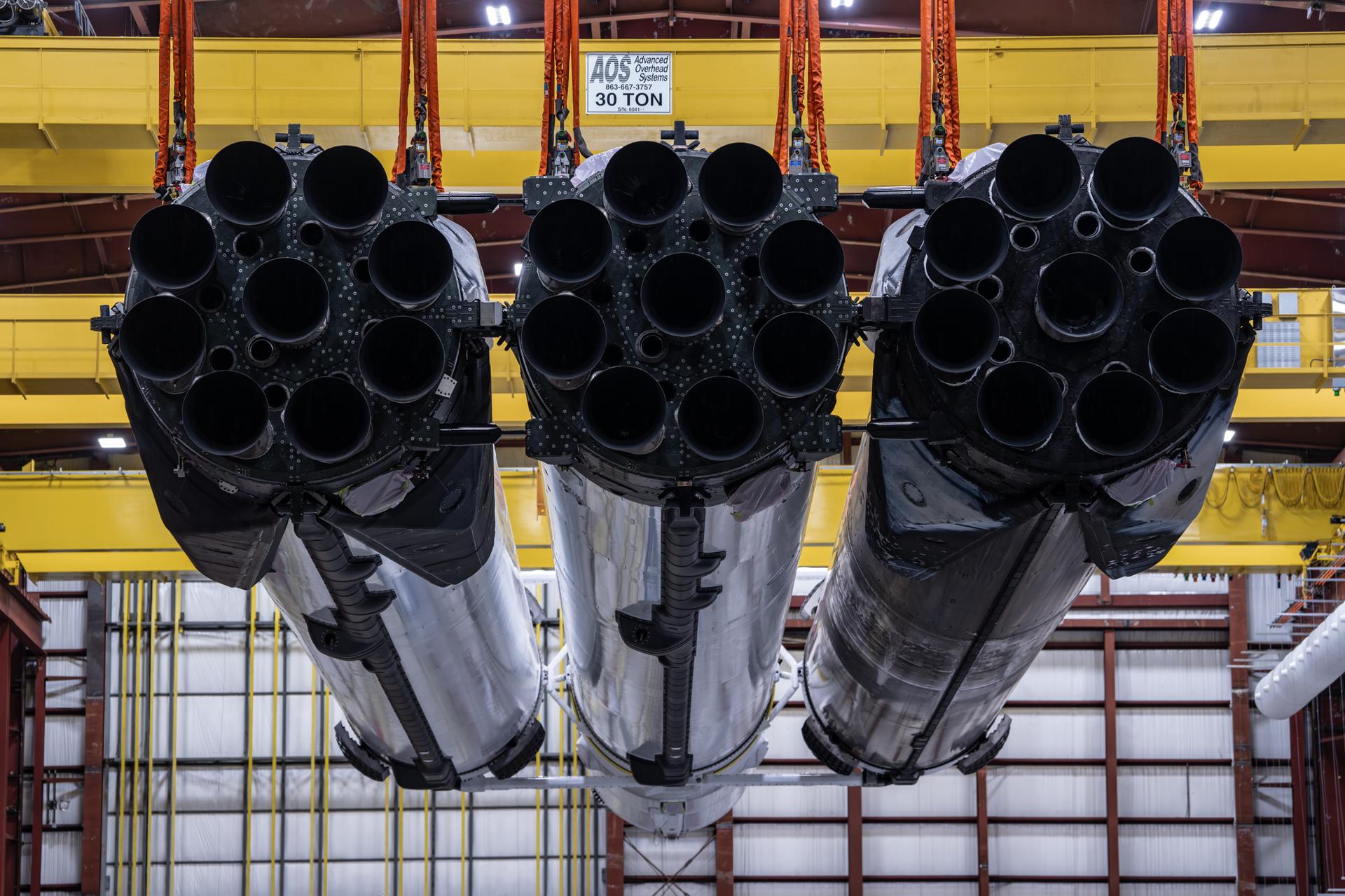
NASA and SpaceX completed the Launch Readiness Review for the Nancy Grace Roman Space Telescope on Friday at Kennedy Space Center, clearing the observatory for liftoff. According to NASA’s mission blog, the review confirmed the readiness of the Falcon Heavy rocket, the observatory itself, the weather outlook, and the supporting teams. Launch is set for Sunday, August 30 at 7:26 a.m. EDT from Launch Complex 39A, with forecasters giving a 60% chance of favorable conditions.
Roman is designed around a different observing philosophy than the telescopes most people picture. Where Hubble and Webb excel at deep, narrow examination of individual targets, Roman is a survey instrument — built to image large areas of sky repeatedly and systematically. NASA describes its core objectives as investigating dark energy and dark matter, discovering exoplanets, mapping billions of galaxies, and studying black holes.
That survey approach matters because several of the most contested questions in astrophysics are fundamentally statistical. Whether dark energy is a constant or something that evolves over cosmic time is a question about the shape of a curve fitted to enormous numbers of objects, and the answer is currently hostage to systematic uncertainties rather than to any shortage of raw signal. Similarly, finding planets by gravitational microlensing — where a foreground star briefly magnifies a background one — requires monitoring vast numbers of stars continuously, because you cannot predict which star will do the lensing.
NASA notes that Roman will be the sixth agency primary mission to launch on a Falcon rocket from Kennedy, following IXPE, Psyche, GOES-U, Europa Clipper, and IMAP. That list is itself a marker of how thoroughly commercial launch has been absorbed into the flagship-science pipeline; a decade ago the roster of vehicles trusted with billion-dollar observatories looked very different.
Source: NASA Science
Curiosity Passes One Vertical Kilometer on Mount Sharp
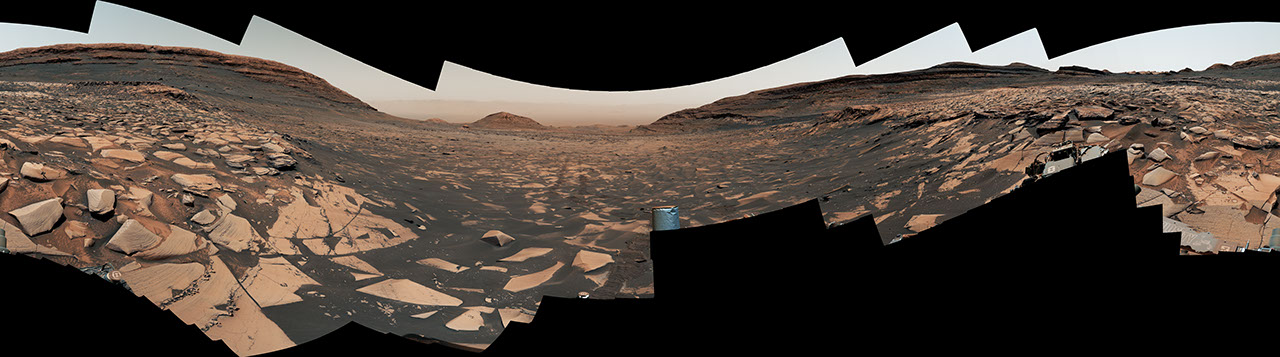
NASA’s Curiosity rover marked a full kilometer of elevation gain this week, fourteen years into a mission that has spent most of that time climbing the flanks of Mount Sharp, the roughly five-kilometer mountain rising from the floor of Gale Crater. To mark the occasion, the mission released a panorama assembled from 323 individual Mastcam frames captured on August 1 and 2 — sols 4,972 and 4,973 of the rover’s time on Mars.
The view looks back down the route Curiosity has traveled, across a broad depression the team calls Valle Grande, toward the floor and northern rim of Gale Crater fading into the dusty summer atmosphere. It is an unusually legible image of a rover’s own history: the tracks recede into the distance, and the terrain in the foreground is younger, higher rock than anything visible on the horizon.
The elevation number is not vanity. Mount Sharp is a layered stack, and each meter of climb moves the rover through a slightly later chapter of Martian environmental history — from sediments laid down in standing water toward material deposited as the planet dried. A vertical kilometer is therefore a vertical kilometer of stratigraphy, sampled and analyzed in place rather than inferred from orbit.
NASA frames the scientific payoff in terms of the mission’s founding question: whether Gale Crater ever offered conditions where microbial life could have survived. Reading the sequence of layers is how that question gets answered, and the pace — a kilometer in fourteen years — reflects how much analysis each layer receives on the way up.
Source: NASA Science
Mars’s Southern Interior Is Hundreds of Degrees Warmer Than Its North
A Caltech-led team reported in Nature that the interior of Mars’s southern hemisphere is substantially warmer than its northern one — by roughly 200 to 400 degrees Celsius — and appears to be partially molten. The work, led by Alexander Berne, upends a working assumption that has quietly underpinned decades of planetary modeling: that a planet’s interior is more or less spherically symmetric.
The method is as interesting as the result. The team used what they call tidal tomography, measuring how the Sun’s gravitational pull deforms Mars differently at different points in its elliptical orbit. Because a warmer, softer interior flexes more than a cold, rigid one, the pattern of seasonal deformation encodes the planet’s three-dimensional internal structure. Extracting that signal required three decades of accumulated radio-tracking data from Mars Global Surveyor, Mars Odyssey, and Mars Reconnaissance Orbiter — spacecraft that were not designed for this measurement, and most of which are no longer operating.
The finding ties together several loose threads. Mars’s southern highlands carry strong remnant magnetization in their iron-bearing minerals, a signature that has never been fully explained. NASA’s InSight lander also recorded seismic waves dissipating faster than expected as they crossed the interior. A hemispherically warm, partially molten south accounts for both.
What produced the asymmetry remains open. The paper canvasses three possibilities: an enormous ancient impact that vented heat from the northern hemisphere, a spontaneous episode of one-sided mantle convection, or thick geological structures in the south that trapped heat which would otherwise have escaped. Each implies a different early history, including different consequences for where liquid water could have persisted.
Source: Phys.org
Webb Retires Two Dyson Sphere Candidates
Project Hephaistos, an Uppsala University–led search for hypothetical alien megastructures, used the James Webb Space Telescope to examine two M-dwarf stars that had emerged as its most promising candidates — and found conventional explanations for both. The results are reported in Monthly Notices of the Royal Astronomical Society.
The search logic behind Dyson sphere hunting is straightforward: a civilization that captured a large fraction of its star’s output would re-radiate that energy as waste heat, producing more infrared light than the star alone should emit. Hephaistos combed roughly a million stars within about 1,000 light-years for exactly that excess. Two M dwarfs survived the initial cuts.
Webb resolved them. In both cases the extra infrared came not from the star but from a background galaxy that happened to lie along the same line of sight. One is consistent with a hot dust-obscured galaxy; the other shows an extended shape with bright knots, characteristic of a dusty starburst. Neither had been separable in the original data because Gaia and WISE, the surveys that flagged the candidates, blend light from sources too close together on the sky to distinguish.
The team is candid that this contamination is a structural limitation rather than a one-off, and notes that proposed mid-infrared telescopes with finer spatial resolution — targeted for the 2030s — would substantially reduce it. That is the honest shape of technosignature research: most of the work consists of eliminating mundane explanations, and each elimination sharpens the method for the next round.
Source: Phys.org
A 43 Billion-Electron-Volt Line That Might Be Dark Matter
Researchers at the Chinese Academy of Sciences, led by Yi-Zhong Fan, report in Physical Review Letters a narrow gamma-ray spectral line at approximately 43 billion electron volts in data from the Fermi Gamma-ray Space Telescope. The analysis draws on more than fifteen years of observations across thirteen nearby massive galaxy clusters, with the strongest signals coming from Virgo, Fornax, and Ophiuchus.
A spectral line is a much stronger claim than a general excess of gamma rays. Astrophysical processes tend to produce smooth, broad emission across a range of energies; a sharp spike at one specific energy is hard to generate by ordinary means. It is, however, exactly what you would expect if weakly interacting massive particles — the long-favored dark matter candidate — annihilate in pairs, converting their rest mass into photons of a characteristic energy. The team argues that a clean, sharp spike would be considerably harder to explain with known physics than with new physics.
The researchers took the obvious precaution of checking the galactic center, where a previous claimed line signal turned out to be instrumental. This one survives that check. What it does not survive is the test of stability: the signal’s apparent strength fluctuates over the observation period, dipping notably in 2016, which is not how a genuine dark matter signal from a fixed population of clusters should behave.
That leaves the finding suggestive rather than settled — a distinction the authors themselves draw. Their proposed resolution is a next-generation instrument, the Very Large Area Gamma-ray Space Telescope, with the collecting area and energy resolution to either confirm the line decisively or dissolve it into noise. Given the field’s history of promising signals that faded under scrutiny, that caution is well placed.
Source: Phys.org
The Fight Over Cosmic Acceleration Reopens
The Yonsei University group that argued last year that the universe may no longer be accelerating has published a rebuttal to its critics, and the dispute over one of modern cosmology’s foundational results is now firmly unresolved. The new analysis, led by Chul Chung with Young-Wook Lee in Monthly Notices of the Royal Astronomical Society, targets a June 2026 paper from a University of Southampton–led team that had defended the standard accelerating-universe picture.
The underlying issue is that Type Ia supernovae — the standard candles used to measure cosmic expansion — are not perfectly standard. Their brightness depends in part on the age of the stellar population that produced them, and stellar populations were systematically younger in the distant past. If that age dependence is not corrected for, it can masquerade as a change in expansion rate. The Yonsei group’s original claim was that correcting for it eliminates the evidence for present-day acceleration, implying instead that expansion has already begun to slow and that dark energy is weakening over time rather than holding constant.
The new paper makes two specific technical objections to the rebuttal. First, Chung argues that combining supernovae across an unusually wide redshift interval artificially flattened the measured age-bias slope, producing a shallow correction as an artifact of the binning rather than a property of the data. Second, the rebuttal’s treatment of dust extinction requires a dependence on host-galaxy mass that runs opposite to the trend seen in large galaxy samples — a model choice the Yonsei team says lacks observational support.
Their conclusion is that a consistent treatment of progenitor-age evolution leaves the original correction essentially intact. Whether that holds up is now a question for the wider community, and it is one where a large, homogeneously calibrated supernova sample would help enormously — which is part of why the launch of a dedicated wide-field survey telescope this same week is more than a coincidence of timing.
Source: Phys.org
Waves in a Hidden Ocean May Have Cut Enceladus’s Tiger Stripes
Saturn’s moon Enceladus carries four roughly parallel fractures across its south polar terrain — the “tiger stripes” — from which plumes of water vapor and ice erupt into space. A study in AGU Advances led by D. Y. Abdulah proposes that these fissures were shaped not by the ice shell alone but by waves moving through the ocean beneath it.
The stripes are substantial features: about 500 meters deep, two kilometers wide, and 130 kilometers long, spaced with a regularity that has been difficult to explain. Any successful model has to account not just for their existence but for their spacing.
The proposed mechanism starts with Enceladus’s eccentric orbit, which causes the moon’s ice shell to rock back and forth relative to the ocean underneath. Once an initial crack exists, that rocking motion excites waves in the ocean. The waves propagate along the seafloor, reflect upward, and break against the underside of the ice adjacent to the original fissure. The energy deposited by that breaking melts ice from below, thinning the shell at particular distances from the first crack and setting up the next fracture.
Computational modeling of this process predicts parallel fractures spaced roughly 35 kilometers apart — close to what Cassini actually observed. The result is appealing partly because it is falsifiable in a specific way: the predicted spacing depends on how the subsurface ocean’s density is layered, so a future mission that measured the stripes precisely could work backward to constrain the structure of a sea no spacecraft has ever seen.
Source: Phys.org
The “Cosmic Sandbar”: Why Some Lava Worlds Keep Their Air
Stanford researchers have proposed an explanation for a persistent oddity in exoplanet observations: some rocky planets orbiting punishingly close to their stars appear to retain thick atmospheres, even though stellar radiation at those distances should have stripped them away long ago. The work, led by Barron Nguyen, appears in The Astrophysical Journal Letters.
The existing organizing idea in this area is the “cosmic shoreline” — a rough dividing line, set by a planet’s gravity and the radiation it receives, separating worlds that keep atmospheres from those that do not. It works well for cooler planets. It does badly for the hottest ones, some of which sit deep in supposedly airless territory while showing clear atmospheric signatures.
Nguyen’s team extends the framework with what they call a cosmic sandbar. On a sufficiently massive planet whose surface has been melted into a global magma ocean, that molten rock continuously outgasses volatiles into the atmosphere. If the outgassing rate roughly matches the rate at which stellar radiation strips gas away, the planet reaches a steady state and can hold an atmosphere for billions of years. The picture yields three regimes rather than two: the classic shoreline where cool planets keep their air, the sandbar where hot lava worlds resupply theirs as fast as they lose it, and between them an “airless valley” where planets cool too quickly to replenish what escapes.
The motivating case is 55 Cancri e, a super-Earth of roughly eight Earth masses orbiting about twenty times closer to its star than Mercury orbits the Sun. Webb observations have found it to have a surprisingly dense atmosphere. Under the sandbar model that stops being an anomaly and becomes the expected behavior for a planet of its mass and temperature — a prediction that upcoming atmospheric surveys of small planets can test directly.
Source: Phys.org
A Falcon 9 Booster Flies for the 37th Time
SpaceX launched 29 Starlink satellites from Space Launch Complex 40 at Cape Canaveral on the Starlink 10-49 mission, using first-stage booster B1067 on its thirty-seventh flight — a new record for orbital-class reuse. Spaceflight Now reports the vehicle lifted off at 5:33 a.m. EDT and the booster landed on the droneship A Shortfall of Gravitas in the Atlantic roughly eight and a half minutes later.
The number is worth sitting with. B1067 entered service in June 2021. Falcon 9 boosters were originally certified for ten flights, with the fleet leader’s flight count raised incrementally as SpaceX accumulated inspection data on how the hardware actually ages. Thirty-seven flights from a single first stage is close to airline-style utilization of a vehicle that spends part of every mission in hypersonic flight through its own exhaust plume.
Spaceflight Now notes the landing was the 165th aboard that particular droneship and the 654th Falcon booster recovery overall. Those cumulative figures are the real story: recovery has moved from a demonstration to a logistics operation, with the marginal cost of a Starlink launch driven mostly by the expendable upper stage, the payload, and range operations rather than by the first stage.
The report adds a note of transition — this may be the last Starlink launch from Cape Canaveral for a while, as SpaceX has redirected part of its workforce there toward Starship preparations. Falcon 9’s reuse record and the ramp toward a fully reusable successor are, in that sense, two halves of the same program.
Source: Spaceflight Now
Hosting Space-Surveillance Sensors on Someone Else’s Satellites
NorthStar Earth & Space and Kepler Communications, both Canadian, announced an agreement to put eleven optical space-domain-awareness sensors aboard Kepler’s next generation of data relay satellites, SpaceNews reports. The sensors will fly across two launches scheduled for 2028; the manufacturer has not yet been named.
The architectural idea is hosted payloads — rather than building and launching dedicated surveillance satellites, NorthStar buys space on a constellation someone else is deploying anyway. That collapses the cost of getting sensors into orbit and, because Kepler’s business is data relay, it also solves the problem of getting observations back to the ground promptly. Kepler’s chief executive framed the arrangement as integrated infrastructure, pairing sensing with timely and reliable access to the resulting data.
The performance targets are meaningful. NorthStar expects the eleven-sensor network to reach up to 98% sky coverage with revisit times of 20 to 30 minutes for resident space objects. Revisit rate is the constraint that matters most for collision avoidance: a conjunction warning is only actionable if you can refresh the orbit determination fast enough to distinguish a real close approach from an artifact of stale data. The company’s original four satellites, launched in January 2024, can detect objects as small as five centimeters in low Earth orbit.
The need follows directly from the rest of this week’s news. Every record-setting reuse milestone and every new broadband constellation adds objects to a finite volume of space. Tracking capacity has to scale with launch capacity, and doing it by hitching sensors to commercial constellations is a considerably faster path than procuring a purpose-built system.
Source: SpaceNews