Space Weekly Review 2026-11-07

Week In Review
Two spacecraft at opposite ends of their careers framed the week. Voyager 1, launched in 1977 and losing about four watts of power a year, went silent for 48 hours in October until engineers at the Jet Propulsion Laboratory swapped three power-hungry units for lighter ones in a single maneuver they nicknamed the “Big Bang.” The fix keeps its remaining science instruments alive, and on November 18 the probe will become the first human artifact one full light-day from Earth (Big Bang Fix Puts Voyager Across the One Light-Day Mark). At the other extreme, NASA’s twin ESCAPADE spacecraft, barely a year old, are flying a trajectory no Mars mission has used before: a powered Earth flyby that combines a gravity assist with a nine-minute engine burn to reach the Red Planet in 2027 (NASA’s Twin ESCAPADE Spacecraft to Slingshot Past Earth on Way to Mars). Both are stories about squeezing more out of hardware than its designers strictly planned for, and both suggest how much mission life is a matter of ingenuity after launch.
The week’s science came disproportionately from reprocessing and reinterpreting existing data. A Northwestern team’s “digital twin” of the James Webb Space Telescope’s optics pulled the giant planet 51 Eridani b out of two-year-old observations where conventional processing had seen only glare (Giant Planet Emerges from Two-Year-Old JWST Data Thanks to Glare-Removal Technique). Webb’s spectra of the interstellar comet 3I/ATLAS resolved a puzzle about missing water-ice features and, in the process, suggested that the same dusty-ice explanation may apply to the Kuiper Belt objects of our own solar system (Interstellar Visitor 3I/ATLAS Shows Water Ice Behaves the Same Across Alien Star Systems). Johns Hopkins physicists argued that one of Webb’s enigmatic “little red dots” may be a primordial black hole older than the first stars (Webb Space Telescope’s Little Red Dots Could Hold Key to First Black Holes). Closer to home, the Rubin Observatory’s preview data yielded an ultra-faint dwarf galaxy and a dust-shrouded globular cluster (The Vera Rubin Has Found Two More of the Milky Way’s Dim Satellites), and the ExoMars Trace Gas Orbiter’s years of hydrogen chloride measurements over Alba Mons added up to the strongest case yet that Mars is volcanically dormant rather than dead (European Orbiter Detects Fresh Hints of Volcanic Activity on Mars).
The forward-looking items concerned what gets built in space and by whom. A Caltech robot assembled a truss bay in orbit without human control, the first autonomous construction of a structure in space, under a DARPA program aimed at antennas hundreds of meters across (Robot Successfully Builds Space Structure in First Autonomous Construction Demo). China laid out the architecture of its crewed lunar landing, two Long March 10 launches and a lunar-orbit rendezvous, with a 2030 target (China Unveils Their Plan for a Crewed Moon Landing). And Centauri Dreams explored how the thin reflective films developed for interstellar sails could just as readily shade the Earth from the Sun-Earth L1 point, with a competition already building prototype hexagonal membranes (Thinking about Sunshades, Starships and the EarthCup L1 Project). Large, lightweight structures assembled or deployed far from Earth are the common thread, whether the goal is a radio antenna, a lunar base, or a planetary parasol.
Items
Big Bang Fix Puts Voyager Across the One Light-Day Mark
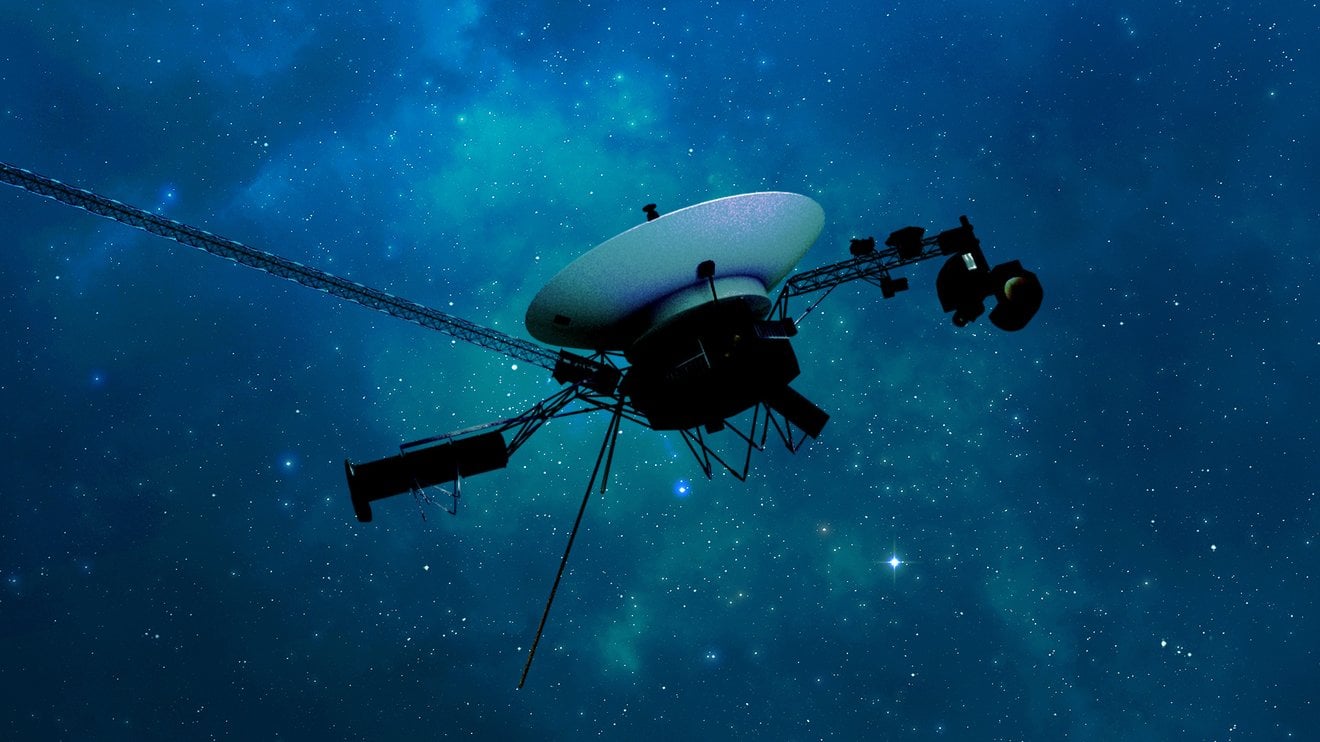
On October 20, Voyager 1 stopped talking to Earth for 48 hours. According to Universe Today’s account of the JPL release, the outage was the first time the spacecraft had behaved this way, and it prompted a procedure the mission team nicknamed the “Big Bang”: a simultaneous swap of three power-consuming units, two primary heaters and the spacecraft’s antiquated 8-track tape recorder, for low-power alternatives. The same procedure had already been applied to Voyager 2 in August.
The underlying problem is arithmetic. Voyager 1’s radioisotope thermoelectric generator runs on plutonium-238 with an 88-year half-life, and its output is falling by roughly four watts per year. The spacecraft now consumes just over 200 watts. Earlier in 2026, controllers had already switched off the Low Energy Charged Particle experiment to stay within budget. The Big Bang swap buys enough margin to avoid shutting down another instrument in 2027, preserving the Plasma Wave Subsystem and the magnetometer, which together measure the interstellar medium Voyager is now sampling directly.
Kareem Badaruddin of the mission team put it plainly: “This is the first time we’ve seen the spacecraft do something like this, but we are also at a point in the mission where we have to expect the unexpected.” That the fix was ready to deploy says something about how deliberately the team has planned for the generator’s decline.
The payoff is a milestone no spacecraft has approached. On November 18, Voyager 1 will cross the one light-day mark, about 26 billion kilometers or 172 astronomical units from Earth, traveling at 16.9 kilometers per second. A radio signal sent from Earth that day will take a full 24 hours to arrive. Launched September 5, 1977, the probe will have taken 49 years to put a light-day between itself and home, a measure of both how far it has gone and how vast the gap remains to the nearest star.
Source: Universe Today
NASA’s Twin ESCAPADE Spacecraft to Slingshot Past Earth on Way to Mars
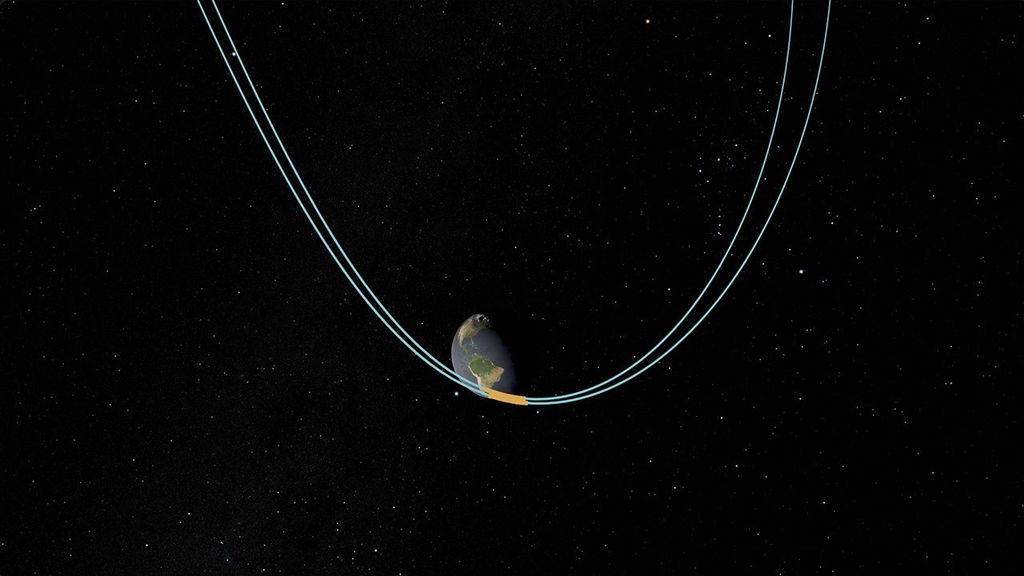
NASA’s two ESCAPADE spacecraft, the Escape and Plasma Acceleration and Dynamics Explorers, are about to do something no Mars-bound mission has done. Each will fly past Earth and, during closest approach, fire its engine for about nine minutes, combining the planet’s gravitational pull with its own thrust in a powered flyby. The first spacecraft performs its maneuver on November 7 around 5 a.m. EST, and the second follows on November 9 around 6 a.m. EST, according to NASA’s mission blog.
The unusual route is a consequence of launch timing. ESCAPADE launched in November 2025, when Earth and Mars were on opposite sides of the Sun and no direct transfer was possible. Rather than wait, the mission flew out to loop around the Sun-Earth Lagrange point 2 and has now returned to Earth to use it as a springboard. The burn, performed at closest approach between 600 and 1,100 miles above the surface, is the most efficient place to add velocity, a principle known as the Oberth effect. It will boost each spacecraft by more than 1,000 miles per hour, from 6.3 to 6.7 miles per second.
After the flybys, the pair settle into a ten-month cruise, arriving at Mars on September 7 and 9, 2027. There, ESCAPADE will become the first multi-spacecraft mission to fly in formation around Mars, measuring how the solar wind interacts with the planet’s magnetic environment and drives the escape of its atmosphere. Two spacecraft taking simultaneous measurements at different points can separate changes in space from changes in time, something a single orbiter cannot do.
NASA notes that observers with telescopes may be able to spot the refrigerator-sized spacecraft, particularly over western Australia during the engine burns and from the western United States before closest approach. For a mission whose launch window had closed, this is a demonstration that trajectory design can turn a missed opportunity into a workable one.
Source: NASA Science
Interstellar Visitor 3I/ATLAS Shows Water Ice Behaves the Same Across Alien Star Systems
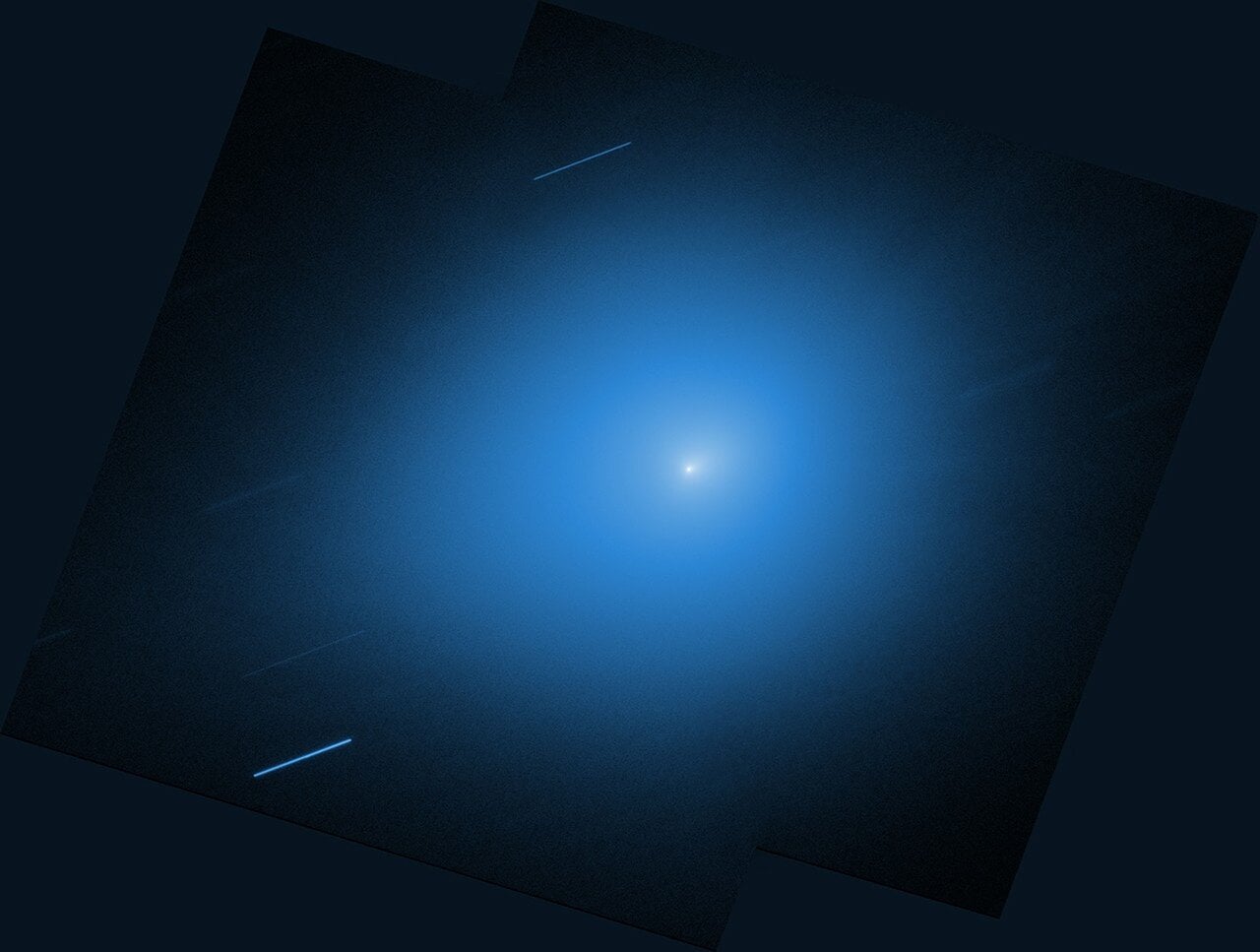
When the James Webb Space Telescope turned its infrared spectrometer on 3I/ATLAS, the third interstellar object ever detected, it saw something that did not quite add up. The comet showed a clear water-ice absorption band at 3.0 microns, but the companion features expected at 1.5 and 2.0 microns were weak or missing. A team led by Silvia Protopapa of NASA’s Goddard Space Flight Center and the Southwest Research Institute has now explained the discrepancy in a paper in The Astrophysical Journal Letters.
The answer lies in grain structure. The water ice on 3I/ATLAS is locked inside microscopic grains intimately mixed with dark, rocky minerals such as pyroxene and carbon. In such aggregates, light travels only a short path through ice before being absorbed by the dark material, which mutes the weaker absorption features while leaving the strong 3.0-micron band visible. It is a matter of how the ice is packaged, not whether it is there.
Webb observed the comet three times as it passed through the inner solar system, spanning distances from about 3.31 to 5.65 astronomical units around perihelion. After the comet’s closest approach to the Sun, the spectra changed: larger, micron-sized ice-rich aggregates and crystalline water ice appeared. The team suggests solar heating either reorganized the surface layers or stripped away outer dust to expose cleaner ice beneath.
The broader result is that the infrared signature of 3I/ATLAS matches that of trans-Neptunian objects in our own Kuiper Belt. That is a double discovery. It means the comet-forming process produces similar material around other stars, and it raises the possibility that spectral patterns in our own outer solar system that had been attributed to complex hydrocarbons may instead reflect dusty ice of the same kind. A visitor from another star has ended up teaching us something about our own neighborhood.
Source: Universe Today
Giant Planet Emerges from Two-Year-Old JWST Data Thanks to Glare-Removal Technique

Exoplanets are roughly a million times fainter than the stars they orbit, and even with a coronagraph blocking the star’s light, residual glare swamps the faintest ones. A Northwestern University team has developed a technique called FLIP, for Physics-based Learning for Imaging Planets, that removes that glare far more precisely than existing methods. The work is published in Nature.
Conventional approaches subtract reference images of other stars to model the glare pattern. But the James Webb Space Telescope is not perfectly stable: thermal drift and vibration from its cryocoolers introduce tiny mismatches between the reference and the target, and the leftover glare can hide a planet. FLIP instead builds a “digital twin” of the telescope, a physics-based simulation of how starlight propagates through the optics, and then uses computational optimization to fit the microscopic imperfections in alignment and positioning for each observation. Across test datasets the team reports sensitivity improvements of 2 to 15 times.
The demonstration case is 51 Eridani. Applied to two-year-old Webb observations at 4.3 microns, a wavelength where carbon dioxide absorption makes planets especially faint, FLIP revealed the giant planet 51 Eridani b where standard processing had failed to separate it from glare. Lead author Rodrigo Ferrer-Chavez, a doctoral student at Northwestern, explained: “Planets are a million times fainter than their stars. Our method models how light travels through the telescope and accounts for those tiny changes, allowing us to remove the glare much more precisely.”
The implications reach beyond Webb. Smaller and colder planets in existing archives may now be recoverable. And for NASA’s proposed Habitable Worlds Observatory, which aims to image Earth-like planets, the team suggests software of this kind could relax the engineering requirement for picometer-scale optical stability, shifting part of the burden from hardware to computation.
Source: Phys.org
Robot Successfully Builds Space Structure in First Autonomous Construction Demo

A Caltech-built robot has assembled part of a structure in orbit with no human at the controls, a first for in-space construction. The project, called ASTRA for Autonomous In-Space Tensioned Reflector Assembly, is part of DARPA’s NOM4D program and launched aboard SpaceX’s Transporter-16 rideshare on March 30, 2026. Team leader Sergio Pellegrino stated: “This is the first time that a structure has been autonomously constructed in space.”
The payload carried two prebuilt bays of a truss made from composite fiber tubes and aluminum joints, along with the materials for the robot to build more. Over six months in orbit, the robot successfully constructed a third bay. The full design calls for a truss supporting a 1.4-meter reflective antenna, and time ran out before the complete antenna could be assembled. The perforated reflective film intended for that antenna was co-invented by researchers at Caltech and the University of Pennsylvania.
Operating conditions were demanding. Communication windows with the spacecraft lasted only about 15 minutes a day, so when problems arose, the ground team worked through them on a flight-spare twin in the laboratory before sending commands. That kind of debugging loop, with a day between attempts, is a preview of what autonomous construction far from Earth will require.
The purpose is scale. Structures that must fold into a payload fairing are limited in size; structures assembled in place are not. DARPA’s Andrew Detor said the program aims to enable “very large” structures “hundreds of meters or kilometers in scale.” Antennas, telescopes, and solar arrays of that size would transform what can be done in orbit, and a robot that can build one bay on its own is the necessary first step.
Source: Phys.org
China Unveils Their Plan for a Crewed Moon Landing
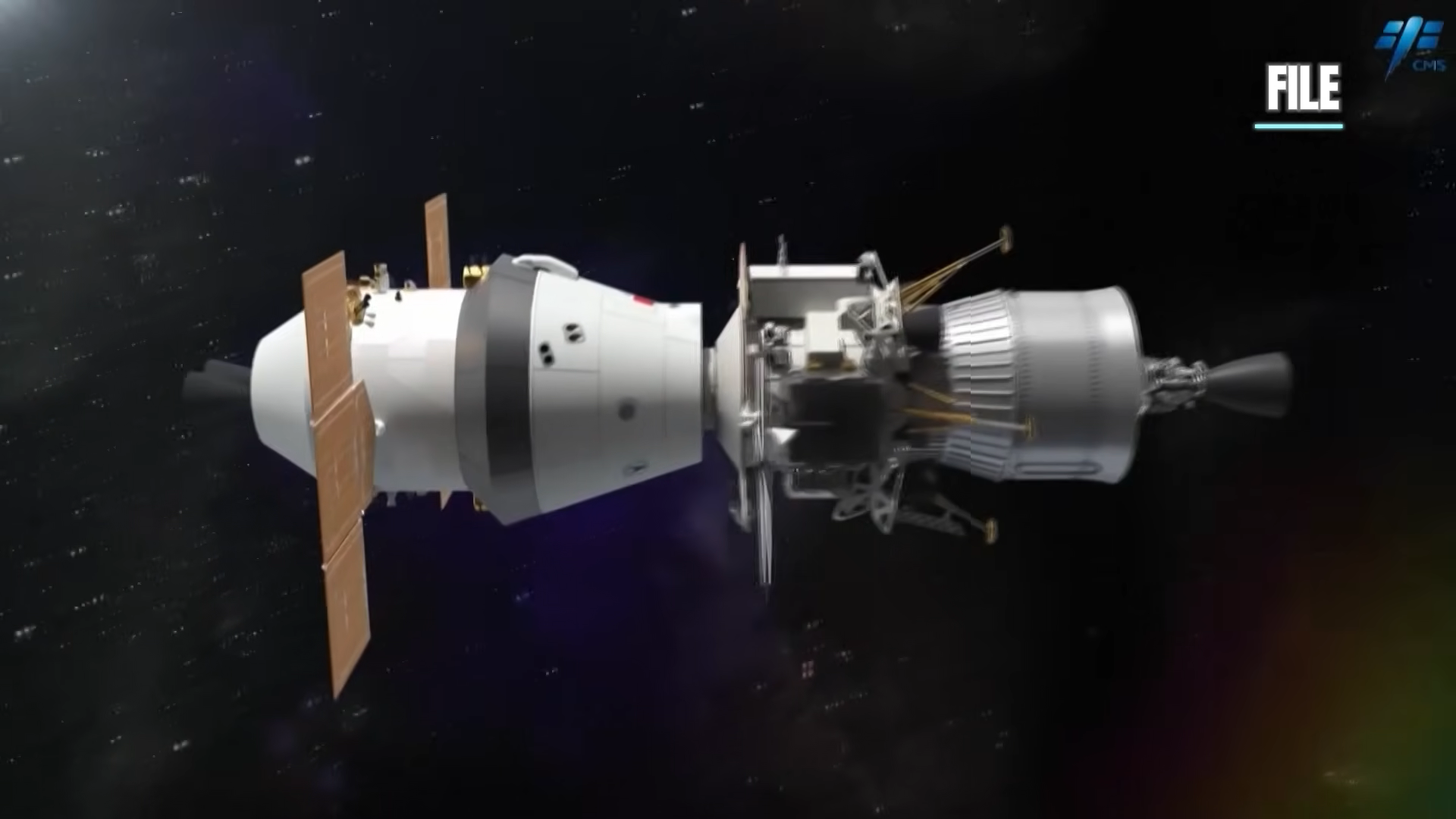
On November 3, Wang Xiang, deputy chief designer of China’s crewed space program and chief designer of its lunar exploration program, laid out the architecture for the country’s first crewed Moon landing at the 7th Manned Space Symposium at Beihang University in Beijing. Universe Today’s Matthew Williams summarizes the plan, which targets completion by 2030.
The mission uses two launches of the Long March 10 rocket. One carries the Lanyue lunar lander, the other the Mengzhou crewed spacecraft. The two rendezvous in lunar orbit, where two of the three taikonauts transfer to the lander and descend to the surface while the third remains in orbit. It is a lunar-orbit rendezvous profile, the same basic approach Apollo used, executed with two rockets rather than one.
The hardware is further along than many outside observers assumed. According to the article, Lanyue passed tethered descent tests in 2025, Mengzhou completed abort and escape tests in June 2025, and the Long March 10 finished low-altitude validation earlier in 2026. Wang described a phased approach: “We will use the near-Earth version of the Long March 10,” the two-stage 10A variant, to validate the rocket’s basic technologies before flying the full three-stage version with boosters, which provides 27 metric tons of payload capacity for lunar missions. An uncrewed Lanyue landing will precede any crewed attempt.
Beyond 2030, the plan calls for construction of an International Lunar Research Station to begin in 2031 using the Long March 9 super heavy-lift rocket. With both the United States and China now committed to crewed lunar landings before the decade ends, the Moon is set to see more human activity in the early 2030s than at any time since 1972.
Source: Universe Today
Thinking about Sunshades, Starships and the EarthCup L1 Project

Paul Gilster’s latest Centauri Dreams essay looks at an unexpected convergence: the ultralight reflective films being developed to push probes toward other stars are the same films that could shade the Earth from a fraction of the Sun’s light. The jumping-off point is the “Dyson Dot,” a concept from Paradise Regained: The Regreening of Earth by Les Johnson, Gregory Matloff, and C Bangs. Unlike Freeman Dyson’s sphere, a Dyson Dot is designed to block or capture only a limited amount of a star’s radiation that would otherwise reach one of its planets.
The numbers come from a 2013 paper by Kennedy, Roy, and Fields in the Journal of the British Interplanetary Society, which proposed a 700,000-square-kilometer lightsail in a non-Keplerian orbit near the Sun-Earth L1 point. Reducing insolation by about 0.25 percent would lower global temperature by roughly 1.8 degrees Celsius, comparable to the cooling of the Little Ice Age between about 1550 and 1850. Earlier feasibility work by Roger Angel in the Proceedings of the National Academy of Sciences set the groundwork, and a May 2026 workshop at the University of Nottingham marked the first International Academy of Astronautics meeting devoted to planetary sunshades.
The practical thread is the EarthCup L1 Project, a competition led by Michael McDonald of OVIAR Global Resilience Systems. Ten teams are developing hexagonal membrane satellites, or “Msats,” one meter across, with dispensers designed by aerospace engineer Walter Holemans that pop them out one at a time, up to 50 per launch. A second phase envisions 50 teams working on design, packaging, deployment, and communications in an X-Prize-style framework.
Johnson draws the key distinction between the two uses. An interstellar sail is silvery and reflects photons to gain momentum; a sunshade is translucent and simply redirects energy away from Earth. Sunlight delivers about nine micronewtons per square meter on a perfect mirror, roughly nine newtons across a square kilometer, which is why a shade near L1 needs a non-Keplerian orbit. Grover Swartzlander of the Rochester Institute of Technology adds that diffractive sails using Bragg gratings and volume holograms could be made wavelength-selective, sparing the bands plants and solar panels need. He also notes an irony: a sunshade could concentrate the light it diverts to irradiances far greater than the Sun’s, enough to accelerate sailcraft past solar escape velocity. The same film could cool a planet and launch a starship.
Source: Centauri Dreams
The Vera Rubin Has Found Two More of the Milky Way’s Dim Satellites

The Vera C. Rubin Observatory’s Early Data Preview 2 has yielded two new companions of the Milky Way, one at each end of the difficulty scale. Evan Gough’s Universe Today article walks through both discoveries and what they say about the survey to come.
The first is Aquarius IV, catalogued as Rubin J2201−0234, an ultra-faint dwarf galaxy with an ancient, metal-poor stellar population. So few stars have been detected so far that its classification remains provisional until deeper imaging and spectroscopy are obtained. The distinction matters: ultra-faint dwarf galaxies are held together by dark matter, while globular clusters generally are not, so confirming which this is will tell astronomers whether they have found a new dark-matter-dominated system. The discovery is reported in Research Notes of the American Astronomical Society, with William Cerny of Yale as lead author.
The second is Rubin-GC1, or Rubin J1628−1735, a globular cluster found in the dust-shrouded direction of the galactic bulge, where faint objects are hardest to see. Its stars are of intermediate age, about 9.2 billion years, with moderate metallicity, and the team believes the cluster was captured from the Sagittarius Dwarf Spheroidal Galaxy during its ongoing merger with the Milky Way. That paper, led by Aashay Pai of the University of Chicago, has been accepted by The Astrophysical Journal Letters.
Astronomers currently know of roughly 65 dwarf satellite galaxies and about 40 globular clusters orbiting the Milky Way, and models predict many more remain hidden. Each one is a record of a past merger and a probe of how dark matter is distributed at small scales. As the article’s authors put it, “If the observatory can find systems this faint and difficult with only its preview data, its full 10-year survey will undoubtedly provide us with many more Milky Way satellite discoveries.” Combined with the Nancy Grace Roman Space Telescope and Euclid, which can see through more of the galactic dust, the census of our galaxy’s companions is about to get much more complete.
Source: Universe Today
European Orbiter Detects Fresh Hints of Volcanic Activity on Mars

ESA’s ExoMars Trace Gas Orbiter has found a seasonal pattern of hydrogen chloride gas above the Alba Mons volcanic region that is hard to explain without heat from below. The study, led by Alexander Trokhimovskiy and published in Science Advances, reports that spikes of the gas appear consistently in early northern summer above fresh fissures on the volcano’s northern flanks.
The proposed mechanism is simple. Hot magma beneath the surface releases gases that rise through newly formed vents. During winter, ice at temperatures around minus 120 degrees Celsius plugs the fissures. As that ice sublimates in early summer, the trapped gas escapes to the atmosphere, where the orbiter’s spectrometers detect it. The timing, the location, and the chemistry all point to the same source. Close-up images from the orbiter’s CaSSIS camera show the fissures themselves, narrow cracks hundreds of meters long, along with color changes in the surrounding terrain consistent with recent venting.
“Our findings suggest that Mars has retained enough internal heat to support volcanic activity until recently, and possibly still does,” said Daniel Mège, co-lead author and professor at Poland’s Space Research Centre. No eruption or fresh lava flow has been observed, so the conclusion is that Mars is dormant rather than dead. That is a meaningful shift from the long-standing picture of a planet whose geological engine stopped billions of years ago.
The result carries an astrobiological corollary. Where there is subsurface heat and water ice, there can be hydrothermal systems, and on Earth such environments host microbial life. If Alba Mons is still warm underneath, its flanks become a candidate for the kind of habitat future missions might want to examine.
Source: Phys.org
Webb Space Telescope’s Little Red Dots Could Hold Key to First Black Holes

Among the James Webb Space Telescope’s most puzzling discoveries are the “little red dots,” compact, red objects scattered across the early universe whose nature has resisted explanation. A Johns Hopkins University team led by Valerio De Luca and Loris Del Grosso now proposes in Physical Review Letters that at least one of them may be a primordial black hole, an object that formed in the first moments after the Big Bang, before any star existed.
Their case rests on an object called QSO1, observed as it was about 700 million years after the Big Bang. What sets it apart is its composition: it consists almost entirely of hydrogen and helium, with essentially none of the heavier elements that stars forge and scatter. An ordinary black hole born from a dead star should sit in gas already enriched by earlier stellar generations. QSO1’s pristine chemistry suggests something older.
The team modeled three scenarios for how a primordial black hole might grow into an object matching QSO1’s observed properties. The most probable, they found, is a relatively small primordial seed that steadily consumed the surrounding gas. De Luca was candid about the stakes, noting that confirmation would be “a groundbreaking discovery in physics,” since no definitive evidence for primordial black holes currently exists.
The next step is a systematic search. The researchers plan to examine roughly 100 catalogued red dots for similar signatures. Decisive proof would require a black hole either too small to have formed from a collapsing star or demonstrably older than the first stars. If one is found, it would answer two questions at once: what the little red dots are, and how supermassive black holes managed to appear so early in cosmic history.
Source: Phys.org