AI Weekly Review 2026-10-19

Week In Review
The week belonged to model releases, and the interesting thing about them was less the headline capability numbers than the economics underneath. Google’s Gemini 4 Argon arrived as a frontier model pitched at “deep work” in coding, finance, law, and science, with a 1-million-token unified context and introductory API pricing low enough to signal that Google intends to compete on cost as well as quality. Two days later Meta published the weights of Muse Spark Open, an 816-billion-parameter mixture-of-experts model with only 42 billion parameters active per token, and the same week Reflection AI released Beam under Apache 2.0 with an explicit argument that the cost that matters is tokens consumed per task, not price per token. NVIDIA’s Nemotron 3.5 Super VL rounded out the open-weights wave with a document-reading model whose pitch is that a customised mid-sized model can beat a frontier one on the narrow task a business actually cares about. Taken together, these four releases describe a market where the price of intelligence is falling along several axes at once: cheaper tokens, fewer tokens, sparser activation, and task-specific post-training.
The second theme was AI as a working scientist rather than a chatbot. Google DeepMind described how biologists used its Antigravity agentic workbench to identify a candidate antimicrobial peptide now in lab validation, collapsing what used to be a fragmented crawl across protein databases into a single session. Meta reported that a cohort of medical researchers using a Muse-based coding scaffold over five million de-identified health records produced ten peer-reviewed manuscripts in four weeks. And a Stanford, Together AI, and Emory team showed that fixed teams of models can learn how to collaborate by reflecting on their own transcripts, lifting accuracy on hard maths well beyond any single member. Jack Clark’s Import AI 476 supplies the meta-level reading: a new benchmark for “research taste” suggests frontier models’ experimental judgement has been doubling roughly every three months, which is why he has pulled his own estimate for when AI can meaningfully improve AI forward by a year.
The third strand is institutional. OpenAI’s mass release of mathematical results earlier this month provoked a backlash among mathematicians, and this week OpenAI, Anthropic, and the Simons Foundation responded with a $15 million initiative to help the field examine and build on AI-generated proofs. Anthropic, meanwhile, announced a Public Benefit Fund that commits a slice of company equity to addressing labour-market disruption from the technology it sells. Both are early attempts to build the social scaffolding that rapidly advancing capability demands, and both acknowledge, implicitly, that the pace set by the model releases above is not going to slow down to let institutions catch up.
Items
Google Introduces Gemini 4 Argon, Built for Deep Work

Google released Gemini 4 Argon on October 13, describing it as a frontier model that “excels at deep work in complex, real-world tasks across domains including coding, finance, legal, cybersecurity, and science.” The announcement, written by Koray Kavukcuoglu, Google DeepMind’s SVP and Google’s Chief AI Architect, leans heavily on applied demonstrations rather than leaderboard positions alone. Google says the model ranks first on the Vals Index, which measures performance across finance, coding, legal, and tax work, and scores 87% on the ERQA benchmark for embodied and spatial reasoning.
The worked examples are the more persuasive part. Google reports that Argon refactored Chrome’s 6-million-line codebase across hundreds of files, optimised the quantum chemistry package xTB to make molecular prediction 2.3 times faster, found new solutions to Grad’s conjecture in fusion research, identified a rare chromosomal rearrangement in a genetic diagnosis case, and designed novel serine esterase enzymes in hours rather than months. In internal use, Google says agentic code submissions rose by more than 35% while rollbacks fell by nearly a third. A video-to-simulation pipeline for robotics is said to compress weeks of manual simulation modelling into hours, and the model trained a humanoid robot to play cornhole from video observation.
The model offers a 1-million-token unified input-and-output context through the Gemini API. Introductory pricing runs at $2 per million input tokens and $10 per million output tokens through November 30, 2026, with a 95% discount on cached input, rising to $4 and $20 after that. That introductory rate undercuts what frontier models have typically cost and puts pressure on competitors to match.
On safety, Google says external bio red-teaming unlocked less than 1% of tested biological sub-tasks, and that the model leads the Gray Swan prompt-injection benchmark with an attack success rate of 0.7% across 15 attempts. A real-time monitoring system watches agent behaviour for misalignment and misuse. Access spans the Gemini API paid tier, the Gemini app and AI Mode in Search for Ultra and Pro subscribers, enterprise channels, and a six-month free top-tier Antigravity allocation for researchers by application. A separate Fairwind Program offers cybersecurity professionals access without cyber guardrails.
Source: Google
Meta Releases Muse Spark Open, a Frontier-Class Open-Weight Model
On October 15 Meta published the weights of Muse Spark Open, which it calls “the most capable US open-weight model to date.” The model is natively multimodal, with 816 billion total parameters of which 42 billion are active per token, and carries a 1-million-token context window. Meta positions it for coding and agentic work: long-horizon tasks, software engineering, and multi-step reasoning. The release is a significant moment for the American open-weights ecosystem, which has spent much of the year trailing Chinese labs in the quality of freely downloadable models.
The sparse mixture-of-experts design is the point. Running only 42 billion parameters per token means inference cost sits closer to that of a mid-sized dense model while the total parameter count gives the model room to store far more knowledge and skills. Meta says it tested the model on real-world jobs including shipping iOS changes to an open-source Mastodon client and an end-to-end video editing workflow, and it points to an external evaluation methodology report for benchmark detail rather than listing numbers in the announcement.
The licence is the Muse Model License with limited commercial terms, which Meta says lets many developers use the model for free. Weights are available on Hugging Face, Amazon SageMaker AI, Google Cloud Model Garden, and Microsoft Foundry Models, and hosted inference is offered through Together AI, Fireworks, Baseten, Modal, Groq, Nebius, and OpenRouter. The model supports the major open inference engines, including vLLM, SGLang, TensorRT-LLM, and MLX, and Meta notes it has been optimised specifically for Apple M5 Ultra Mac Studios, a nod to the growing community running large models on local hardware.
For developers, an openly available model of this class means the ability to fine-tune, inspect, and self-host a system that until recently existed only behind proprietary APIs. For the industry, it resets the baseline against which every closed model’s price is judged.
Source: Meta AI Research
Reflection’s Beam Bets on Fewer Tokens, Not Cheaper Tokens
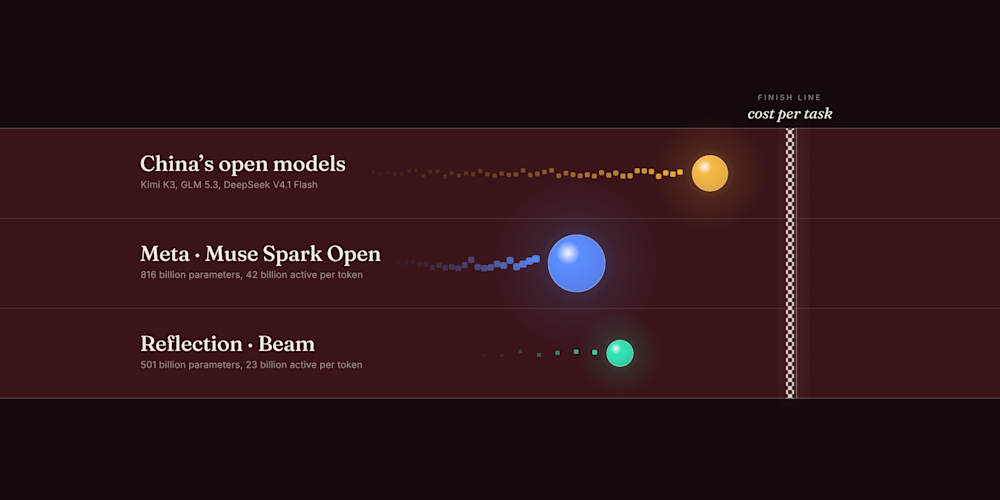
Reflection AI released the weights of Beam, its first open model, on October 16 under the permissive Apache 2.0 licence. Beam is a mixture-of-experts model with 501 billion total parameters and 23 billion active per token. VentureBeat’s Matt Marshall reports that its strategy differs from the Chinese open models it is positioned against: instead of competing on a cheaper per-token price, Beam is trained to finish tasks using dramatically fewer tokens, on the reasoning that what a company pays is price per token multiplied by tokens consumed per task.
The numbers Reflection cites make the case concrete. On Terminal-Bench 2.1, a test of agentic command-line work, Beam scores 80.1% while using roughly 25,000 tokens per attempt, versus a lower score from GLM-5.2 at around 80,000 tokens. On the DeepSWE software-engineering benchmark it matches GLM-5.2 using slightly more than half the tokens. For comparison, the article notes Meta’s Muse Spark Open scores 76.4% on Terminal-Bench 2.1. Reflection’s Ioannis Antonoglou described the training approach simply: intensive reinforcement learning with a penalty on token use. “You don’t give up anything. You just penalize it in terms of how many tokens it can use.”
The commercial backdrop is a wave of enterprises cutting AI spending by switching to Chinese open models; the article names DoorDash and Coinbase among them. Reflection’s argument is that a model which reasons more tersely can beat those models on total cost even at a higher sticker price per token. Antonoglou said Beam would “win on merit rather than on anything else.” Pricing has not been announced, and the hosted version is free during public beta through partners such as Baseten.
The release matters beyond Reflection. Token efficiency is a dimension of model quality that leaderboards mostly ignore, and if Beam’s approach holds up, reinforcement learning against token budgets could become a standard part of post-training for agentic models everywhere.
Source: VentureBeat
NVIDIA’s Open Nemotron 3.5 Super VL Beats Frontier Models After Task-Specific Post-Training

NVIDIA released three open models on October 15 aimed at enterprise agent workflows. The flagship, Nemotron 3.5 Super VL, is a 120-billion-parameter vision-language model built to read PDFs, charts, tables, images, and webpages while following instructions and calling tools. Alongside it came Nemotron 3.5 Bolt 74B-A9B, a sparse model with 9 billion active parameters that fits in 24GB of memory for local coding and research, and a 4GB Bolt E4B for on-device conversational agents, due October 23.
The headline claim is not that Super VL beats frontier models out of the box but that it beats them after customisation. VentureBeat’s Carl Franzen reports NVIDIA’s comparison across five specialised tasks: on medical insurance claims, accuracy rose from roughly 28% to 72% after post-training, against 38% for Claude Opus 5; on security attack resilience it improved from about 35% to 76%, versus 66% for GPT-6.1 Sol. Across the evaluated tasks, post-training gains ranged from 9 to 44 percentage points. The argument to enterprises is that a mid-sized open model trained on their own data, tools, and policies can outperform a general-purpose frontier model on the narrow job that matters, while running wherever their security requirements dictate.
The training recipe is unusually transparent. NVIDIA says Super VL saw approximately 26 trillion tokens across pretraining and continued pretraining, 3.8 million post-training samples, and reinforcement learning across roughly 100 environments, and it is shipping the training recipes and datasets alongside the weights through NeMo. On the Artificial Analysis Intelligence Index the model scores 26 and generates 625 output tokens per second, about five times faster than comparable baselines.
The licence is OpenMDW, which permits commercial use, fine-tuning, and redistribution, with weights on Hugging Face, OpenRouter, ModelScope, and NVIDIA NIM. Production support comes through NVIDIA AI Enterprise at $4,500 per GPU per year, software only. For NVIDIA the models are, of course, a reason to buy Blackwell and Hopper hardware, but the broader signal is that open, customisable models are now a credible route to frontier-beating results on specific work.
Source: VentureBeat
Google Antigravity Turns Antimicrobial Peptide Discovery Into a Single Session
Google DeepMind published a case study on October 15 showing how biologists used Antigravity, its agentic development platform, as a scientific workbench for finding new antimicrobial peptides. The motivating problem is antimicrobial resistance, which the post notes could cause an estimated 10 million deaths a year globally by 2050 without new therapeutics. Finding candidate molecules has traditionally meant a fragmented search across separate databases and specialised tools, each with its own interface, which slows the path from hypothesis to a lead worth testing in the lab.
In the workflow DeepMind describes, the researcher sets strategy while the agent orchestrates the tooling. It runs BLAST sequence searches, pulls predicted structures from the AlphaFold Database and compares them with Foldseek, examines genomic context, and synthesises the relevant literature, all within one environment. A key ingredient is ProtNLM, a deep learning model that predicts biological function from amino acid sequence and has annotated millions of previously uncharacterised proteins in UniProt, which widens the pool of candidates the agent can consider. An embedded Biomolecular Structure Viewer lets the human and the agent look at the same 3D structure, so the collaboration is visual as well as textual.
The demonstration identified a novel bacteriocin from Streptococcus pseudopneumoniae with predicted activity against respiratory pathogens. That candidate is now undergoing laboratory validation, so the result is a promising lead rather than a confirmed drug. What the post emphasises is the compression: “what used to be a fragmented search over multiple databases” became a single session, letting researchers evaluate high-confidence leads before committing to expensive wet-lab work.
The same platform appeared in Google’s Gemini 4 Argon launch this week, where researchers can apply for six months of free top-tier access. The pattern, in which an agent handles cross-database orchestration and a domain expert handles judgement, is one that other fields with sprawling, siloed data are likely to copy.
Source: Google DeepMind
Medical Researchers Produce Ten Peer-Reviewed Papers in Four Weeks With Muse
Meta AI Research described on October 14 an experiment in human-led, AI-accelerated health data science. The team built an internal coding scaffold around Muse Spark 1.3 and Muse Wonder with access to public data and a licensed database of five million de-identified electronic health records. They then invited practising medical researchers, from specialties including cardiology, epidemiology, infectious disease, and internal medicine, to use it. Participants came from institutions including Penn State Health, Baylor College of Medicine, Stanford, the University of Washington, Emory, and Dana-Farber Cancer Institute.
Over four weeks the cohort produced ten research manuscripts, each of which went through peer review by medical professionals and independent expert evaluation. The topics are the kind of practical clinical questions that often go unexamined for lack of analyst time: arrhythmias after endocarditis, emergency department outcomes for behavioural health patients, patterns of type 2 diabetes remission (a 4.3% remission rate, with 47.8% of remissions ending when treatment restarted), pickleball injuries (70% in 60- to 79-year-olds), e-scooter and e-bike emergency visits, Staphylococcus infection complications, breast cancer treatment sequencing, a series of 21 rare Cladophialophora bantiana fungal infections, social-determinants-of-health coding, and endocarditis outcomes by organism.
The scaffold helped at every stage: brainstorming and refining hypotheses, writing and executing analytical code, synthesising literature, drafting and revising manuscripts, and flagging potential biases and methodological problems. Researchers reported productivity gains of up to tenfold, with some manuscripts going from concept to draft in seven days. One participant said the approach could “democratize research: lowering practical barriers without replacing experts or rigorous review.”
The design choice worth noting is that the human stays in charge of the scientific decisions and the conclusions, while the model removes the friction. If the pattern generalises, the bottleneck in observational health research shifts from analyst hours to the supply of good questions and the capacity of peer review to keep up.
Source: Meta AI Research
Self-Organizing Agent Teams Learn to Audit and Repair Each Other’s Reasoning

Researchers at Stanford, Together AI, and Emory University have proposed Self-Organizing Agent Teams (SAT), a framework in which a fixed group of language models learns how to work together rather than following a workflow written in advance by a human. VentureBeat’s Ben Dickson reports that the method works in three phases. First, in offline reflection, a designated model reviews transcripts of the team working through a small training set, identifies where it failed, and rewrites the collaboration strategy, meaning roles, phases, and rules for synthesising answers, across six evolutionary rounds. Second, the system filters the resulting strategies to avoid overfitting, validates candidates against five probes, and freezes up to ten complementary strategies. Third, at test time, all ten strategies produce candidate solutions, and a judge model picks the best.
The results are striking on verifiable reasoning. On maths and physics benchmarks, SAT averaged 66.7% accuracy, ahead of compute-matched alternatives including linearisation at 58.7%, Mixture of Agents at 57.3%, and debate at 52.7%. On AIME 2026 it reached 71.2%, which the paper says is 29 percentage points above the strongest individual model in the team and 13.4 points above a perfect routing oracle that always picks the best single model for each question. On knowledge and logic tasks spanning GPQA, MMLU-Pro, and BBEH it scored 72.8%.
The framework’s limit is also instructive. SAT generated at least one correct answer on 87.9% of the knowledge-logic problems but often failed to select it, so its edge is largest where answers can be checked step by step. The practical upshot is that organisations can get better results from models they already have, without retraining, by letting the models discover their own division of labour, provided the task offers something to verify against. Diversity of models plus peer audit beat homogeneous teams at the same compute budget. The paper is available on arXiv.
Source: VentureBeat
Import AI 476: Research Taste Doubling Every Three Months
Jack Clark’s October 12 issue of Import AI opens with a benchmark that bears directly on the question of when AI will meaningfully accelerate AI research. TasteVal, from P-Zero Research, measures “research taste”: the ability to pick promising problems, design experiments, and interpret results, across eight tasks in pretraining, fine-tuning, preference modelling, and adversarial robustness. The headline finding is that the experimental research taste of frontier models has doubled roughly every three months since December 2025, and that Opus 5.5 exceeded human baselines with a 2.30x compute multiplier at about one-thirtieth the cost of expert researchers. Clark says the combination of this result and the recent creative mathematical breakthroughs has moved his own estimate for when full recursive self-improvement becomes feasible from 2028 to 2027.
The issue’s second section is a sober audit of Western open-weight models against Chinese ones, written before this week’s releases. Clark notes that Reflection’s Beam, trained on 6,144 GB300 NVL72 GPUs over eight weeks, matches GLM-5.2 while using three to four times less inference compute but trails on some benchmarks (44.4 versus 61 on DeepSWE 1.1 against GLM-5.3), and that Mistral Large 4, trained on 3,800 Grace Blackwell GPUs, is the strongest Western open model yet still behind Chinese alternatives on DeepSWE and Terminal-Bench. Both labs promised weights by the end of October; Beam’s have since arrived.
Two further items widen the frame. Humanity’s Sixth Sense, a visual-reasoning benchmark from Elorian and Scale AI, finds that on 522 questions across 288 images and 17.6 hours of video, humans score 93.1% while GPT-6 Astra manages 53.6% and the best open models sit around 26%, with the most common failures being missed details and misidentified objects. And two Department of Energy projects demonstrate federated training across six national laboratories on mixed-vendor GPUs while protecting restricted data, though at a scale Clark puts at around 100 times below frontier industry runs.
Clark closes with a speculative essay on AI in space, arguing that autonomous spacecraft and space-based assembly could give early movers compounding advantages, before raising the uncomfortable question of why machines operating across the solar system would keep taking instructions from slow-communicating organic beings. It is a characteristic mix: hard numbers on where the technology stands and a willingness to follow the implications further than most.
Source: Import AI
OpenAI, Anthropic, and the Simons Foundation Fund a $15 Million Effort to Help Mathematicians Work With AI Results
OpenAI announced on October 16 that it will give $5 million to the Simons Foundation as part of a $15 million initiative, funded jointly with Anthropic and the foundation itself, to help mathematicians examine, understand, and build on results produced by AI. Euronews’s Pascale Davies reports that the money will go to workshops, conferences, and special programmes, and that OpenAI will also provide Simons-supported researchers with access to its models and computing resources.
The context is the uproar that followed OpenAI’s release earlier this month of a large body of AI-generated mathematical results, including work on the Navier-Stokes equations. The Association for Human Mathematics criticised the release, saying “Mathematicians did not ask for this work to be done” and accusing the company of “total disregard for the norms of scientific research.” Two mathematicians said they had been developing similar results, one of them, Levent Alpöge, employed at Anthropic; OpenAI denies having accessed their work.
Whatever one makes of the dispute, the initiative addresses a real problem that will outlast it. A proof produced by a model is only useful to mathematics if humans can check it, situate it, and build on it, and the field’s existing machinery of seminars, refereeing, and apprenticeship was not designed for hundreds of results arriving at once. Funding the institutions that do that work, rather than only the models that generate results, is an acknowledgement that verification and absorption are now the bottleneck.
It is also notable that two competing labs are co-funding the effort. Whether it succeeds in reconciling the mathematical community to AI-generated results will depend on how much control mathematicians have over the programmes, something the foundation, which will manage the funds, is well placed to ensure.
Source: Euronews
Anthropic Commits Company Equity to a Public Benefit Fund

Anthropic announced on October 18 the creation of the Anthropic Public Benefit Fund, a wholly-owned LLC into which the company will place equity dedicated to public benefit purposes. The initial commitment is 5% of Anthropic shares, subject to stockholder approval, with a further 2% added for every 50% increase in the company’s valuation above a baseline. Combined with existing co-founder pledges and employee equity donation programmes, the company says roughly 20% of its shares will be dedicated to the public good.
The fund’s stated focus is the labour-market disruption that advancing AI is expected to cause. Anthropic notes it has already committed $200 million to researching and addressing the economic impacts of the technology, and says the fund will allow “bolder approaches” than conventional grant-making as well as potentially larger donations to traditional nonprofits. The structure gives flexibility between forms of giving while explicitly prohibiting use of the equity for lobbying or political activity.
The rationale Anthropic offers is a pointed one: rather than directing escalating equity awards to executive compensation, the company is routing that equity toward public benefit, so that the growth of the business funds mitigation of the problems the business may create. Full governance details, including the valuation milestones and a public benefit report tracking mission progress, are promised in the coming months.
The announcement is an early instance of an AI lab building a financial mechanism that scales with its own success. Whether it proves adequate to the disruption it anticipates is unknowable now, but as a template, a growing equity stake earmarked for economic transition is a more durable commitment than a one-off donation.
Source: Anthropic