AI Weekly Review 2026-10-26

Week In Review
Biology was where artificial intelligence did its most concrete work this week, and it did that work three different ways. The UW Medicine Institute for Protein Design and NVIDIA released RFD4-Proteina, a model that folds sequence and all-atom structure generation into a single system and reports five- to tenfold gains in both design success and throughput. Anthropic published the results of an autonomous design campaign against scorpion neurotoxins in which a Claude model drove twelve computational tools for 64 hours and produced binders that held up under laboratory measurement. OpenAI, working with PerturbAI and Scripps Research, split a mouse-brain CRISPR atlas across 1,946 reasoning agents and got back ranked research leads in 32 minutes. One is a tool, one is an operator, one is a swarm. All three were checked against wet-lab or published results rather than benchmarks alone.
Underneath those results sits a quieter engineering question: how much of an agent’s capability comes from the model and how much from the scaffolding around it. Two findings landed on opposite sides of that question in the same week. A Shandong University team found that swapping coding-agent harnesses changed accuracy by less than the run-to-run noise while changing cost by up to a factor of three. A group from UC Santa Barbara and Microsoft went the other way, mining arXiv for techniques and compiling them into harness code, and closed roughly three quarters of the gap between a 27-billion-parameter open model and a frontier one without touching any weights. The reconciliation is that harness choice is not the same as harness content. Moonshot’s Kimi K3.1 Pro makes a related point about models: its large jumps came from post-training breadth rather than from a bigger pretraining run.
Two pieces stepped back to argue about what all this adds up to. Nick Cammarata, formerly of OpenAI, published a long argument that neural networks are considerably more legible than the field assumed, and drew both acclaim and sharp methodological pushback. Jack Clark used Import AI 477 to tell the International Monetary Fund that the singularity has already started, and built the case on benchmark trajectories and specific scientific results rather than on vibes. The two sit together uneasily and productively. Clark’s argument is that capability is compounding faster than institutions can absorb it. Cammarata’s is that comprehension may not be as far behind as feared.
The grounding came from the balance sheet and from the ground itself. A VentureBeat Intelligence survey found most enterprises sitting on idle GPUs while planning to buy more compute, a mismatch between owned hardware and metered frontier APIs that looks less like a bubble than like two incompatible budgets. And Google DeepMind released a global map of forest types at ten-meter resolution, which distinguishes a primary forest from the plantation that replaced it. That is the unglamorous end of the week’s work and arguably the most durable: a public dataset that makes a previously invisible distinction measurable everywhere on Earth.
Items
A Single Model for Protein Sequence and Structure, Released Open
The UW Medicine Institute for Protein Design and NVIDIA released RFD4-Proteina on October 21, an open generative model for designing proteins with specified functions. Its lineage is a merger of two separate research programs: the Institute’s RosettaFold Diffusion line and NVIDIA’s Proteina-Complexa work. The practical consequence of that merger is the elimination of handoffs. Previous pipelines passed a design between a backbone generator, then a sequence designer, then an all-atom structure model, with each stage able to invalidate the last. RFD4-Proteina generates sequence and all-atom structure together.
The more interesting property is simultaneity. The model refines a protein’s sequence and structure alongside the structures of the molecules it is meant to interact with, so a change on one side propagates to the other instead of being evaluated against a frozen target. Proteins do not hold still when they bind something, and neither do their partners. A design system that treats the complex as a single evolving object is closer to the physics than one that optimizes against a fixed pose.
The Institute reports five- to tenfold higher design success rates and five- to tenfold faster candidate generation than the models it was compared against, measured across four benchmark suites covering protein binding, small-molecule binding, enzyme scaffolding, and DNA binding. The model can also spend more computation on harder problems rather than applying a fixed budget to every design, which matters because design difficulty varies enormously across those four categories.
Two applications in the announcement suggest what the speed is for. A pesticide-degrading enzyme designed in a few days outperformed the previous best design for that target. Control over glycans, the sugar structures attached to proteins that heavily influence how a therapeutic behaves in the body, took under a week rather than months. David Baker framed the payoff as better medicines plus applications outside medicine entirely. The laboratory validation is real but the broader industrial case remains to be demonstrated.
Source: UW Medicine Newsroom
An AI Model Ran a 64-Hour Antivenom Design Campaign and Produced Verified Binders
Scorpion envenomation affects roughly 1.2 million people a year, and existing antivenoms are animal-derived, expensive to produce, and specific to particular regional species. Anthropic gave an internal research Claude model a target list of five neurotoxins drawn from the places where scorpion stings actually happen: Cn2 from Mexico, Ts1 from Brazil, AaH I and AaH II from North Africa, and LqhIII from the Middle East. The model was then left to run a design campaign using twelve computational tools.
The funnel is worth reading in full. Claude generated 318,484 candidate designs and evaluated 553,052 design-toxin pairs computationally over 64 hours, consuming about 10,000 GPU hours. From that, 211 designs went to physical testing, carried out by Adaptyv Bio in cell-free systems and Twist Bioscience in mammalian cells, with binding measured by surface plasmon resonance. Seventeen designs met the binding criteria, a success rate of roughly eight percent: seven against Cn2, four each against AaH I and AaH II, and two against LqhIII. The two strongest Cn2 binders reached single-digit nanomolar affinity, which is a therapeutically interesting range. Competition experiments suggest they occupy the same site as a known neutralizing antibody.
The failures are as informative as the hits. Ts1 yielded nothing. Repeated attempts to design a single molecule that binds multiple toxins at once, which is what a broad-spectrum antivenom would actually require, produced no successes. That is the hard version of the problem and it remains unsolved.
The caveats are substantial and Anthropic states them plainly. Testing used recombinant toxins rather than venom-purified ones. No cellular or animal efficacy work was done, so binding has been demonstrated and neutralization has not. Timothy Jenkins of the Technical University of Denmark, who works on antivenoms, called designing credible binders against five toxins in parallel within days a showcase of a shift in therapeutic discovery. The claim being tested here is less about antivenom than about autonomy: whether a model can hold a multi-week research campaign together well enough that the output survives contact with a laboratory.
Source: Anthropic
Nearly 2,000 Agents Read a Brain Atlas in 32 Minutes
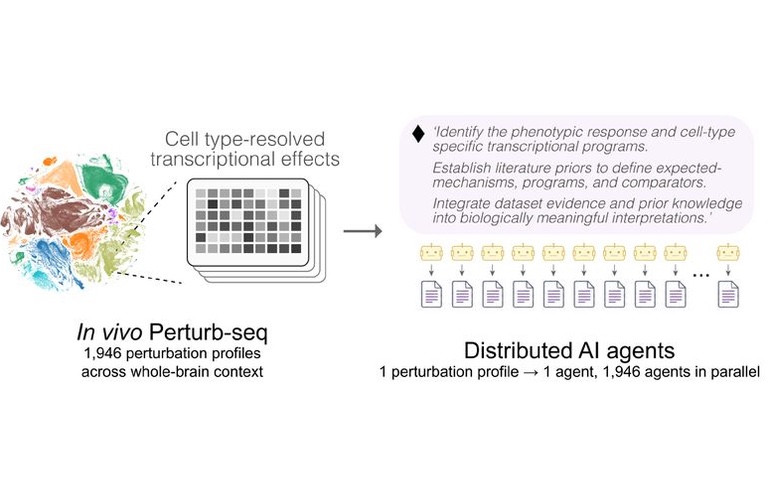
OpenAI, with PerturbAI, Scripps Research, the University of Cambridge, and UCSF, took a whole-brain CRISPR atlas of millions of mouse brain cells and distributed its analysis across 1,946 agents built on a life-sciences model called GPT-Rosalind. Each agent received one gene disruption, examined the resulting cellular changes, searched the literature for explanations, and wrote up what it found. A compilation step then looked across all the reports for connections and ranked the resulting leads by how worthwhile a follow-up experiment would be.
The design choice that makes this more than a parallelism stunt is the division of labor. The analysis of millions of cells was finished in 32 minutes, work the team estimates would take human analysts months to a year. But the breadth of reading is the striking number: the agent population collectively retained 7,586 literature references, against roughly eleven for a single-agent baseline on the same task. One agent reasoning over an entire atlas cannot hold the relevant literature in view. Two thousand agents each responsible for one gene can.
Validation was done two ways. Without access to the atlas manuscript, the agents matched or refined 48 of the 55 findings the human authors had originally reported, which tests whether the system recovers known signal. Thirty doctoral-level biologists then reviewed the outputs blind, and their assessments broadly tracked the system’s own rankings, which tests whether its sense of what is worth pursuing resembles an expert’s. Among the novel leads was a link between disruption of the DCTN1 gene and cholesterol production, rated 4.3 out of 5 for follow-up priority, pointing at a possible relationship between cholesterol regulation and neurodegeneration.
These are leads, not findings. Nothing here has been experimentally confirmed, and the researchers are explicit that reading the literature, weighing explanations, and choosing decisive experiments remain central to scientific training and judgment. What changes is the ratio between questions a lab can afford to investigate and questions it can afford to ask. Existing datasets contain far more structure than anyone has had the labor to extract, and this is a direct attack on that backlog.
Source: R&D World
Kimi K3.1 Pro Leads the Open-Weights Field on Post-Training Alone

Moonshot unveiled Kimi K3.1 Pro, a three-trillion-parameter model it says will lead Artificial Analysis’s Intelligence Index, and committed to releasing the weights under an open license on November 4. Moonshot attributes the gains not to a larger pretraining run but to substantially more post-training on the existing K3 base, including reinforcement learning across hundreds of task domains and better isolated tool environments.
The benchmark deltas are unusually large for a point release. Terminal-Bench 4.0 went from 13 percent to 67 percent, a 54-point jump, putting it near Claude Sonnet 5.5 at 64 percent. A cybersecurity end-to-end benchmark rose from 58 to 95 percent. The composite Intelligence Index moved from 44 to 55. Artificial Analysis also measured a drop in one hallucination metric from 53 to 44 percent, and Moonshot’s internal stress testing reports claim-level hallucination falling from 23.4 to 8.3 percent. Pricing is two dollars per million input tokens and ten per million output, which VentureBeat notes is half the per-token cost of Claude Opus 5.5 and identical to Claude Sonnet 5.5.
The qualifications matter more than usual. Per-token price is not cost per finished task, and Artificial Analysis measures roughly 15 percent higher task cost than K3 because the model consumes about twice the input tokens. Performance is strongly workload-dependent: the model trails GPT-6 Astra by about 30 points on a scientific computing variant of Terminal-Bench. And until the weights ship, self-hosting is unavailable, so current use means sending data through hosted infrastructure.
One demonstration is more telling than the scores. Given a walking simulator that would not behave, the model investigated the environment and corrected 36 errors in its shoulder-muscle calculations rather than repeatedly tweaking its own unsuccessful solution. Debugging the harness instead of thrashing against it is precisely the behavior that separates an agent that can be left alone from one that cannot. Separately, an unverified document circulated on X appearing to instruct promotional creators to omit paid-partnership labels. Moonshot’s involvement is unconfirmed and no company response had been identified, and the allegation bears on promotional claims rather than on the independently measured benchmarks.
Source: VentureBeat
The Claim That Neural Networks Were Always More Legible Than We Thought
Nick Cammarata, a researcher at the interpretability startup Goodfire who helped pioneer mechanistic interpretability at OpenAI, published a roughly 26,000-word argument that large language models may be far more comprehensible and controllable than the field has assumed. The target is a foundational premise: that the internals of a trained network are an irreducibly tangled mess, and that the polysemantic neuron responding to several unrelated things is evidence of that mess.
His central example is a reexamination of his own earlier work on Inception v1, a 2014 image classifier. One neuron had long been cited as responding to both cars and cats, an apparently arbitrary pairing. Looking again, Cammarata argues it is detecting neither: it fires on a shared V-shaped visual pattern, which is present in cat faces, car fronts, pool table corners, train noses, and water fountains, and it deactivates on round O-shapes. The methodological claim that follows is a diagnosis of the field’s habit. Researchers expected incomprehensibility, so when a unit looked confusing they filed it under confusing. The alternative is to keep asking what the confusing cases share.
Reactions split hard. One researcher said their understanding of what a neural net is had been catapulted forward by years, and another called it the most important AI paper of the year. Chris Potts of Stanford counters that nothing in the post makes the underlying problems any easier, and notes the analysis lacks rigorous evaluation despite covering thousands of examples. Jacob Hilton of the Alignment Research Center argues it paints an unrealistic picture of where the field actually stands, pointing out that researchers understand well under 0.01 percent of a frontier model’s internals. Neel Nanda of Google DeepMind grants the interest while disputing that it constitutes significant progress.
The gap in the evidence is specific and acknowledged: the clean result is on a twelve-year-old vision model, not on a current language model, and individual units are a much easier object of study than the circuits connecting them. Cammarata’s own framing is more modest than his critics’ reading of it, noting it is not infinitely good news and not everything solved. His strongest claim is about tractability rather than completion, that given enough time with a frontier model there is a good chance of arriving at a real understanding. Whether that is true is an open empirical question, which is a considerable upgrade from assuming the answer is no.
Source: MIT Technology Review
Import AI Tells the IMF the Singularity Has Already Started
Jack Clark, an Anthropic co-founder who came to the field through journalism and OpenAI, used this week’s Import AI to report on telling the International Monetary Fund that the singularity has begun. He anchors the word in Vernor Vinge’s 1993 definition rather than in contemporary usage, which sets the bar at AI systems operating at scientific frontiers and contributing to their own development, and argues the measurable evidence now clears it.
The quantitative case rests on benchmark trajectories. Clark cites scores on Humanity’s Last Exam rising from 8 percent in January 2025 to 67.7 percent in October 2026, and FrontierMath going from 2 to 94 percent since November 2024. Alongside those he lists specific results: proposed solutions in mathematics touching Navier-Stokes, the Jacobian Conjecture, and Erdős problems, AI-designed drug candidates entering trials, and systems operating laboratory equipment autonomously. The most pointed example is TheoPhysEval, where the physicist Suvrat Raju documented systems scoring above the human experts who wrote the answer key, because they found subtle errors buried deep in expert calculations and then insisted they were right. Clark’s phrase for this is that the teacher becomes the student.
From there he argues an economic consequence. If scientific labor can be multiplied by instantiating hundreds or thousands of virtual researchers per human one, productivity growth is no longer bounded by the roughly ten million scientists UNESCO counts worldwide. His modeling suggests US GDP reaching $44 trillion by 2030 under those conditions. The bottleneck shifts to physical capacity: his first implementation phase, concentrating compute and electricity, is partially complete, while the second, scaling robotics and laboratory instruments, has barely started. There are not enough benches and machines for the discovery rate he projects.
The governance section is where the piece earns its argument rather than asserting it. Clark identifies three decisions he thinks are live now: which directions warrant the strictest human oversight, with biological research named explicitly; whether humans need to comprehend AI-generated science and instruments or can simply use them; and whether development pace can be deliberately controlled while capability accelerates. He closes on Carl Sagan’s hope that humanity becomes more confident, farseeing, capable, and prudent, with the observation that the timeline for that transition has compressed from Sagan’s hundreds of thousands of years to a handful.
Source: Import AI
A Coding Agent’s Harness Can Triple Its Cost Without Improving Accuracy
A Shandong University team ran a controlled comparison of the scaffolding around coding agents, testing three production harnesses, Claude Code, OpenCode, and the deliberately minimal mini-SWE-agent, across 492 offline tasks from SWE-bench Verified in isolated containers. Five models went through them, two locally served open-weights models and three served by API. The question was simple: how much does the harness contribute, separate from the model inside it?
Less than the marketing implies. The most elaborate and the most minimal harnesses landed within five percentage points of each other, and on the larger 447-task pool Claude Code and mini-SWE-agent were within two points. On the 45 hardest tasks, switching harnesses flipped about 13 percent of problems between pass and fail, which is the same flip rate produced by simply rerunning an unchanged setup. In other words, on the difficult cases the harness effect is indistinguishable from run-to-run noise. Cost, meanwhile, varied by up to a factor of three across harnesses running identical models, driven partly by initial context that ranged from 829 to 16,581 tokens depending on the harness. A separate study from UC Berkeley’s Sky Computing Lab and Arena found cost multiplying up to fivefold on the same basis.
Two findings cut against intuition. A vendor’s own harness running on that vendor’s own model bought no score advantage, so the assumed home-field benefit of co-designed scaffolding did not appear. And the weakest model was not the most harness-sensitive, which undercuts the idea that good scaffolding mainly props up weak models. One configuration is worth noting for anyone paying the bills: Claude Opus 5 solved 34 of the 45 hardest tasks at 44 percent of the average API cost with thinking disabled.
A methodological detail deserves attention on its own. The researchers discarded 71 percent of their early web-enabled trials because the agents retrieved the original fixes from GitHub rather than solving the problems. Any agent benchmark with live web access is measuring retrieval as much as reasoning unless someone checks, and most do not.
Source: VentureBeat
Agents That Read the Literature and Rewrite Their Own Scaffolding
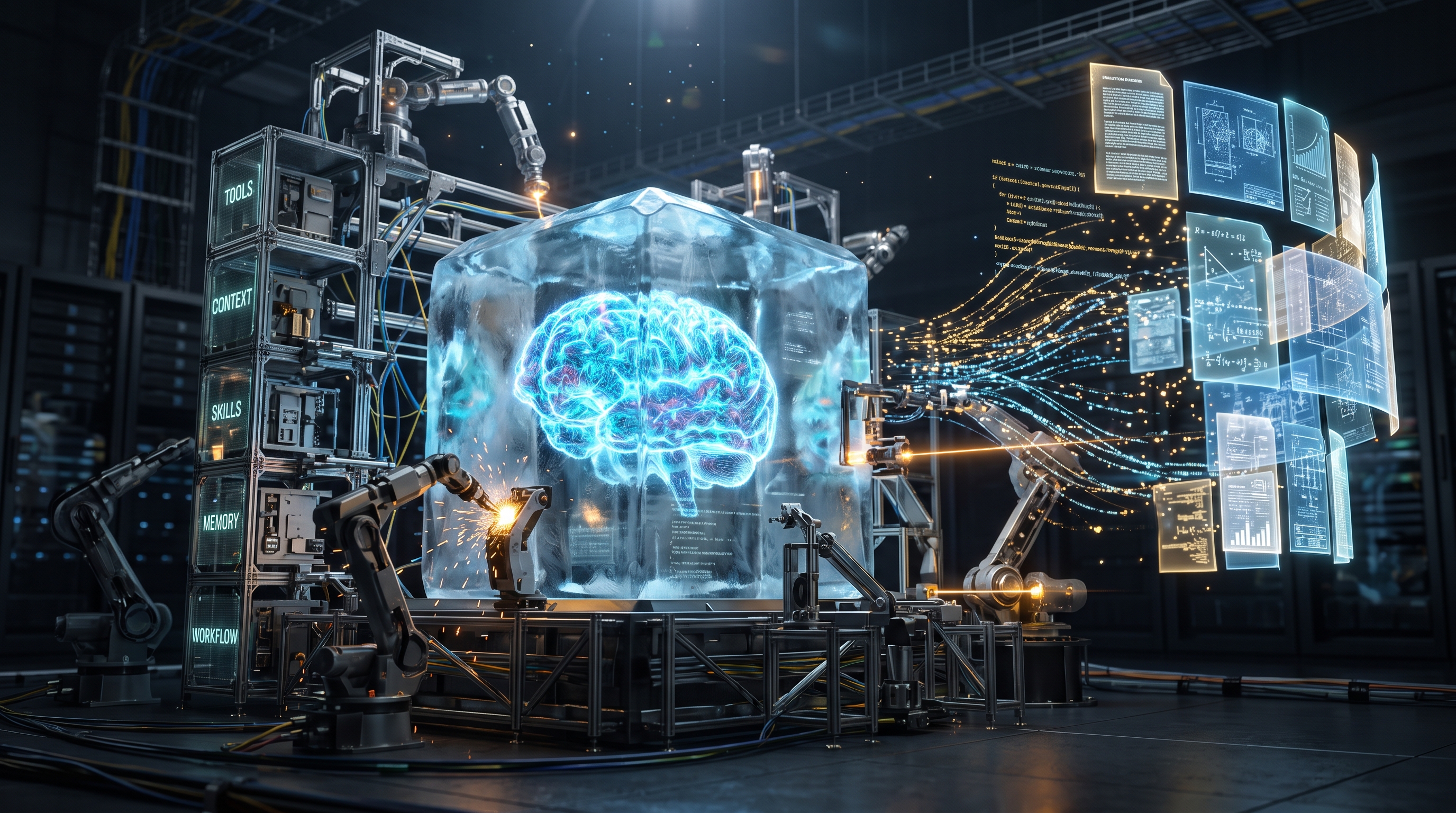
Researchers at UC Santa Barbara and Microsoft built ScholarEvolve, a framework that reads academic papers and turns the techniques in them into working code improvements for AI agents, with no retraining of the underlying model. The pipeline starts by auditing an agent’s failures, then retrieves relevant arXiv papers, uses topic modeling to avoid piling up redundant sources, generates implementation blueprints, validates them with health probes, and finally recombines the surviving modules using genetic crossover with statistical testing. The agent’s harness is decomposed into five components the system can modify: tool interface, context management, skills, memories, and workflows.
The results are large for a method that leaves the weights alone. On the AppWorld Normal benchmark, Qwen3.5-27B went from 69.0 to 81.4 percent task completion, closing about 74 percent of the gap to GPT-5.4. On AppWorld Challenge, which uses APIs the agent has not seen, it rose from 49.6 to 63.6 percent. The method also improved a frontier-tier model, taking GPT-5.4-mini from 72.7 to 81.9 percent on a telecom benchmark. The most practical gain was in recovery: when agents hit an intermediate error, task completion went from 44.9 to 59.9 percent, meaning the improvements made failures survivable rather than terminal.
The specific borrowings show what kind of knowledge transfers. An abstract-syntax-tree check on API calls came from a paper on tool-use reliability. Query-aware context budgeting decides how much conversation history to retain based on what is being asked. Skill-as-pseudocode templates capture recurring API sequences so the agent stops rederiving them. None of these are conceptual breakthroughs. They are the accumulated craft of the literature, and the point is that compiling them into a harness is now an automatable step rather than a graduate student’s year.
Read against the Shandong harness study, the two results are complementary rather than contradictory. Picking a different off-the-shelf harness buys little, because the available harnesses encode broadly similar craft at widely different costs. Systematically importing techniques the harness does not yet have buys a lot. The caveats are real: the project’s GitHub repository was empty at publication, the pipeline describes no security scanning of retrieved code, and it cannot repair deterministic guardrails or a weak retrieval layer. Automatically generated code pulled from papers and merged into a production agent is a supply chain, and it needs to be treated as one.
Source: VentureBeat
A Global Forest Map That Distinguishes a Forest From a Plantation

Google DeepMind and Google Research, with the World Resources Institute and the International Institute for Applied Systems Analysis, released Forest Typology 2020, a classification of the world’s forests at ten-meter resolution into six categories: primary forest, naturally regenerating forest, planted forest, plantation forest, tree crops and agroforestry, and other land. The distinction being added is the one that conventional tree-cover maps structurally cannot make. Satellite greenness tells you whether trees are present. It does not tell you whether you are looking at old-growth forest or the oil palm that replaced it.
That gap has quietly distorted a great deal of environmental accounting. A natural forest cleared and replanted as a timber plantation registers as roughly unchanged tree cover while representing a substantial ecological loss, and deforestation-free supply chain commitments are difficult to verify against a map that cannot see the substitution. ForTy also ships an early-release annual time series covering 2017 to 2025, so the question becomes not only what was lost but what took its place.
The method builds a custom remote-sensing architecture on top of AlphaEarth Foundations embeddings, which compress multi-year satellite observations into a compact per-pixel summary. Working from those embeddings lets the model pick up cues that no single image contains: planting geometry, growth cycle timing, and harvest rhythm. A monoculture plantation and a regenerating forest can look similar on one date and quite different across eight years. Training used about 1.7 million labeled locations, and validation ran against more than 9,000 randomly selected sites worldwide, yielding 90 percent accuracy on forest type and 95 percent on the simpler forest versus non-forest distinction.
Usefully, the output is probability scores rather than hard labels, so users can tune thresholds for their region or application instead of accepting a global default that will be wrong somewhere. That design choice signals the intended audience. This is infrastructure for other people’s analysis, and its value accrues to the agencies, researchers, and companies who now have a consistent global baseline for a distinction they previously had to estimate country by country.
Source: Google DeepMind
Most Enterprises Have Idle GPUs and Are Buying More Compute Anyway
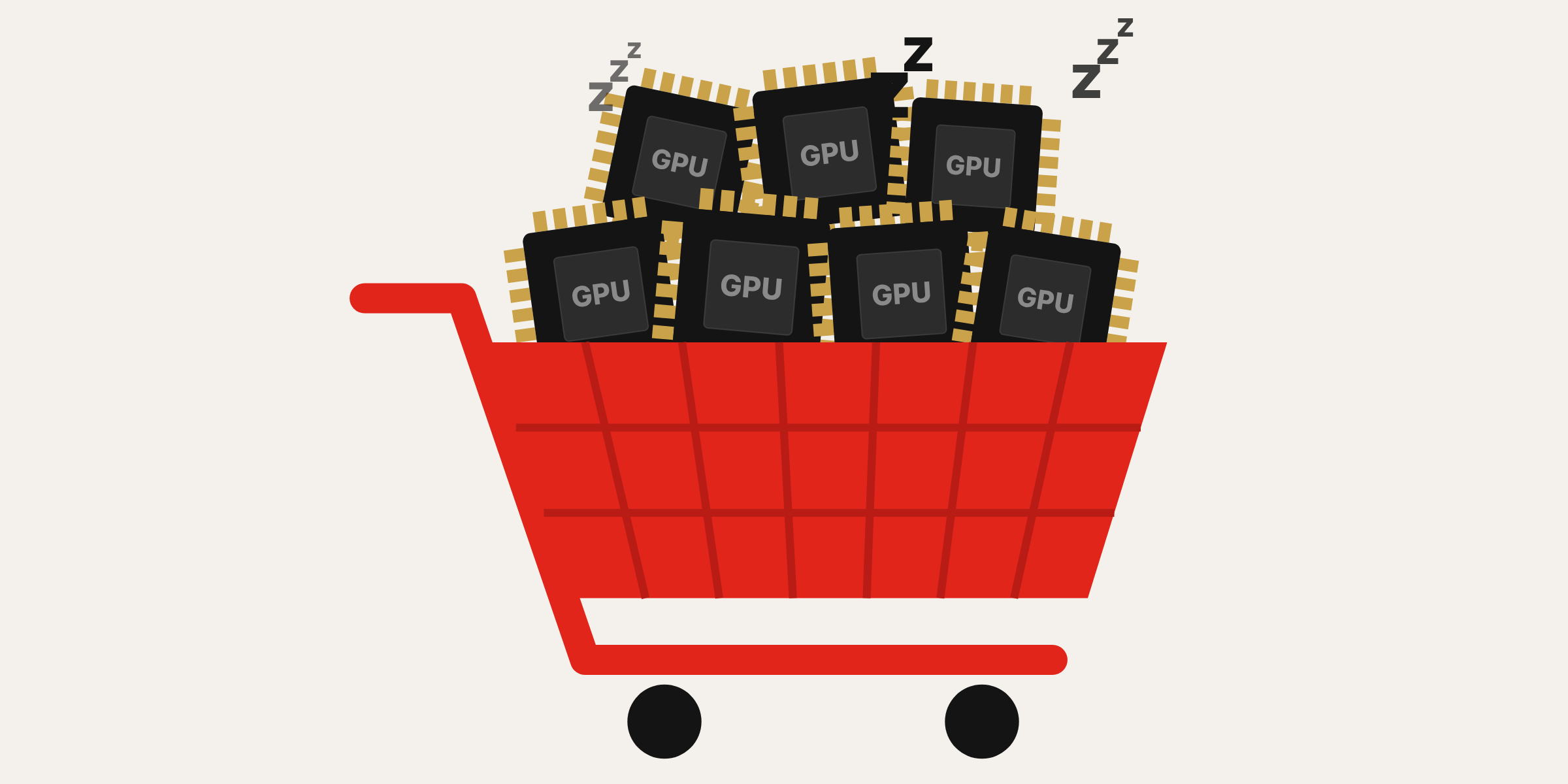
VentureBeat Intelligence pooled three monthly surveys from July through September 2026, covering 385 qualified respondents at organizations with at least 100 employees, and surfaced an apparent contradiction. Seventy-nine percent of companies reported their GPUs sitting idle at least half the time. Seventy percent of those same companies plan to adopt a new AI compute platform within twelve months. Ninety-one percent of the ones planning a new platform have no finance-reviewed return-on-investment figure for it.
The resolution is not that buyers are irrational. It is that the two kinds of spending are not substitutes. Much of the idle hardware was bought on-premises during the 2024 and 2025 shortage, when securing capacity looked more urgent than utilizing it. The workloads companies actually care about now run on frontier models metered through APIs from Anthropic, OpenAI, and Google. An idle cluster cannot absorb that demand, and the API bill cannot be paid down by using the cluster, so the organization pays twice. VentureBeat’s framing is a bubble inside the enterprise rather than one in the market.
One number points at the fix. Companies running self-managed stacks reported idle GPUs at 56 percent, against 83 percent for everyone else, which suggests utilization is substantially an operational competence rather than a hardware-selection problem. Yet 90 percent of the firms with idle GPUs planning new platforms are looking at cloud providers or model APIs, which is to say at more metered capacity rather than at the operational work of using what they own.
The pressure is already visible at scale. Uber’s chief technology officer described reaching the end of the so-called tokenmaxxing era after the company burned through its 2026 budget within months, and a Fortune 500 AI leader noted costs rising while productivity gains stay uncertain. The usual caution applies: these are self-selected VentureBeat readers rather than a representative sample, the surveys did not ask how capacity was acquired or who controlled it, and some idle capacity is deliberately held in reserve for demand spikes. Even discounted, it points at where the next phase of enterprise AI effort has to go, which is utilization rather than procurement.
Source: VentureBeat