Energy Weekly Review 2026-10-09

Week In Review
Fusion had one of its stronger weeks in recent memory, and the stories arrived from three directions at once: hardware, money, and theory. On the hardware side, General Fusion reported the first 1 keV plasma produced by slow mechanical compression, a result from its LM26 machine that validates the core physics bet behind magnetized target fusion. In southern France, ITER welcomed the ninth and final vacuum vessel sector, meaning every core component of the world’s largest tokamak is now on site after more than a decade and a half of procurement. On the money side, Type One Energy closed a $200 million Series B to push its stellarator toward a 400 MWe plant at a Tennessee Valley Authority site, and Germany launched a milestone-based fusion program that pays companies for demonstrated progress rather than promises. And from the theory side, Princeton physicists reformulated the 70-year-old Lawson criterion to show that heating a plasma before densifying it may reach ignition with far less energy than the conventional route.
Fission’s week was about getting more out of what already exists, and about who pays for it. Two of the largest nuclear transactions of the year landed on the same day. Google signed a 20-year agreement with Constellation backing 890 MW of uprates across eleven reactors in three states, with Constellation investing $4.3 billion. Hours later, the Department of Energy offered Vistra a $4.2 billion conditional loan for uprates and life extensions at four reactors in Pennsylvania and Ohio. Together these deals describe a maturing playbook: hyperscalers and federal lenders supply long-dated capital, and operators squeeze hundreds of megawatts from plants that were licensed decades ago, at a fraction of the cost and timeline of new construction.
The new-build side of fission looked very different in scale and certainty. At one extreme, BWXT’s BANR microreactor was selected for a two-unit plant in New Brunswick, a modest 50 MWe project with a provincial power purchase letter of intent and an early-2030s target. At the other, Valar Atomics filed plans for a 456-reactor, 9.6 GW data center campus in Utah with no regulatory pathway yet identified. Both are high-temperature gas reactors fueled with TRISO particles, and both point at the same market of industrial and compute loads that want firm power close to where it is used. The gap between them is a reminder that the microreactor sector now spans everything from bankable first deployments to audacious proposals that will test the limits of licensing reform.
A Stanford economist supplied the week’s dissenting frame. His argument, reported by Tech Xplore, is that the real bottleneck for clean energy is market design, not technology: grid batteries undercut their own revenue by flattening the price spikes they were built to capture, and interconnection reviews that once took a year or two now take seven or eight. It is a useful lens for the rest of the week’s news. Germany’s milestone payments, Google’s two-decade offtake, and the DOE’s loan guarantee are all, at bottom, attempts to fix the revenue and timing problems that stop good engineering from reaching the grid.
Items
General Fusion Reaches 1 keV by Squeezing a Plasma With a Lithium Liner
General Fusion announced on October 8 that its Lawson Machine 26 (LM26) has produced electron temperatures above 1 keV, equivalent to roughly 12.6 million degrees Celsius, by mechanically compressing a plasma. The company describes it as a world first: no other fusion machine has reached that temperature using practical, low-speed compression on millisecond timescales rather than the microsecond implosions of laser-driven inertial fusion.
The measurement was corroborated by two independent diagnostics. Thomson scattering recorded about 1.1 keV just before peak compression, and an AXUV detector recorded roughly 1.2 keV, or 13.7 million degrees Celsius, at peak compression. Ion temperatures rose to about 0.46 keV, roughly double the baseline. Critically, temperature, density, and magnetic field all climbed together during the compression as the physics models predicted, which is what the company set out to demonstrate.
Magnetized target fusion sits between the two mainstream approaches. Like a tokamak, it starts with a magnetically confined plasma; like inertial fusion, it then compresses that plasma to fusion conditions. General Fusion’s version forms a spherical tokamak plasma inside a cavity of liquid or solid lithium and collapses the liner inward. The attraction is a reactor with no superconducting magnets and a liquid metal wall that absorbs neutrons and breeds tritium, but the question has always been whether compression could heat the plasma efficiently rather than just disrupt it.
The 1 keV result is the first of three LM26 milestones. The next is 10 keV, which is in the range needed for a burning plasma, and the final one is the Lawson criterion itself. The company says upgrades toward the 10 keV target are already underway and reiterated a goal of a commercial plant operating around 2035. The result does not make that timeline certain, but it removes one of the largest scientific uncertainties that had hung over the approach.
Source: General Fusion
ITER Receives the Last of Its Nine Vacuum Vessel Sectors
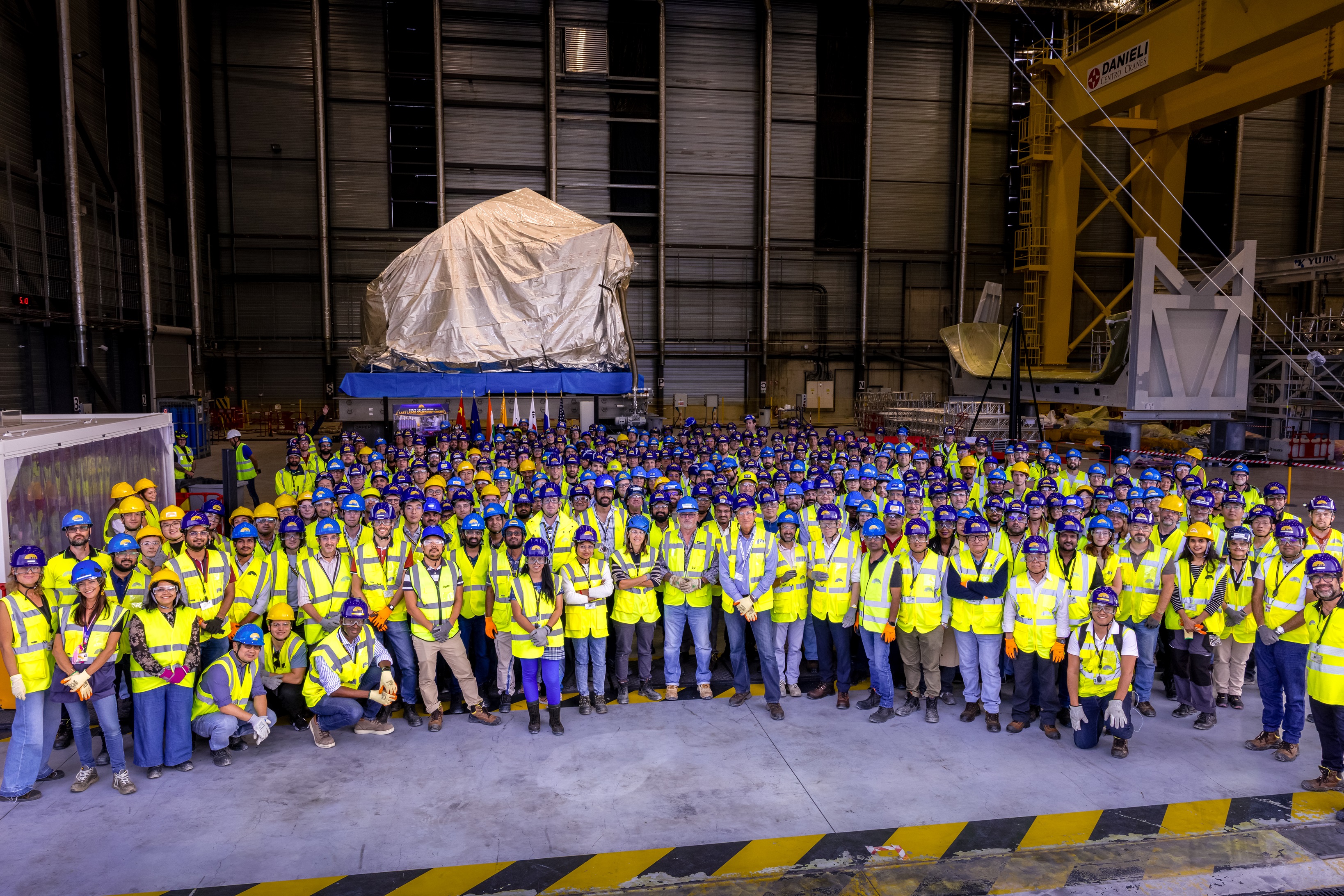
The ITER Organization gathered on October 5 to mark the delivery of vacuum vessel sector #2, the ninth and final section of the tokamak’s plasma chamber. The sector arrived at the site in southern France on October 2 after shipping from Monfalcone, Italy, in mid-September. With its arrival, every core component of the machine, meaning the cryostat, the magnets, and the full vacuum vessel, is now physically on site.
The vacuum vessel is the steel donut that will hold the plasma, and it is assembled from nine massive sectors, each weighing more than 400 tonnes. Europe was responsible for five of them and Korea’s Domestic Agency for the other four. Europe’s five were manufactured by the AMW consortium of Ansaldo Nucleare, Westinghouse, and Walter Tosto, along with more than 15 supply chain companies, over a procurement effort that Fusion for Energy says spanned more than 16 years. All five European sectors were delivered within the past two years, a sharp acceleration after the early sectors took far longer.
Director-General Pietro Barabaschi called sector #2 “the last of our core tokamak components,” and Marc Lachaise of Fusion for Energy described the moment as an emotional one for the teams involved. Machine assembly formally began in July 2020 when the cryostat base was lowered into the pit; the arrival of the last sector closes the chapter of waiting on large deliveries from member states.
What remains is still considerable. The new sector must be fitted with thermal shields and toroidal field coils in the assembly hall before it can be lowered into the tokamak pit, and in-vessel components, plant systems, and supporting equipment are still to come. But ITER’s schedule has for years been hostage to component delivery and the repairs that followed; having everything on site shifts the critical path to assembly, which is work the project controls directly.
Source: ITER Organization
Germany Launches a Pay-for-Milestones Fusion Program Worth €2.5 Billion

Germany’s Federal Agency for Breakthrough Innovation, known as SPRIND, launched a milestone-based fusion funding program on October 7 on behalf of the Federal Ministry of Research, Technology and Space. According to the Fusion Industry Association’s report, the program will provide €500 million through 2029, with total public funding expected to grow to €2.5 billion. It is designed as a new public pathway specifically for private fusion companies rather than for national laboratories.
The structure is what makes it notable. Rather than paying for proposals, SPRIND will pay against technical and financial milestones defined for each participating company’s development roadmap. Expert evaluators assess progress, companies advance as they hit targets, and the end goal for a participant is a Technical Design Report for a commercial-scale fusion demonstration machine. The approach is explicitly intended to pull in additional private investment alongside the public money.
The program fits into an existing German framework that includes the “Fusion 2040” research initiative, the “Hubs for Fusion” program, and the national Fusion Action Plan. Research minister Dorothee Bär framed the rationale plainly: fusion “has achieved significant scientific breakthroughs and is on the verge of transitioning from basic research to industrial applications.” SPRIND director Rafael Laguna de la Vera added that the agency’s aim is to build “strong companies with measurable progress and rapid learning,” not just to fund technologies.
Milestone-based funding shifts risk in a way grant funding does not: the public purse pays only when a company has demonstrably moved forward, and companies that stall stop drawing funds. Germany’s version positions fusion as a domestic industrial opportunity rather than purely a research field, and the scale of the commitment puts the country among the largest public backers of private fusion anywhere.
Source: Fusion Industry Association
Type One Energy Closes $200 Million to Build a Stellarator Plant in Tennessee

Type One Energy announced on October 6 that it has completed a $200 million Series B financing round co-led by Breakthrough Energy Ventures and Clutterbuck Capital. New investors include Lowercarbon Capital, Siemens Energy Ventures, and SiteGround Capital, alongside others the company did not name. The money funds the company’s FusionDirect development program and continued design work on Project Infinity at the Tennessee Valley Authority’s Bull Run Energy Complex in east Tennessee.
Project Infinity has two phases. Infinity One is an engineering prototype stellarator; Infinity Two is intended to be a 400 megawatt-electric commercial fusion power plant. The company notes that the project recently received Tennessee’s initial operating license, which it describes as the first fusion-power-plant-specific licensing process anywhere in the world.
Stellarators are the less common cousin of tokamaks. They confine plasma with twisted, three-dimensional magnetic fields produced entirely by external coils, which lets them run continuously without the large plasma current that tokamaks need and that can trigger disruptions. The historical penalty has been that the coils are fiendishly hard to design and build. Type One’s pitch is that modern computational physics, advanced manufacturing, and high-field superconducting magnets have largely removed that penalty, and that a stellarator is therefore the more practical shape for a plant that has to run around the clock.
The investor mix is as telling as the amount. Siemens Energy Ventures’ participation signals interest from a major turbine and grid equipment supplier, and Type One emphasized a capital-efficient model built on partnerships with original equipment manufacturers rather than vertical integration. Carmichael Roberts of Breakthrough Energy Ventures summarized the sector’s shift: “Fusion is approaching the point where deployment, not discovery, defines the challenge.” The company is also developing a second commercial project through the UK Infinity Fusion Consortium with Tokamak Energy, AECOM, Sheffield Forgemasters, and Barclays.
Source: Type One Energy
Princeton Physicists Chart a Cheaper Route to Fusion Ignition: Heat First, Then Add Fuel

Researchers at the Princeton Plasma Physics Laboratory have reworked the Lawson criterion, the 1950s-era benchmark for whether a fusion plasma can sustain itself, and found that the conventional path to ignition may be the hard way around. The study by Luis Delgado-Aparicio, Masayuki Ono, and Jonathan Menard, published in Physical Review Letters, argues that heating a plasma first and raising its density afterward reaches ignition conditions with far less external energy than the usual approach of building density and then adding heat.
The original Lawson criterion is elegant but idealized. The Princeton team added four conditions that real reactors cannot escape: accumulation of helium “ash” from spent fuel, which dilutes the plasma; impurities, both light and heavy, that drift in from the reactor walls; synchrotron radiation losses from electrons spiraling in the magnetic field; and the temperature-dependent outflow of heat. Ono’s summary was that once these effects are included, “the picture changes, and it becomes quite important.”
The reformulated map has a feature the authors call the Cordey saddle, the lowest point on the ridge that separates a plasma needing external heating from one that burns on its own. In an idealized plasma, fusion output is five times the heating input at that threshold; the real-world effects raise it. The impurity result is sobering: tungsten contamination at just one part in 10,000 roughly doubles the pressure required for ignition, and extended to three dimensions the required pressure can exceed plasma stability limits. Since tungsten is widely used for plasma-facing surfaces, that sensitivity is a direct design constraint rather than an academic curiosity.
The practical upshot is a route around the peak rather than over it. “Go around the peak instead,” Delgado-Aparicio said. “You reach the same place in a much smarter way, and you use far less energy.” The analysis applies to tokamaks and stellarators alike, which covers most of the machines now being built by labs and companies. It is theoretical work and experimental validation is pending, but it offers operators of upcoming devices a specific, testable recipe for the approach to burning plasma.
Source: Phys.org
Google Backs 890 MW of Uprates Across Eleven Constellation Reactors

Google and Constellation Energy have finalized a 20-year power purchase agreement that will underwrite capacity uprates at eleven reactors across Illinois, Pennsylvania, and New Jersey, ANS Nuclear Newswire reported on October 6. The uprates will add 890 MW of new nuclear capacity to the PJM Interconnection grid, and Constellation will invest $4.3 billion in the upgrades and associated modernization. The first uprate is expected by 2028, with multiple Nuclear Regulatory Commission applications to follow over the coming years.
The plants involved are Braidwood, Byron, LaSalle, and Quad Cities in Illinois; Limerick in Pennsylvania; and Salem in New Jersey, where Constellation holds a 43 percent stake. Alongside the uprate agreement, Google signed a separate 15-year energy supply contract for 2,700 MW within PJM and expanded a five-year technology agreement under which Constellation uses Google Cloud and AI services. Constellation says the deal sustains 4,400 existing jobs and will create 7,200 construction jobs during the upgrade period.
Uprates work by replacing or refurbishing components such as turbines, generators, feedwater systems, and instrumentation so a plant can safely run at higher thermal power. The reactor’s physics does not change; the plant simply extracts more of what the core can already deliver. Because the site, licensing basis, transmission, and workforce already exist, the cost per megawatt is far below that of a new reactor and the timeline is measured in years rather than a decade or more.
The agreement is structured to comply with the Trump administration’s Ratepayer Protection Pledge and the Department of Energy’s UPRISE program, both aimed at ensuring that large new loads pay for the capacity they consume rather than shifting costs to households. Amanda Peterson Corio of Google put it in those terms: “We’re committed to meeting our growth responsibly by actively investing in clean, reliable power that brings new capacity to our nation’s grids.” A single hyperscaler financing nearly a gigawatt of new nuclear output through existing plants is a model other data center builders are likely to copy.
Source: ANS Nuclear Newswire
DOE Offers Vistra a $4.2 Billion Loan for Uprates and Life Extensions

On the same day as the Google deal, the Department of Energy announced a $4.2 billion conditional loan commitment to Vistra for uprates and modernization at its Beaver Valley plant in Pennsylvania and its Davis-Besse and Perry plants in Ohio, according to ANS Nuclear Newswire. The work is expected to add 433 MW of new capacity while preserving roughly 4 GW of existing baseload generation and supporting about 3,000 jobs. The investments are also meant to support operation for an additional 20 years beyond the plants’ current licenses.
The fleet involved is a mix of designs and vintages. Beaver Valley’s two pressurized water reactors total 1,872 MWe; Davis-Besse is a single 908 MWe pressurized water reactor; and Perry is a 1,268 MWe boiling water reactor. Vistra’s uprate applications are sequenced over several years: Perry in the third quarter of 2029, Beaver Valley Unit 2 in the third quarter of 2030, Beaver Valley Unit 1 in the third quarter of 2031, and Davis-Besse in the third quarter of 2032. Meta’s involvement in supporting the uprates had been announced earlier but was not detailed in the DOE announcement.
The DOE’s Loan Programs Office lends at government borrowing rates for projects that commercial lenders consider too long-dated or novel, and nuclear uprates and license extensions fit neatly within its mandate to maximize output from existing infrastructure. Energy Secretary Chris Wright summarized the rationale: “By getting more power out of the nuclear plants we already have, we can deliver more affordable, reliable, around-the-clock energy for American families and businesses.”
Taken together with the Google-Constellation agreement, the week brought commitments to more than 1.3 GW of uprate capacity at fifteen reactors in the PJM region alone. Those are nearly a large new reactor’s worth of firm output, delivered through turbine halls and control rooms rather than new containment buildings, and financed by a combination of corporate offtake and federal credit rather than ratepayers.
Source: ANS Nuclear Newswire
Valar Atomics Files for a 456-Reactor, 9.6 GW Data Center Campus in Utah
Valar Atomics has submitted plans for Project Beehive, a nuclear-powered data center campus in Utah that would house 456 high-temperature gas reactors producing around 9.6 GW of electricity, ANS Nuclear Newswire reported on October 5. The site covers more than 9,000 acres of Bureau of Land Management land east of Price and north of Wellington, plus 480 acres of nearby state-owned land. The company says non-nuclear construction would begin by the end of 2026 and the first reactors would operate in 2028.
Each reactor is rated at roughly 25 MWe, with the company specifying a minimum of 21 MWe per unit, and uses TRISO fuel in a design derived from the company’s Ward 250 test reactor. That demonstration unit, rated at 15 MW thermal, reached criticality at Utah’s San Rafael Energy Lab in June 2026 under the Department of Energy’s Reactor Pilot Program. The campus plan includes co-located data centers and an on-site fuel production facility, and it is separate from a smaller Utah data center partnership the company previously announced with Nvidia.
The regulatory path is the obvious open question, and the ANS report is candid about it. Valar has not begun preapplication activities with the Nuclear Regulatory Commission. The company was a party to litigation, State of Texas et al v. U.S. Nuclear Regulatory Commission, challenging the NRC’s authority over small reactors, though the state plaintiffs have since voluntarily dismissed. Potential licensing routes include the existing Part 50 and Part 52 processes, the newer risk-informed Part 53 framework, or the proposed Part 57. The BLM said it is reviewing the application for completeness and that the public will have “meaningful opportunities to provide input.”
The proposal is best read as a statement of ambition and a test case. Nothing on this scale has been attempted with microreactors, and the economics of mass-producing hundreds of 25 MWe units rather than building a few large plants remain unproven. But the concept is coherent: TRISO fuel cannot melt under credible accident conditions, a gas-cooled reactor can be factory-built, and a data center is a load that will pay for firm power on site. Whether the licensing system can process 456 units on a timeline anything like the one Valar proposes is the question that will define the project.
Source: ANS Nuclear Newswire
BWXT’s BANR Microreactor Wins Its First Commercial Deployment in New Brunswick

BWX Technologies announced that its BANR microreactor has been selected for a power plant at Belledune, New Brunswick, marking the design’s first commercial and first international deployment, ANS Nuclear Newswire reported on October 7. The project partners are Prodigy Clean Energy, BWXT, and BWXT’s Canadian subsidiary Kinectrics. The Government of New Brunswick has signed a letter of intent to purchase the plant’s electricity, and operation is targeted for the early 2030s.
BANR is a high-temperature gas reactor fueled with TRISO particles containing uranium enriched to 19.75 percent. Each unit produces 75 MW thermal and 22 MWe; the Belledune plant would pair two units for up to 50 MWe. Prodigy’s contribution is a transportable platform design that allows the reactor to be fabricated and integrated off site and delivered as a package, which is central to the economic case for small reactors. The site sits on the traditional territory of the Pabineau and Eel River Bar First Nations.
The reactor has a long government pedigree. BWXT received $106.6 million in Department of Energy Advanced Reactor Demonstration Program funding in 2020 to develop BANR, and the design was later selected for the U.S. Army’s Janus Program for deployment at Fort Campbell. The New Brunswick project moves it from defense and demonstration into a conventional utility context with a provincial offtaker.
John MacQuarrie, BWXT’s president of commercial operations, said that “by joining forces with Prodigy and integrating BANR with Prodigy’s transportable platform design, we are truly expanding BWXT’s horizons.” A 50 MWe gas-cooled plant with a provincial purchaser already lined up is the kind of modest, financeable first project that the microreactor sector needs before larger fleets become plausible.
Source: ANS Nuclear Newswire
A Stanford Economist Argues the Clean Energy Bottleneck Is Market Design, Not Technology

Tech Xplore published on October 2 a Stanford University piece by Lee Simmons on the research of economist Ömer Karaduman, whose central claim is that the obstacles to scaling clean energy are now mostly about how electricity markets are structured. Wind and solar supplied 17 percent of U.S. generation last year, but Karaduman’s work on batteries, interconnection, and demand response suggests the rules of the market are holding back the next tranche more than any hardware limitation.
His battery finding is the most counterintuitive. Grid-scale storage earns money by buying cheap power and selling it when prices spike. But “storage itself affects prices,” Karaduman notes: as batteries are added, they flatten the very volatility that made them profitable, so the private return falls short of the social benefit well before the grid has as much storage as it needs. His proposed fix is to replace pure per-kilowatt-hour arbitrage revenue with guaranteed capacity payments that reward storage for being available, which is roughly how the firm nuclear capacity in this week’s uprate deals is being paid for.
The interconnection queue is the second bottleneck. Engineering reviews for new generators that once took one to two years now take seven or eight, and the queue holds roughly twice the existing generating capacity of the United States, much of it speculative. Karaduman’s research recommends cluster studies that evaluate geographically grouped projects together and financial screening to weed out projects that will never be built. PJM Interconnection adopted both measures when it reopened its queue in 2026.
The piece also addresses two areas where the standard playbook has disappointed. Peak-pricing schemes meant to shift household demand have largely failed because people will not manually optimize their electricity use; the answer, he argues, is automated home energy management where the user specifies an outcome, such as a car charged by 8 a.m., and software chooses when to draw power. And an analysis of 3,500 fossil-fuel plants found that mergers raised efficiency by 5 percent and output by 7.3 percent while lowering emissions per unit of generation, a result that cuts against the instinct to treat consolidation as inherently bad for consumers. The thread running through all of it is that better rules are often cheaper than better machines.
Source: Tech Xplore