Intelligence Augmentation Weekly Review 2026-09-29

Week In Review
The week’s strongest thread was an unusually concrete look at how humans and AI systems divide up intellectual work, with science as the test bed. The largest single result came from a study pitting 25 language models against 73 human researchers on the full cycle of theory building, which found that AI systems out-scored most individuals but that humans, taken collectively, predicted better with simpler theories. That is a complementarity finding rather than a replacement finding, and it landed in the same week that IEEE Spectrum profiled Paper2Agent, a Stanford framework that turns a published paper and its code into an AI agent a researcher can query in plain English. MIT Technology Review supplied the necessary counterweight, asking when we can fairly say an AI made a discovery and arguing that the bar should be set high now so that a genuine machine discovery, when it comes, is recognised for what it is.
Underneath those headline pieces, a cluster of human-computer interaction studies examined the fine structure of working alongside capable AI. Harvard and Heidelberg researchers watched spatial biologists direct and verify agent-driven analyses of their own tissue data and found that experts constantly step outside the agent to gather evidence in their own tools. Microsoft Research built ParallelPilot to help developers supervise several coding agents at once, and measured a large throughput gain when they did. Two studies added cautionary detail: an Aalto University experiment showed that AI assistance raised reasoning scores without improving people’s ability to judge their own performance, while a University of Michigan system called HelpCoach demonstrated that teaching students to ask more targeted questions of a chatbot improved what they retained a week later. Read together, these papers describe a role for humans that is less about producing answers and more about directing, verifying, and knowing what one does not know.
The neurotechnology side of the subject had a quieter week in the clinic but a loud one in finance and methods. Precision Neuroscience closed a $250 million Series D for its thin-film cortical array, part of a run of large brain-computer interface rounds. Two methodological preprints matter for anyone hoping such interfaces will one day serve healthy users: Hong Kong researchers showed how to separate a genuine personalisation benefit from mere population-model strength when calibrating EEG foundation models to a new user, and a Georgia Tech team extended human-in-the-loop optimisation of a lower-limb exoskeleton to trade off metabolic cost against the wearer’s own comfort ratings. Both are examples of machines learning the individual rather than the average, which is the direction augmentation has to go.
Items
AI Systems and Human Scientists Show Complementary Strengths in Building Theories
A large collaborative study posted to arXiv this week asked whether large language models can do the intellectual core of social science: propose a theory, forecast what the data will show, and revise the theory when the evidence comes in. The team, led by Ke Li, Spyros Zoumpoulis, and Phanish Puranam with more than 80 co-authors, chose the academic literature on gender and racial inequality as its testing ground and compared 25 language models against 13 senior researchers and 60 doctoral students.
The headline result cuts both ways. Individually, the AI systems outperformed most human participants on most tasks. But the human-generated theories were far more diverse, and when the humans’ predictions were aggregated, their accuracy improved substantially. The AI theories were more elaborate, containing additional causal paths and latent variables, yet that elaboration bought no predictive advantage. Human scientists achieved better predictive efficiency with simpler theories.
The two groups also differed in how they updated. The models revised their theories at significantly higher rates in response to new evidence, while the humans were more discriminating, changing their minds selectively and in proportion to how badly a prior prediction had missed. The authors read this as a division of labour: machines are well suited to carrying the burden of theoretical elaboration, while human cognitive diversity drives the collective insight and creative leaps that science ultimately depends on.
For the augmentation agenda this is a useful calibration. It suggests that the productive design is not a single scientist checking a model’s output but a crowd of differently minded people using models to elaborate and stress-test the ideas that the crowd generates.
Source: arXiv
Paper2Agent Turns a Published Study Into a Tool You Can Talk To

IEEE Spectrum’s Elie Dolgin reports on Paper2Agent, an open-source framework from James Zou’s group at Stanford, published in Nature on September 16, that converts a research paper together with its code and data into an interactive AI agent. Instead of reading a methods section and reimplementing it, a scientist uploads the paper and receives a working toolkit that can run the paper’s analyses on new datasets in response to plain-English questions.
The pipeline is itself agentic. One component reads the documentation and code and generates executable tools for each part of the workflow. A testing agent then runs each tool against the paper’s reference results and attempts fixes when it fails. Validated tools are packaged as a Model Context Protocol server and connected to an assistant such as Claude Code, which returns results with visualisations. Applied to AlphaGenome, the system produced 22 validated tools in under 45 minutes for less than $15, and the resulting agent outperformed both a standard model given the raw codebase and a specialist biology tool called Biomni. In one demonstration, cooperating agents surfaced GPR137 as a candidate gene in psoriasis.
The limits are instructive. Of 100 computational biology papers tested, 26 could not be converted because of incomplete code, missing documentation, or broken software dependencies. Zou frames this as a feature: successful “agentification” becomes a certificate that a piece of work is complete and well documented. His larger claim is that knowledge should not be a static record but something dynamic and interactive.
This is intelligence augmentation applied to the scientific literature itself. The bottleneck in reusing published methods has long been the labour of reimplementation. If that labour can be automated and verified, the effective reach of any individual researcher expands to every paper they can point an agent at.
Source: IEEE Spectrum
When Can We Say an AI Made a Scientific Discovery?

James O’Donnell at MIT Technology Review uses a contested announcement to ask a question the field will keep facing. Anthropic reported that its Claude agents, working in a molecular biology lab for 21 hours, found a repeating pattern around a known enzyme in DNA sequences, and positioned the result as reminiscent of the early observations that led to CRISPR. Critics pushed back. Biologist Lucas Harrington argued that finding a strange cluster of genes and repeats is often the easy part and that the hard part is working out what the system actually does. A University of Copenhagen researcher said his team had already found the pattern, raising a question about whether the agents had encountered that prior work.
O’Donnell’s point is definitional rather than dismissive. AI companies have an incentive to present their systems as independent discoverers rather than as powerful tools, and the gap between that framing and what actually happened erodes credibility and makes real progress harder to see. Discovery, in his account, requires novelty with consequential scientific impact, not impressive pattern recognition alone.
The article’s closing line makes the constructive case: set the bar high now, so that when an AI does uncover a fundamentally new biological mechanism, everyone appreciates how big a deal it is. Placed alongside this week’s complementarity study and the Paper2Agent work, it sketches a division of credit to match the division of labour. The tool that finds a pattern augments the scientist who determines what it means.
Source: MIT Technology Review
How Expert Biologists Actually Supervise an AI Analyst

Researchers at Harvard and Heidelberg University set out to learn what happens when working scientists hand real data to an AI agent and then have to decide whether to believe it. Ella Hugie, Hanspeter Pfister, Denis Schapiro, and colleagues synthesised the spatial biology workflow from 14 contextual inquiries, ran a pilot, and then observed ten spatial biologists using an agentic assistant called Claude Science on their own tissue datasets.
The biologists welcomed help with visualisation, cell identification, and labour-intensive procedures. But verification was the interesting part. Participants repeatedly left the agent to inspect images interactively in their own viewers, because the static output the agent returned was not sufficient for the check they needed. They gathered evidence, sometimes through external tools, and interpreted it with domain knowledge the agent lacked. They also wanted visibility into what the computation was doing while it ran, so they could steer the next step rather than judge only the end product.
From this the authors draw four design recommendations: give experts real control over execution, provide the interactive visualisations they already trust, expose the sources and steps behind each result, and make verification workable across different computing setups and skill levels. The larger lesson is that expert oversight is an active craft with its own tooling needs, not a checkbox at the end of an automated pipeline.
Source: arXiv
ParallelPilot Helps Developers Supervise Several Coding Agents at Once

As coding assistants become autonomous enough to work on a task for minutes at a time, developers have started running several of them in parallel, and the skill that matters shifts from writing code to coordinating and monitoring agents. A team from Microsoft Research AI Frontiers and Columbia University, led by Tao Long, studied that shift and built a tool for it.
A formative study with 14 developers identified five supervisory practices the authors call PILOT: planning task scope, isolating agents so they do not interfere, logging context, observing progress centrally, and triaging where to intervene. One participant’s reflection contrasted the idle waiting of old compile cycles with the active management that parallel agents demand. ParallelPilot turns the framework into three components integrated with existing coding environments: a planning interface that analyses task dependencies and lays them out across agent windows and execution waves, a run-logger, and an ambient dashboard of task cards with intervention cues.
In a counterbalanced evaluation with 16 developers, the tool produced a 63 percent increase in ticket throughput on short coding tasks. Users supervised one additional concurrent agent at peak, reported less tracking effort and context switching, and 14 of 16 preferred it to their current workflow. Perceived control and success at redirecting agents did not significantly improve, which the authors flag as the open problem.
The result is a small, measured instance of a general pattern: as the machine takes over execution, the human’s leverage comes from how many parallel efforts they can meaningfully direct.
Source: arXiv
Confident, Not Wiser: AI Help Raises Scores but Not Self-Knowledge

A study from Aalto University and the University of Bayreuth separates two things that are often assumed to travel together: how well people perform with AI help and how well they know how they are doing. Daniela Fernandes, Robin Welsch, and colleagues had 366 participants work through reasoning tasks, including matrix reasoning, mental rotation, letter-string analogies, and syllogisms, either alone or with an AI assistant, estimating their own scores and rating confidence in each answer.
The AI-assisted group scored higher overall. But self-estimates tracked actual performance poorly in both groups, and average overestimation was about the same with and without help. Two findings are more pointed. Confidence distinguished correct from incorrect answers less reliably in the AI-assisted group, and the Dunning-Kruger pattern, in which weaker performers overestimate themselves most, appeared stronger with AI in the loop. Participants’ estimates of the AI’s own performance also varied less across task blocks than its actual performance did.
The authors’ framing is careful: AI assistance improved performance without improving self-assessment. Their design recommendations follow directly. Interfaces should support verification, communicate the model’s task-specific performance, and help users evaluate the quality of the joint work rather than simply hand over answers.
This is the week’s one cautionary result, and it is a constructive one. Augmentation that raises output while flattening a person’s sense of where they might be wrong is incomplete. The remedy the authors propose is better instrumentation of the collaboration, not less of it.
Source: arXiv
HelpCoach Teaches Students to Ask AI Better Questions, and They Remember More

Students increasingly turn to chatbots for help, and the worry is that too much support short-circuits learning. A team at the University of Michigan and KAIST, including Hyoungwook Jin, Q. Vera Liao, and Xu Wang, argues that the problem is partly one of skill: learners often cannot formulate a targeted question that specifies what knowledge they are missing and what kind of help they want.
HelpCoach is an add-on to a chat interface that scaffolds exactly that skill. It continuously assesses how specific a student’s requests are, flags vague ones, and offers adaptive revision templates and personalised suggestions that represent the space of possible help as a grid of knowledge components and scaffold types. The system was evaluated with 40 college students learning web programming, comparing HelpCoach against the alternative of teaching good help-seeking before the task and then leaving students alone with the chatbot.
Students using HelpCoach asked more specific questions during their chatbot interactions and showed greater knowledge retention, measured a week later. The authors’ interpretation is that metacognitive skills are best developed inside the activity where they are needed, where concrete practice and immediate adjustment are possible, rather than in a separate lesson.
Together with the Aalto self-assessment study, this points to a design principle for cognitive tools: the interface should shape how a person thinks about the problem, not only deliver the solution.
Source: arXiv
Precision Neuroscience Raises $250 Million for Its Thin-Film Brain Interface
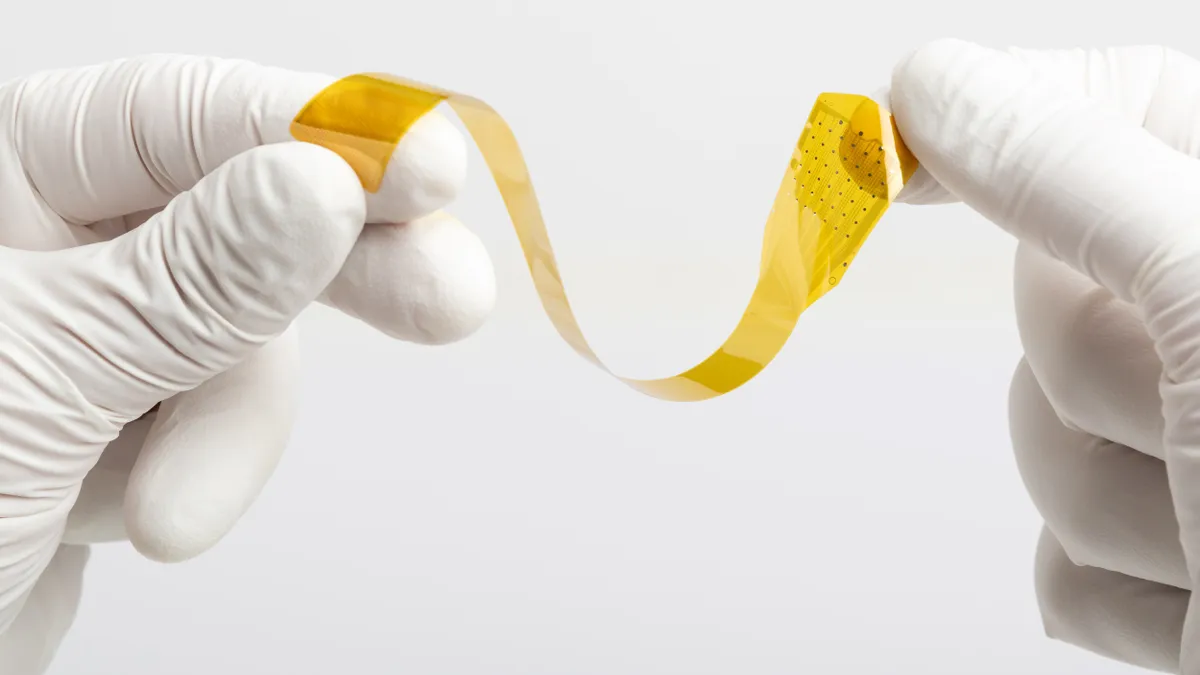
MedTech Dive reports that Precision Neuroscience has closed a $250 million Series D, bringing its total funding to $430 million. The round was co-led by Pershing Square, the Ackman Oxman Institute, and an undisclosed life sciences fund. Bill Ackman, who leads Pershing Square and co-founded the institute, said neurotechnology will be central to the next generation of cures, treatments, and rehabilitation.
Precision’s device, Layer 7, is a flexible film thinner than a human hair carrying 1,024 electrodes on a postage-stamp-sized footprint. It rests on the brain’s surface rather than penetrating it and can both record and stimulate, converting neural signals into commands for digital devices. It is implanted through what the company calls a micro-slit incision, a deliberate contrast with approaches that insert electrodes into tissue. The device received FDA clearance for 30-day use in 2025, and the company has a partnership with Medtronic to integrate Layer 7 with Medtronic’s neurosurgical platform.
The money is earmarked for expanding clinical programmes, carrying Layer 7 through further FDA review, and building commercial infrastructure. MedTech Dive places the round within a broader surge of brain-computer interface investment, noting recent raises of $230 million by Science Corporation and $252 million by Merge Labs.
The augmentation angle is the form factor. A high-channel-count interface that can be placed and removed through a small incision, and that is designed to stimulate as well as read, is the kind of hardware that could eventually be justified for people who are not severely disabled. The capital now flowing into the sector is a bet that the clinical path leads somewhere much larger.
Source: MedTech Dive
Does Personalising an EEG Foundation Model Really Help the Individual?
Foundation models trained on large pools of brain recordings are becoming the default starting point for non-invasive brain-computer interfaces, and the natural next step is to fine-tune a small adapter for each new user. Xilin Tao and Kani Chen of the Hong Kong University of Science and Technology point out a methodological trap: an apparent gain from personalisation may simply reflect a stronger underlying population model, not anything learned about the person.
To separate the two, they evaluated three frozen EEG foundation models, CBraMod, REVE, and LaBraM, across 235 held-out subjects on three motor-imagery datasets. Each subject’s personal adapter was compared not only against the base population model but also against adapters trained on other subjects, a parameter-exchange control that isolates the owner-matched benefit. They repeated the analysis under different population training budgets, including one with four times the original training data.
Personal adapters improved balanced accuracy by 1.5 to 5.4 percentage points over the population model and beat exchanged adapters by 2.3 to 7.3 points across all nine model-dataset combinations. The gains shrank as the population model got stronger, to a median of 1.0 to 2.0 points, but stayed positive. Attempts to calibrate with very few labels were unreliable, and neither unlabelled context nor meta-learned initialisation consistently beat the controls.
The practical message for anyone building consumer-grade neural interfaces is that individuality is real but modest, and that claims of personalisation should be tested against both a population baseline and a swapped-parameter control before they are believed.
Source: arXiv
An Exoskeleton That Learns Both Your Energy Cost and Your Comfort

Human-in-the-loop optimisation has become a standard way to tune wearable robots: the device tries a controller setting, measures how the wearer responds, and updates its search. Most such systems optimise a single number, typically metabolic cost. A Georgia Institute of Technology team led by Neil Janwani and Maegan Tucker argues that real users care about several things at once and that their priorities shift over time, so the system should recover the whole frontier of good trade-offs rather than one point.
Their method, Multi-Objective Human-in-the-Loop Bayesian Optimisation, or MO-HILBO, builds on explicit multi-objective Bayesian optimisation to infer a personalised set of Pareto-optimal controllers, meaning settings where no objective can improve without another getting worse. It cycles through collecting feedback from the wearer, updating its belief about the underlying objectives, and choosing the next settings to try. On a lower-limb exoskeleton, the two objectives were metabolic cost measured by indirect calorimetry and comfort captured as ordinal ratings on a tablet.
In synthetic experiments with high noise and limited samples, MO-HILBO found better frontiers than the evolutionary algorithm NSGA-II across noise levels, action dimensions, and numbers of objectives. On the exoskeleton it discovered Pareto-optimal controllers, and validation trials confirmed that the ordering of points along the frontier held up. For one subject the Pareto set converged on low delay and low hip-extension scale. The team released an open-source Python package, mohilo, for running both the single- and multi-objective methods on wearable devices.
The augmentation relevance is direct. A device that can learn a wearer’s personal trade-off between effort saved and how the assistance feels is one that a healthy person might choose to keep wearing.
Source: arXiv