Intelligence Augmentation Weekly Review 2026-10-06

Week In Review
The most consequential story of the week came from inside a brain implant company’s engineering blog rather than a journal. Neuralink reported that pretraining neural encoders on 50,000 hours of unlabeled recordings from its trial participants produced decoders that stay usable for weeks instead of days, cut the weekly calibration burden by an order of magnitude for some users, and set a new record for information transfer through a brain-computer interface. The result matters less for the record than for what it removes: the daily ritual of re-teaching the device, which has been the main practical tax on living with an implant. Two other items chip away at different kinds of friction. A team working on endovascular interfaces showed a reinforcement-learning controller steering a catheter through the brain’s venous system without a human on the joystick, a step toward implants placed without opening the skull or needing a specialist operator. And IEEE Spectrum covered the first fully implantable cochlear implant, a neural prosthesis with no external hardware at all, which its developers call the first substantial change to the device in three decades.
A second cluster of papers asked a question that is becoming central to the field: how should AI assistance be shaped so that the human remains the one doing the thinking? A controlled experiment with nearly 400 writers found that withholding generative AI until the user has engaged with the task shifted effort toward writing and made evaluation more efficient without lengthening the job. A desk-mounted robot arm that projects AI guidance directly onto the student’s paper matched a chatbot while the help was available and then substantially beat it once the help was taken away, a direct measure of learning rather than performance. A study of referential uncertainty in collaborative tasks found that an AI partner expressing doubt helps people only when the doubt is accurately aimed, and that poorly targeted hedging is worse than none. And a multi-centre pathology study showed what the right division of labour looks like in practice: an AI that directs pathologists to the busiest regions of a tumour slide raised agreement between readers from middling to near-perfect while halving their time, with the human still making every call.
The remaining items widen the lens. A closed-loop neurofeedback experiment on a demanding flight task found that peripheral signals such as heart rate and pupil size decode arousal better than EEG, and that each pilot has an individual optimal arousal trajectory, which points toward personalised regulation for healthy users rather than patients. An agent-based market simulation asked who actually keeps the savings when consumers delegate to AI assistants and found that sellers claw back about a third while the unassisted are not, as feared, made worse off. And an analysis of 200,000 real ChatGPT conversations from India, Nigeria, Brazil, and Pakistan found that personal use, not work, dominates everywhere, and that self-expressive conversation has grown from a rounding error to a fifth or more of all use. Together the week suggests a field moving on two fronts at once: the hardware and models that connect brains to machines are shedding their operational burdens, and the design science of how people and AI should share a task is accumulating real experimental evidence.
Items
Neuralink Pretrains on 50,000 Hours of Brain Data and Cuts the Calibration Burden
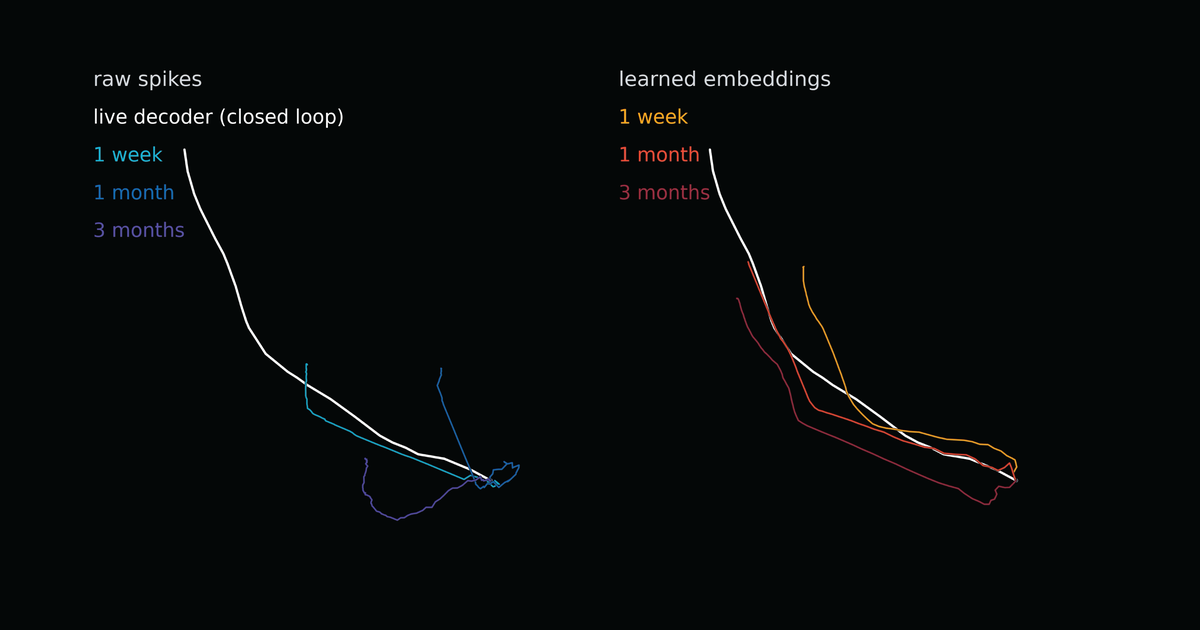
Anyone who has followed brain-computer interfaces knows the headline numbers: a paralysed person moves a cursor, types, plays a game. What is less visible is the maintenance. Neural recordings drift from day to day, so the decoder that maps spikes to intended movement goes stale, and users have to re-run structured calibration tasks to get their control back. In an engineering post published October 1, Neuralink says its participants were spending an average of 55 minutes a week on this, with a separate decoder needed for each feature such as typing or gaming. The company calls it a Sisyphean cycle.
The fix was to stop throwing data away. Over two years of its clinical trial, participants streamed more than 50,000 hours of unlabeled, freeform neural activity, almost none of which had been used. Neuralink trained participant-specific encoders on thousands of hours of each person’s own recordings using a self-supervised objective: feed the model half the recording channels and ask it to predict the other half, which forces it to represent the underlying population state. The architecture borrows from the Mamba state-space family for low-latency causal inference and treats individual spikes as tokens in the style of the POYO decoder. The encoders turn noisy, drifting spikes into stable embeddings, and supervised decoders are then trained on top of those.
The practical effects, as the company reports them, are substantial. Six participants set personal records in the bits-per-second metric Neuralink uses to score cursor control, three beat the prior record of 10.39, and one reached 11.32, which the company describes as a new BCI record. Decoders that previously lasted a day or a few days now hold up for more than a week, some for more than three weeks, and one 20-month-old calibration still produced usable control. Thirty seconds of labeled data on the embeddings is reported as equivalent to about three and a half minutes of raw spikes, so some users’ calibration burden fell from ten minutes a day to ten minutes a week. The gains carried over to a simulated robotic arm with seven or more simultaneous degrees of freedom, a task whose decoders used to become unusable within six days.
The post is candid about what has not worked yet. Pooling data across participants into a single shared model does not yet improve live performance over single-participant models, though a model trained only on one participant transferred to another with 99 percent of its weights frozen and outperformed that person’s existing decoder. The stated goals are one-shot calibration, zero-shot calibration for new users straight out of surgery, and what the company calls an API for the motor cortex: one decoder for all intended hand movement that application developers could build against. The post also previews “cursor teleportation,” predicting where a user wants to go from neural activity and jumping there in one step, which crossed 10 bits per second in early tests.
Source: Neuralink
Making Writers Think First: Productive Friction Before the AI Unlocks
The usual complaint about generative AI in knowledge work is that it invites people to outsource the thinking. A team led by Xiaotian Su tested a design response they call Engage-to-Unlock: the model’s generative capabilities only become available after the user has meaningfully engaged with the task themselves. The question was whether this kind of deliberate friction improves the human contribution without destroying the productivity benefit.
The study, posted October 1, randomised 398 participants on a writing task across four conditions: human only, a standard chatbot with unrestricted access, Engage-to-Unlock, and a time-matched control where the AI unlocked after the same delay regardless of what the user had done. That last condition is the methodological heart of the design, because it separates the effect of engagement from the effect of simply waiting.
Participants in the engage-first condition spent more of their time writing and less of it evaluating AI output compared with the other AI-assisted groups, yet their total task duration did not increase. They also submitted more prompts, suggesting that having thought about the problem first gave them more to ask. On the authors’ measure of accuracy per unit of evaluation time, the engage-first group was the most efficient.
The result argues that the design space for AI tools is wider than the binary of access or no access. Where and when assistance arrives in a workflow shapes what the human does with it, and a small, well-placed obstacle can tilt the balance toward thinking without costing time.
Source: arXiv
An AI That Points Pathologists to the Right Place Nearly Triples Their Agreement
Counting mitotic figures, the cells caught in the act of dividing, is one of the oldest tasks in tumour grading and one of the least reproducible. Pathologists scanning a slide choose which region to count in, and that choice, along with fatigue and the sheer tedium of the task, produces large disagreements between readers. A multi-centre study posted October 1 evaluates a tool called MitPro that is designed to assist rather than replace: it directs the pathologist to the regions with the highest predicted mitotic activity and highlights candidate figures for review, leaving every decision to the human.
The design was a retrospective paired-reader study. Thirteen pathologists each assessed 385 whole-slide images covering seven tumour types from three centres in three countries, once without the tool and again after a washout of at least two weeks with it, across three different scanner systems. Reading the same slides twice with a gap lets the study attribute changes to the tool rather than to the individual.
Agreement between pathologists, measured by intraclass correlation, rose from 0.589 to 0.949, which is the difference between “moderate” and “excellent” in the usual interpretation. Mean assessment time fell from 286 seconds to 128 seconds per slide. The improvements held across additional tumour types and image management systems, which matters because many AI pathology tools degrade when moved to a new scanner.
The structure of the result is worth noting. The AI did not grade the tumour. It solved the attention-allocation problem, deciding where to look, which is exactly the part humans do inconsistently, and left the recognition and judgement to the expert. That division turns out to be enough to make thirteen pathologists agree with each other, a model that likely generalises to many expert tasks where the bottleneck is search rather than interpretation.
Source: arXiv
A Desk Robot That Projects AI Help Onto Your Paper Improves What You Retain
A chatbot on a laptop and a student working on paper live in different spaces, and switching between them is more than an inconvenience. A team led by Gregorio Orlando built AIfred, a robotic arm mounted at a desk with a projector at its tip that perceives the workspace, generates context-aware guidance, and projects it directly onto the user’s work surface. The study, posted September 30, asked whether co-locating the help with the work changes how much people learn.
Thirty-six participants worked through mathematics assignments, creative image generation, and drawing tasks under two conditions, AIfred versus ChatGPT on a laptop, and were assessed both while assistance was available and after it was withdrawn. The second phase is the one that measures learning rather than performance.
While the help was on, the two conditions were statistically indistinguishable on the maths assignments, with scores of 6.7 and 7.3 out of 10. After the help was withdrawn, AIfred users scored 7.0 against 4.4 for the chatbot group, a 60 percent advantage that the authors report as significant. On drawing, independent art and design professors ranked the AIfred-assisted work higher in 33 of 36 cases.
The authors’ interpretation is that guidance sharing the same spatial frame as the work gets integrated into the user’s own process rather than consumed and discarded. It is the physical counterpart to the engage-first finding above: assistance that sits inside the task, rather than in a window beside it, leaves more behind when it goes away.
Source: arXiv
Your Heart and Pupils Say More About Your Arousal Than Your EEG Does
Closed-loop neurofeedback promises to keep a person in the zone, regulating their arousal in real time during a demanding task. The usual signal is EEG. A study by Anirudh Natarajan and Paul Sajda, posted October 2, asked whether that is the best choice. Participants flew a boundary-avoidance flight task designed to escalate stress while receiving EEG-based neurofeedback, sham feedback, or none, and the researchers decoded arousal from multiple physiological channels at once.
The multimodal decoder combined heart rate, heart rate variability, respiration, electrodermal activity, and pupil diameter. Within subjects, it discriminated arousal states with an AUC of 93.0 percent, against 85.2 percent for an EEG-only decoder and 79.8 percent for the original filter-bank common spatial pattern decoder that drove the neurofeedback. For a continuous arousal readout, in other words, the cheap peripheral sensors beat the brain signal.
The second finding is about individuals. Each participant had a personal optimal arousal trajectory, and how far a trial deviated from that trajectory predicted performance, with correlations in the range of −0.24 to −0.28. People differ in how sensitive they are to arousal and in where their best operating point sits, which means a one-size-fits-all feedback target is the wrong design.
The authors propose personalised closed-loop regulation, potentially using transcutaneous vagus nerve stimulation tuned to each person’s arousal profile. The target population here is healthy, skilled operators rather than patients, and the practical implication is that a wearable with a pulse sensor and an eye tracker may be a better foundation for performance augmentation than an EEG cap.
Source: arXiv
A Robot Learns to Steer a Brain Interface Through the Veins Without a Surgeon
Endovascular brain-computer interfaces, which place electrodes inside a vein running over the brain, avoid opening the skull but still require an interventional neuroradiologist to thread the device through the venous system. A team including Thomas Booth and Sam John reports the first in-vitro demonstration of autonomous robotic navigation for that route, posted October 2.
The controllers were trained with Soft Actor-Critic reinforcement learning in simulation and then tested in physical anatomical phantoms under fluoroscopy, on two sequential tasks running from the right internal jugular vein to the superior sagittal sinus. Critically, the team evaluated on both the anatomy used for training and a held-out phantom the controller had never seen.
In simulation, success rates were 85.6 and 98.4 percent on the two tasks in the training anatomy, falling to 42.0 and 91.6 percent in the unseen anatomy. In the physical phantoms, 14 of 20 runs succeeded. The team also built failure predictors that flagged impending failures with detection rates of 99.3 to 100 percent and false-alarm rates of 0.8 to 6.7 percent, which is the kind of safety layer a human supervisor would want before letting a controller run.
The authors are explicit that anatomical generalisation and sim-to-real calibration must improve before preclinical work. But the direction is clear. If the placement of a brain interface can become a semi-automated catheter procedure with a human supervising rather than steering, the bottleneck of specialist operator availability loosens considerably, and the economics of these devices change with it.
Source: arXiv
An AI Partner’s Doubt Only Helps When It Is Aimed at the Right Thing
When a person tells an AI assistant to “put the blue one over there,” the assistant may not know which blue one or which there. Christian Poelitz, Finale Doshi-Velez, and Siân Lindley call this referential uncertainty, and their study, posted September 30, examines what an AI should do about it and how humans respond when it does.
The setup was a collaborative puzzle in which a human Helper instructed an AI Worker on where to place pieces. The Worker had to detect when it was unsure what the instruction referred to and communicate that; the Helper had to notice and respond. The team tested three frontier vision-language models and ran a human study with 210 participants.
One technical result concerns how to get a model’s uncertainty out of it. Separately elicited belief distributions were far better calibrated, with an expected calibration error of 0.15 and an AUROC of 0.65, than the raw probabilities of the model’s action tokens, which had a calibration error of 0.44. The naive approach of reading confidence off the output probabilities is, in this setting, close to useless.
The human result is the one that should shape design. Without any uncertainty signal, participants accepted 78 percent of the AI’s incorrect placements. With well-targeted hedging, acceptance of wrong moves fell to 36 percent while acceptance of correct moves held steady. But the authors’ headline is that externalised uncertainty helps only when it is accurately targeted; vague or misdirected hedging is counterproductive. An assistant that says “I’m not sure” at the wrong moments trains its partner to ignore it.
Source: arXiv
Who Keeps the Savings When Consumers Delegate to an AI Assistant?
Personal AI assistants that not only advise but act, cancelling add-ons, haggling, and clicking through fine print on their owner’s behalf, are often sold as a consumer win. Economists have raised two worries: sellers will adapt their pricing to absorb the gain, and people without assistants will end up paying more as sellers recoup from them. A paper by Haonan Huang and Joey Xiao, posted October 5, builds an agent-based simulation to test both.
The market is a rental setting in which language models play consumers, personal assistants, and six adaptive sellers with algorithmic pricing. Half the consumers get an assistant under either an advisory mandate, which recommends, or an executing mandate, which can take authorised online actions; the other half go unassisted. Contracts pair fees that can only be avoided by physical action with pre-selected add-ons that an authorised assistant can cancel digitally, so the design distinguishes what an assistant can actually do from what it can merely advise.
With sellers’ prices frozen, executing assistants cut their owners’ daily spending by $13.70. Once sellers were allowed to adapt, they recovered roughly a third of that, leaving net savings of $8.70 per renter-day. Sellers responded by raising headline rates while cutting fees, shifting revenue toward the part of the price an assistant cannot negotiate away.
The second worry did not materialise in this model. Unassisted consumers’ spending changed by a mean of +$0.40, with a confidence interval spanning −$0.60 to +$1.30, against a predicted burden of +$3.60. The simulation is not the world, and its assumptions about seller behaviour are only as good as the language models playing them. But it is a concrete, quantitative framing of a question that matters for how delegation to AI spreads: the gains are real, partially contested, and so far not paid for by the people left out.
Source: arXiv
The First Fully Implantable Cochlear Implant Reaches Patients

Cochlear implants have restored hearing to hundreds of thousands of people, but every one of them has required an external processor worn on the scalp or behind the ear, carrying the microphone, the sound processing, and the battery. Edd Gent reports for IEEE Spectrum that the Austrian company Med-El has launched the TICI Unico, which it describes as the world’s first fully implantable cochlear implant, with four commercial implantations performed on the day of the announcement.
The 20-gram device has four parts: a nickel-sized subcutaneous microphone placed six millimetres under the scalp skin, a postage-stamp-sized stimulator containing the sound processor and a rechargeable lithium-ion battery, a coil for charging and data transfer, and a standard electrode array into the cochlea. The battery runs up to 40 hours on a charge of one to one and a half hours, and is designed to keep at least 24 hours of function for a minimum of 15 years.
The device has European regulatory approval. A feasibility study enrolled six patients, and a separate 30-patient study found hearing performance comparable to conventional implants. Fan-Gang Zeng of UC Irvine told Spectrum it represents “the first meaningful innovation in cochlear implants in the past 30 years.” One trial recipient described the main change as freedom, including the ability to hear at night.
What makes this generalise beyond hearing is the engineering. A subcutaneous microphone, a scalp-charged battery with a 15-year service life, and full processing inside the body are exactly the components that every future neural interface, from motor implants to sensory prostheses, needs in order to disappear into daily life. The cochlear implant has once again gone first.
Source: IEEE Spectrum
What 200,000 Real Conversations Reveal About How People Use ChatGPT Outside the West
Most studies of how people use AI assistants are surveys, platform-side aggregates, or focused on rich-country office workers. Shreyasi Roy Chowdhury and Kiran Garimella collected something rarer: the complete ChatGPT export histories of 1,252 users across India, Nigeria, Brazil, and Pakistan, totalling 202,590 conversations between December 2022 and February 2026, paired with self-reported age and gender. The paper, posted September 29, is the first conversation-level demographic comparison across multiple non-Western countries.
The team analysed the corpus three ways: with the platform’s own built-in classifiers, with unsupervised topic modelling, and with thematic reading of the expressive conversations. The headline finding cuts against the workplace-productivity narrative. Personal use accounts for 55 to 64 percent of conversations in every country, and coursework-related use matches work-related use.
The topics are distinctly local. Health and wellness dominate in India and Brazil, Urdu-to-English translation in Pakistan, current affairs in Nigeria, and religious questions in both Nigeria and Pakistan. The same tool is being bent to quite different needs, and a product strategy based on Silicon Valley’s own usage would miss most of them.
The trend over three years is the most interesting part. Information-seeking declined modestly, task delegation grew only slightly, and self-expressive conversation rose from a few percent to roughly a fifth or more of all use in every country. People are increasingly using the assistant to think out loud, work through feelings, and articulate themselves, which is a form of cognitive augmentation that productivity metrics do not capture at all.
Source: arXiv