Intelligence Augmentation Weekly Review 2026-10-13

Week In Review
The week’s two neural-decoding papers share a single idea: stop treating each brain as its own problem. A team working with scalp EEG found that decoding video from brain signals keeps improving log-linearly as the participant count grows past the point where earlier studies had stopped, with no saturation in sight and faster gains when the encoder starts from a pretrained EEG foundation model. A second group pooled eight visual fMRI datasets into one shared visual-semantic space, so that a model trained across 93 participant entries decodes any one of them better than models fitted to each alone. Both results say the same thing from different modalities: the limiting factor in reading visual experience out of the brain is now the size and diversity of the cohort, not the cleverness of the architecture. That is the regime in which non-invasive interfaces for healthy users start to look plausible, because scale is something the field knows how to buy.
The larger cluster this week asks how AI help should be shaped so that the human comes out more capable rather than less. A pair of items frame the problem from both sides. Nautilus reports a Berkeley experiment in which a few minutes with ChatGPT lifted performance and then, once the tool was removed, left people solving fewer problems and skipping more than a control group that never had help. A study of two problem-solving games found that what people say to the AI predicts how they do without it: thinking aloud and receiving explanations of the problem state improved later unassisted performance, while asking for the answer and receiving direct actions degraded it. Read together, the two studies suggest the drop in persistence is not inherent to AI assistance but to a particular way of using it. Three applied studies land on designs that steer toward the good pattern. A preregistered field experiment with 759 MBA students found that rehearsing with a voice-based AI discussion partner before class raised voluntary in-class contributions by about 31 percent. A randomised trial of a tool that makes users clarify context, pick a strategic direction, and articulate their reasoning before the model generates anything improved document quality by 32 percent and cut off-task deliverables from 34 to 5 percent. And a tutoring system that reads attention from a webcam and lets a reinforcement-learning agent decide when to intervene delivered fewer, better-timed nudges and improved learning in a 187-person study.
Two items take the human-in-the-loop question to settings where the stakes are physical. IEEE Spectrum reports that nearly all of the 94 US nuclear reactors now use AI assistants that search tens of millions of pages of regulatory and maintenance records for operators, with the vendors insisting the systems recommend and never decide. A framework paper formalises the question those plants will eventually face as the Handover Problem: a scored, auditable rule for when a system should be allowed more autonomy and when it should be pulled back, with hysteresis so that trust is earned slowly and withdrawn fast. Finally, Quanta’s Natalie Wolchover traces the attention mechanism from a 2014 intern’s insight to the engine of every large language model, and asks whether the thing that made machines fluent resembles the thing that makes humans intelligent. Her answer, that human thought draws on far more than language, is a useful reminder of why the week’s best results pair machine fluency with human reasoning instead of substituting one for the other.
Items
Decoding Video From EEG Gets Better the More Brains You Train On
Reconstructing what someone is watching from their brain activity is one of the showcase problems in neural decoding, and the usual tool is fMRI, which is expensive and immobile. EEG, the cheap scalp-electrode alternative, has lagged badly, and a common conclusion in earlier work was that adding more participants to the training set gave only marginal gains. A paper posted October 7 by Dung Truong, Kuntal Kokate, and Arnaud Delorme argues that conclusion was an artefact of stopping too early.
The team trained a cross-modal contrastive encoder that aligns EEG recordings with the video clips that produced them, then measured decoding quality as a function of the number of participants in the training cohort. They compared encoders initialised at random with encoders initialised from an EEG foundation model, at two model depths, and evaluated both with probes for stimulus features and with a retrieval task that asks the model to pick out the moment in a film that a given EEG segment corresponds to.
The result is a scaling curve with a knee. Below roughly 50 participants, which is about where prior studies had topped out, more subjects did little. Above it, decoding accuracy rose log-linearly with cohort size and had not saturated at the largest cohort the authors could assemble. Encoders that started from the foundation model improved about 1.6 times faster per doubling of the cohort than randomly initialised ones, and the authors report that initialisation mattered more than model capacity for how well the system scaled. The gains carried over to films the model had never seen.
The practical implication is that EEG decoding is not stuck; it was under-fed. Scalp recording is the only brain-reading modality that could plausibly be worn by healthy people at a desk, and this result says the path to making it useful runs through larger, naturalistic datasets and pretrained encoders, both of which are engineering and logistics problems rather than open scientific ones.
Source: arXiv
One Geometry for Many Brains: Pooling Eight fMRI Datasets Into a Shared Decoding Space
Visual decoding studies almost always fit a separate model per participant, because brains differ in anatomy, in the way responses are measured, and in which images each person was shown. That makes every new participant a cold start and wastes the accumulated data of the field. BRAID-fMRI, described in a paper posted October 7 by Moein Khajehnejad, Nicola Toschi, and colleagues, is an attempt to decode everyone in the same space.
The method uses a single Transformer operating on region-of-interest features, with optional conditioning on participant identity, and aligns its outputs to the visual representations of the CLIP ViT-B/32 model through contrastive learning. The key trick is in how positives are defined: when two different people viewed the same image, their responses are treated as matching pairs, which forces the model to find what is common across brains rather than what is idiosyncratic to each.
The training corpus combined eight visual-fMRI datasets, 93 participant entries, more than 430,000 single-trial responses, and roughly 163,000 unique images. On matched-participant tests the model reached 35.0 percent top-10 retrieval accuracy against baselines of 27.1 and 21.1 percent. More telling for the field, adding training sources improved holdout accuracy on unseen data by up to 92.1 percent, meaning the model gets better at decoding a given person by having seen other people’s brains.
Alongside the EEG scaling result above, this paper suggests that the constraints on brain decoding are increasingly about data aggregation rather than modelling. Every lab that has published a visual-fMRI dataset has, in effect, contributed to a decoder that works on participants it never scanned. The authors frame this as a step toward scalable, population-level neuroscience, and it is also the kind of foundation on which practical non-invasive interfaces would be built.
Source: arXiv
Nearly Every US Nuclear Reactor Now Has an AI Assistant, and None of Them Make Decisions

Nuclear power is about the most conservative operating environment in industry, which makes the speed of this adoption notable. Writing in IEEE Spectrum on October 8, Andrew Moseman reports that nearly all 94 US reactors have taken on AI tools, driven less by enthusiasm for novelty than by a workforce problem: experienced staff are retiring and the pipeline behind them is thin. Nuclearn’s chief financial officer puts it bluntly in the piece: he has had positions open that he cannot fill.
Two vendors dominate. Atomic Canyon’s NIVA, the Nuclear Industry Virtual Assistant, launched in August 2026, was piloted at Constellation Energy plants and is now offered fleet-wide. Nuclearn serves more than 65 US partners, including conventional plants and NuScale Power’s small modular reactor programme. Microsoft and Nvidia are working on optimisation across the plant lifecycle from permitting through operations. The core job of these systems is retrieval at a scale no human can manage: the article cites 53 million pages of Nuclear Regulatory Commission documents, plus maintenance guides, incident reports, and compliance records, which workers can now query in plain language. Nuclearn’s Equipment AI lets engineers ask how a specific piece of equipment behaves; NIVA synthesises technical information across the fleet.
What the systems are not allowed to do is as carefully specified as what they do. Both vendors describe strict human control: the AI recommends, people decide. Pilot projects are testing whether the tools can flag inspection concerns, but every flag goes to a human reviewer. Atomic Canyon’s chief executive, Trey Lauderdale, says he cannot see an environment in which AI makes decisions about plant operation. Data security is treated with the same seriousness: NIVA only reaches databases that already require plant-level clearance, and Nuclearn offers deployments that keep all data on site.
The story is a clean example of augmentation in a high-consequence setting. The scarce resource is not judgement but the ability to find the relevant page among tens of millions, and that is exactly the part being delegated. The push from technology companies to revive nuclear power for data centres adds an irony the article notes: the AI industry is both the cause of the demand and the supplier of the tools that help an ageing workforce meet it.
Source: IEEE Spectrum
What You Say to the AI Predicts How You Do Without It
The worry that leaning on an AI assistant hollows out one’s own skill is usually studied by measuring performance after the tool is taken away. A paper posted October 7 by Li Siyan, Federico Bianchi, James Zou, and Kaitlyn Zhou takes a more diagnostic approach: it asks which specific behaviours during the assisted phase predict how well a person does afterwards.
The team ran two game-based problem-solving studies with 139 and 111 participants, recording every exchange between user and AI. They then coded the conversations with a dialogue-act scheme adapted from research on human tutoring, which classifies utterances such as verbalising a thought, requesting a solution, explaining a problem state, or supplying an action. This lets the analysis treat the conversation as a set of measurable moves rather than a black box.
The pattern was consistent across both studies. Participants who verbalised their reasoning to the AI went on to perform better unassisted, while those who asked directly for solutions performed worse. On the AI’s side, explanations of the problem state improved later independent performance, whereas handing over direct actions diminished it. The same interaction can therefore be either a learning experience or a crutch depending on who is doing the thinking in it.
The result gives designers something concrete to aim at. Rather than rationing access to AI, a system could watch for solution-requesting and action-giving patterns and nudge the exchange toward reasoning and explanation, which the data say leaves the human stronger. It also reframes the Berkeley persistence finding reported elsewhere this week: a tool that answers is a different cognitive object from a tool that explains, even when both are the same model.
Source: arXiv
Minutes With a Chatbot, Then a Measurable Drop in Persistence
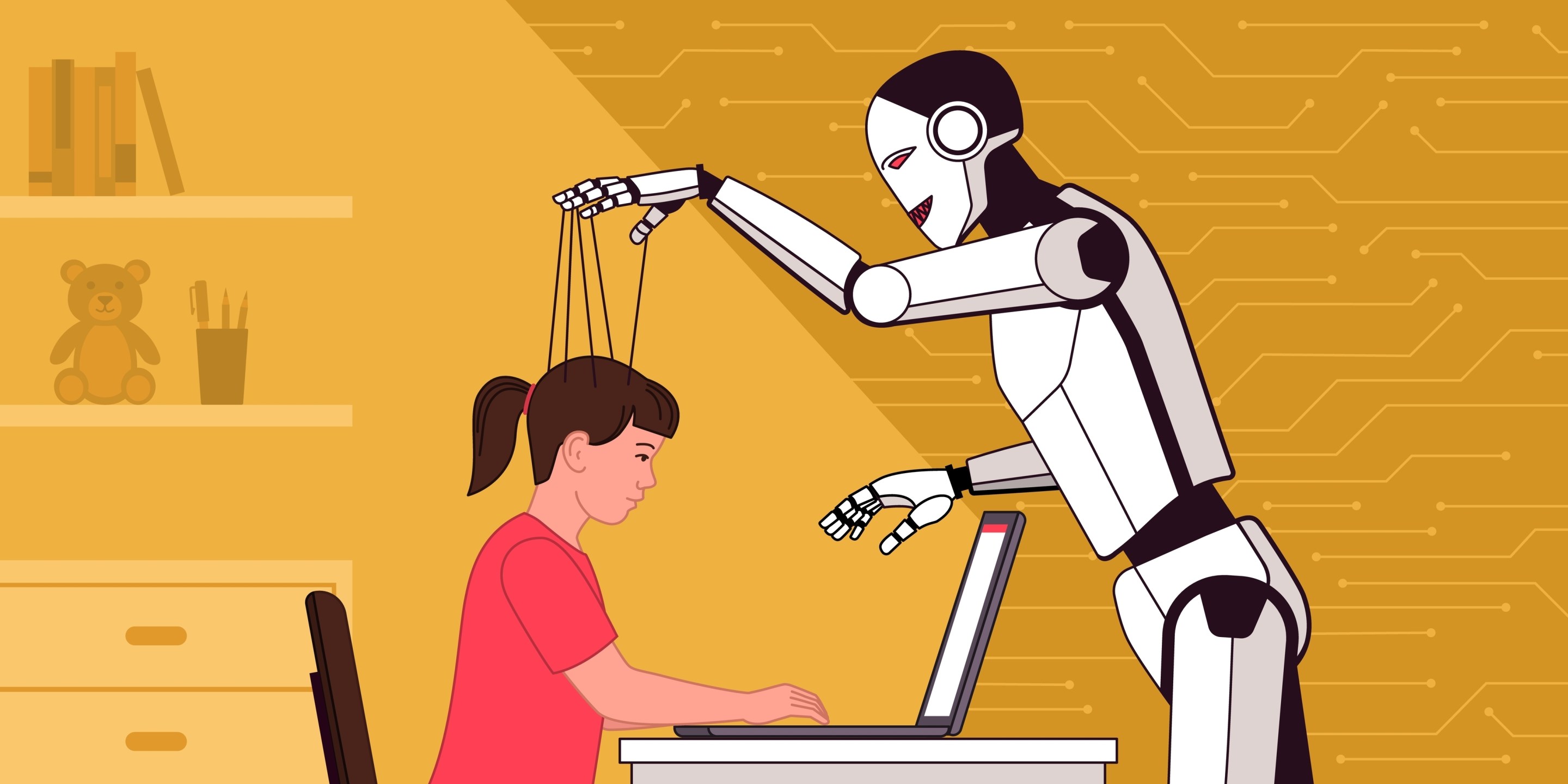
Most accounts of AI eroding human skill are anecdotal or span months. The experiment Jake Currie describes in Nautilus on October 12, led by Brian Christian at UC Berkeley, compresses the effect into a single sitting. Adult participants worked through fraction problems and SAT-style reading comprehension questions. One group had ChatGPT; a control group did not. Partway through, the chatbot was taken away from the first group and both groups continued unaided.
While the tool was available, the AI group did what one would expect: higher solve rates and fewer skipped questions than the controls. After it was removed the picture inverted. The formerly assisted group solved significantly fewer problems and skipped significantly more, while the control group, which had been practising all along, improved. The pattern held for both the maths and the reading tasks, which argues against it being a quirk of one problem type.
Christian’s interpretation is that even brief reliance erodes the willingness to push through difficulty, and he offers a boiling-frog metaphor: if a few minutes does this, prolonged dependence could accumulate damage that is hard to reverse by the time it is noticed. The article is honest about its limits. The exposure lasted minutes, the sample size is not reported in the piece, and the study does not examine sustained use, so the long-run claim is an extrapolation rather than a finding.
The study is best read alongside the conversational-behaviour result above, which found that the harm depends on whether the AI supplied answers or explanations. Christian’s participants had an unrestricted chatbot, which is the condition most likely to produce answer-seeking. The two papers together point to a design question rather than a verdict on the technology: the persistence that evaporated here is what the deliberately structured tools elsewhere in this week’s items are built to preserve.
Source: Nautilus
Rehearsing With a Voice AI Before Class Makes Students Speak Up 31 Percent More
Business school pedagogy runs on class discussion, and the students who stay silent lose much of its value. A preregistered field experiment posted October 7 by Dan J. Wang, Bruce Kogut, and six colleagues tested whether a purpose-built voice-based AI discussion partner, used as preparation at home, could change what happens in the room.
The study randomised 759 MBA students across ten course sections. Treated students talked through the upcoming case with the AI partner before two class sessions; the researchers then tracked voluntary participation in the subsequent discussions. Preregistration and the field setting are both worth noting, since much of the literature on AI in education comes from short online tasks with self-selected participants.
Students who rehearsed with the AI made roughly 31 percent more voluntary contributions in later class discussions. They also reported feeling more comfortable speaking and perceived that they had learned more. Measures of focus and motivation did not differ between groups, so the effect appears to run through confidence and preparation rather than through any general boost in engagement.
The outcome being measured is unusual and important. Most evaluations of AI tutors stop at test scores; this one asks whether practising with an AI changes a live human behaviour that the AI is not present for. The answer is that a private rehearsal partner lowers the cost of the first contribution, and the benefit shows up precisely where it is meant to, in conversation with other people.
Source: arXiv
Making People Think Before the Model Generates Improves Strategy Documents by a Third
Prompting a language model with a one-line request and accepting what comes back is the default mode of AI-assisted knowledge work, and it is also the mode most likely to produce a polished document that answers the wrong question. A randomised online experiment posted October 7 by William Scott-Jackson tested an alternative: Cognistance, a prototype from the Oxford Centre for Impact Research that walks the user through clarifying the context, choosing a strategic direction, and spelling out their reasoning before the model produces anything.
Participants were asked to produce enterprise strategy documents. One group used single-shot prompting; the other used the structured elicitation scaffold. Independent raters scored the deliverables on a composite quality measure and on specific dimensions, and the researchers also recorded time on task and tested immediate recall of the material.
Mean composite quality rose 32 percent with the scaffold. Off-task deliverables, documents that did not address the brief, fell from 34 percent to 5 percent. The gains concentrated in trade-off articulation and strategic coherence, the parts of a strategy document that require judgement, and were absent for technical specificity, which the model handles well on its own. The cost was about 2.4 extra minutes on a task that averaged 10.46 minutes in the treatment group, and treatment participants also scored higher on immediate recall, suggesting they understood their own documents better. Among participants whose prompts had already spotted the key data-localisation issue in the brief, the scaffold still added 21 percent.
The study is small and online, and the author flags delayed retention and real organisational deployment as the next tests. But the direction of the result matches the week’s other findings: the quality of AI-assisted work tracks how much structured thinking the human puts in before the generation step, and a modest amount of enforced deliberation pays for itself several times over.
Source: arXiv
The Handover Problem: A Scored, Reversible Rule for When AI Gets More Autonomy
Debates about human-in-the-loop AI tend to treat autonomy as a dial set once at deployment. In practice, as a paper posted October 7 by Vicente Pelechano, Antoni Mestre, Manoli Albert, and Miriam Gil argues, control moves back and forth continuously as an operator and a system work together, and nobody has written down an auditable rule for how it should move. The authors name this the Handover Problem: at each operating cycle, decide whether to escalate, hold, or reduce the system’s autonomy, in a way that can be reversed and explained afterwards.
Their proposal is a Handover Readiness Score that fuses four streams of evidence: operator readiness, the measured trust between human and AI, the stability of whatever the system is learning, and operational performance. The score drives transitions with hysteresis, the same principle a thermostat uses to avoid chattering. Autonomy increases only after sustained positive evidence across the dimensions, but reverts promptly when conditions deteriorate. Trust, in other words, is granted slowly and withdrawn quickly.
The authors position the framework as complementary to conventional safety guards. A hard limit catches a single critical breach; the readiness score is designed to catch the slow, multi-signal drift that no single threshold would trip, such as an operator gradually disengaging while performance metrics stay nominal. The paper, submitted to IEEE Transactions on Human-Machine Systems, draws on adaptive automation and trust-in-automation research but argues that neither literature had treated the transition itself as a governance object.
This is the kind of infrastructure the nuclear plants in this week’s Spectrum story will need if their assistants ever move from retrieval toward recommendation with teeth. A formal, logged account of why a system was given more latitude on a given day, and what would take it away, is what turns “humans stay in control” from a slogan into a procedure.
Source: arXiv
A Tutor That Watches Attention Through the Webcam and Learns When Not to Interrupt
Intelligent tutoring systems have mostly decided when to intervene based on the content of what a student is doing: a wrong answer, a long pause on a particular step. TutorLoop, described in a paper posted October 7 by Songlin Xu and Xinyu Zhang, decides based on the student’s cognitive state, read in real time from an ordinary webcam.
The system has three parts. Webcam-based sensing estimates the learner’s attention and workload moment to moment. A deep reinforcement-learning agent takes those signals and chooses whether and when to intervene, optimising over the whole learning session rather than reacting to isolated events. A language model then turns the agent’s abstract recommendation into a natural, contextually appropriate message. The reinforcement-learning policy was trained offline and then applied to a new learning task without retraining, which is the test of whether the approach generalises.
In a 187-participant study, the system intervened less often than conventional approaches but to greater effect. The authors report improved attention, lower cognitive workload, higher engagement, and better learning outcomes, and they describe the key property as “less frequent yet more effective interventions.”
The design inverts the usual logic of AI tutoring, in which more feedback is assumed to be better. Here the agent learns that most moments are the wrong moment, and that a well-timed nudge when attention flags outperforms a steady stream of help. It is a sensor-in-the-loop version of what a good human tutor does by instinct, and the fact that the policy transferred to a new task without retraining suggests the instinct is learnable.
Source: arXiv
Is Attention the Essence of Intelligence, or Just the Essence of Language Models?
Natalie Wolchover’s October 12 essay in Quanta traces the single mechanism behind every modern language model back to its origin: in 2014, Dzmitry Bahdanau, a 23-year-old intern at the University of Montreal, was trying to fix machine translation’s inability to handle long sentences and arrived at the idea of letting the model look back selectively at the input. He describes it as one of those moments in science where something is simply obvious to one person who had no prior experience of the problem. Three years later Google’s “Attention Is All You Need” paper built an entire architecture on the idea; Wolchover notes it has been cited more than 250,000 times.
The essay explains the mechanism accessibly, including the query-key-value operations and the multiple attention heads that let a model weigh every word against every other, and then asks the harder question in its title. Llion Jones, a co-author of the Google paper and now chief technology officer at Sakana AI, argues in the piece that language modelling may be “AI-complete”: nearly every written human task reduces to predicting the next token, so a system that does that well enough can do nearly everything.
Wolchover is not convinced the same is true of people. She points to neuroscience showing that human thought is not purely linguistic, that far more of the brain lights up during thinking than the language network, and that human intelligence draws on sensory experience and reasoning that language merely reports on. She also observes that transformers are strikingly inefficient compared with the brain they are so often likened to.
The piece matters for anyone building tools that pair people with language models, because it names what each side brings. The machine supplies a fluency over text that, as Jones argues, covers a startling range of work. The human supplies the grounded, multimodal reasoning that attention does not capture. The week’s experimental results, in which structured human thinking before and during generation produced better outcomes than fluent output alone, are a practical version of the same distinction.
Source: Quanta Magazine