Resource Abundance Weekly Review 2026-10-01

Week In Review
The week’s strongest thread is the ground beneath us being re-read as a richer source than it looked. The US Department of Energy put $29.5 million into 17 national-laboratory mining projects that share a single premise: the cheapest new mine is often the ore we already dug up and discarded, or the deposit we can reach without digging at all. Induction heating to pull copper, nickel and cobalt out of tailings, electrochemical lithium extraction from clay, in-situ mining that reshapes a formation underground, and vanadium drawn from aging oil wells are all bets that extraction cost, not geology, is the binding constraint. The same logic sits behind the first US construction permit for a commercial small modular reactor: a licensing pathway finished four months early is an input-cost story for every energy-hungry process downstream, and the 300 MW electrolyser now under construction in Huelva shows what that downstream looks like when a refinery decides to make its own hydrogen from dedicated solar rather than buy it from natural gas.
A second thread is doing the same job with a cheaper or more plentiful input. A platinum-free fuel-cell cathode built from a blue pigment set a power-density record for its class using iron, one of the most abundant metals on Earth. A new form of elemental boron made by cooking the sodium out of a precursor crystal is both flexible and millions of times more conductive than any boron known before, a reminder that even well-studied elements still hold unexplored structures. In agriculture, a three-dimensional textile originally designed for soldiers’ uniforms multiplied strawberry yields several times over in field trials without blocking light or rain. And a biodegradable aerogel modelled on fish gills keeps a solar still from clogging with salt, attacking the maintenance problem that has held back passive desalination.
The third thread is the economics of waste and abundance, and here the week offered unusually heterodox material. An industry-sponsored Oxford Economics study argues that a landfill tax paired with a recycling subsidy would recover far more plastic than a cap on virgin production, at a fraction of the household cost. Its funding is a fair reason for scepticism, and the piece carries the critique, but the underlying claim that pricing waste beats rationing supply deserves a hearing. A historian’s essay on a federal cooking-oil theft conspiracy makes the Simon-style point from the other direction: once biofuel incentives pushed used fryer grease above the price of virgin oil, a waste stream became a commodity worth stealing, exactly as whey, fly ash and cottonseed oil did before it. Human Progress’s latest Doomslayer roundup closes the loop with the most dramatic falling-cost curve in the economy, AI performance per dollar, alongside a wave of new trade agreements that widen the market every one of these technologies can sell into.
Taken together, the ten items describe a world where the cost of a metal, a fuel, a fruit, a litre of fresh water and a unit of computation are all being pushed down by named, specific techniques, and where the waste of one decade keeps turning into the feedstock of the next.
Items
DOE Funds 17 National Lab Projects to Mine Tailings, Clay and Old Oil Wells
The US Department of Energy’s Office of Critical Minerals and Energy Innovation has selected 17 projects across its national laboratories for $29.5 million in funding, all aimed at expanding domestic mineral supply by lowering the cost of getting metal out of the ground or out of what has already been dug up. The announcement is notable less for its size than for its direction: most of the projects target material that conventional mining treats as waste, or formations that conventional mining cannot reach economically.
Argonne National Laboratory is developing a continuous induction-heating process to extract copper, nickel and cobalt from mine tailings, and a rotating-bed technology to recover rare earth elements from low-grade material. Sandia’s “Zero Waste” project pairs biological and electrochemical processing to pull critical minerals from tailings while turning the residue into construction materials. SLAC will test low-toxicity solutions for recovering vanadium from aging oil and gas wells. Lawrence Berkeley’s SEOL project tackles electrochemical lithium extraction from clay, a resource the United States has in abundance but has struggled to process cheaply.
A second group of projects aims at the mine itself. Pacific Northwest National Laboratory’s SECURE-CM is an in-situ mining technology that reshapes underground formations to release minerals without excavation, with the DOE noting its promise of lower cost and faster permitting. Idaho National Laboratory is working on an electric-hydraulic fracturing method to extract critical minerals from underground formations while controlling permeability. Oak Ridge is pursuing millimetre-wave drilling with laser spectroscopy and an autonomous mining robot, and Lawrence Livermore is applying machine-learning-optimised microwave energy to comminution, the energy-intensive crushing and grinding step that dominates many mines’ power bills.
The remaining projects are about seeing ore better: magnetoacoustic and computer-vision ore sorting at Ames, nuclear sensing with AI for ore sorting at Lawrence Berkeley, fibre-optic monitoring of underground reactions at Los Alamos, and real-time AI-driven drill-core analysis at Savannah River. Sorting and sensing sound mundane next to new chemistry, but separating rock from ore early is one of the surest ways to cut the cost per tonne of finished metal. The programme as a whole is a wager that American mineral scarcity is mostly a cost problem, and that cost problems yield to engineering.
Source: US Department of Energy
NRC Issues First US Construction Permit for a Commercial Small Modular Reactor

The US Nuclear Regulatory Commission has approved the Tennessee Valley Authority’s application to build a GE Vernova Hitachi BWRX-300 at its Clinch River site near Oak Ridge, Tennessee, the first construction permit ever issued in the United States for a commercial small modular reactor. The 300 MWe design is a water-cooled, natural-circulation reactor with passive safety systems, a deliberately conservative choice that keeps it close to decades of boiling-water-reactor operating experience.
The schedule is the real news. TVA submitted the application in May 2025 and the formal review began in July 2025. The NRC finished its safety evaluation in June 2026, held a public hearing in Oak Ridge in August, and issued the permit after 14 months, four months ahead of its own schedule. For an agency long criticised as the slowest step in any nuclear project, a review that beats its timeline is a meaningful signal, and World Nuclear News reports the permit is expected to establish a clear, repeatable licensing pathway for future BWRX-300 applicants.
TVA has not announced a construction date and says it is still negotiating with industry partners on cost sharing, so the permit is a licence to build rather than a commitment to build. But the same reactor design is advancing in Canada, Poland, the United Kingdom and Texas, and each permit on each side of the Atlantic makes the next one cheaper to obtain.
For resource abundance the relevance is upstream of the grid. Last week’s review covered the case that small reactors pay off first as industrial heat and power rather than as utility generation. A repeatable US licensing path is what turns that case into a procurement option for a refinery, a desalination plant or a mineral-processing facility that wants firm electricity it controls. Cheap, dependable energy is the common input to almost every other item in this review.
Source: World Nuclear News
Construction Starts on a 300 MW Electrolyser to Make a Refinery’s Own Hydrogen
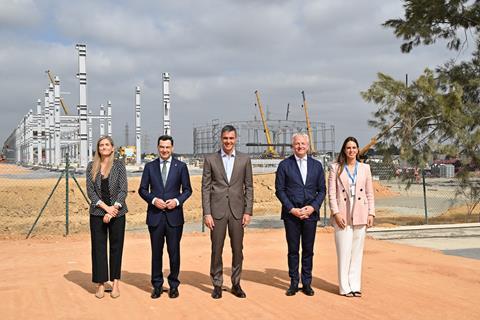
Spanish energy company Moeve has begun construction of a 300 MW electrolyser in Huelva, in the south of Spain, that will produce about 45,000 tonnes of hydrogen a year running roughly 7,000 hours annually. The project is budgeted at over €1 billion, with the Spanish government contributing €300 million. Its first job is to replace the fossil-derived hydrogen consumed by the existing refinery on the same site, with later output going into sustainable aviation fuel, the hydrogenation of waste vegetable oils for shipping and heavy-truck fuels, and chemical manufacturing.
What distinguishes this project from the many announced-but-never-built hydrogen schemes is the energy sourcing. The electrolyser will run on a combination of dedicated solar generation and grid electricity, and from 2030 the grid share can qualify as green under the European Union’s renewable-fuels rules through hourly matching with renewable output. Huelva has some of the best solar resource in Europe, and the plant sits next to a customer that already uses hydrogen at industrial scale, which removes the two biggest risks in the hydrogen business: an energy input that costs too much and a buyer that does not exist.
Moeve’s stated ambition is to grow what it calls the Andalusian Green Hydrogen Valley to 2 GW of electrolysis. Chemistry World quotes analyst Adrian Odenweller putting the 300 MW phase in perspective at 0.45% of the EU’s 2030 target, a useful corrective to the gap between Europe’s hydrogen announcements and its working capacity.
The abundance lens here is substitution at the molecule level. A refinery’s hydrogen demand is fixed by its chemistry, so the question is only whether the molecule comes from methane or from water and sunlight. When the second route is built next to a solar field and a captive customer, it becomes a production asset rather than a demonstration, and the Spanish state’s willingness to fund a third of it reflects a bet that the running costs will stand on their own.
Source: Chemistry World
Blue Pigment Catalyst Sets Platinum-Free Fuel Cell Power Record

Platinum is the standard cathode catalyst in hydrogen fuel cells, and its scarcity and price are one of the main reasons fuel cells have stayed expensive. Researchers at Tohoku University, Technion and Hokkaido University report in ACS Catalysis a catalyst built from nitrogen-rich iron phthalocyanine, a close relative of the blue pigment used in paints and inks, that delivers the highest power density ever recorded for an anion-exchange membrane fuel cell cathode based on a metal phthalocyanine.
The team made two variants on a carbon support, and the better of the two, labelled AZ-FO-30, reached a peak power density of 902 milliwatts per square centimetre at 80°C. The sibling catalyst managed 744 mW/cm². In a durability test, the leading catalyst ran for 35 hours at 400 mA/cm² with a decay of only 2.4 millivolts per hour. Both catalysts had almost identical electrochemical surface areas, around 156 m²/g, so the performance difference came from how the molecule was designed rather than from how much of it was exposed, which is the result the researchers were after.
The caveats are the usual ones for a catalyst paper. Testing was at a single temperature, the durability run was short by commercial standards, and the modelling that explains the mechanism used simplified systems. Nothing in the article addresses manufacturing cost or scale.
Even so, the direction matters. Iron is among the cheapest and most abundant metals on Earth, and phthalocyanines are made by the tonne for the pigment industry. A fuel-cell cathode that approaches platinum performance using those ingredients would remove a hard material constraint from a technology whose other inputs, hydrogen and air, are not scarce at all. It is a clean example of substitution turning a bottleneck into a commodity.
Source: TechXplore
A Flexible Form of Boron Conducts Ten Million Times Better Than Any Before It
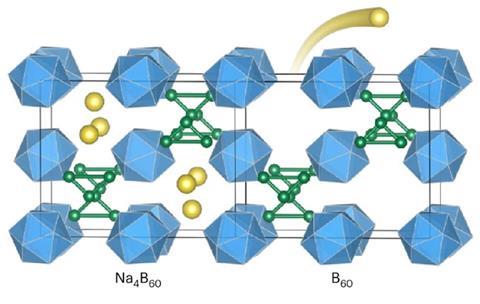
Boron is a thoroughly studied element, which makes it striking that a group at Yanshan University in Qinhuangdao, China, has produced an entirely new crystalline form of it with properties that no known boron possesses. Reported in Nature Chemistry by Xiao-Ji Weng, Xiang-Feng Zhou and colleagues, the allotrope they call Imma-B60 is up to 10 million times more electrically conductive than other forms of boron and is unusually flexible for a solid held together by covalent bonds, which are normally rigid and brittle.
The method is as interesting as the material. The researchers first synthesised sodium boride, Na4B60, under high pressure to get high-quality crystals, ground it to powder, then pumped the sodium out by heating to 900°C under vacuum for two days. What remained was a boron framework of 12-atom icosahedral cages linked by triangular boron units, threaded with empty channels where the sodium atoms had been. Those channels are what give the structure room to flex, and the open framework also explains the conductivity.
The group describes the approach as “degassing templating” and suggests it could yield many more unconventional framework materials, offering what they call a promising foundation for designing mechanically resilient, functional inorganic materials. Chemistry World’s report does not list specific applications or limitations, and at this stage the result is a materials-science discovery rather than a product.
It earns a place here for novelty. The abundance story is usually about extracting or recycling more of a known material; this is the other mode, where a familiar, plentiful element turns out to have a new structure with properties that previously required something rarer. Boron is cheap and widely available, and a conductive, flexible form of it widens the menu of what cheap elements can do.
Source: Chemistry World
A Textile Designed for Soldiers Multiplies Strawberry Yields in the Field

Researchers at North Carolina State University have shown that a three-dimensional textile called Plant Armor, draped over strawberry plants in tunnel field trials, raised yields by up to 3.56 times compared with uncovered plants. The work, led by graduate researcher Gabriel Olawuyi and published in the journal Agriculture, began as military research into making uniforms mosquito-resistant and more comfortable under body armour.
The fabric is multilayered and looks opaque, yet the researchers found it did not impede light reaching the plants at all, contrary to their expectation that shading would trigger the stretching, low-yield growth that plants use to escape shade. Rain and airflow pass through as well. What the layers do block is insects, and the physical barrier works without any chemical treatment.
The second mechanism is thermal. The cover produced consistent warming across the growing season, which let the plants accumulate “growing degree-days” faster and reach their fruiting stage earlier than unprotected neighbours. In effect the textile extends the useful season on both ends and protects the crop in between.
The study did not quantify pesticide savings, and the trials were in tunnels rather than open fields at commercial scale, so the economics of covering acres of fruit remain to be worked out. But the headline result is an order-of-magnitude improvement in output per plant from a passive, reusable input, and the underlying idea, a barrier that lets through the things a plant needs while stopping the things that eat it, is not specific to strawberries.
Source: Phys.org
Fish-Gill Aerogel Keeps a Solar Still Running Without Salt Buildup

Passive solar desalination, where sunlight heats a floating absorber and the vapour is condensed as fresh water, has an old enemy: salt crystallises on the evaporating surface and chokes it within hours. A team at Shinshu University in Japan led by Jian Shi, writing in Nano-Micro Letters, reports an aerogel that borrows the trick marine fish use in their gills to keep that surface clear.
The material is made from carboxymethyl chitosan and sodium alginate, two biomass-derived polymers, loaded with bamboo-derived carbon black to absorb sunlight and convert it to heat. The polymers carry charged groups that repel salt ions through what chemists call Donnan repulsion, while water-loving groups maintain a thin water layer that continuously flushes salt away from the interface. The result is a surface that evaporates water but will not let salt settle on it.
In testing, the aerogel produced fresh water at 2.88 kilograms per square metre per hour under ordinary sunlight, worked in brine nearly six times as salty as seawater, and ran for 24 hours continuously and then through repeated day-night cycles for a week with no visible salt accumulation and no loss of output. The authors describe the materials as inexpensive and biodegradable.
This is laboratory work, and the article does not address commercial scale or field costs. The energy input, however, is free and unmetered sunlight, and the economics of passive stills have always turned on maintenance rather than on energy. A surface that stays clean for a week in hypersaline brine addresses the operating cost directly, which is why this ranks above most lab-scale desalination papers for a review focused on fresh water becoming cheaper.
Source: TechXplore
Study Argues Pricing Waste Beats Capping Plastic Production
A study by Oxford Economics, sponsored by the International Council of Chemical Associations, concludes that waste-management policies would recover far more plastic than a cap on virgin plastic production, and at far lower cost to households. The sponsor is the global trade body for the chemical industry, and Chemistry World’s report is appropriately careful to say so up front. But the modelling itself is worth reading on its merits, because it tests a question that matters well beyond plastics: whether resource problems are better solved by rationing supply or by pricing the disposal of waste.
The researchers modelled three alternatives to a production cap. A landfill tax combined with a recycling subsidy produced more than 32 million tonnes of recycled plastic, a 64% increase over the roughly 20 million tonnes recovered under a cap scenario. Applying that same tax-and-subsidy regime only in South and East Asia, where most ocean plastic originates, still beat the cap by an additional 4%. Removing cross-border restrictions on trade in recyclable waste added nearly 1% more. The study also estimated that cutting global plastic production by 5% would impose household costs at least five times higher than the waste-focused policies.
The critique is substantive. Steve Fletcher of the University of Portsmouth told Chemistry World that the results are surprising at first but not once you see what is excluded, pointing out that the analysis leaves out the climate, biodiversity and health benefits that upstream production limits would also deliver. That is a fair objection to the cost side of the ledger.
What the critique does not touch is the recovery side. If a landfill tax and recycling subsidy really would pull 64% more plastic back into use than a cap, that is an abundance result: more material in circulation, not less. Readers can discount the sponsor and still take the structural point that making waste expensive to bury is a stronger lever than making new material scarce.
Source: Chemistry World
Cooking-Oil Thieves Show How Waste Becomes a Commodity

Nineteen defendants face federal charges for stealing used cooking oil from restaurants across ten states, with two pleading guilty in mid-September 2026 and the rest headed for trial in April 2027. Historian Edward D. Melillo uses the case, in an essay for The Conversation republished by Phys.org, to make a point that Julian Simon would have recognised: nothing is waste by nature, only by the current state of technology, markets and rules.
Used fryer grease became worth stealing because it qualifies for biofuel incentives, which at times have pushed its price above that of virgin vegetable oil. The same premium has created a second crime, passing off cheap virgin oil as waste oil to collect the subsidy, and has set off international trade disputes over how to verify that a shipment of biodiesel feedstock really came from a fryer. A substance that restaurants once paid to have hauled away now has a price, a supply chain and a fraud problem.
Melillo traces the pattern back through industrial history. Whey from cheesemaking was a disposal nuisance until 1970s ultrafiltration turned it into protein concentrates. Fly ash from coal plants, discovered in the 1930s to work as a partial replacement for Portland cement, became a construction input. Cottonseed oil was dumped into 19th-century rivers before it became one of the great industrial oils of the following century. In each case the material did not change; the surrounding ingenuity did.
The essay is honest that reprocessing can carry its own costs, citing trans fats from hydrogenated cottonseed oil and persistent chemicals in sewage biosolids spread on farmland. But its central argument is the abundance thesis stated from an unusual angle: the moment a waste stream becomes valuable enough to steal, it has stopped being waste, and the economy has quietly gained a new resource.
Source: Phys.org
Doomslayer: AI Costs Fall 13-Fold a Year as Trade Deals Multiply
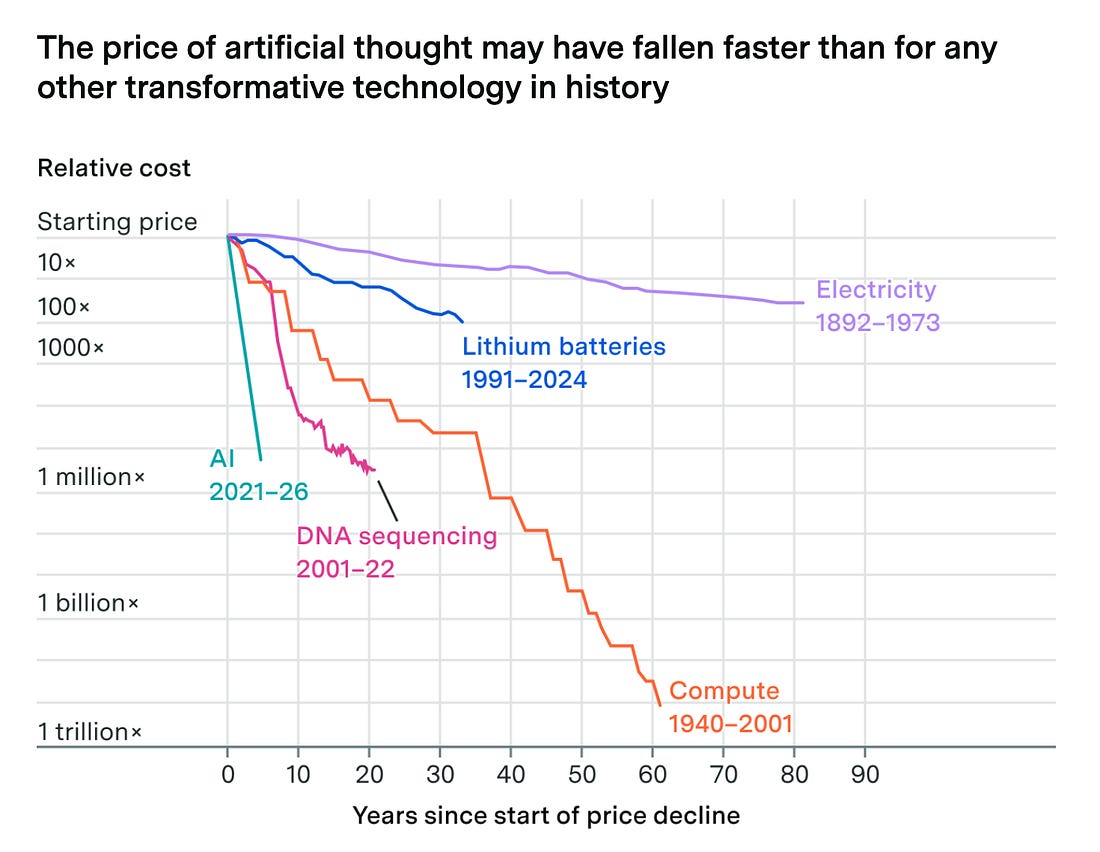
Human Progress’s Doomslayer newsletter, written by Malcolm Cochran, gathers the week’s evidence that the world is getting richer, and the September 27 edition is anchored by the steepest cost decline in the modern economy. Drawing on recent analysis, it reports that the cost of a given level of AI performance has fallen about 47% per quarter since 2023, which compounds to roughly a 13-fold decline per year. No physical resource has ever cheapened at that pace, and because AI is increasingly the tool used to find ore bodies, design catalysts and optimise plants, its price curve propagates into every other input.
The trade news is the other half of the abundance story. India has signed seven new free trade agreements since February 2021, bringing its total to 17, has concluded negotiations with the European Union and is negotiating with the United States. The EU has reached substantial agreement with the Philippines and plans deals with Indonesia, Thailand and Malaysia by mid-2027, which would cover six of eleven Southeast Asian nations. Larger markets reward specialisation, and specialisation is where falling real resource costs come from.
The roundup’s other items are reminders that recovery is normal when people decide to pursue it. New Zealand’s black robin has gone from five birds in 1980 to around 350 in 2025, and China’s crested ibis from seven birds in 1981 to over 10,000. The EU’s age-standardised suicide rate fell 15% in a decade, global new leprosy cases dropped 3.1% in 2025, and the share of American drinkers who report overindulging fell from 35% in 1989 to 13%.
A Joby Aviation-equipped Cessna flew 3,199 miles autonomously from California to North Carolina, and in 32 of 37 countries surveyed, adults aware of AI who expect it to improve their lives outnumber those who expect the opposite. The newsletter’s running argument, that the data on human welfare keep pointing up while the headlines point down, is a useful frame for the technical items above.
Source: Human Progress