Robotics Weekly Review 2026-10-11

Week In Review
The humanoid business showed its arithmetic this week. Agility Robotics used its investor day to put numbers on Digit 5 that the industry usually keeps private: a bill of materials of roughly $150,000 at launch, a target of $30,000 per unit at 10,000 units a year, and a $300 million order that releases robots in tranches only as each use case proves itself. Jabil, the contract manufacturer that would build many of those units, described in an interview with The Robot Report the shift from hand-assembled prototypes to runs of tens of thousands, and the unglamorous work on cost structure and wiring harnesses that comes with it. Boston Dynamics, which Agility named as its strongest rival, hired Amazon’s former head of Alexa and Nova, Rohit Prasad, as chief executive, a signal that the company sees its next decade as a software and AI problem as much as a mechanical one.
Alongside the business case came a sharper argument about what success should mean. Nicolas Sauvage of TDK Ventures made the case that dexterity is physical AI’s real bottleneck, and that the measure is not a single impressive action but the reliability needed to finish a hundred of them in a row. His examples of robots that already clear that bar are not humanoids. The Groceryshop conference offered a case study: Simbe’s 3,000 shelf-scanning robots are deployed, the anxiety about them has faded, and the competition has moved to what retailers do with the data.
The research side was unusually rich in machines that get more capability out of fewer parts. ETH Zurich turned an off-the-shelf robotic hand into a self-contained robot that walks on its fingertips, rights itself, and pushes objects around. North Carolina State’s feather-star-inspired swimmer achieves full three-dimensional maneuvering with two actuators instead of the usual six by letting its elastic wings do the computing. EPFL’s FiberMotor is a thread-thin sliding motor with no gears, aimed at exosuits and prosthetics. The Robotics and AI Institute’s AthenaZero took the opposite tack, building a low-inertia two-armed torso that can throw, catch, and bat a ball because its joints yield rather than resist. And MIT’s SANDO planner gives a drone a mathematical guarantee against collision in places it has never mapped, the kind of assurance that field autonomy needs before it can be trusted inside collapsed buildings or mines.
Items
Agility Puts a Price on Digit 5: $150,000 to Build, $30,000 at Scale, and a $300 Million Order That Unlocks Skill by Skill
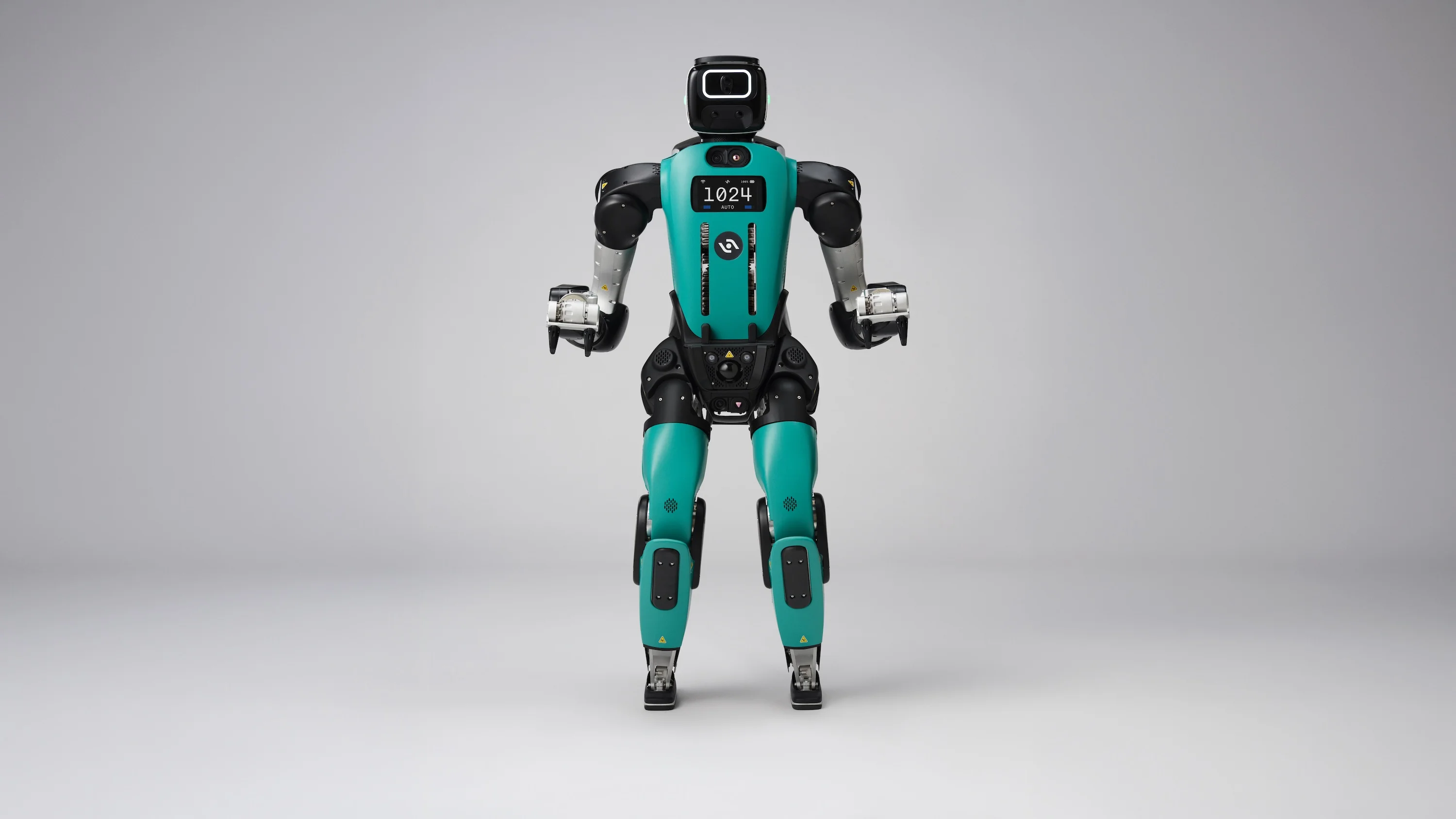
Agility Robotics held an investor day on October 6 ahead of its planned public listing through a $2.5 billion merger with Churchill Capital Corp XI, and it used the occasion to disclose economics that humanoid companies rarely share. According to Humanoids Daily’s account, Digit 5 will launch with a bill of materials of about $150,000, up from roughly $125,000 for Digit 4, because of added sensors and the safety computing required to work near people. Chief operating officer Jen Hunter said the target is $30,000 per unit once annual production reaches 10,000 units.
The margin path follows the same curve. Agility said product margins are around 50 percent at launch volumes, rising to 70 percent at 1,000 units a year and 75 percent at 10,000. Under its robots-as-a-service model, the company projects hardware payback within 1.5 years against roughly $240,000 in cumulative costs over five years. These are company projections, and the publication treats them as such.
The most instructive detail was the structure of a $300 million, 1,000-robot order from an unnamed customer. Chief business officer Daniel Diez explained that the order releases robots in tranches as Digit 5 proves each use case against agreed throughput targets, with revenue spread across three years of service over four calendar years. That is a customer paying for demonstrated capability one skill at a time, not for a promise, and it is a more honest template for humanoid commercial deals than a headline unit count.
The schedule slipped. Early-access units ship in the first half of 2027, with general availability now at the end of 2027 and into early 2028, later than the late-2026 target in the company’s registration filing. A Schaeffler engineer, Courtney Baines, added the practical constraint: until humanoids achieve ISO safety certification, her company must fence off every one it runs. Co-founder Jonathan Hurst said “almost none of the humanoid robots that exist compete with us” and named Boston Dynamics as the strongest rival.
Source: Humanoids Daily
Boston Dynamics Hires Amazon’s Alexa and Nova Leader Rohit Prasad as Chief Executive

Boston Dynamics announced that Rohit Prasad becomes its chief executive officer effective October 7. Prasad spent 12 years at Amazon, most recently as senior vice president and head scientist for Alexa and artificial general intelligence, where he built Alexa into a service used in hundreds of millions of households and led the Amazon Nova family of foundation models. Before Amazon he spent nearly 14 years at Raytheon BBN Technologies managing machine-learning research. He has been based in the Boston area for more than 25 years and is expected to join the board pending approval.
The choice says a great deal about how Hyundai Motor Group, Boston Dynamics’ owner, sees the company’s future. For most of its history the company was defined by mechanical and control engineering, and its leadership reflected that. Hiring someone whose career is in conversational AI and large models to run it is a bet that the differentiating layer for Atlas and Spot will increasingly be learned behavior, data pipelines, and the operational discipline of shipping AI products at scale.
Jaehoon Chang, vice chair of Hyundai Motor Group and board chair of Boston Dynamics, framed it that way, citing Prasad’s “proven ability to turn AI into products at global scale” as the foundation for building and scaling physical AI. Prasad’s own statement called the company “uniquely positioned to advance Physical AI through its world-class robotics expertise.”
The timing is notable. Boston Dynamics has spent the past month making the manufacturing case for Atlas, including a hand redesigned for volume production, while its closest competitor prepares to go public with detailed unit economics. A chief executive who has run a consumer-scale AI product through its entire lifecycle is a plausible answer to the question of who turns a famous research company into a volume supplier.
Source: Boston Dynamics
Jabil on Building Humanoids by the Tens of Thousands
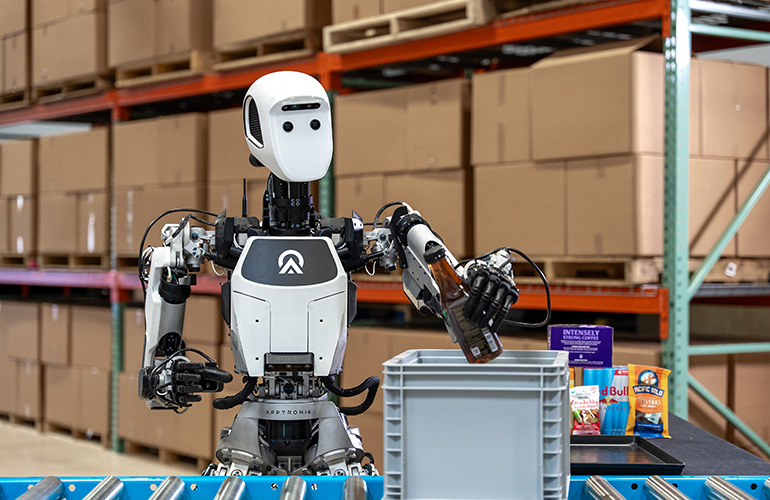
Jabil is one of the world’s largest contract manufacturers, and it is increasingly the company humanoid developers call when they need to go from a few hand-built prototypes to real production. In an interview with Eugene Demaitre of The Robot Report, Thomas Brown, Jabil’s senior director for engineering and technology, described the industry as entering a phase of “tens of thousands” of units, where the problems shift from making the robot work at all to cost structure, manufacturability, and quality.
Brown’s assessment of the compute situation is reassuring for developers: “Compute is now sufficient for many of the experiences you see on the demo reels,” with NVIDIA’s Jetson line popular among builders, though edge compute and its pricing remain constraints. Where the hard engineering lives now is in the mundane. Humanoid wiring, he said, needs “a hybrid of automotive-type robustness with an extremely small form factor like high-grade consumer electronics,” which is why automotive suppliers are showing up in humanoid supply chains.
He was measured about consumer humanoids, estimating “maybe in five-ish years” and only if AI models and computing continue to improve. The nearer opportunity is manufacturing itself, where he argued humanoids could act as a “programmable substrate for manufacturing,” changing how factories are laid out by replacing purpose-built automation with general-purpose machines that can be retasked.
Safety certification and standards, he noted, remain a substantial industry-wide gap. That echoes the constraint Agility’s customers described the same week, and it suggests that the pace of humanoid deployment will be set as much by standards bodies as by the robots.
Source: The Robot Report
Why Dexterity, Measured in Nines, Is Physical AI’s Real Bottleneck
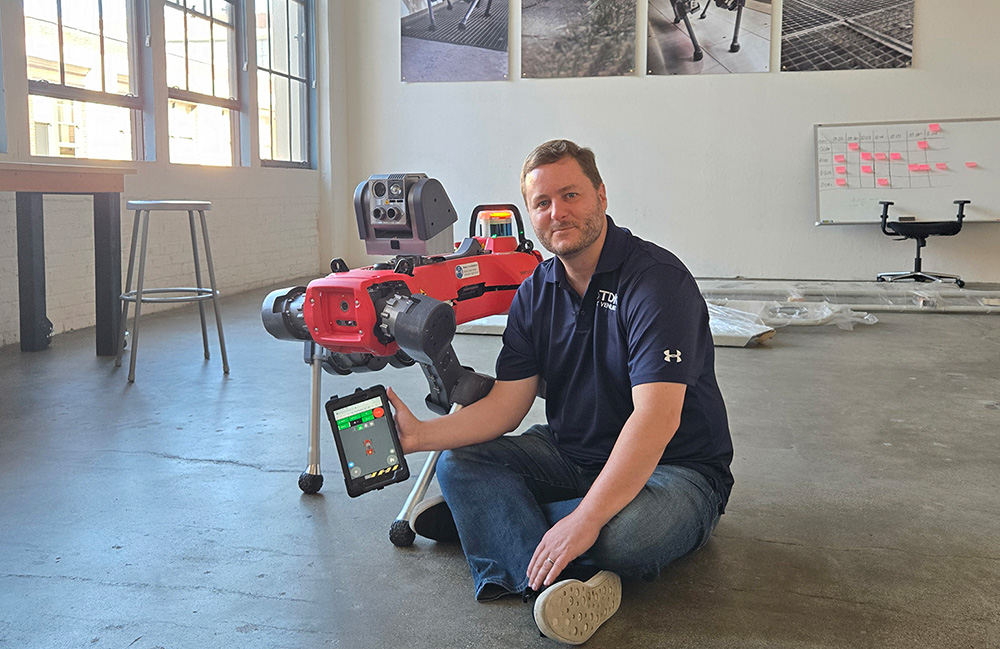
In a guest essay for The Robot Report, Nicolas Sauvage, founder and president of TDK Ventures, argues that the robotics field is measuring the wrong thing. A robot that performs a task once in a video has demonstrated almost nothing about whether it can run a workflow unattended. His arithmetic is the heart of the piece: a robot with 99 percent per-action reliability has only a 36.6 percent chance of completing 100 sequential actions, while 99.99 percent per action yields 99 percent workflow completion. Dexterity, in his framing, is a reliability number, and the units are nines.
Sauvage insists that dexterity is a whole system, integrating vision, sensing, force feedback, and control, rather than a question of how many fingers or joints a hand has. The nines accrue through deployment. Each real-world failure improves the software, sensing, and control stack, and the companies collecting that feedback at scale are compounding an advantage that cannot be bought with a better demo.
His examples are pointedly not anthropomorphic. He cites Agility’s Digit as a bipedal logistics robot built for a job, ANYbotics’ quadruped with more than 33,000 inspections completed, and Starship Technologies’ delivery robots with 10 million autonomous deliveries. The form, he argues, should match the work, and the right metrics are uptime, repair speed, recovery from failure, and complete jobs finished without a human stepping in.
The essay comes from a venture investor whose fund has a stake in how the field is scored, and it should be read as an argument rather than a neutral survey. But its central demand, that robots be judged on complete autonomous workflows rather than isolated actions, is one that the more candid companies in the field are already adopting.
Source: The Robot Report
Groceryshop 2026: Retail Robots Have Scaled, and the Fight Has Moved to the Data
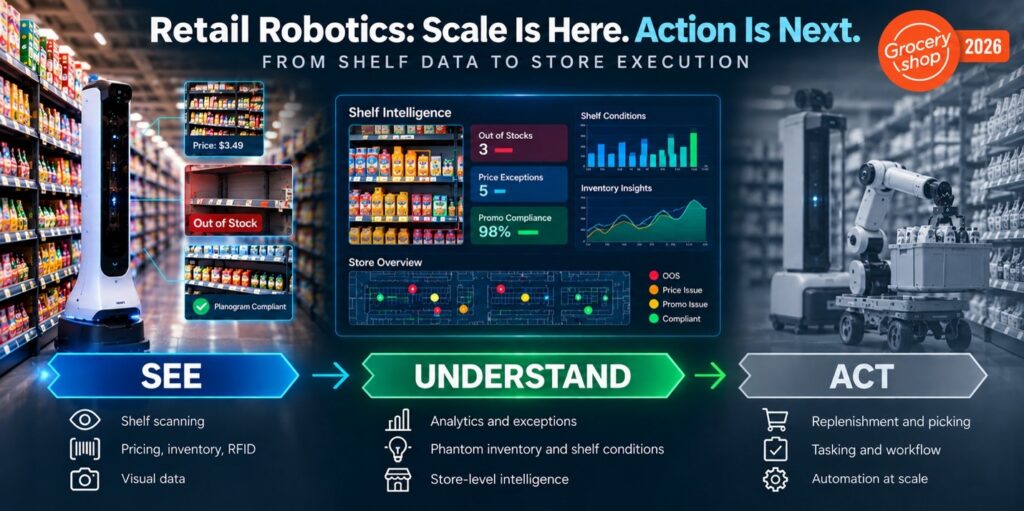
Georges Mirza’s report from the Groceryshop 2026 conference opens with an observation about what was absent. The worries that dominated earlier years, about robots displacing store staff or unnerving shoppers, had largely disappeared from the conversation. Shelf-scanning robots are now a settled part of the grocery landscape, and the vendors have moved on to the next problem.
The scale is concrete. Simbe Robotics has completed its rollout of 3,000 Tally robots worldwide and is now building the analytics layer, with dashboards and virtual store tours, to make the shelf data those robots gather useful. Badger Technologies has gone further in reframing itself. Its newly appointed chief executive, John Gehre, described the company’s transition from a robotics firm to a retail intelligence company, with the platform now exploring estimates of how many units remain on a shelf and predictions of when replenishment will be needed.
Deployment models are diversifying to fit smaller formats. ShelfOptix showed a foldable robot that humans escort between drug stores and convenience shops, so that a retailer unwilling to dedicate a permanent unit per location can still get scanned data. MUSE continues to expand a modular platform with customer guidance and promotion modules, and plans picking and floor cleaning. Blue Collar Robotics, a startup finalist, is tackling the harder problem of actually picking products and moving them between shelves and carts.
Mirza’s conclusion is that the competitive ground for the next several years is not whether a robot can see a shelf but what the retailer does with what it saw. That is the standard arc for a successful automation category: the hardware becomes a commodity and the value migrates to decisions.
Source: The Robot Report
ETH Zurich’s Disembodied Hand Walks on Its Fingertips and Pushes Things Around

Researchers at ETH Zurich have taken an off-the-shelf robotic hand from Wuji Technology, strapped an 80-gram backpack to it containing a battery, an inertial measurement unit, and a Raspberry Pi Zero, and taught it to walk. Led by doctoral candidate Amirhossein Kazemipour, the team used reinforcement learning in simulation to train the hand to crawl on its fingertips, right itself when flipped, press keys, and push objects, as Edd Gent reports for IEEE Spectrum.
The hand’s anatomy made the training harder than for a conventional legged robot. Its digits are different lengths and the thumb is opposed to the others, so the team assigned each finger target positions and added “virtual springs” during training to keep the hand in a crawling posture. The resulting controller switches between four trained models depending on whether the hand needs to walk, right itself, press a keyboard, or manipulate an object.
The numbers are modest but real. The hand walks at an average of 9 centimeters per second, righted itself in 21 of 25 trials, and autonomously pushed 41-gram objects up to 40 centimeters away 15 times in a row. It was tested on 14 surfaces, including floors, gravel, and grass.
The researchers suggest maintenance tasks and search-and-rescue in confined spaces as applications, but the more interesting idea is what they call “autonomous modular embodiments,” in which a part of a robot can detach and take on a different role. A hand that can walk itself to a job, do the job, and return is a small example of a robot body that is not fixed.
Source: IEEE Spectrum
AthenaZero: A Low-Inertia Two-Armed Robot That Throws, Catches, and Bats

Factory robot arms are built to be stiff and precise, which makes them poor at anything that happens fast. Researchers at the Robotics and AI Institute in Cambridge, Massachusetts, have built a dual-arm robot called AthenaZero that takes the opposite design philosophy, and demonstrated it with three baseball tasks: throwing a ball, catching one, and hitting one with a bat. The work is published in Science Robotics as “AthenaZero: A low-inertia, bimanual robot for dynamic manipulation.”
The machine consists of a central torso, two arms with hands, and the motors and gears that drive them. The key property is that its arm joints can yield to external forces instead of rigidly resisting them. That low-inertia design lets the robot be “delicate when needed, but also forceful, similar to a human,” according to Andrew S. Morgan, the paper’s first author. A catch needs the arm to absorb energy. A throw needs it to deliver energy quickly. A rigid arm is bad at both.
Ball sports are a useful proving ground because they compress the hard parts of dynamic manipulation, which are fast perception, precise timing, and controlled impact, into tasks that are easy to score. But Morgan is clear that baseball is not the point. “Dexterous manipulation is the end goal for this large-scale project,” he said, with testing to expand toward real-world objects.
The result points toward robots that can handle the unpredictable physical interactions of everyday environments, where things get tossed, dropped, and caught, rather than only the choreographed motions of an assembly line.
Source: TechXplore
EPFL’s FiberMotor Is a Thread-Thin Sliding Motor With No Gears

Herbert Shea’s Soft Transducers Laboratory at EPFL has built a motor that looks like a piece of thread. FiberMotor measures 1 to 3 millimeters across and consists of two concentric hollow fibers wrapped with hair-thin insulated copper electrodes. Applying voltage generates electrostatic forces that make the inner fiber slide inside the outer one, converting electricity into linear motion with no gears at all. The work is published in Advanced Materials.
Artificial muscles made from stretchy materials are limited by how far the material can stretch. A sliding motor’s range of motion is limited only by the length of the fiber, which is a fundamentally different constraint. Each motor supported a static load of about 75 grams, and four bundled together lifted a 46-gram chocolate bar and flexed a robotic finger. Shea described it as “the first fiber-format sliding motor” and noted it remains silent, flexible, and bidirectional.
The property that matters most for wearable use is backdrivability. If a person moves against the motor, it gives way rather than locking up, which is essential for anything worn on the body. The lab points to soft exosuits for mobility assistance, haptic systems for virtual reality, and lightweight prosthetics as the first targets.
Co-founder Sylvain Schaller has launched a startup, Elecsyor, to commercialize the technology. A quiet, gearless actuator that can be woven into fabric is the kind of component that could make assistive devices light enough to wear all day.
Source: TechXplore
A Feather Star Taught This Underwater Robot to Move in 3D With Two Actuators

Moving freely in three dimensions underwater usually takes around six actuators. Researchers at North Carolina State University have done it with two, by borrowing the body plan of a feather star, a marine animal whose feathery arms radiate from a central disk. Their soft robot has four elastic, monostable wings extending from a central disk that houses the two actuators, and its behavior comes largely from the mechanics of those wings rather than from control code. The paper appears in Science Advances.
Professor Jie Yin, who led the work, calls this “mechanical intelligence”: letting the structure govern behavior so the computation can be simpler. Fire both actuators quickly and all four wings snap down, pushing the robot vertically or letting it hover, which the team calls jellyfish mode. Fire one actuator and a single wing flutters, driving the robot forward or backward in fish mode. Alternate between the two rapidly and the robot rotates, giving it steering in rotor mode.
First author Haitao Qing, now a postdoctoral researcher at UC Berkeley, and co-authors from the University of Virginia and UC Riverside demonstrated the robot carrying a camera for underwater exploration and manipulating objects, both alone and cooperatively with other units.
Fewer actuators mean lower cost, less weight, fewer failure points, and simpler control, which is exactly the recipe for deploying many small robots rather than one expensive one. Ocean monitoring, where coverage matters more than any single vehicle, is the obvious beneficiary.
Source: TechXplore
MIT’s SANDO Guarantees a Drone’s Path Stays Collision-Free in Unmapped, Moving Environments

A drone flying into a collapsed building or an unmapped mine has two problems at once: it does not know the layout, and things in the environment may be moving. MIT researchers have developed SANDO, short for Safe Autonomous Trajectory Planning for Dynamic Unknown Environments, a planner that provides mathematical guarantees against collision under exactly those conditions. The work is published in IEEE Transactions on Robotics.
The approach builds time-sensitive safety corridors. For each obstacle, the planner uses its maximum possible velocity to bound where it could be at future moments, so the corridor shrinks appropriately as time advances. A heat-map planner identifies the zones that are dangerous, and the system then optimizes a flight path through the safe region, replanning continuously as new information arrives.
The team, led by Kota Kondo, who recently completed his doctorate in aeronautics and astronautics at MIT, with Jesús Tordesillas of Comillas Pontifical University in Madrid, MIT graduate students Juan Rached, Lili Sun, and Yixuan Jia, and senior author Jonathan P. How, validated the system in 12 real-world test flights in which the drone avoided every dynamic obstacle. In simulation, SANDO reached its goals faster than the state-of-the-art systems it was compared against.
The applications the researchers name are search and rescue in collapsed structures, mine exploration, urban package delivery, and wildfire reconnaissance. What those share is that an operator cannot pre-map the space and cannot accept a collision. A planner that can promise safety in advance, rather than merely usually avoiding trouble, is what moves autonomous flight from controlled demonstrations into those settings.
Source: TechXplore