Robotics Weekly Review 2026-10-18

Week In Review
The most convincing robots this week were the ones with a job and a record to show for it. NASA’s Perseverance rover passed Opportunity’s 15-year-old Mars distance record, and the interesting part of the story is not the mileage but the fact that it drove itself 90 percent of the way, up from 23 percent for Spirit. A Delft racing drone beat three former world champion pilots with one camera, one inertial sensor, and a neural network that writes motor commands directly, no GPS or external tracking. And Fleet Robotics’ magnetic-footed hull cleaners attack a problem that costs the US shipping industry tens of billions a year, by scrubbing a little every day rather than a lot in port. All three are autonomy in places where a human cannot easily follow, and in each case the measure of success is a workflow completed, not a clip.
The industry side of the week was about building capacity. Promise Robotics signed America’s largest homebuilder to a multi-year deal for more than 1,250 homes, framing housing construction as a manufacturing problem that has never had a factory. Stryker put $400 million into CMR Surgical with an option to buy the whole company, a disciplined way for the orthopedics giant to enter soft-tissue surgery, where Versius has already logged 45,000 cases. Physical Intelligence opened an API so that hardware teams can fine-tune and run its robot foundation models without maintaining the infrastructure themselves, which is how software platforms usually begin to compound.
Humanoids were present but judged on process rather than performance. Boston Dynamics showed how it builds Atlas, admitting it takes about a day per robot today and targeting an hour next year. South Korea’s regulatory sandbox approved a 20-robot trial of Robros humanoids in shared workspaces at semiconductor, automotive, shipbuilding, and logistics sites, with the publication careful to note that approval to test is not a deployment. Both stories are about the slow, auditable work of turning a prototype into a product.
Two items rounded out the picture with sensing and companionship. HKUST’s EmArm wraps a rigid arm in 71,000 square millimeters of optical tactile skin and reads it fast enough to catch a basketball and dodge obstacles by feel. And New York State renewed its ElliQ program for another three years, with usage data from hundreds of older adults who talk to the companion robot an average of 48 times a day. Between the rover on Mars and the robot on a kitchen counter, the common thread is reliability measured over months, which is what the field is increasingly being asked to show.
Items
Perseverance Breaks the Mars Driving Record, and Drove 90 Percent of It Itself

On October 11, NASA’s Perseverance rover drove 299.6 feet and in doing so passed the Opportunity rover’s long-standing record for distance traveled on Mars. According to IEEE Spectrum’s interview with Mark Maimone, Perseverance’s robotic operations deputy team chief at the Jet Propulsion Laboratory, the new total stands at 45.22 kilometers against Opportunity’s 45.16, a mark that took Opportunity more than 15 years to set.
Maimone designed autonomous driving software for Spirit, Opportunity, Curiosity, and Perseverance, which makes him a good witness to how the autonomy improved. Perseverance now drives autonomously about 90 percent of the time. Spirit managed 23 percent, and Curiosity only 5 percent, because its onboard processing was too slow to make autonomous driving worthwhile. Perseverance carries upgraded processors and field-programmable gate arrays dedicated to accelerating image processing, so it can evaluate terrain and pick a path while moving, rather than stopping to think.
The operating numbers are modest by Earth standards and remarkable for Mars. Perseverance tops out around 120 meters per hour, has climbed slopes of up to 24 degrees, and plans from orbital imagery with a resolution of 25 centimeters per pixel. Maimone also described a recent experiment in which Anthropic’s Claude AI model planned a 400-meter drive route from orbital images, a sign that planning tools from outside the space program are being tested against this problem.
“Perseverance is the culmination of decades of work on Mars rover autonomy,” Maimone said. The record will fall again, but the ratio is the real milestone: a rover that drives itself nine times out of ten is a different kind of explorer from one that waits for every command from Earth.
Source: IEEE Spectrum
A Delft Drone Beats Former World Champions With One Camera and No GPS

Researchers at Delft University of Technology’s Micro Air Vehicles Lab have built MonoRace, an autonomous racing drone that senses the world with a single forward-facing camera and an inertial measurement unit, and nothing else. There is no GPS, no external motion-capture system, and no offboard computer. According to TechXplore’s report on the work, published in Science Robotics, the drone reaches 100 kilometers per hour and issues 500 motor commands per second from a small onboard flight-controller chip.
The notable design choice is what the team left out. Conventional drone control stacks are layered: a perception module estimates where the drone is, a planner picks a trajectory, and a controller converts that into motor commands. MonoRace’s neural network, trained with reinforcement learning, generates motor commands directly from its sensor inputs. As one of the researchers put it, “This allows the controller to react extremely fast” while remaining computationally cheap enough to run on minimal hardware.
The proof came in competition. At the 2025 Abu Dhabi Autonomous Drone Racing Competition, MonoRace outperformed every other autonomous team and three former world champion human pilots. Lead authors Stavrow Bahnam and Robin Ferede worked with Christophe De Wagter and Professor Guido de Croon on the project.
Drone racing is a benchmark, not an application, but it is a benchmark that rewards exactly what field robots need: fast, robust perception and control from cheap sensors in a cluttered space. A controller that can do this on a flight-controller chip is a controller that can fit on a small inspection or delivery drone.
Source: TechXplore
Magnetic-Footed Robots Brush Ship Hulls Every Day So Nobody Has to Scrape Them in Port

Biofouling, the crust of algae, barnacles, mollusks, and seaweed that accumulates on ship hulls, adds drag and burns fuel. According to a TechXplore report on Fleet Robotics, a Boston company working with Northeastern University students and alumni, the cost to the US shipping industry in extra fuel and antifouling paint runs to as much as $36 billion a year. Fouled hulls also carry invasive species from one port to another.
Fleet’s robot looks like two Roombas joined together, roughly a meter long and 60 centimeters wide. Instead of rolling, it walks on switchable magnetic feet, stepping along the steel hull so it can position itself precisely and hold on. Scrubbing brushes remove growth as it goes. It works underwater, autonomously, with no tether and no Wi-Fi link, and docks between cleaning cycles.
The business idea matters as much as the hardware. Rather than periodic deep cleaning in port, which is expensive, disruptive, and often done by divers, Fleet wants the robot to live aboard the ship and clean a little each day at sea. Joshua Batra, a Fleet engineer and Northeastern alumnus, compared it to “brushing your teeth every day versus going to the dentist.” The company intends to install the robots permanently on vessels.
This is a textbook case of an autonomous machine doing dull, dirty work in a place people cannot comfortably go, with a fuel-cost argument that makes the economics straightforward for a ship operator.
Source: TechXplore
Promise Robotics Signs D.R. Horton to Build More Than 1,250 Homes by Robot
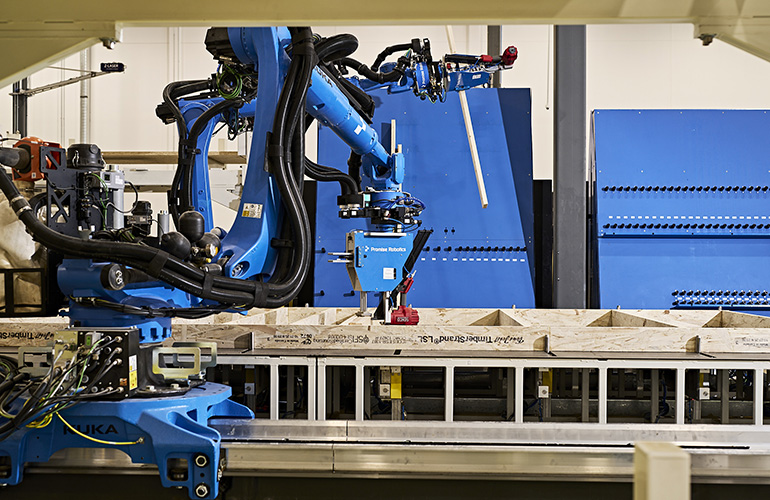
Promise Robotics, a Toronto company founded in 2021, has signed a multi-year agreement with D.R. Horton, the largest US homebuilder by volume, to manufacture more than 1,250 homes through what it calls Factory-as-a-Service. The Robot Report describes a system that takes a builder’s existing designs, generates production plans, translates them into instructions for KUKA industrial robot arms, and orchestrates the manufacture of structural components.
The pitch is that homebuilding has never had production infrastructure. “Homebuilding has long lacked production infrastructure needed to scale with speed, predictability, and efficiency,” said chief executive Ramtin Attar. The complication, compared with automotive manufacturing, is variability: every project has different layouts, clearances, and components. Promise’s answer is software that handles that variability upstream of the robots, with the arms doing the repetitive assembly. The company says its process captures 300 images and 5,000 tactile data points per home as a record of what was built.
The throughput claim is striking. Promise says its system can produce the structure of a two-family home, with two stories, a basement, and a garage, in a single day, against the two to three weeks typical of conventional methods. The company is setting up initial facilities in Edmonton, Calgary, and Phoenix, and the system adapts to local codes: Phoenix required about half the sheeting of the Canadian sites because of the climate.
Brad Conlon, D.R. Horton’s senior vice president for strategic growth and innovation, said the partnership supports the builder’s goals of improving cycle times and adding production capacity consistently across its operations. Housing is one of the largest industries that automation has barely touched, and a volume builder committing to a robotic factory model is a meaningful signal.
Source: The Robot Report
Stryker Invests $400 Million in CMR Surgical With an Option to Buy It Outright

Stryker has invested $400 million in CMR Surgical, the Cambridge, UK maker of the Versius surgical robot, and in return gets an exclusive option to acquire the company’s remaining equity and exclusive commercial rights to Versius in the United States. According to The Robot Report, Stryker will act as sole US sales agent while CMR continues to lead development and commercialization in the rest of the world. The purchase option is subject to deal terms and regulatory approval.
Versius is a modular system designed to move between operating rooms rather than occupying a dedicated one, and it supports general, colorectal, urological, gynecological, and thoracic surgery. CMR says the robot has been deployed in hospitals in more than 30 countries and used in 45,000 cases worldwide. In the United States, Versius Plus has FDA 510(k) clearance for gallbladder removal, with a further submission pending for benign gynecological procedures.
Stryker is a giant in orthopedic robotics but has been absent from soft-tissue surgery, the market Intuitive Surgical dominates. Andy Pierce of Stryker called soft-tissue robotics “a high-growth adjacency” and described the deal as “a thoughtful and disciplined entry.” CMR chief executive Massimiliano Colella said the investment will “accelerate innovation and the continued global expansion” and opens “significant growth opportunity in the United States.”
The structure is worth noting: a large investment plus a purchase option lets Stryker test the US market with its own sales force before committing to a full acquisition. For surgical robotics, where the installed base and the surgeon training pipeline are everything, a second well-capitalized distributor in the US could change the pace of adoption.
Source: The Robot Report
Physical Intelligence Opens an API for Training and Running Robot Foundation Models
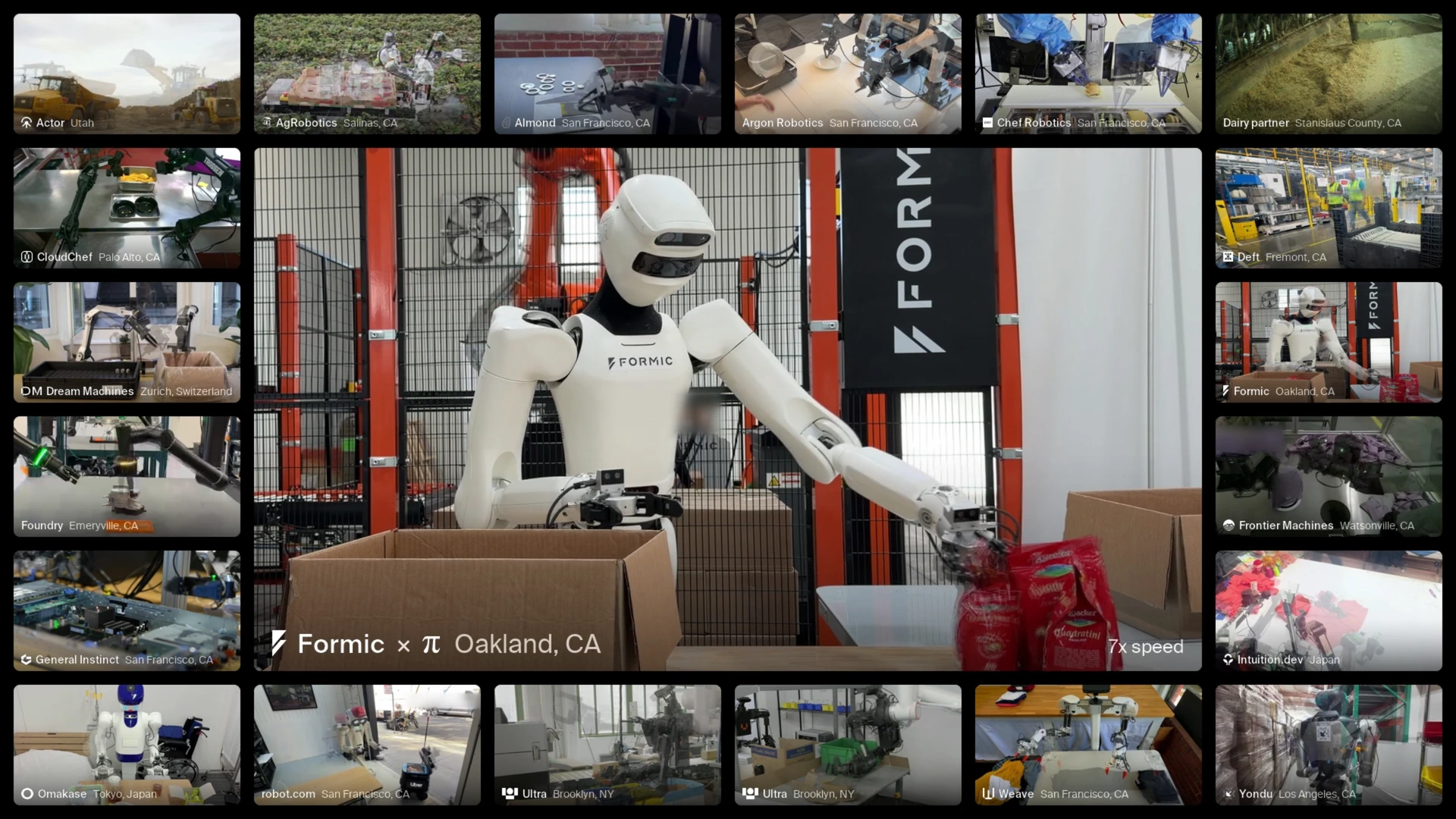
Physical Intelligence announced a beta API on October 13 that lets outside teams fine-tune its robot models on the company’s managed infrastructure and run inference from the cloud. According to Humanoids Daily, the workflow is to upload demonstrations, train a policy, test it on hardware, and then collect more data around whatever failed. Access is by application, in batches, and the form asks about the applicant’s hardware, training experience, available teleoperation data, and whether inference needs to be cloud, local, or hybrid.
The company had already published its π0, π0-FAST, and π0.5 models through its open-source openpi repository, with checkpoints and adaptation examples. The managed service is aimed at teams that would rather not maintain training and serving infrastructure themselves, which describes most hardware startups.
The early examples are practical rather than flashy. Almond’s Axol dual-arm robot was taught to deburr parts for assembly within four days of iterating through the API. Actor’s wheel loader is loading dump trucks in commercial deployments. Most of the demonstrations used cloud inference, and the publication notes that “network connectivity proved challenging for some,” a reminder that physical AI still has a latency problem that software AI does not.
The significance is the business model. A robot foundation model that other companies can adapt and call through an API is the same shape as the large language model platforms that preceded it, and it lets a hardware company find out whether a learned policy can do its job without first hiring a machine learning team.
Source: Humanoids Daily
Boston Dynamics Says Atlas Takes a Day to Build, and Wants to Cut That to an Hour
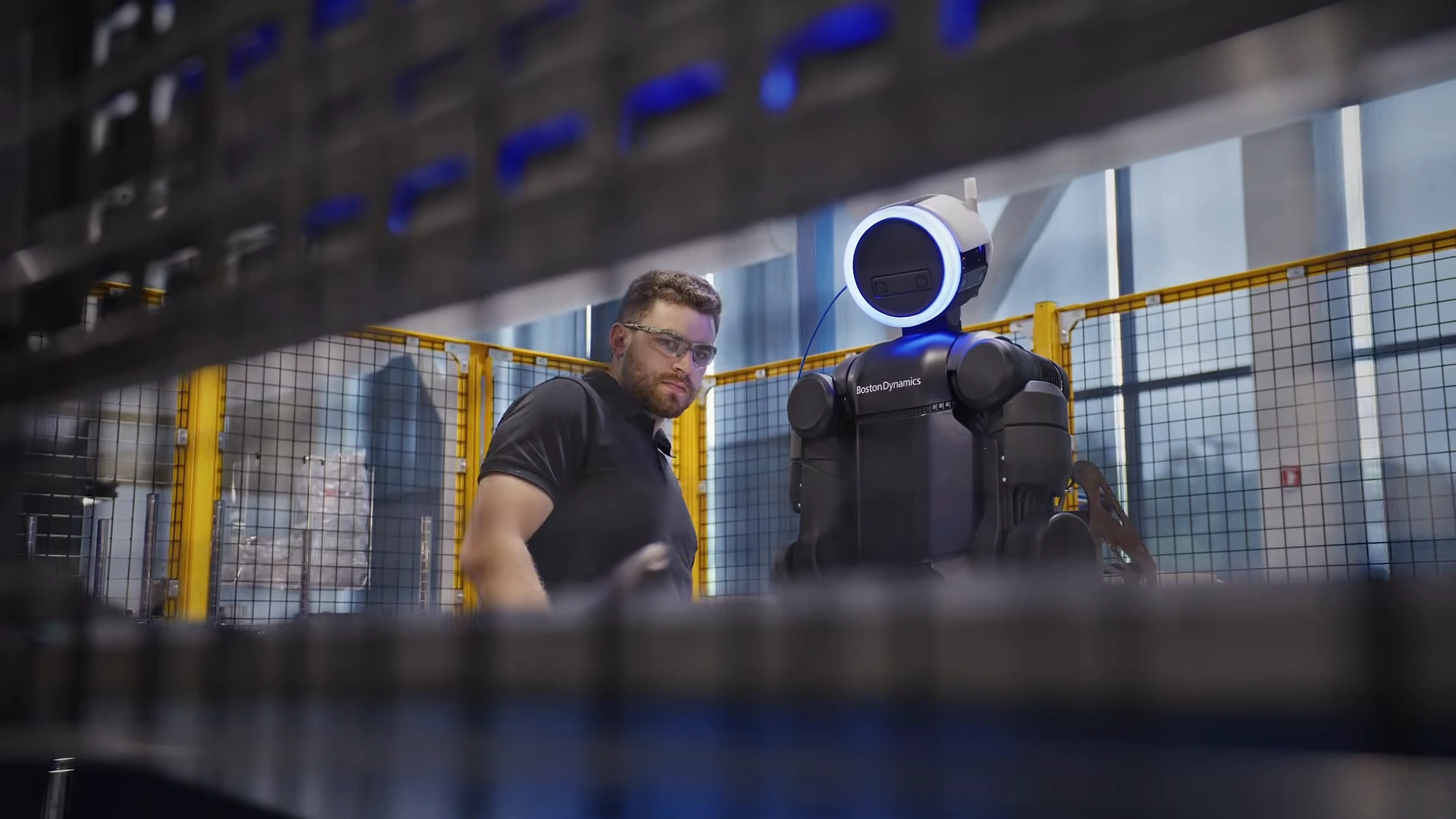
Boston Dynamics released a six-minute video called “Machine, Assemble, Repair: How We Build Atlas,” and the useful part is a number. According to Humanoids Daily’s account, senior technical program manager Katie Conner said assembling one Atlas currently takes “about a day,” with a target of “roughly an hour next year” and further acceleration after that.
The video tours a prototype facility where machining, assembly, and repair sit together. The company keeps precision work such as gear cutting and tight-tolerance machining in-house so machinists and designers can work side by side, and staff described a loop fast enough to take “an idea from Monday to implementation by the end of the week.” The segment ties the manufacturing push to Atlas’s new four-finger hands, which trade some dexterity for cost and durability.
Humanoids Daily sets the numbers in context. Figure claims one robot per hour at its BotQ facility, and Tesla is reported to build several hundred Optimus units a week, mostly for internal testing. By those measures Boston Dynamics is behind on throughput and ahead on candor, since a day per unit is a prototype-shop figure that the company chose to say out loud.
A week after the company hired an Amazon AI executive as chief executive, the video is a reminder that the other half of the humanoid problem is mechanical production, and that the companies most willing to show their factories are the ones with the least to hide.
Source: Humanoids Daily
South Korea’s Regulatory Sandbox Approves a 20-Humanoid Trial in Shared Workspaces
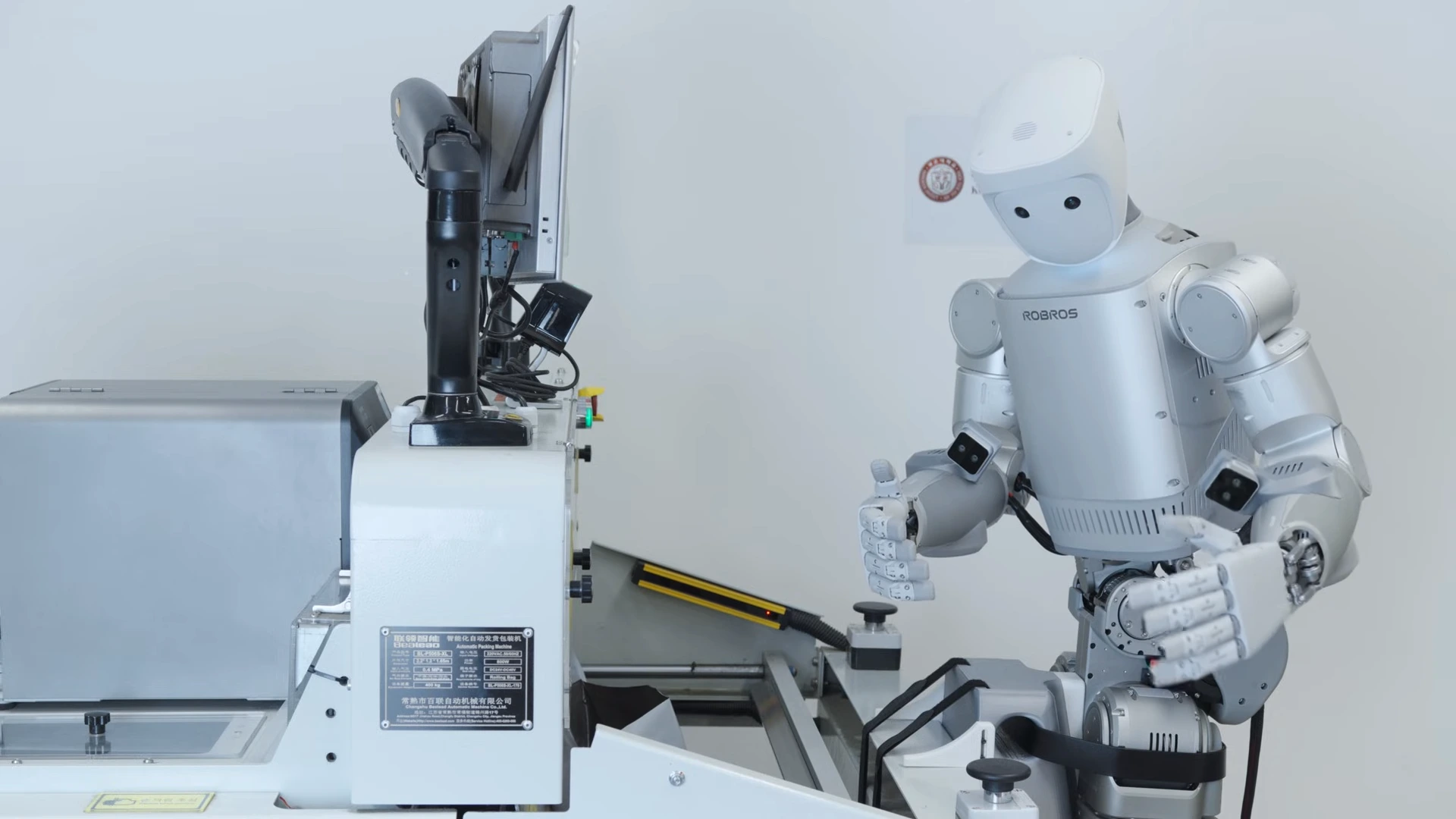
South Korea’s industrial-convergence regulatory sandbox committee has approved a trial of 20 humanoid robots from Robros across manufacturing and logistics sites, and the approval covers something most humanoid pilots do not: working in spaces shared with people, subject to risk assessments and safety mitigation. Humanoids Daily reports the host sites as Nepes, Sungwoo Hitech, HD Hyundai Samho, and Delivery Lab, spanning semiconductors, automotive, shipbuilding, and logistics.
The planned tasks are specific and unglamorous: cleaning semiconductor-packaging components, positioning automotive body parts, stacking shipbuilding materials, and moving refrigerated packaging units. Humanoids Daily is careful to say that the committee authorized testing only, and that nothing in the announcement is a completed deployment or a confirmed production result.
Robros also laid out its AI roadmap. Chief AI officer Daegyu Lim said the company aims to “secure 800,000 hours of simulation data and 200,000 hours of human video” ahead of releasing its own humanoid AI model in the first half of 2027, with development focused on sustained task completion, recovery when vision is obstructed, and adaptation to unfamiliar environments.
The regulatory angle is the story. Agility’s customers said last week that until humanoids are safety-certified, every unit must be fenced off. A government-sanctioned sandbox that lets 20 robots work alongside people under supervision is how the evidence for those standards gets gathered, and Korea has chosen to gather it on real factory floors.
Source: Humanoids Daily
HKUST’s EmArm Gives a Whole Robot Arm a Sense of Touch

Most tactile sensing in robotics lives in the fingertips. A team at the Hong Kong University of Science and Technology led by Professor Shen Yajing has covered an entire arm instead. According to TechXplore’s report on the paper in Nature Sensors, EmArm embeds more than 71,000 square millimeters of soft optical tactile skin over a rigid mechanical skeleton, mimicking the bone, muscle, and skin layering of a human arm. Submillimeter cameras inside the arm watch the skin deform and infer the distribution of force across the upper and lower arm.
The reported figures are strong. Spatial resolution is 0.085 millimeters, in the range of a human fingertip, and the two-point discrimination threshold of 18.2 millimeters is finer than the 30 to 50 millimeters typical of human arm skin. The team reports 97.9 percent sensing fidelity under five kinds of environmental interference, 99.8 percent accuracy at classifying five kinds of touch, and tolerance of loads above 15 kilograms and 7.35 newton-meters of torsion.
Sensing is only half of it. “For robots to acquire perceptual capabilities,” Shen said, “a more important aspect is how to rapidly decode these signals so the robot ‘knows’ what this tactile information means.” EmArm fuses joint angles with the tactile map in a perception-action loop fast enough to act on. In demonstrations it distinguished stroking, pinching, poking, tickling, and hitting; balanced an off-center basketball through force control; and detected and avoided moving obstacles by touch alone when vision was unavailable.
A robot that can feel contact anywhere on its arm, not just at the hand, is a robot that can work safely close to people and recover when its cameras are blocked, two of the capability gaps that factory-floor trials like Korea’s are designed to expose.
Source: TechXplore
New York Renews ElliQ Companion Robot Program With Three Years of Usage Data Behind It
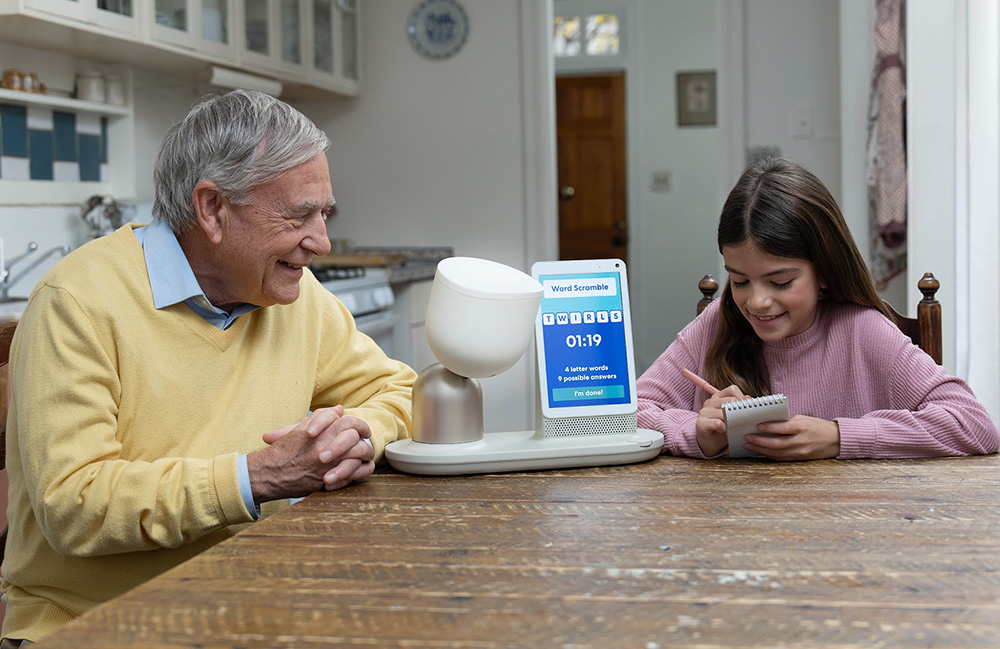
The New York State Office for the Aging has signed a new three-year, $2.1 million agreement with Intuition Robotics to expand ElliQ, a tabletop AI companion robot, to more older adults at risk of loneliness. According to The Robot Report, the renewal follows three years of a program launched in 2022 that has served hundreds of older adults and drew more than 3,500 applications in 2025 alone.
The original rationale came from a 2018 AARP and Centers for Medicare and Medicaid Services report estimating that loneliness costs Medicare more than $7 billion a year, with health effects the report compared to smoking nearly a pack of cigarettes a day. ElliQ’s response is persistence: it extracts memories from conversations, ranks them by importance, and carries that context into future interactions, so it can check in each morning, remember what matters, and prompt a walk or a phone call.
The 2026 program data, as reported by the state, shows participants engaging with ElliQ an average of 48 times a day, up from 29 in earlier years. The state reports that 94 percent say they feel less lonely, 97 percent report improved wellbeing, 88 percent say ElliQ positively affects daily life, and 81 percent take part in physical activity the robot encourages. These are self-reported survey figures from program participants, and they should be read as such, but the engagement trend is consistent with people who find the device useful rather than novel.
“An AI companion who remembers the older adult, checks in every morning, and encourages them to take a walk or call their daughter can meaningfully change how connected and independent someone feels,” said Dor Skuler, Intuition Robotics’ co-founder and chief executive. Intuition runs similar programs in Wisconsin, Florida, and Washington, where it supports Medicaid recipients. A state renewing a robot program on the strength of multi-year outcome data is the kind of adoption that lasts.
Source: The Robot Report