Robotics Weekly Review 2026-10-25

Week In Review
The week’s strongest thread was humanoids moving from demonstration into contracted, measured work. Agility Robotics signed a commercial agreement to put Digit on an AGCO agricultural-equipment line in Kansas, with parts sorting, tote placement, and assembly support as the named tasks (AGCO and Agility Robotics Advance Smart Manufacturing with Humanoid Robot Pilot). Schaeffler opened a plant in Taicang where six humanoids assemble the actuators that go into other humanoids, with a digital twin logging every station (Schaeffler Puts Humanoids to Work Building Parts for Other Humanoids). The most candid account of what it takes to get there came from Agility co-founder Jonathan Hurst, who explained why Digit 5 grew to more than 120 kilograms, lost its bird-like legs, and gave three quarters of its torso to batteries and cooling so that it could legally and safely share a floor with people (The Robot I Didn’t Expect to Build). Read together, these three pieces describe a field whose constraints are now set by insurers, certification bodies, and shift schedules rather than by locomotion research.
Underneath the deployments sits a contest over where robot intelligence should come from. NVIDIA’s expansion of its Isaac platform bets on an open stack: a reference humanoid for universities, an open-source runtime, a general-release learning framework, and a million-clip dataset of human activity (NVIDIA Advances Isaac Platform for General-Purpose Robotics). Researchers in Shanghai built a wearable rig to capture exactly that kind of human data, synchronising first-person video, whole-body motion, finger articulation, and touch (Wearable System Captures Human Activity Data for Robot Training), while Seoul National University folded language, vision, video prediction, and action into one model that outscored several well-known robot foundation models on tabletop tasks (Robot AI Predicts Future Scenes to Guide Its Next Moves). Eka Robotics raised a large Series A on the opposite thesis, arguing that robots should learn physics through simulated reinforcement learning rather than imitate people, and pointing to throughput figures from factory deployments as evidence (Eka Robotics Raises $150M to Scale Its Vision-Force-Action Model). Illinois researchers offered something both camps need: a reinforcement-learning controller with mathematical bounds on how far a robot can drift from its intended path, tested on wheeled, flying, and six-legged machines (Wheeled, Flying and Six-Legged Robots Stay on Track With New Learning Method).
Two items looked past the current hardware generation. A feature on American startups building commercial products on top of Unitree’s G1 argued that humanoid bodies are becoming a commodity substrate, with the value migrating to software, character, and application, and aired the counterargument that this reflects a hollowing of domestic manufacturing (The Unitree G1 Is Becoming a Platform for American Robot Startups). And at a scale of centimetres rather than metres, ETH Zurich grew mouse muscle onto computationally designed hydrogel scaffolds to make actuators that jump, swim, walk, and grasp, a reminder that motors are not the only way to make a machine move (Lab-Grown Mouse Muscles Enable Tiny Robots to Jump, Swim, Walk and Grasp).
Items
AGCO Signs Agility Robotics to Put Digit on an Agricultural Equipment Line in Kansas
Agility Robotics and AGCO, the agricultural machinery group behind brands such as Fendt and Massey Ferguson, announced a commercial agreement on October 20 to pilot Digit humanoid robots at AGCO’s production facility in Hesston, Kansas. The pilot is expected to begin in 2027. According to the announcement, Digit will take on parts sorting and stacking, intelligent placement of totes for storage, and support for assembly and production operations, tasks the companies describe as repetitive and physically demanding.
The framing from both sides is ergonomic rather than headcount-driven. Thomas Enghof, AGCO’s director of manufacturing technology, called humanoid robotics and AI essential “teammates” in building flexible, intelligent factories. Agility’s chief business officer Daniel Diez emphasised working alongside AGCO as it continues to lead in agricultural innovation. The practical case is that heavy-equipment plants have many short, awkward material-handling jobs between fixed automation cells that are hard to justify automating with purpose-built machinery.
Agility says its Digit fleet has now accumulated more than 65,000 hours of real-world operation across customers including Toyota, GXO, and Schaeffler. That number matters because it is the kind of operating history that insurers and safety certifiers ask for before approving robots in shared workspaces, which is the regime the Hesston pilot will run under. The announcement also notes that Agility expects its pending business combination to close in the fourth quarter of 2026, which would make it one of the first publicly traded humanoid companies in the United States.
An agricultural-equipment plant is a demanding environment: large castings, long production cycles, and a product mix that changes with the season. If Digit performs there, it extends the evidence base for humanoids beyond the logistics and automotive settings where most deployments have been reported so far.
Source: Agility Robotics
Agility’s Co-Founder Explains Why Digit 5 Became a 120-Kilogram Industrial Worker

Jonathan Hurst, co-founder of Agility Robotics, wrote a first-person essay in IEEE Spectrum on October 19 titled “The Robot I Didn’t Expect to Build.” It is an unusually honest account of how a research vision of elegant, bird-legged bipedal locomotion turned into Digit 5, a robot that weighs more than 120 kilograms, has conventional human-style knees and hips, and devotes about three quarters of its torso to batteries and cooling. Hurst admits plainly, “I cannot love Digit 5,” before explaining why he is convinced it is the right machine.
The answer is that customers and regulators, not roboticists, set the specification. Early Digit deployments had to run behind physical barriers to satisfy insurers and safety rules. Removing those barriers required safety-rated sensors inside protective housings, isolated computers dedicated to safety functions, and behaviours such as halting, lowering the payload, and sitting down with motors de-powered when a person approaches. Compliance with European CE marking, North American UL electrical standards, and FCC electromagnetic limits added further mass and complexity. The distinctive backward-bending legs went because frequent squatting to pick bins from the floor made the old ankle geometry strike the ground.
The performance envelope Hurst describes is specific. Digit 5 is designed to lift 23-kilogram bins repeatedly to a height of 1.75 metres, run for 90 minutes on a charge, recharge in about nine minutes at 240 amps and 48 volts, and work 20 hours a day. Hurst traces the lineage from the ATRIAS research biped of 2008 through Cassie, of which he says ten were sold to researchers at $250,000 each, to Digit versions 1 through 4 that were tested commercially with Amazon and GXO. Digit 5 is the first designed from the start as a product.
The essay closes with a reflection that will resonate beyond robotics: running a company demanded skills unrelated to solving technical problems, and hiring experienced executives while giving up sole control was “painful and necessary.” His conclusion that “customers and product requirements didn’t ruin my vision; they revealed what my vision was missing” is a useful corrective to the field’s tendency to judge humanoids by the grace of their videos.
Source: IEEE Spectrum
Schaeffler Opens a Plant Where Humanoids Assemble the Joints for Other Humanoids
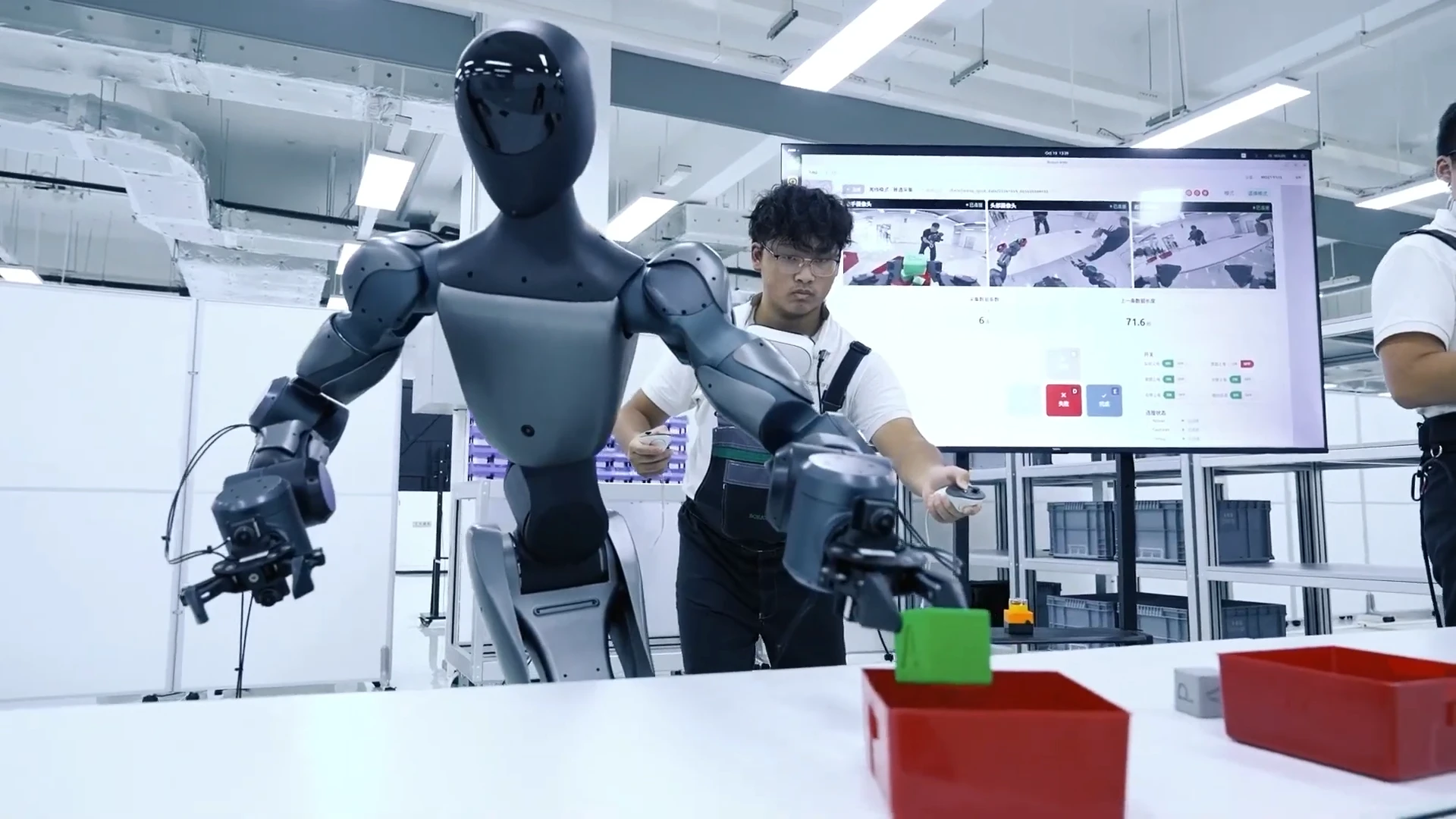
Schaeffler, the German bearings and motion-components group, has opened a roughly 7,500-square-metre facility in Taicang, China, in which six humanoid robots work across five assembly stations producing joint modules, linear actuators, and rotary actuators destined for other humanoid robots. Humanoids Daily reported the opening on October 20. The robots prepare and sort parts, join components, inspect finished products, and handle labelling and packaging. The plant does not build complete robots; it builds the parts that make humanoids move.
The site is designed as much for learning as for output. A digital twin mirrors the line in real time, and sensors record assembly accuracy, task duration, energy consumption, and equipment condition, so that process changes can be tested virtually before they reach the floor. The facility also houses training and data-acquisition infrastructure built around tasks drawn from Schaeffler’s roughly 100 manufacturing plants worldwide, including inspection, packaging, material transport, and line replenishment. That makes Taicang a template Schaeffler could replicate elsewhere.
The commercial signal is concrete. Schaeffler says global incoming orders for its humanoid robotics components have reached approximately €400 million, and that it added two new customers in Greater China in the third quarter. The report is careful to note that these are incoming orders rather than recognised revenue, and that Schaeffler did not name the customers or give delivery schedules.
A century-old supplier of bearings becoming a volume producer of humanoid actuators says something about where the industry’s bottleneck sits. The cost and reliability of joints, not the cleverness of the control software, will largely determine whether humanoids can be built at the prices and volumes their makers project. Having robots assemble those joints under instrumented conditions is a direct way to attack that bottleneck.
Source: Humanoids Daily
NVIDIA Expands Isaac With a Reference Humanoid, an Open Runtime, and a Million Clips of Human Activity
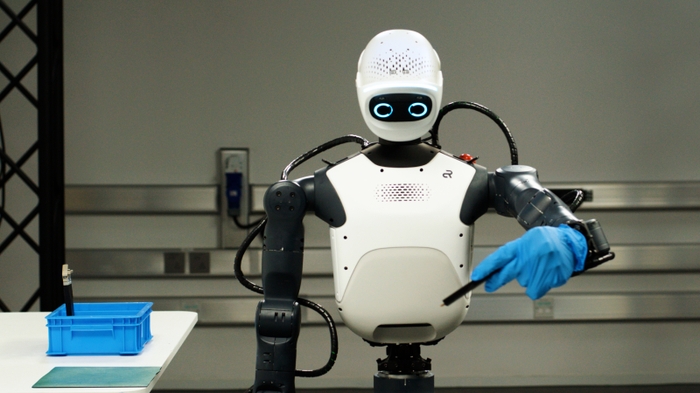
At GTC Berlin on October 21, NVIDIA announced a broad expansion of its Isaac robotics platform aimed at making general-purpose robot development look more like software development. The centrepiece is a reference humanoid, the Agile ONE SN from Agile Robots, built on NVIDIA’s Isaac GR00T models and Jetson Thor compute. The robot stands 1.40 metres tall, weighs 40 kilograms, has 31 degrees of freedom plus two five-fingered WUJI Hand 2 hands with 20 degrees of freedom each, and can carry 3 kilograms per arm. It is scheduled for availability in early 2027, with Stanford University and ETH Zurich named as interested institutions.
The software side is arguably more consequential. Isaac Lab 3.0, the robot-learning framework, is now generally available as open source with multi-GPU support and both the Newton and PhysX physics engines. Isaac OS, a new open-source runtime built on Holoscan, connects AI models, sensors, controllers, and hardware with deterministic real-time performance. Three reference workflows for the DGX Station cover reinforcement learning with GR00T 1.7, dexterous manipulation training, and post-training of Cosmos world models.
The data releases round out the picture. A SimReady Central library of more than 2,000 simulation-ready robot and factory assets is on Hugging Face, with contributions from Comau, FANUC, Franka Robotics, Robotiq, Standard Bots, and others. A Human 1M dataset of diverse human activities with synchronised three-view video and 3D hand tracking goes to Cosmos Coalition partners. The partner list for the announcement spans ABB Robotics, KUKA, Universal Robots, NEURA Robotics, Humanoid, Sereact, 1X, Skild AI, and Agility, with Agility, Dexory, FORT Robotics, and KION named as safety-integration partners.
Jensen Huang’s claim that “the ChatGPT moment for robotics is fast approaching” is the kind of line the field hears often. What is less rhetorical is the strategy: by offering a standard body, a standard runtime, a standard simulator, and standard datasets, NVIDIA is trying to become the layer every robot company builds on, whether or not any single humanoid succeeds.
Source: NVIDIA Newsroom
A Wearable Rig Records Vision, Motion, and Touch as People Work, to Teach Humanoids

Researchers at Shanghai AI Laboratory, Zhejiang University, and Shanghai Jiao Tong University have built EgoExplorer, a wearable system for recording how people move their whole bodies while handling objects, with the goal of giving humanoid robots training data that captures locomotion, posture, and manipulation together. Tech Xplore reported the arXiv preprint on October 24. The rig combines a head-mounted GoPro HERO13 camera, five VIVE Ultimate Trackers for body motion, sensor-equipped gloves (MANUS Metagloves or Wuji models, the latter also recording tactile feedback), and custom 3D-printed mounts and straps.
The point of synchronising all of these streams is that most existing robot-learning datasets capture hands or bodies in isolation. As the authors put it, learning humanoid loco-manipulation from human demonstrations “rests on observing how locomotion, posture, and object interaction evolve together.” Reaching for a box on a high shelf involves stepping, leaning, and grasping as one coordinated act, and a dataset that records only the hand or only the gait loses the relationship between them.
The team collected 100 hours of human activity data with step-level task descriptions. Their motion-reconstruction pipeline reduced body-point error by 71.9 percent relative to the strongest baseline, according to the paper. As a proof of concept, a simulated Unitree G1 humanoid followed two adapted motion sequences without falling. The researchers are explicit that physical-robot testing has not yet been done, so the result is about data quality and retargeting rather than a deployed skill.
EgoExplorer sits alongside the large human-activity datasets that platform companies are now assembling, and shows that a university group can build a capture system that records a richer signal, including touch, with consumer and prosumer hardware. The question the field will have to answer is which of these signals actually transfers to robots, and this kind of open rig makes that question testable.
Source: Tech Xplore
Seoul National University’s Single Model Predicts the Scene and Then Acts on It

A team at Seoul National University led by Professor Jaeyoung Do of the AIDAS Lab has built Dynin-Robotics, a robot foundation model that handles language understanding, image and video processing, prediction of how a scene will change, and generation of robot actions in a single architecture. Tech Xplore reported the work on October 19; the paper has been accepted to NeurIPS 2026 and is on arXiv. The model extends the group’s earlier Dynin-Omni omnimodal model by adding robot-action data.
The idea is that a robot which can forecast the visual consequences of its own movements has a better basis for choosing them. In the researchers’ words, “a single model jointly handles what a robot should do, how its surroundings will change after it moves, and what actions it should actually take.” Most vision-language-action models skip the middle step, mapping observation to action without an explicit prediction of the future.
The team evaluated the model on four real-world tabletop tasks: moving fruit, sorting blocks by colour, stacking blocks in any order, and stacking blocks in a specified colour sequence, plus simulated fruit-picking and flower-arrangement tasks. According to the paper, Dynin-Robotics achieved a 78.4 percent average success rate, against 73.0 percent for NVIDIA’s GR00T N1.6, 73.6 percent for NVIDIA’s Cosmos Policy, and 76.9 percent for Physical Intelligence’s π0.5. The team also reports that action generation ran up to 29.2 times faster than its own unoptimised version and 36.6 times faster than π0.5.
Tabletop block tasks are a long way from a factory floor, and the margins over competing models are modest. What makes the result worth noting is that a university lab, rather than a company with a large fleet, produced a model that is competitive with the best-known commercial robot foundation models, and did so with an architecture that treats future prediction as a first-class output rather than a side effect.
Source: Tech Xplore
Eka Robotics Raises $150 Million for Robots That Learn Physics Instead of Copying People
Eka Robotics, founded in 2024 and based in Cambridge, Massachusetts, announced a $150 million Series A on October 24, led by Andreessen Horowitz and F-Prime Capital, with participation from Obvious Ventures, E14 Fund, MFV Partners, Bison Ventures, Glasswing Ventures, Samsung Next, and several unnamed Fortune 500 strategic investors, according to The Robot Report. The size of the round is notable, but the more interesting part is the technical position it funds.
Eka is building what it calls a vision-force-action model, and its stated philosophy is that robots should “master physics, not mimic human data.” Rather than training on recordings of people performing tasks, the company uses large-scale reinforcement learning in simulation, varying objects, environments, and physical conditions to generate what it says are thousands of hours of robot experience in minutes. The claim is that this produces robots with an intuition for contact and force that generalises to objects and situations outside the training set, and that it narrows the usual gap between simulation and the real world.
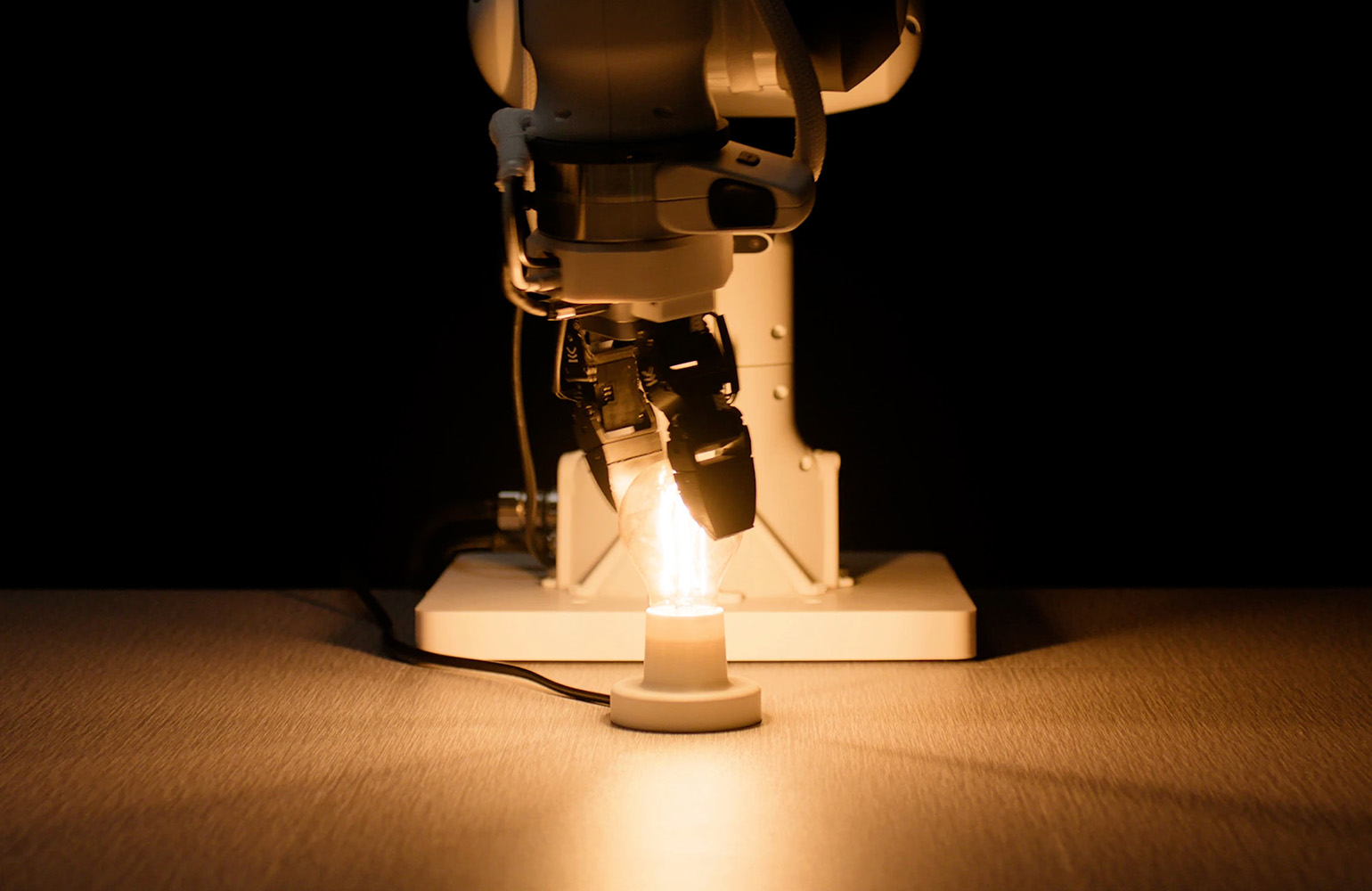
The company backs this with throughput numbers from deployments. The Robot Report reports that robots running Eka’s model perform about 1,500 operations per hour and handle dexterous tasks including picking diverse objects outside the training distribution, screwing in light bulbs, and inserting wires. Investor Shyam Kamadolli summarised the commercial logic: “From the factory floor, a robot’s value comes down to two things: its success rate and its speed over thousands of repetitions.” Raghu Raghuram of a16z called it “the first approach I’ve seen that truly solves manipulation with the generality and throughput needed for deployments.”
Eka’s bet runs directly against the human-demonstration approach that much of the field, and most of the large new datasets, are built around. Whether simulated physics or recorded human behaviour produces more capable robots is one of the open empirical questions in robot learning, and a well-funded company committed to each side makes it more likely the question gets answered in the market rather than in papers.
Source: The Robot Report
Illinois Researchers Give Reinforcement Learning a Mathematical Leash

Reinforcement learning produces controllers that perform well but rarely come with guarantees about how badly they can fail. Researchers at the University of Illinois Grainger College of Engineering have addressed that with CARL, short for Contraction-Aware Reinforcement Learning, published in IEEE Transactions on Robotics and reported by Tech Xplore on October 21. The authors are Minjae Cho, Hiroyasu Tsukamoto, and Huy T. Tran.
The method combines reinforcement learning with contraction theory, a branch of control theory concerned with whether trajectories that start apart converge toward each other over time. By building contraction constraints into the learning process, CARL yields a learned controller that can serve as the robot’s primary controller, rather than a cautious wrapper around a conventional one, while still providing mathematical bounds on tracking error. As the researchers put it, small tracking errors may occur, but the method provides mathematical limits on how large they can become.
The team tested the approach on three very different machines: a wheeled TurtleBot 3 Burger, a flapping aerial drone, and a six-legged Jethexa walking robot. According to the paper, CARL improved tracking performance by about 15 percent over existing methods and was more robust to differences between simulation and reality, such as a physical robot being heavier than its simulated model. Real-world performance matched or exceeded what the simulations predicted.
This matters because the barrier to deploying learned controllers in safety-relevant settings is often not average performance but the absence of a worst-case guarantee. A learned controller with a provable error bound is something a safety engineer can reason about, and the fact that the same method worked across wheels, wings, and legs suggests it is not tuned to one body plan.
Source: Tech Xplore
The Unitree G1 Is Becoming the Body That American Robot Startups Build On
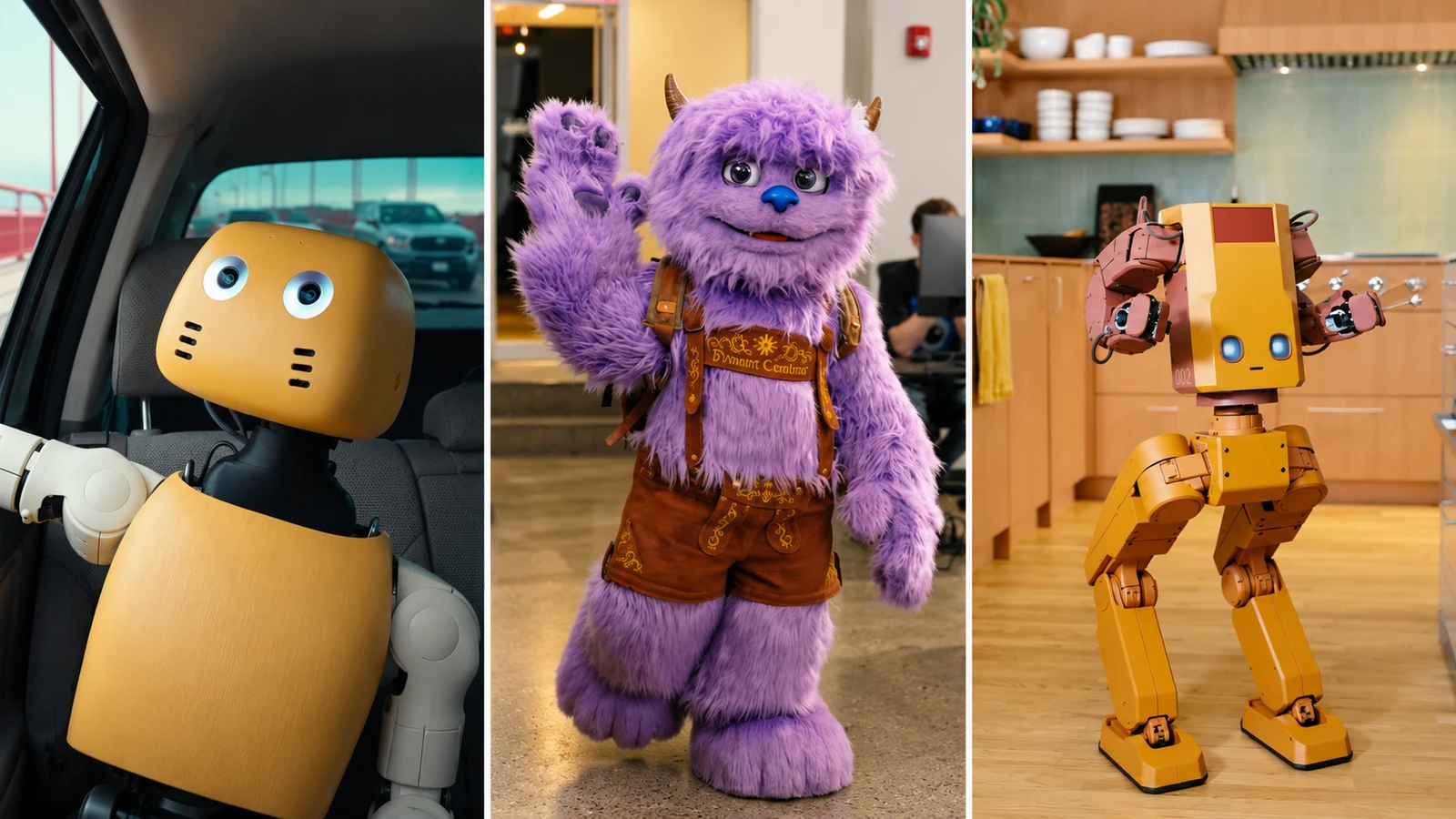
A feature in Humanoids Daily on October 22 argues that the Unitree G1 is turning into a hardware platform for American robotics startups in the way that commodity PCs once were for software companies. The piece documents three young companies whose products are, to varying degrees of acknowledgement, built on a G1 body, and uses them to make a broader point about where value in humanoid robotics is settling.
Lightberry’s Lumi, priced at $39,990 in a Founder Edition, has 29 degrees of freedom, a custom Jetson Thor T4000 compute module, an eight-microphone array, stereo cameras, a moving neck, and grippers, and is aimed at conversational interaction for commercial entertainment and marketing. Tuesday Labs’ Voxel, a yellow robot with an illuminated face expected around 2028 at roughly $20,000, targets household tidying, fetching, and plant care; an investor, Benjamin Bolte, openly called it a “Unitree G1 wrapper,” while CEO Rosalind Shinkle describes the robot’s character as the architecture that unifies its design decisions. Dynamic Creatures’ Hugo, a purple furry character with 43 actuators and a model the company calls vision-language-expression, appeared to run on a modified G1 in a developer’s monitor, though the company has not confirmed it.
The platform economics are what make this possible. The article cites Unitree founder Wang Xingxing’s October 22 remarks putting cumulative G1 production at 10,000 to 20,000 units, and notes a base price of $13,500 for the version without secondary-development support. It also observes that the G1’s FCC authorisation of March 3, 2025 predates US restrictions on foreign robots that took effect on July 28, 2026, which is why the imports continue.
The piece does not pretend the trend is uncontroversial. Clay Haight of Sunday Robotics is quoted criticising the pattern as a symptom of weak US manufacturing, and Bolte counters that buying bodies lets a startup avoid both a manufacturing programme and the cost of training a foundation model. Both can be true, and the debate is a useful lens on the question of whether humanoid hardware or humanoid software is where the durable businesses will be.
Source: Humanoids Daily
ETH Zurich Grows Mouse Muscle Onto Computer-Designed Scaffolds to Make Robots That Jump and Swim

Researchers in the Soft Robotics Lab at ETH Zurich, led by Professor Robert Katzschmann, have built centimetre-scale robots powered by living skeletal muscle grown from mouse cells, and shown them jumping, walking, swimming, and grasping. The work, by doctoral student Aiste Balciunaite and Mike Y. Michelis with colleagues, appeared in Nature Communications and was reported by Tech Xplore on October 22.
What distinguishes this from earlier biohybrid robots is how the actuators were designed. Instead of growing muscle onto a scaffold of fixed shape, the team designed the muscle geometry and the soft hydrogel scaffold together in simulation, using algorithms to search for configurations in which a contraction produces the most movement. “Instead of specifying a fixed form for our muscle geometry, we wanted to design the whole thing from scratch on the computer,” Balciunaite said. Fine grooves in the scaffold give muscle fibres something to anchor to, reducing the force lost at the interface between tissue and gel.
The performance figures reflect that optimisation. According to the paper, the roughly 1.5-centimetre actuators lifted themselves about 5 millimetres, a third of their body length, per contraction when jumping, walked at 6.2 millimetres per second, and achieved a range of motion up to 11 times greater than comparable earlier systems.
The limitations are real and the authors are candid about them. The muscle needs a continuous nutrient solution to stay alive, cultured tissue varies from batch to batch so no two actuators behave identically, and long-term operation would require something like an artificial vascular system, which does not yet exist. But living muscle is self-repairing, efficient, and silent in ways that no electric motor is, and co-designing tissue and scaffold computationally is a step toward treating biological actuators as an engineering material rather than a curiosity.
Source: Tech Xplore