Space Weekly Review 2026-09-26

Week In Review
The strongest thread this week is origins, read from chemistry. A Webb transit spectrum of TOI-6894 b, a temperate sub-Saturn orbiting the lowest-mass star known to host a transiting giant, found an atmosphere whose elemental ratios match Jupiter and Saturn, which argues that giant planets form by the same core-accretion route even around stars a fifth the Sun’s mass. In our own system, isotopic fingerprints in half a gram of Bennu show the asteroid formed near the water-ice line rather than in the outer solar system, making it a candidate sample of the raw mix that built the terrestrial planets. And a high-field mass spectrometer and an atomic force microscope together revealed more than 150,000 organic compounds in two carbonaceous meteorites, recasting such rocks as petrochemical reservoirs rather than neat deliveries of biological building blocks. The odd one out is GJ 3090 b, a sub-Neptune orbiting its red dwarf backwards, whose discoverers propose that a late-arriving stream of interstellar gas flipped the star’s disk. Each of these results is a reminder that planet formation is now an empirical science with samples, spectra, and orbital geometry as its evidence.
A second thread is the Sun and stars observed on human timescales. Centauri Dreams revisited Sakurai’s Object, a dying star that reignited helium burning and is now reheating toward Wolf-Rayet temperatures within three decades of its 1996 outburst. Closer to home, Solar Orbiter’s Extreme Ultraviolet Imager caught thousands of fast, short magnetic waves in polar coronal holes that earlier instruments missed, waves that carry enough power to bear on the long-standing puzzle of why the corona is so hot.
The third thread is engineering that changes what can be done in space rather than what can be seen. Google confirmed that its first Project Suncatcher satellite, carrying four TPU accelerators, flies October 1, the first hardware step toward orbital AI compute. Stanford researchers trained a world-model AI to dock with the space station using far less training than reinforcement learning needs. An MIT group is pulling oxygen from Martian carbon dioxide with a pulsed plasma reactor, a step toward fueling the return trip on the surface. And a Beihang University team argued that diffractive solar sails could deliver a head-on asteroid impactor at 100 kilometers per second, roughly 230 times the punch per kilogram of the DART test. Compute, autonomy, propellant, and planetary defense are the infrastructure layer beneath the science above, and this week all four moved.
Items
Webb Reads a Jupiter-Like Chemistry in a Giant Planet Around a Tiny Star
TOI-6894 b should not exist by the standard account of planet formation. It is a giant planet, at 0.86 Jupiter radii and 0.17 Jupiter masses, orbiting an M5 dwarf of just 0.21 solar masses, which the authors describe as the lowest-mass star known to host a transiting giant. Small stars have small disks, and small disks were not supposed to have enough solid material to build a giant’s core before the gas dispersed. A new paper in The Astrophysical Journal Letters, led by Michael Zhang of the University of Chicago with Michael Line of Arizona State and Eliza Kempton among 15 co-authors, uses Webb to ask what the planet is made of.
The team obtained a NIRSpec PRISM transmission spectrum spanning 0.8 to 5.2 micrometers and found it unusually clean. The white-light curve scatter was 2.2 times the photon noise, and the spectrum showed no obvious contamination from starspots, a persistent problem for giant planets around M dwarfs. Against that quiet background, the planet’s atmosphere, at an equilibrium temperature near 420 kelvin, shows five methane absorption bands, a carbon disulfide feature at 4.65 micrometers produced by photochemistry, water, carbon dioxide, and ammonia. The authors note that the ammonia is visually evident, which they call a first for a transit spectrum.
The chemistry points to a familiar composition. Grid retrievals give a metallicity of about three times solar, with semi-free retrievals spanning 3 to 10 times solar, and a carbon-to-oxygen ratio of 0.69 plus or minus 0.06. Nitrogen-to-oxygen, sulfur-to-nitrogen, and carbon-to-nitrogen ratios all sit near solar values. Interior models consistent with the spectrum imply roughly 11 Earth masses of heavy elements, a bulk metallicity that resembles Jupiter and Saturn.
That resemblance is the point. If TOI-6894 b had formed by disk instability, a direct gravitational collapse of gas, its composition would be expected to track the star’s rather than show the enrichment of a rocky core plus captured gas. Instead the paper concludes that the planet formed by standard core accretion, and that the process works even in the sparse disks of the smallest stars. Since M dwarfs are the most common stars in the galaxy, that widens the population of systems where giant planets, and the dynamical histories they impose, can be expected.
Source: The Astrophysical Journal Letters
Bennu Formed at the Water-Ice Line, and May Preserve the Terrestrial Planets’ Recipe

NASA’s OSIRIS-REx brought about 120 grams of asteroid Bennu back to Earth in 2023, and ETH Zurich received half a gram of it. That was enough for Maria Schönbächler’s group to measure the isotopic composition of iron, titanium, and chromium in the material and, in a paper published in Science Advances, to argue that the prevailing story of Bennu’s birthplace is wrong.
Bennu, a rubble pile of fine dust bound by water ice and roughly 4.5 billion years old, had generally been assumed to have formed in the outer solar system, where its water-rich, carbon-rich composition seemed to belong. The ETH isotopes instead place it near the water-ice line, the radius in the young solar nebula where temperatures first fell low enough for water to freeze. That zone was a mixing region. According to the ETH account, Jupiter, which formed within about a million years of the Sun, acted as a bridge pillar, holding back coarse material while letting fine dust from both inner and outer regions drift through and accumulate near the ice line.
The measurements also tie Bennu to a family. Its isotopic signatures match asteroid Ryugu, sampled by Japan’s Hayabusa2, and the CI class of carbonaceous chondrite meteorites, suggesting that all three share a common formation region rather than representing independent samples of the outer solar system.
The consequence, in Schönbächler’s words, is that “Bennu may offer our best glimpse of the original mix of chemical elements from which the terrestrial planets were ultimately built.” Earth, Venus, and Mars grew from material that passed through the same inner-disk mixing zone, and their bulk compositions have been heavily processed by melting and differentiation since. A primitive body that condensed at the ice line and never melted is a much cleaner record of the starting ingredients, which is the kind of question sample return missions were built to answer.
Source: ETH Zurich
Two Meteorites Yield More Than 150,000 Organic Compounds, Photographed Molecule by Molecule
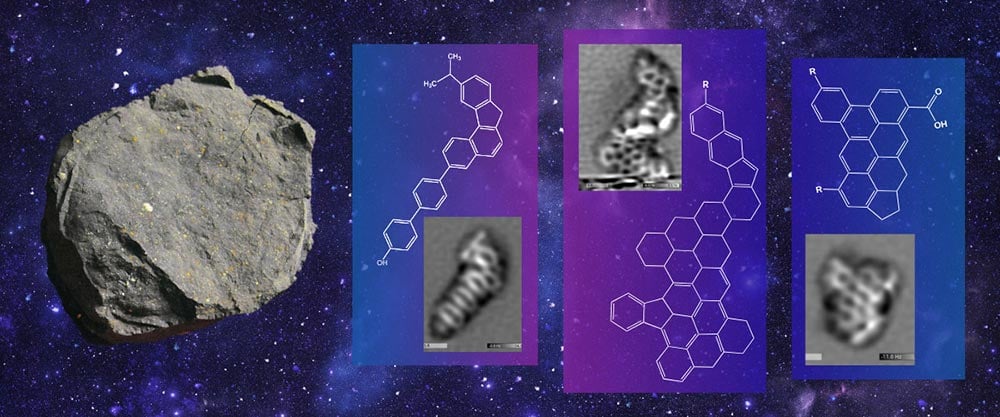
The Murchison meteorite, which fell in Australia in 1969, and Aguas Zarcas, which fell in Costa Rica in 2019, are the two most studied carbonaceous chondrites on Earth. A team at the National High Magnetic Field Laboratory and Florida State University, led by Joseph Frye-Jones, has now shown how much of their chemistry had gone unread. Their study in The Planetary Science Journal reports more than 66,000 unique molecular formulas in Murchison and more than 91,000 in Aguas Zarcas, over 150,000 compounds in total that had not been catalogued before.
The method matters as much as the count. Rather than a single extraction, the team washed the meteorite powder sequentially in solvents of decreasing polarity, methanol, then ethanol, chloroform, toluene, and acetone, so that each pass pulled out a different chemical population. Less than one percent of the molecules overlapped between extracts, and the two meteorites, despite similar classification, shared little. The extracts went to the MagLab’s 21-tesla mass spectrometer in Tallahassee, which resolves molecular masses to better than the mass of a single electron, and to an atomic force microscope at Brookhaven National Laboratory, where molecules deposited on copper crystals were traced with a carbon-monoxide-tipped probe to produce actual images of their structures.
The molecules run up to about 1,000 atomic mass units, with 10 to 70 carbon atoms and up to 20 oxygen atoms each. Among them are iron-bearing organometallic compounds with more than 35 carbons, a class not previously reported from meteorites.
The authors’ framing is that these rocks were petrochemical reservoirs, not tidy parcels of amino acids and nucleobases. Complex organic chemistry was running long before life, across a far wider range of molecules than the familiar prebiotic shortlist. Understanding the transition from that chemistry to biology means starting from the full inventory, and this work is the first real look at how large that inventory is.
Source: Universe Today
A Sub-Neptune That Orbits Its Red Dwarf Backwards
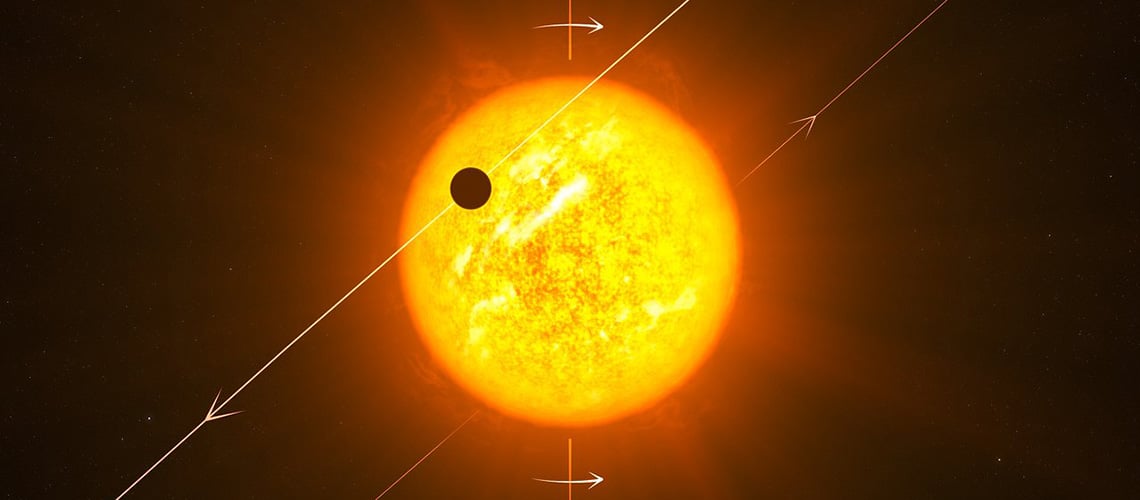
GJ 3090 b is an unremarkable planet in most respects: about 2.2 Earth radii, 4.5 Earth masses, a 2.9-day orbit around a red dwarf 73 light-years away in Phoenix. What a team led by Yann Carteret at the University of Geneva found is that it goes around the wrong way. In a paper in Astronomy & Astrophysics, they report an orbital obliquity of about 136 degrees, meaning the planet’s orbit is tilted well past perpendicular to the star’s spin and is effectively retrograde. For comparison, the solar system’s planets are aligned to within about seven degrees.
The measurement used the Rossiter-McLaughlin effect with the NIRPS spectrograph on the European Southern Observatory’s 3.6-meter telescope in Chile, across five transits. As a planet crosses a rotating star, it blocks first the side rotating toward us and then the side rotating away, or the reverse, and the resulting distortion of the stellar spectral lines reveals the orbit’s orientation. GJ 3090 b crossed the receding hemisphere first. According to Universe Today, it is the smallest exoplanet to have its obliquity measured around a red dwarf.
Retrograde orbits are known among hot Jupiters, where a massive companion can tilt an orbit over time. The usual mechanisms struggle here, because no such companion is evident and the planet is small. The team instead proposes a primordial disk flip: after the star formed, a fresh stream of gas and dust from interstellar space fell onto it with opposite angular momentum, creating a second-generation disk rotating the other way, in which the planet formed. They connect the idea to so-called Peter Pan disks, protoplanetary disks observed to persist millions of years longer than models expect, which late infall could explain.
The result is one data point, but it is a data point that standard formation theory does not predict. Red dwarfs host most of the galaxy’s planets, and if late infall episodes are common, the orbital architectures of those systems may be more varied, and their histories more violent, than the tidy solar-system template suggests.
Source: Universe Today
Sakurai’s Object: A Star Reborn Within a Human Lifetime
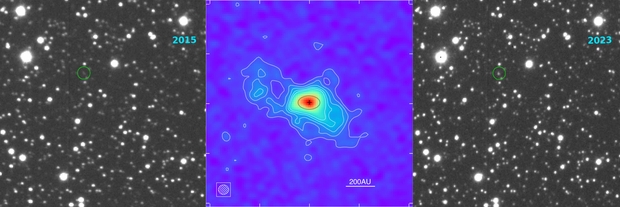
In 1996 the Japanese amateur astronomer Yukio Sakurai noticed a star in Sagittarius that had brightened from magnitude 21, as recorded in 1976, to magnitude 11. Paul Gilster’s Centauri Dreams post this week traces what astronomers have learned since about V4334 Sagittarii, now known as Sakurai’s Object, drawing on a 2026 paper by Marcolino and colleagues in Monthly Notices of the Royal Astronomical Society.
The star had been on its way to becoming a white dwarf when helium deep in its interior reignited, an event called a very late thermal pulse. The renewed burning inflated the star and blew off a shell of material, producing the 1996 outburst. Along with V605 Aquilae, Sakurai’s Object is one of only two stars observed directly undergoing this process, which theory says a small fraction of Sun-like stars experience as they die.
The new work catches the star reheating. Its surface temperature is now between 27,000 and 36,000 kelvin, roughly six times hotter than it was 30 years ago, and its spectrum has taken on the signature of a [WC]-class Wolf-Rayet star, a low-mass cousin of the massive Wolf-Rayet stars, with carbon-rich material streaming off its surface. According to Gilster’s summary, the reheating is proceeding more gradually than some models predicted, which is itself a useful constraint on the physics of these final pulses.
Albert Zijlstra of Jodrell Bank puts the appeal plainly: “Most stars evolve so slowly that major changes take place over timescales far longer than a human lifetime.” Sakurai’s Object compresses a stage of stellar evolution into decades, so that a single generation of astronomers, and a well-placed amateur, can watch a star’s death and rebirth as a time series rather than infer it from a population.
Source: Centauri Dreams
Solar Orbiter Catches the Sun’s Missing High-Speed Waves
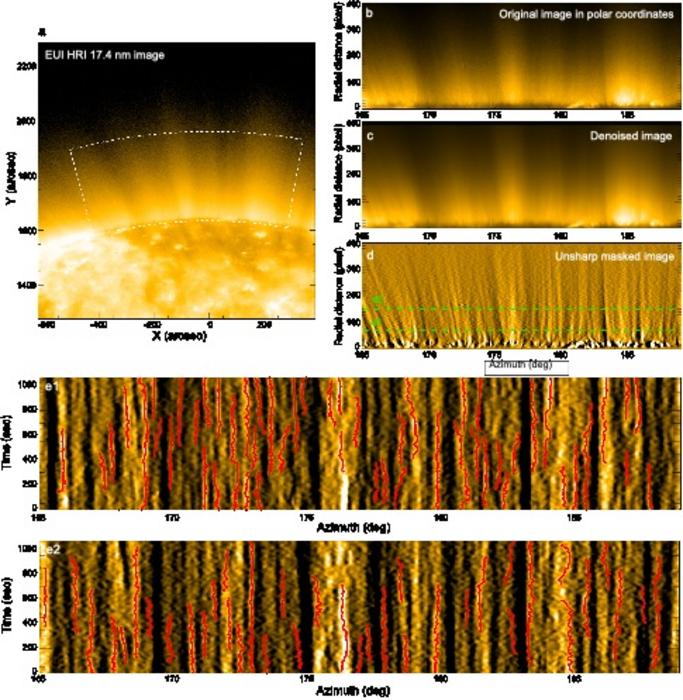
Why the Sun’s corona is millions of degrees hotter than its surface, and what accelerates the fast solar wind, are two of the oldest open problems in solar physics. Magnetic waves have long been a leading candidate for both, but earlier instruments could see only the slowest and largest of them. A team at Peking University led by Yuhang Gao and Hui Tian has used Solar Orbiter to find the rest, in work published in National Science Review.
The comparison is between NASA’s Solar Dynamics Observatory and Solar Orbiter’s Extreme Ultraviolet Imager. Where SDO images every 12 seconds at about 1,100 kilometers per pixel, EUI images every 5 seconds at 420 kilometers per pixel. Applying the Northumbria University Wave Tracking algorithm to September 2021 observations of plumes in polar coronal holes, the team counted 2,318 wave events in EUI data against 560 in SDO data covering the same region.
The waves EUI sees are not just more numerous but different. Thirty-eight percent have periods under 100 seconds, against nine percent for SDO, and their average speed is 15.4 kilometers per second versus 9.9. Taken together, the EUI population carries about 2.6 times more power. The team proposes three candidate sources: magnetic reconnection, the plasma jets known as spicules, or turbulent cascade from larger waves breaking down.
The significance is that a substantial fraction of the wave energy available to heat the corona and drive the wind was simply below the detection threshold until now. The team notes that the Solar Polar-orbit Observatory, planned for launch in early 2029, should be able to look for even higher-frequency waves from a vantage above the Sun’s poles.
Source: Universe Today
Google’s First Project Suncatcher Satellite Flies October 1
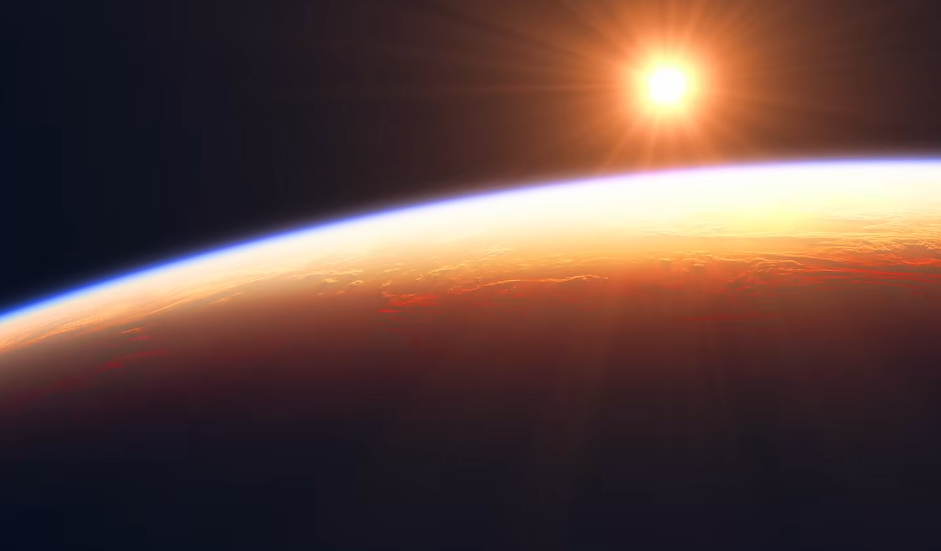
Google announced on September 24 that the first hardware for Project Suncatcher, its plan for AI data centers in orbit, will launch October 1 on a SpaceX Falcon 9. The satellite, built with Planet Labs and called MVP, is refrigerator-sized and carries four of Google’s Trillium-generation TPU accelerators, powered by solar arrays generating about one kilowatt. According to SiliconANGLE, cooling limits mean the chips will run in bursts of roughly 15 minutes.
Google first described Suncatcher in November 2025. The pitch is that orbit offers near-continuous sunlight and no water cooling, and that as launch costs fall, some fraction of compute could move off the grid entirely. The first flight tests none of that economics. It tests whether the chips survive. Ground trials at UC Davis’s Crocker Nuclear Laboratory reportedly showed Trillium TPUs holding up under radiation doses equivalent to a five-year mission, and the flight will add the vibration and up to ten g of launch loads, the radiation environment of real orbit, and the heat pipes and radiators that carry chip heat away without convection.
Travis Beals, senior director of Google’s Paradigms of Intelligence team, described the goal as “seeing what works, identifying points of failure and applying those findings to future missions.” Later satellites, planned for 2027, would add laser links between spacecraft, the piece that turns isolated chips into a distributed cluster.
Google is not alone. SiliconANGLE lists SpaceX, Starcloud, and Orbital among companies pursuing orbital compute. Whether any of them close the economics against terrestrial data centers is an open question, and the answer depends on launch cost curves that Starship is meant to bend. But the shift from slide decks to flight hardware is the moment such an idea stops being speculative and starts generating data.
Source: SiliconANGLE
Stanford Engineers Teach Spacecraft to Dream Their Way to the Space Station
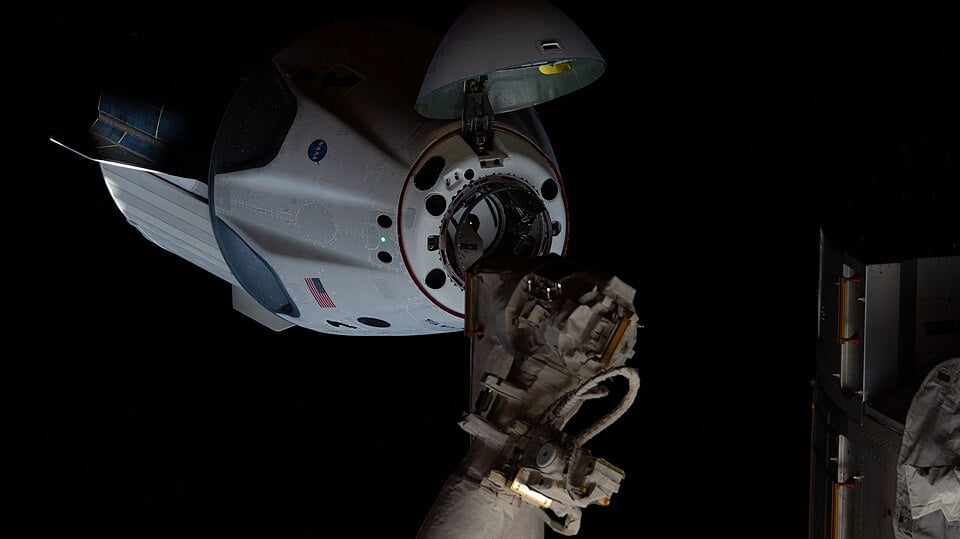
Docking with the International Space Station means matching a target moving at 28,000 kilometers per hour and easing into a port with centimeter precision. Universe Today’s Andy Tomaswick likens it to parallel parking into an open garage at highway speed, with the garage also moving. Today’s spacecraft do it with guidance, navigation, and control algorithms wrapped around Extended Kalman Filters, which work well but struggle with high-rate video and with the visual chaos of sunlight glinting off solar arrays or shadows swallowing the target.
A Stanford team led by D. Eddy has taken a different approach, described in an arXiv preprint on GPU-accelerated astrodynamics world models. Instead of reinforcement learning, which learns a policy by trial and reward and tends to break when the rules change, they built a world model: an AI that learns the physics of the rendezvous from experience and then imagines, or in the field’s term dreams, many possible futures before choosing the trajectory most likely to end at the port. The system also estimates how confident it is in each prediction.
To train it, the team wrote AstroJAX, a library that runs orbital dynamics simulations on graphics processors. The resulting Out-of-this-World-Model reached competence in about 500,000 training iterations, against roughly 25 million for a comparable reinforcement learning system. In testing across ISS docking ports it succeeded about 53 percent of the time versus 29 percent for the reinforcement learning baseline, though the authors acknowledge that the final close-approach phase remains hard.
Those numbers are nowhere near flight-ready, and the article does not claim otherwise. The interest lies in the sample efficiency. A method that learns a physical task in fifty times fewer trials is one that could plausibly be trained for new vehicles, new targets, or degraded sensors without a decade of engineering, which is the kind of autonomy that servicing, refueling, and debris removal missions will need.
Source: Universe Today
MIT Plasma Reactor Aims at Refueling Depots on Mars
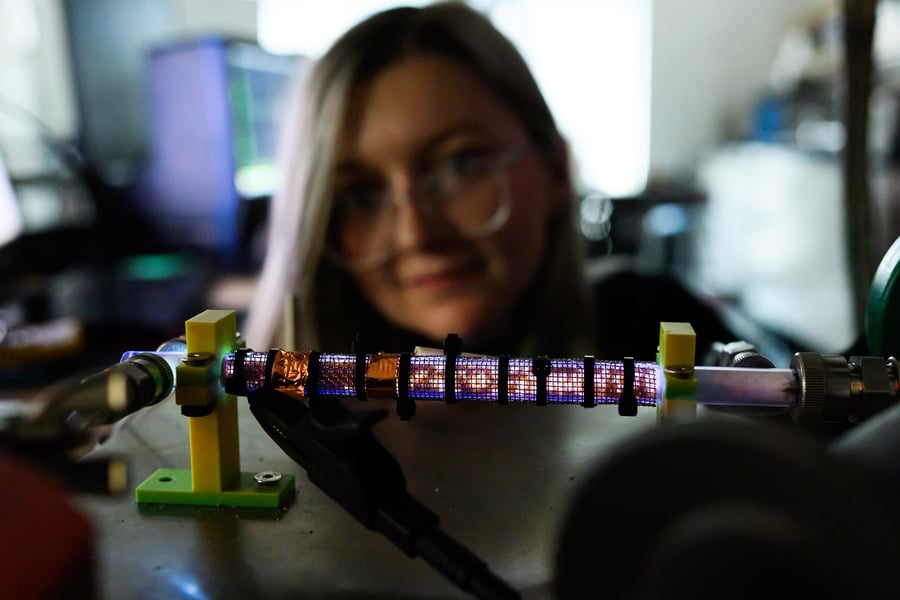
The single largest mass a crewed Mars mission must carry is the propellant to come home, and the single biggest lever for reducing it is making that propellant on the surface. Mars’ atmosphere is mostly carbon dioxide, and splitting it into oxygen is the first step. Universe Today profiles Lanie McKinney, a PhD candidate in MIT’s Aerospace Plasma Group under Carmen Guerra-Garcia, whose reactor takes a different route from the solid-oxide electrolysis that NASA’s MOXIE experiment demonstrated on Perseverance.
McKinney’s device is a nanosecond repetitively pulsed dielectric barrier discharge reactor, a plasma system that uses extremely short electrical pulses to break carbon dioxide into carbon monoxide and oxygen. The known difficulty with plasma conversion is that the products want to recombine. In her words, “We can actually perform the conversion step really well. But what happens in a plasma is we convert it, and then we get a mixture that needs to be separated.” Her contribution is pairing the reactor with an oxygen-selective membrane that pulls the oxygen out before it can rejoin the carbon monoxide.
The profile places the work in a wider program of resource-use research. Through MIT’s Space Resources Workshop McKinney has taken part in NASA design challenges, including a study of a ten-year self-sustaining Mars mission. She co-led the CERBERUZ team that won first prize in Phase 2 of NASA’s LunaRecycle Challenge, a 775,000 dollar award for a system that turns mixed mission waste into feedstock for 3D printing and injection molding. She has also worked on radiation-shielding bricks made from lunar regolith.
None of this is flight hardware yet, and the article is careful to present it as laboratory research. But the combination of a lower-temperature conversion path and an integrated separation step is the kind of engineering that decides whether in-situ propellant production stays a demonstration or becomes a depot.
Source: Universe Today
How Diffractive Solar Sails Could Stop an Asteroid at 100 Kilometers per Second
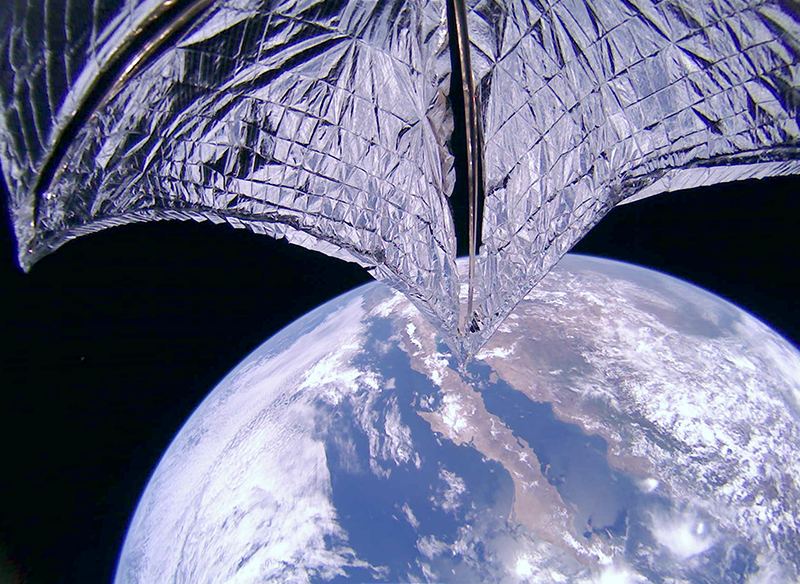
NASA’s DART mission proved in 2022 that a kinetic impactor can change an asteroid’s orbit. It also showed the limits of the technique: DART caught up with its target from behind at about 6 kilometers per second. Since kinetic energy scales with the square of velocity, a much faster impact would deliver far more push per kilogram launched, and the fastest possible impact is a head-on one, with the spacecraft traveling opposite to the asteroid’s orbital motion. A paper by J. Zhang and colleagues at Beihang University, summarized by Universe Today’s Andy Tomaswick, argues that diffractive solar sails could make that maneuver practical.
The trajectory idea is not new. In the 1990s Giancarlo Vulpetti described the H-reversal trajectory, in which a solar sail dives close to the Sun and uses radiation pressure to cancel and then reverse its orbital angular momentum, so that it ends up circling the Sun the wrong way. The problem has been the sail. Conventional reflective sails, like Japan’s IKAROS and the Planetary Society’s LightSail 2, must tilt to generate sideways thrust, and tilting reduces the sunlight they catch.
Diffractive sails replace the mirror with a microstructured optical grating that bends incoming light sideways without tilting the sail. The sail stays face-on to the Sun, collects the full flux, and still produces the perpendicular force the H-reversal requires. In the team’s simulations, a combined diffractive-reflective sail could deliver an impactor to the 340-meter asteroid Apophis in 200 to 300 days, nearly a year faster than a reflective sail alone, and arrive head-on at roughly 100 kilometers per second. Universe Today calculates that as something like 230 times DART’s force per kilogram of impactor mass.
The paper is a feasibility study, and diffractive sail materials have flown only as small experiments. But the argument is one of physics rather than budgets, and it suggests that planetary defense could scale with a very modest launch mass if the sail technology matures. It also makes the case that sail research, often discussed for interstellar precursors, has a nearer-term application close to home.
Source: Universe Today