Space Weekly Review 2026-10-03

Week In Review
The week belonged to Starship. On September 28 the vehicle reached orbit for the first time and released 26 third-generation Starlink satellites, its first operational payload, before both stages came back down under control (Starship returns to Earth; rocket splashes down north of Hawaii after three-hour flight). The flight was not flawless: one upper-stage engine shut down early and the mission ended after about three hours. But the rocket did the thing it was built to do, and the question has now shifted from whether Starship works to what a working Starship makes possible. NextBigFuture’s same-day analysis takes the most expansive view, arguing that roughly 120 Starship launches could put a gigawatt of computing power in orbit, a target that would take Falcon 9 many hundreds of flights to match (SpaceX Starship Orbital, Deployed Commercial V3 Satellites, Gigawatt AI Possible With 120 Launches).
Away from Texas, it was an unusually rich week for seeing planets being made. ALMA delivered the first direct image of gas spiralling onto a forming planet, WISPIT 2b, confirming a prediction that simulations have made for years (First Direct Image of Protoplanet Swirling Surrounding Gas). Webb looked at a later and more violent stage, sorting 21 dusty young systems into those shaped by Mars-sized impacts and those shaped by gentler Moon-sized ones, a sequence that echoes our own solar system’s history (Webb provides crash course on planet-shattering collisions). And a Copenhagen team reports that Earth and Mars, despite being neighbours, were assembled from different ingredients in different proportions, with Earth mostly built from pebbles and Mars mostly from planetesimals (Earth and Mars: Built from different cosmic recipes).
The exoplanet results were a study in calibrated confidence. A candidate super-Jupiter around 61 Cygni, one of the nearest stars to the Sun, rests on a 4.4-sigma astrometric anomaly and will need years of follow-up to confirm, yet its presence or absence matters directly to where future telescopes should look for Earth analogues (Worlds Next Door. V. A Candidate Solar System Scale Super-Jupiter in the 61 Cygni Binary System). Webb found the coldest known lava world, HD 3167 b, apparently holding onto an atmosphere (Coldest Lava Exoplanet Found to Hold an Atmosphere), while a measured essay on the habitable-zone super-Earth LHS 1140b explains why a helium detection that appeared in one observation and vanished in the next should be treated as a lead rather than a result (Alien life? Why the possibility of exoplanet LHS 1140b emitting helium gas is so exciting).
Two items reach furthest. Astronomers in Rome tied a ten-minute X-ray flash to a neutron star merger, opening a new way to catch these collisions and perhaps to learn how often they leave a magnetar behind (Astronomers link mysterious cosmic flashes to collisions of dead stars). And Centauri Dreams examines a proposal that the pace of biological evolution tracks the total carbon a planet’s photosynthesis has fixed, not its age, which would mean most habitable-zone worlds around red dwarfs are stuck at microbes and would offer a quiet, physical explanation for the Fermi paradox (Photosynthesis: A New Angle into Fermi’s Paradox?). Taken together, the week shows a field that is getting both bigger rockets and sharper instruments, and is learning to be honest about what each can and cannot yet tell us.
Items
Starship Reaches Orbit and Delivers Its First Operational Payload
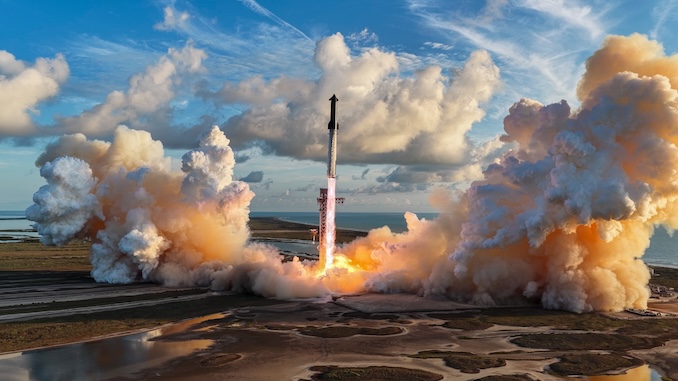
SpaceX’s Super Heavy-Starship flew its first orbital mission on Monday, September 28, lifting off from Starbase in Texas and placing its upper stage into a roughly 180-mile-high orbit. Once there, the ship released 26 third-generation Starlink satellites, the first time the new rocket has carried an operational payload rather than test articles. According to Spaceflight Now’s William Harwood, each of the V3 satellites carries about ten times the capacity of the previous generation, so the single flight added a large increment to the Starlink network.
The flight did not go entirely to plan. One of the six Raptor engines on the upper stage shut down prematurely during ascent. The remaining five burned longer to compensate, and the vehicle reached orbit anyway, a useful demonstration of engine-out margin on a rocket that will eventually need to fly crews. The mission was concluded after about three hours.
Both stages came home under control. The 33-engine Super Heavy booster, which generates some 16 million pounds of thrust at liftoff, performed a boost-back burn and splashed down a few miles off the Texas Gulf Coast. The upper stage re-entered, relit three Raptors near the ocean surface north of Hawaii, flipped to a vertical attitude, and executed a controlled tail-first splashdown before tipping over and exploding as residual propellants ignited. For a 400-foot rocket, bringing both pieces back to a chosen patch of water on the first orbital attempt is the headline as much as the satellites are.
What comes next is mostly infrastructure. SpaceX is building additional Starship pads in Florida and is developing the lunar lander variant for NASA’s Artemis program, which is targeting a 2028 Moon landing. That landing will require multiple tanker flights to fill a depot in orbit, so the cadence of routine launches like this one, rather than any single test, is now the thing to watch.
Source: Spaceflight Now
What an Orbital Starship Changes: The Case for a Gigawatt of Computing in Space
Brian Wang’s NextBigFuture piece, posted the same day as the flight, treats Starship’s orbital success as the removal of a bottleneck rather than as a spaceflight milestone in itself. The argument begins with the payload: the 26 V3 Starlinks deployed on Flight 14 carry about 26 terabits per second of capacity, which Wang equates to roughly ten full Falcon 9 Starlink missions carrying the older V2 mini satellites. One Starship flight did the work of ten Falcon 9s for one product line, and the piece asks what that ratio means for a much heavier class of satellite.
That heavier class is orbital computing. Wang contends that about 120 Starship launches carrying large, power-hungry AI satellites could put a gigawatt of computing capacity in space. To reach the same figure with Falcon 9 and smaller satellites, he estimates somewhere between 700 and 3,000 launches, which at historical cadence would take ten to twenty years and would not be economically feasible. The comparison is doing the real work in the analysis: it is not that Falcon 9 cannot lift the hardware, it is that the number of flights required makes the idea a non-starter without a much larger vehicle.
The cost projections are the most speculative part and should be read as a scenario rather than a forecast. Wang notes that Starship boosters have already been caught three times and reflown twice in the Version 2 configuration, and projects that with repeated catches and reuse the cost to orbit could fall below $200 per kilogram after five or more reuses, and below $100 per kilogram at thirty reuses. Those numbers depend on reuse rates, refurbishment costs, and a launch cadence that has not yet been demonstrated.
Even discounted heavily, the framing is worth taking seriously. Flight 14 showed the vehicle can reach orbit and release a commercial payload with an engine out. Whether the next step is large data-center satellites, propellant depots, or lunar landers, the economic logic Wang lays out is the same: the number of flights needed for any big orbital project just dropped by roughly an order of magnitude.
Source: NextBigFuture
A Candidate Super-Jupiter in the 61 Cygni System, 11 Light-Years Away
61 Cygni is a pair of orange dwarf stars about 3.5 parsecs, or 11.4 light-years, from the Sun. Because it is so close, it sits near the top of the target lists for the next generation of exo-Earth hunting telescopes. A preprint posted to arXiv on September 26 by Aniket Sanghi and colleagues, including Dimitri Mawet, Charles Beichman, and Jack Lissauer, reports evidence for a giant planet in the system that would reshape how those searches are planned.
The detection is astrometric. By comparing the pair’s proper motion as measured by Hipparcos in the 1990s with the Gaia DR3 measurements, and cross-checking with two independent methods, the team found a tangential velocity anomaly of about 88.5 plus or minus 19.8 metres per second, a 4.4-sigma discrepancy that points to an unseen massive body tugging on one of the stars. Folding in nearly four decades of radial-velocity data, including about two years of new NEID measurements, together with infrared imaging from the MMT and N-body dynamical modelling, the authors find the data are consistent with a planet of roughly 8 plus or minus 3 Jupiter masses orbiting at about 8 plus or minus 3 astronomical units. Its estimated temperature of around 282 kelvin would make it a cold giant, with a radius close to Jupiter’s. The team cannot yet say which of the two stars it orbits.
The habitable-zone implications are the reason the paper matters beyond the catalogue. The authors ran 100 test particles through each star’s habitable zone for a million years alongside the candidate giant. A planet inside about 5 au disrupts the habitable zone severely regardless of inclination. Between 5 and 10 au, strongly misaligned orbits also clear it out through Lidov-Kozai oscillations. Only coplanar or nearly coplanar configurations beyond roughly 10 au leave room for stable terrestrial planets. In other words, confirming the planet and pinning down its orbit will largely decide whether 61 Cygni stays a prime target for the Habitable Worlds Observatory and the LIFE and SHERA concepts, or drops down the list.
Confirmation will take patience. Gaia DR4 should improve the proper-motion precision three- to four-fold and will include a time series, but the planet’s orbital period likely exceeds ten years, longer than the DR4 baseline. Continued radial-velocity monitoring with NEID or ESPRESSO could eventually catch the reflex motion, and direct imaging at 8 au around such a nearby star is on the edge of what upcoming instruments can do. The paper is careful to call this a candidate. It is also exactly the kind of candidate worth the effort to confirm.
Source: arXiv
ALMA Captures the First Direct Image of Gas Spiralling Onto a Forming Planet
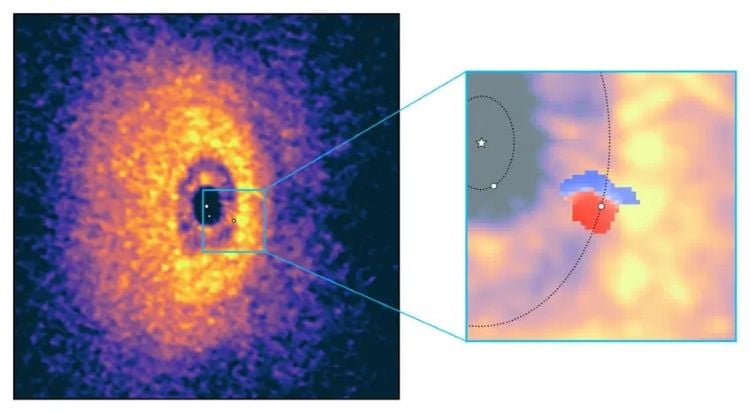
Simulations of planet formation have long predicted that a young giant planet embedded in a disk should be surrounded by a swirl of infalling gas, feeding its growth. Astronomers have now photographed one. Using the Atacama Large Millimeter/submillimeter Array in Chile, a team led by Myriam Benisty of the Max Planck Institute for Astronomy has imaged the protoplanet WISPIT 2b together with the gas moving around it, and published the result in The Astrophysical Journal Letters.
WISPIT 2b lies about 430 light-years away, has roughly five times the mass of Jupiter, and orbits its host star at about 57 astronomical units, well beyond where Neptune sits in our own system. ALMA combined its 66 dishes to resolve the velocity structure of the gas near the planet. In the resulting map, gas moving towards us appears blue and gas moving away appears red, and the pattern shows material swirling in the way accretion models require. It is the first visual confirmation of those predicted flows rather than an inference from indirect signatures.
The system turns out to host a second forming planet as well. WISPIT 2c, estimated at 8 to 12 Jupiter masses and orbiting at about 15 au, has carved a central cavity in the disk, while WISPIT 2b has opened a gap further out. Seeing two protoplanets sculpting the same disk in different ways gives theorists a rare side-by-side test of how planet mass and location control the structures we see in so many disk images.
Beyond the picture itself, the measurement constrains how fast giant planets accrete gas and how that gas arrives, questions that bear on everything from the composition of giant planet atmospheres to the final architectures of planetary systems. WISPIT 2 is likely to become one of the most studied young systems in the sky.
Source: Universe Today
Webb Sorts Planet-Shattering Collisions Around Young Stars

Only about one in a hundred young stars shows an “extreme debris disk,” an unusual concentration of warm dust close to the star that signals recent, violent collisions between planet-sized bodies. A study led by Kate Su of the Space Science Institute in Boulder, published in The Astrophysical Journal, used the James Webb Space Telescope’s mid-infrared spectroscopy to examine 21 such systems, combining 16 Webb observations, 12 of them new, with five archival Spitzer datasets.
The dust sorts cleanly into two chemical families. About a third of the disks are rich in silica, the glassy material produced when rock is vaporised in a high-energy impact. These point to collisions between Mars-sized bodies and were found only around stars younger than about 300 million years. The remaining two-thirds are silica-poor, consistent with lower-energy grazing impacts between Moon-sized objects. This second type appears across a wider range of stellar ages and shows greater variability in brightness over time, as if the debris is still being stirred.
The two populations map neatly onto the story told for our own solar system. The silica-rich phase resembles the giant impact between the proto-Earth and the Mars-sized body Theia, thought to have formed the Moon roughly 100 million years after the solar system’s birth. The longer-lived silica-poor phase resembles the sustained bombardment by smaller bodies that followed. Webb is in effect watching other systems pass through the same stages at different moments.
For planet formation theory, the result turns a handful of anecdotal systems into a statistical sample with a time axis. It suggests that violent giant impacts are confined to the first few hundred million years, and that the quieter bombardment phase can persist much longer. Both constrain how often rocky planets end up with large moons and how much late-arriving material they can expect.
Source: Phys.org
The Coldest Known Lava World Appears to Keep an Atmosphere
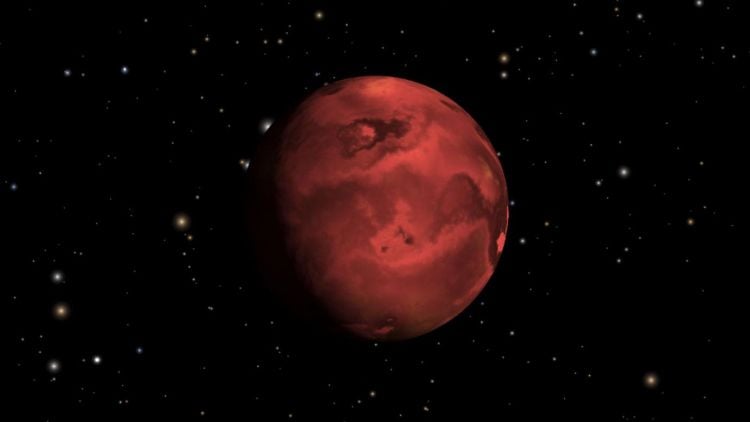
HD 3167 b is a super-Earth 154 light-years away that circles its orange K-type star in just under one Earth day. With a radius about 1.6 times Earth’s and a mass about 4.8 times Earth’s, and an orbit that close, its dayside surface is expected to be molten rock. It sits at the cool end of the lava-world population, and the conventional expectation was that such a planet, having lost whatever volatiles it started with, would be a bare rock with no atmosphere to speak of.
A team led by Brandon Park Coy, a doctoral student in geophysical sciences at the University of Chicago, used the James Webb Space Telescope to watch the planet’s secondary eclipse, the moment it passes behind its star, which isolates the light from the planet’s dayside. The dayside turned out to be markedly cooler than a bare rock in that orbit should be. The most natural explanation is that something is carrying heat from the day side to the night side, and that something is an atmosphere. The work, by an international group from the United States, United Kingdom, China, and Spain, appears in The Astrophysical Journal Letters.
The result complicates a tidy picture. Models have tended to predict that lava worlds keep atmospheres only when they are hot enough for rock vapour to form a thin envelope, and that cooler ones are airless. A cooler lava world with heat redistribution suggests either a more substantial atmosphere of different composition or that the models underestimate how much outgassed material such planets can retain.
Coy frames the interest in terms of our own past. Earth spent its first few million years as a magma ocean with an entirely liquid surface, a stage no geological record preserves. Lava worlds like HD 3167 b are the closest thing to a live view of that era, and whether and how they hold onto atmospheres informs how the early Earth might have behaved.
Source: Universe Today
A Tenuous Helium Signal from LHS 1140b, and Why Caution Is the Right Response

LHS 1140b is one of the most carefully watched planets in the sky. It is 1.7 times the size of Earth, just over five times as massive, and orbits in the habitable zone of a nearby red dwarf. A new James Webb Space Telescope study has detected helium apparently escaping from the planet, which would indicate a secondary atmosphere, the kind of stable, long-lived envelope that forms after a planet sheds its primordial hydrogen. Writing for The Conversation, astronomer Jon Willis explains why that would matter and why nobody should yet say it has been found.
The physics is encouraging. A secondary atmosphere around a rocky, temperate planet is a prerequisite for any serious discussion of surface water or biosignatures, and this would be only the second hint of an atmosphere around a remotely Earth-like world, after the hotter Gliese 1214b. The problem is reproducibility. The same study made a second observation of the planet, and the helium signal was absent. There is no agreed explanation for the discrepancy, and until there is, the detection is, in Willis’s words, tenuous and nuanced.
Willis is equally careful about the planet’s temperature. Depending on the atmospheric assumptions fed into the models, the surface could be anywhere from about minus 90 to minus 30 degrees Celsius. “Habitable zone” describes the orbit, not the climate, and a world that cold would need a thick greenhouse atmosphere to host liquid water. None of that is known.
The essay’s broader point is methodological. Single detections around single planets will not settle whether temperate rocky worlds commonly keep atmospheres. That will require measuring thousands of them and looking for patterns, which is what the next generation of telescopes is being designed to do. LHS 1140b is a lead worth pursuing, and the honest framing of the result is itself a sign of a field maturing.
Source: Phys.org
Earth and Mars Were Built From Different Recipes

Earth and Mars formed from the same disk of gas and dust at roughly the same distance from the Sun, yet they ended up strikingly different in size, composition, and fate. A study from the University of Copenhagen’s Globe Institute, led by Anders Johansen and Haiyang Wang and published in Nature Astronomy under the title “Volatile depletion in rocky planets as a chemical fingerprint of hybrid accretion,” argues that the difference was baked in from the start by two distinct ways of growing a planet.
Rather than relying on isotopic ratios, the team looked at moderately volatile elements such as sodium, potassium, and zinc in the crusts and mantles of the two planets. These elements evaporate at relatively modest temperatures, so how much of each a planet retained records the thermal history of the material it was built from. Feeding the measured abundances into formation models, the researchers found that the two planets are best explained by very different mixes of building blocks.
For Earth, at least 75 percent of the mass came from two young protoplanets that grew by sweeping up millimetre- to centimetre-sized pebbles drifting through the disk, with planetesimals, the kilometre-scale bodies of classic formation models, contributing at most a quarter. For Mars the proportions flip: about 75 percent planetesimals, 25 percent pebbles. The same disk, two neighbouring planets, and nearly opposite assembly histories.
The practical payoff is in exoplanets. Pebble accretion and planetesimal accretion deliver water and other volatiles differently, so knowing which route a planet took helps predict whether it kept the ingredients for oceans and an atmosphere. If volatile-element fingerprints can be read in the spectra of rocky worlds around other stars, the method developed here offers a way to sort promising candidates from dry ones before committing expensive telescope time.
Source: Phys.org
Ten Minutes of X-rays Tie Mysterious Cosmic Flashes to Merging Neutron Stars

When two neutron stars collide they produce a short gamma-ray burst lasting well under a second, a kilonova, and, when we are lucky, a gravitational-wave signal. A team at Tor Vergata University of Rome led by Eleonora Troja and graduate student Niccolò Passaleva has now shown that at least some of these mergers also produce something else: a flash of soft X-rays lasting several minutes. The work, published in Science Bulletin, connects a class of fast X-ray transients that had resisted explanation to the deaths of dead stars.
The key event was EP250704a, also catalogued as GRB 250704B, detected on July 4, 2025 by the Einstein Probe, SVOM, and Insight-HXMT satellites. It began with a gamma-ray burst of about half a second, the classic signature of a compact-object merger, but was followed by nearly ten minutes of X-ray emission, a record duration for this type of event. Follow-up with the X-Shooter spectrograph on ESO’s Very Large Telescope picked out iron and magnesium absorption lines that fixed the redshift at 0.661, placing the explosion more than six billion light-years away. Deep imaging with FORS2 and radio observations with the Very Large Array completed the picture.
The decisive clue was what was not there. Had the burst come from the collapse of a massive star, a supernova should have brightened at the site over the following weeks. None appeared. That absence, combined with the short initial burst, points to a neutron star merger. The prolonged X-ray emission then needs an engine, and the most plausible one is a magnetar, a newborn neutron star spinning rapidly with an enormous magnetic field, formed from the merger and continuing to radiate for minutes before collapsing or fading. As Troja puts it, if the remnant is a magnetar, it could keep bursting for longer.
The result gives astronomers a new handle on how often mergers leave behind a magnetar rather than collapsing straight to a black hole, which in turn constrains the maximum mass a neutron star can hold. It also suggests that wide-field X-ray monitors like Einstein Probe may catch mergers that gamma-ray instruments miss. Passaleva’s stated hope is to pair one of these X-ray flashes with a gravitational-wave detection from the same source, which would let the two channels be read together.
Source: Phys.org
Photosynthesis as a Clock: A New Angle on the Fermi Paradox
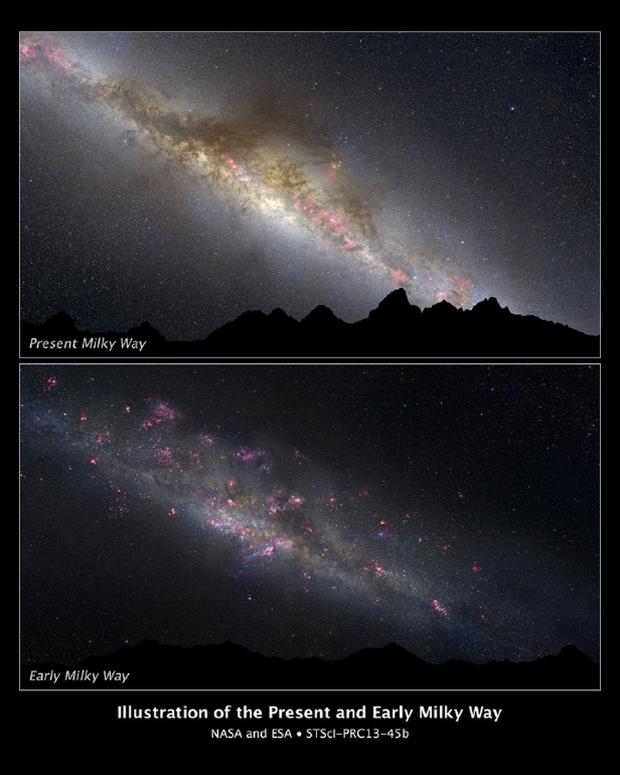
A common assumption in astrobiology is that an older habitable planet should, on average, host more advanced life. Paul Gilster’s Centauri Dreams essay examines a paper by Chris Doughty of Northern Arizona University and colleagues, published September 22 in the International Journal of Astrobiology, which argues that the right clock is not time but energy: the pace of evolution tracks the cumulative amount of carbon a biosphere has fixed through photosynthesis, its integrated net primary production.
The idea is grounded in Earth’s history, where the major evolutionary transitions correlate with the total organic carbon produced up to that point rather than with elapsed years. Doughty’s team applied that relation to 29 potentially habitable worlds from the Habitable Worlds Catalog. Twenty-seven of them orbit red dwarfs, and most are tidally locked, which limits the light available for photosynthesis to a fixed hemisphere and a spectrum shifted away from what plants on Earth prefer. Under baseline assumptions only two of the 29 planets could have fixed more carbon than Earth has, and 27 are predicted to be stuck at a microbial stage. TRAPPIST-1e, one of the best-studied temperate worlds, could fix only about 21 percent of Earth’s cumulative carbon.
The paper allows for more generous scenarios in which thick carbon dioxide atmospheres boost productivity, under which about a third of the sample might progress beyond microbes. But as Gilster notes, recent Webb observations found no evidence of a thick carbon dioxide atmosphere on either TRAPPIST-1c or TRAPPIST-1e, so the optimistic branch has taken a hit from data.
The implication for the Fermi paradox is a quiet one. If complex life needs a large budget of fixed carbon, and most habitable-zone planets orbit stars that cannot supply it, then the number of sites where intelligence could arise is much smaller than planet counts alone suggest, with no need for catastrophes or self-destruction to explain the silence. Gilster is careful to list the open questions: atmospheric composition is poorly known for nearly all these worlds, surface carbon availability is unmeasured, and biochemistries not built on carbon fixation are not addressed. The framework’s real value may be as a prioritisation tool, pointing biosignature searches towards the few planets with enough energy to have gotten somewhere.
Source: Centauri Dreams