Space Weekly Review 2026-10-17

Week In Review
The week’s science ran from the edge of a single planet’s atmosphere to the largest structures in the universe, and in each case the news was that something long treated as a smooth, idealised object turned out to have shape. A Bristol and Cornell team used the James Webb Space Telescope to show that the hot Jupiter WASP-17b’s atmosphere is not the neat ring a transit normally implies but a lopsided profile, hotter and more extended on its evening side, in Trailblazing technique uncovers real shape of scorching-hot exoplanet atmospheres. A survey of 300 multi-planet systems found they sort cleanly into two families by the mass of their star, in Host Stars Shape Their Planetary Systems Into Two Families. And at the far end of the scale, simulations of the colliding cluster El Gordo suggest that dark matter may need an internal structure of its own, with ground and excited states, to explain how such a mass assembled so early, in A distant supercluster of galaxies points to self-interacting dark matter.
Closer to home, two studies read the history of violent events from their aftermath. A tidal disruption event caught by the Zwicky Transient Facility turned out to sit thousands of light-years from the centre of its galaxy, marking a million-solar-mass black hole wandering far from where such objects are supposed to live, in Shredded star reveals a massive black hole wandering far from its galaxy’s center. On the Moon, a Smithsonian-led team catalogued more than 10,000 young faults to measure how much the lunar radius has shrunk as the interior cools, in Lunar fault maps reveal how much the moon is shrinking. Both results come from patient, wide-field accounting rather than a single spectacular observation, and both change the picture of how settled and quiet these systems are.
Engineering results arrived alongside the astronomy. NASA’s post-flight analysis of the Artemis II heat shield, in Rigorous Analysis Confirms NASA’s Artemis II Heat Shield Performance, reports a ten-fold reduction in char loss after the agency reshaped the return trajectory, closing the question that had hung over Orion since Artemis I. The University of Tokyo marked the completion of four 23-metre gamma-ray telescopes on La Palma, in Completion of the Large-Sized Telescopes at CTAO-North, giving ground-based astronomy its lowest-energy window yet on gamma-ray bursts and distant active galaxies.
The commercial thread this week was cadence. Blue Origin laid out new Florida pads, a 150-upper-stage-a-year factory, and a request to lift its permitted New Glenn flights from 12 to 50 a year, in Blue Origin to add new Florida launch pads, seeks aggressive increase in New Glenn flight rate. NextBigFuture’s Brian Wang took the same question to its logical extreme, asking what it would take operationally to fly Starship 5,000 times a year in service of orbital computing, in SpaceX’s Space AI Challenge: 5,000 Launches a Year. If launch rates of that order ever arrive, the orbital environment becomes the constraint, which is where the UK’s £60 million commitment to a robotic debris-removal mission fits, in World-first mission puts UK expertise to work to help clean up space. Together the three pieces describe an industry working out, in public filings and funded contracts, what a high-cadence orbital economy will actually require.
Items
Webb Maps the Lopsided Atmosphere of a Hot Jupiter

When an exoplanet crosses its star, astronomers measure how much starlight its atmosphere absorbs at each wavelength. The standard assumption is that the planet’s silhouette is a circle, and that the atmosphere is the same all the way around its rim. A team co-led by the University of Bristol and Cornell University has now shown, for the hot Jupiter WASP-17b about 1,300 light-years away, that the assumption is wrong in a measurable and physically meaningful way.
The method, which the researchers call “transmission strings,” uses the exquisite timing and photometric stability of NASA’s James Webb Space Telescope to work out not just how much light the atmosphere blocks but where along the planet’s edge the blocking happens. Lead author Lili Alderson, a Klarman postdoctoral fellow at Cornell, put it this way: “We’re able to go around the edge. So, we’ve gone from a ring to understanding where on the ring the gemstones are.” The paper, in Nature Astronomy, is the first use of transit mapping to resolve an exoplanet atmosphere’s contour across different latitudes.
What the map shows is a planet whose evening side, at the equator, bulges outward further than its morning side. The explanation is wind. WASP-17b is tidally locked, with one hemisphere in permanent daylight and the other in permanent darkness, and ferocious jets carry heat from the dayside across the terminator. The evening limb, where hot gas arrives, is puffed up and much hotter. The morning limb, where gas has had the whole night to cool, has contracted. Co-author Hannah Wakeford of Bristol described the result as “this very structured, dynamical picture of this giant world over 1,000 light-years away.”
The implications go beyond one planet. Transmission spectroscopy is the workhorse technique for studying exoplanet atmospheres, and models that treat the limb as uniform will misread the composition and temperature of any world with strong day-to-night circulation. Having a way to measure the asymmetry directly, rather than assume it away, is a step toward three-dimensional characterisation of planets that cannot be imaged, and toward the smaller, cooler worlds where such subtleties will matter even more.
Source: Phys.org
Planetary Systems Come in Two Families, and the Star Decides Which
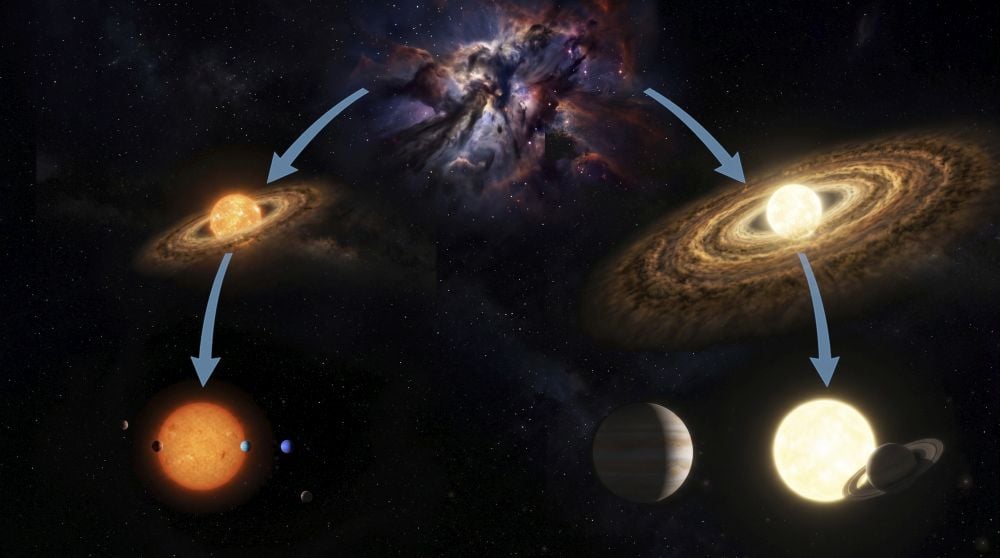
A study in Nature Astronomy led by Diego Turrini of Italy’s Istituto Nazionale di Astrofisica and Camilla Danielski of the University of Valencia examined 300 well-characterised multi-planet systems and found that they do not form a continuum. They split into two populations, and the dividing line is the mass and metal content of the host star.
The first family orbits stars no more massive than the Sun. These systems are tightly packed with planets of similar size, the “peas-in-a-pod” arrangement that transit surveys have found to be common. Their orbits are nearly circular and nearly coplanar, much like our own solar system. The authors describe them as dynamically “cold,” meaning their histories have been relatively gentle, without the gravitational upheavals that scatter planets onto wild orbits.
The second family orbits stars of solar mass or greater that formed in metal-rich environments. The total planetary mass in these systems runs two to ten times that of the solar system, and the architectures are gravitationally compact, with orbits the authors characterise as an order of magnitude dynamically hotter. Eccentric and inclined orbits are common, signatures of what the paper calls “violent evolutionary pathways driven by global instabilities and planet–planet scattering.” Co-author Danae Polychroni explained the mechanism: “The greater abundance of material from which planets form…causes them to be born too large, preventing stability.”
Turrini summarised the finding as “a genetic link between planetary systems and their stars,” one that determines their fate. If the pattern holds, a star’s mass and composition would tell astronomers in advance roughly what kind of planetary system to expect around it, and which stars are the most promising hosts for stable, long-lived systems where habitable conditions could persist.
Source: Universe Today
A Colossal Early Cluster Hints That Dark Matter Has an Excited State

El Gordo is a pair of colliding galaxy clusters some seven billion light-years away whose combined mass exceeds two quadrillion suns. It has been a thorn in the side of cosmology for years, because standard cold dark matter models have trouble building something so large so early in cosmic history. A new study by R. Valdarnini in The Astrophysical Journal proposes a resolution that changes the nature of dark matter itself.
The conventional picture treats dark matter as collisionless: particles that feel gravity and nothing else. Self-interacting dark matter models allow particles to scatter off one another, but simple elastic scattering has struggled to match the full range of observations. Valdarnini’s model goes a step further and gives the dark matter particle two states, a ground state and an excited one. Most collisions would be elastic, as with ordinary matter. But a collision with the right energy could kick a particle into the excited state, converting kinetic energy into internal energy and removing it from the system.
That mechanism matters because it lets dark matter cool as it clumps. A cloud of particles that can shed kinetic energy on collision will collapse and cluster more readily than one that cannot, which is exactly what is needed to assemble El Gordo’s mass in the time available. Hydrodynamical N-body simulations run with the two-state model reproduce the observed system better than either non-interacting dark matter or the elastic-only variant.
The author is careful about what the result does and does not show. El Gordo’s precise mass and the collision velocity of its two components remain uncertain, and those uncertainties feed directly into any comparison with simulation. The two-state model is a possible solution rather than a demonstrated one. But it is a concrete, testable proposal for what dark matter might be made of, derived from a specific astrophysical puzzle rather than from theoretical preference, and that is how progress on this question is likely to come.
Source: Phys.org
A Star Torn Apart Reveals a Million-Solar-Mass Black Hole Far From Home

Supermassive black holes are supposed to sit at the centres of their galaxies. A team led by Itai Sfaradi at the University of California has found one that does not. The clue was a tidal disruption event, catalogued as TDE 2023mfm, in which a star wandered too close to a black hole and was shredded, producing a flare that the Zwicky Transient Facility picked up. Follow-up with the Hubble Space Telescope fixed the position of the flare at roughly 1.08 kiloparsecs, about 3,500 light-years, from the centre of its host galaxy.
The flare behaved like a textbook disruption. Its optical light rose to peak within about 30 days and then faded over the following 100, while the temperature of the emitting material stayed near 20,000 kelvin for more than a month past peak. Spectra from Keck and Lick observatories showed a broad hydrogen emission line, placing the event in the hydrogen-rich class of disruptions. What was missing was equally informative: Chandra and XMM-Newton detected no X-rays from the event, and the Very Large Array found only a faint radio signal that emerged some 991 days after the disruption.
From the light curve and spectra, the team estimates the black hole’s mass at between one and ten million solar masses. That is the kind of object normally found anchoring a galactic nucleus, not drifting a kiloparsec away. The researchers conclude that “TDE 2023mfm is an off-nuclear TDE-H,” an event that would have gone unrecognised as unusual without the precise positional work.
Off-nuclear massive black holes are expected on theoretical grounds. Galaxy mergers should leave behind black holes that have not yet sunk to the new centre, and some could be ejected by gravitational recoil. But finding them is hard, because a quiescent black hole far from a galactic nucleus emits almost nothing. Tidal disruptions act as flares that light them up for a few months, and as wide-field surveys catch more such events, they offer a census method for a population that has so far been mostly hypothetical. The study is posted to arXiv.
Source: Phys.org
Ten Thousand Young Faults Measure a Shrinking Moon

The Moon is still cooling, and as its interior contracts the crust has to shrink to fit. It does so by breaking along thrust faults that push one block of surface up and over another, leaving cliff-like features called lobate scarps and smaller wrinkle ridges in the volcanic plains. A team led by Thomas R. Watters of the Smithsonian’s National Air and Space Museum has now mapped these features across the whole lunar surface using Lunar Reconnaissance Orbiter Camera images, and used the catalogue to put a number on how much the Moon has shrunk.
The count is large. The team identified more than 8,900 lobate scarps and about 2,000 small mare ridges, for a total exceeding 10,000 young contractional landforms. “The number of these young faults revealed in LROC images is much greater than I ever imagined,” Watters said. The paper, in The Planetary Science Journal, estimates that the lunar radius has decreased by roughly 45 metres, about 148 feet, over the past 400 to 800 million years. That works out to a contraction rate of 6 to 11 centimetres per million years, or around a tenth of a micrometre a year. For scale, Earth’s tectonic plates move about 1.5 centimetres every year.
The rate sounds negligible, and in human terms it is, but the point is that the process is ongoing. The faults are young by geological standards, their crisp morphology shows little degradation by impacts, and Watters notes that new faults continue to form today. The Moon is not a dead world but one still adjusting to the slow loss of its primordial heat.
That has practical consequences. Thrust faulting produces moonquakes, and the Apollo seismometers recorded shallow events whose locations correlate with scarps like these. Any long-duration lunar base will need to account for ground motion and slope instability near active faults, and a global map of where the crust is under compression is the starting point for that assessment. Co-authors on the study include Maria Banks, Cole Nypaver, and Mark Robinson.
Source: Phys.org
Artemis II’s Heat Shield Passed Its Test, and the Numbers Say Why
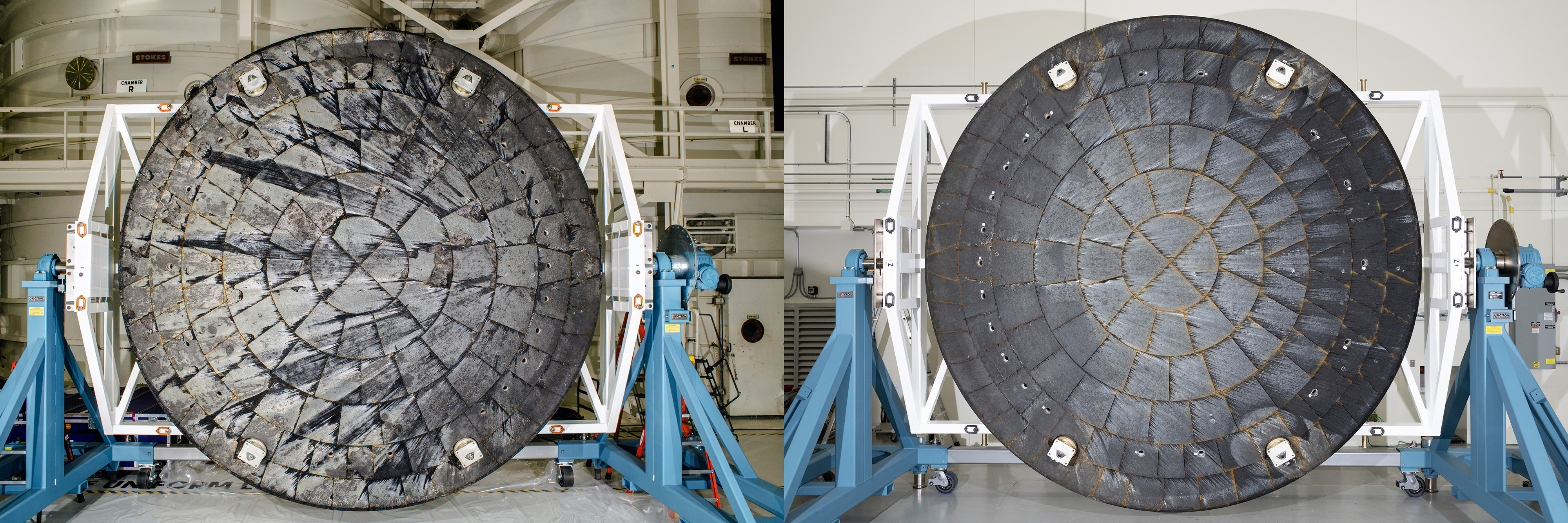
The uncrewed Artemis I flight in 2022 returned with its Orion heat shield pocked by unexpected char loss, and the question of whether the shield could be trusted with a crew hung over the program for years. NASA’s answer was not to redesign the shield but to change how Orion flew through the atmosphere, shortening the maximum downrange distance of the skip entry so the Avcoat ablator spent less time in the conditions that caused the problem. NASA’s post-flight analysis of Artemis II, published this week, reports that the change worked.
The spacecraft came home from the Moon at up to 39 times the speed of sound, with external temperatures above 4,000 degrees Fahrenheit while the crew cabin stayed in the mid-70s. On inspection, the heat shield showed 9 spots of char loss. Artemis I had shown 103. The ten-fold reduction is the central result, and it was achieved with the same shield design and material, 186 unique blocks of Avcoat, which means the fix is a matter of trajectory rather than hardware.
The precision of the return is also notable. Orion hit its entry interface within 192 feet of the target point and splashed down 0.59 miles from the predicted spot off San Diego. The analysis drew on inspections at Kennedy Space Center followed by sample extraction and internal X-ray scans at Marshall Space Flight Center, which confirmed the ablator’s structure was consistent across the shield. The backshell’s 1,300 ceramic tiles showed no overheating.
With the heat shield question closed, Artemis III is moving through assembly. NASA reports that its heat shield was attached in early July and the crew and service modules were joined by late July 2026. The lesson of the two flights is a useful one for any reentry program: the interaction between a thermal protection material and its flight profile can matter as much as the material itself, and a well-instrumented test flight can reveal that interaction in a way ground testing cannot.
Source: NASA
Four 23-Metre Gamma-Ray Telescopes Are Complete on La Palma
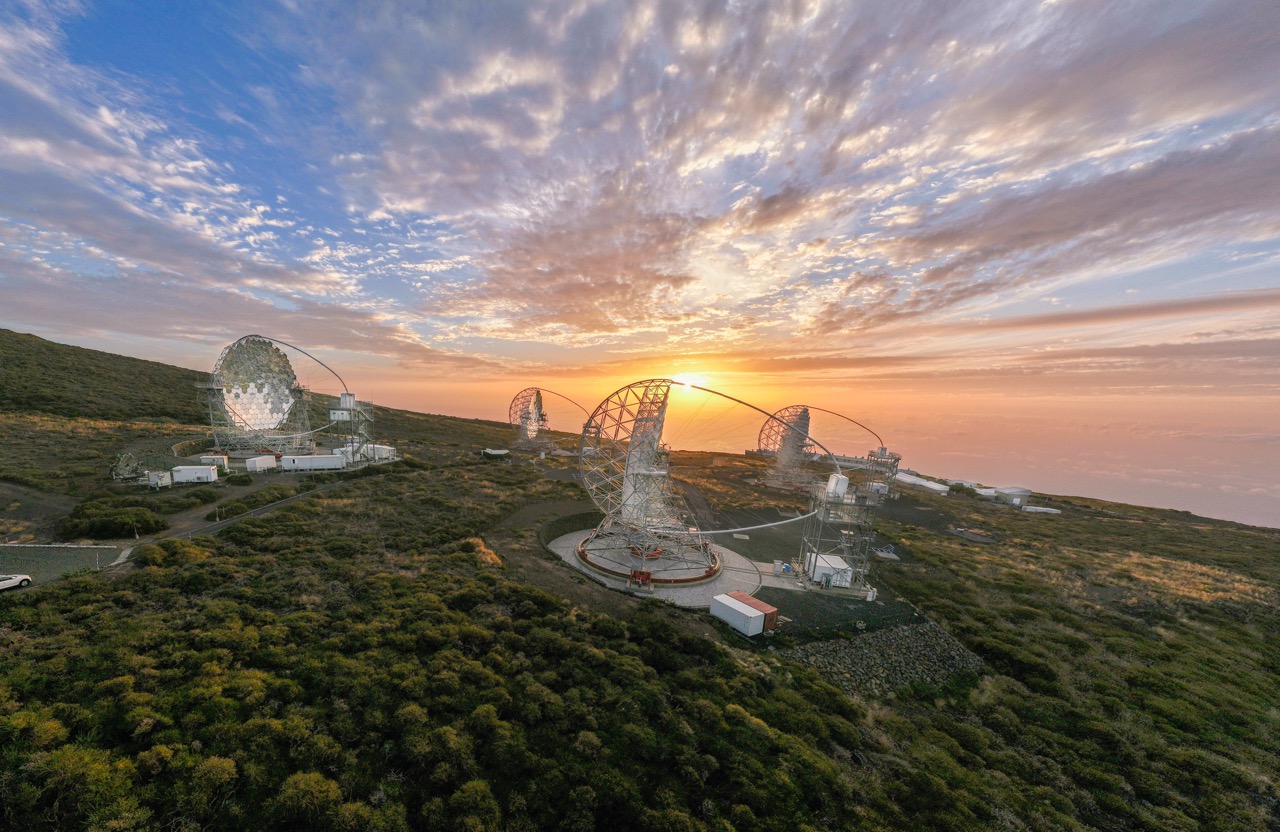
The Cherenkov Telescope Array Observatory marked the completion of its four Large-Sized Telescopes at the northern site on La Palma in the Canary Islands this week, with a ceremony attended by about 250 scientists and officials. The University of Tokyo, which leads the LST international collaboration through Masahiro Teshima, announced the milestone along with Hideaki Kubo, representing the Japanese CTAO group.
Gamma rays do not reach the ground, but when one strikes the upper atmosphere it triggers a cascade of particles that emits a faint, nanosecond flash of blue Cherenkov light. The LSTs catch that flash with 23-metre reflectors and ultra-fast cameras, reconstructing the direction and energy of the original photon. Their size is what makes them special. A bigger mirror collects more of the faint light from low-energy showers, so the LSTs reach down to about 20 gigaelectronvolts, the lowest energy threshold of any ground-based gamma-ray instrument, while still covering up to several teraelectronvolts.
The low threshold matters for distance. High-energy gamma rays from far away are absorbed by the sea of starlight filling intergalactic space, so the further a source is, the softer its surviving spectrum. By reaching lower energies, the LST array can see transient sources such as gamma-ray bursts and flaring active galaxies out to redshifts around 4, when the universe was a few billion years old. Four telescopes working together also improve the rejection of background cosmic-ray showers and sharpen the reconstruction of each event.
The full observatory will eventually comprise more than 60 telescopes of three sizes across the La Palma site and a southern site at Paranal in Chile. It is designed as an open observatory, with data products available to the wider community, and will generate hundreds of petabytes of raw data a year, compressed to roughly 12 petabytes for archiving. Completion of the LSTs gives the northern array its most sensitive instruments and moves CTAO from construction project toward operating facility.
Source: University of Tokyo
Blue Origin Builds for Dozens of New Glenn Flights a Year
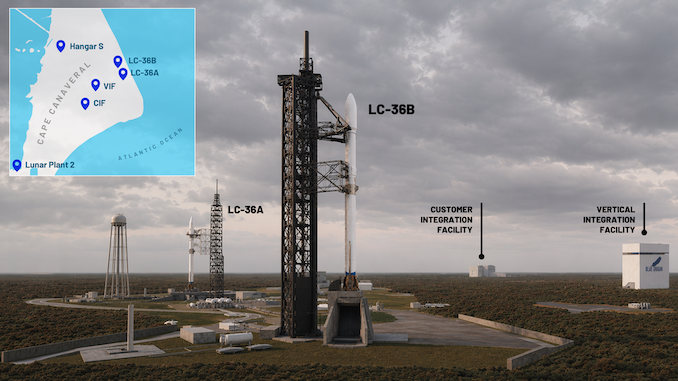
Blue Origin has described how it intends to turn New Glenn from an occasional launcher into a frequent one, and the plan is mostly concrete and steel. The company announced new launch pads on Florida’s Space Coast modelled on its existing Launch Complex 36 facilities, where LC-36A serves the current two-stage 7x2 variant and LC-36B is being readied for the larger 9x4 version with nine BE-4 engines on the first stage and four BE-3U engines on the upper stage. Locations for the new pads have not been disclosed.
The regulatory side runs in parallel. Blue Origin is asking the Federal Aviation Administration to raise the permitted annual launches from LC-36A from 12 to 50, with a 30-day public comment period that includes a virtual hearing on October 22 and closes on October 30. The stated goal is multiple flights per week by the end of the decade. The company is also pursuing Space Launch Complex 14 at Vandenberg for a West Coast presence.
The manufacturing commitment is the part that signals seriousness. A $330 million expansion at the company’s Rocket Park, adding 1.37 million square feet, is intended to produce up to 150 upper stages a year when it is complete in summer 2027. Because New Glenn’s first stage is reusable and its upper stage is not, upper-stage production is the throughput bottleneck, and 150 a year is a factory sized for a cadence far beyond anything the vehicle has yet flown. Two new landing vessels, a vertical integration facility, and a payload processing facility developed with the US Space Force round out the infrastructure.
Blue Origin says it has invested more than $3 billion in Florida, employs over 5,000 people there, works with some 500 in-state suppliers, and operates from more than 20 sites across Brevard and Orange Counties. “These investments are centered on one goal: building the capacity to support more missions, more reliably, and more efficiently,” said Ian Richardson, the company’s senior vice president of operations. The announcement is a reminder that high launch cadence is not a property of a rocket but of the entire industrial system around it.
Source: Spaceflight Now
What Would 5,000 Starship Launches a Year Actually Require?

Brian Wang at NextBigFuture takes the idea of orbital data centres seriously enough to run the numbers on what it would take to build them, and his conclusion is that cheap launch is necessary but nowhere near sufficient. The piece works through a scenario of 5,000 Starship launches a year, nearly fourteen a day, and asks where it breaks.
The arithmetic starts with payload. At an assumed 200 tonnes per flight for a V4 Starship, 5,000 launches deliver a million tonnes to orbit annually. Wang then applies a power-density assumption of 100 kilowatts of computing capacity per tonne of satellite, which makes each launch worth about 20 megawatts and means a gigawatt of orbital compute needs 50 launches and 10,000 tonnes. At a more conservative 50 kilowatts per tonne, the requirement doubles to 100 launches per gigawatt. Across a year at full cadence, he estimates the output at 50 to 100 gigawatts of new orbital AI capacity.
The more interesting half of the analysis is about what sits between the rocket and the payload. Wang identifies three constraints that bite before launch cost does. The first is turnaround: catching, inspecting, and refurbishing boosters and ships fast enough that a fleet of manageable size can sustain fourteen flights a day. The second is launch towers, since each tower has a finite cycle time and the cadence implies many towers across multiple sites. The third is satellite manufacturing, because a million tonnes of spacecraft a year is a production problem of a scale the industry has never approached, and it must scale in lockstep with the rockets or the launches have nothing to carry.
Wang frames his 2027 to 2029 scenarios as conditional projections, with the higher outcomes depending on flight rates that are far more demanding than anything demonstrated. The value of the exercise is less in the headline numbers than in its identification of where the real bottlenecks lie. If orbital computing is to be more than a slogan, the pacing items are ground infrastructure and factories, and those are the investments to watch.
Source: NextBigFuture
Britain Funds a Robotic Mission to Pull Two Dead Satellites From Orbit

The UK government has committed more than £60 million to an Active Debris Removal mission that will capture and deorbit two defunct British-licensed satellites. ClearSpace UK is the industry delivery partner. The spacecraft is to launch in 2029 from SaxaVord Spaceport in Shetland, Scotland, and complete the removal of both targets by 2032. It is designed to be refuelable, which points toward a vehicle intended for a career rather than a single demonstration.
The case for the mission is straightforward. Thousands of active satellites underpin navigation, weather forecasting, and communications, and every dead spacecraft left in a crowded orbit is a collision risk that grows with time. Removing objects that can no longer manoeuvre is the only way to reduce the existing hazard rather than merely slow its growth. “Space junk and debris pose an immense and growing challenge but with our homegrown expertise, the UK is determined to lead the global effort to clean up space,” said Space Minister Liz Lloyd.
The government is also explicit that the mission is an industrial bet. The robotic capture, close-proximity operations, and refuelling technologies it requires are the same ones needed for in-orbit servicing, assembly, and manufacturing, a sector the announcement predicts will be worth billions within a decade. Alice Bunn, co-director of the UK Space Agency, said the technologies developed through the mission “will help establish the UK’s position at the forefront of a new generation of space services.” The UK space sector is currently valued at £18.6 billion and employs more than 55,000 people, and ClearSpace UK’s Rob Atchison emphasised that the team draws on engineers from across Great Britain and Northern Ireland as well as international partners.
Debris removal has been studied for decades and demonstrated in pieces, but funded missions against real, uncooperative targets remain rare. A government contract with a launch date, a spaceport, and two named objects to remove is the kind of commitment that turns a capability from a slide deck into a service, and it arrives as launch providers on both sides of the Atlantic are planning for cadences that will make orbital hygiene a necessity rather than a virtue. A public competition to name the spacecraft has also been launched.
Source: UK Government